Smoke Detectors
The Best Battery-Operated Smoke Detectors
Going battery is a decision about two things: how the alarm is powered, and whether the alarms in your house can talk to each other. Most buying guides only cover the first.
By Ryder M.Last reviewed

For most houses the right battery alarm is a sealed ten-year unit, and the Kidde 20SD10 is our pick: photoelectric sensing, no battery to change, and a listing to the 10th edition of UL 217 — the edition that added a cooking-nuisance test. If your house has more than one floor, spend the extra on the X-Sense SC07-W instead, because a wirelessly interconnected set is the only way a battery-powered house gets whole-house alerting.
Siren & Safe is reader-funded. We earn a commission on some links on this page, at no cost to you. It does not change what we recommend or the order we rank it in. Full disclosure.
What going battery actually decides
"Battery-operated" sounds like one decision about power. It is two, and the second one matters more.
The first is sealed versus replaceable. A sealed alarm has a lithium cell rated for the same ten years as the sensing chamber, welded in. A replaceable-battery alarm takes a 9V or a pair of AAs that you change roughly once a year. The sealed design is better for almost everyone, for an unglamorous reason: the failure mode of the replaceable design is not the battery dying, it is somebody pulling the battery out at 3am to stop a chirp and never putting it back. That is one of the most common conditions in which a house is found to have a non-functioning alarm after a fire.
The second is interconnection, and it is the one battery buyers historically lost. A hardwired alarm circuit links every alarm in the house so that one sounding sounds all of them. Battery alarms traditionally could not do that, which meant a battery-powered house was a house full of alarms that each protected only the room they were in. Wireless interconnect — the X-Sense above, and Kidde's wire-free interconnect models — is what closed that gap, and it is the single most important thing to understand before you buy battery alarms for a house with stairs in it.
Everything else on the box is secondary to those two. Sensor type matters, and we go through it below, but a photoelectric alarm that wakes the whole house beats a dual-sensor alarm that wakes one bedroom.
Sealed ten-year versus replaceable battery
The comparison that decides most of this purchase. Neither column is wrong, but one of them fails in a predictable human way.
| Sealed 10-year | Replaceable (9V or AA) | |
|---|---|---|
| Battery changes over 10 years | None | Roughly ten |
| Low-battery chirp | Once, at end of life, as the replacement signal | Annually, usually starting overnight as the room cools |
| Common failure mode | Unit left in place past its ten-year date | Battery removed to stop a chirp, never replaced |
| Cost over ten years | Higher up front, no consumables | Lower up front, plus ten batteries |
| Tamper resistance | Nothing useful to remove | The battery compartment is the weak point |
| Best for | Almost every domestic position | Somewhere you genuinely need to swap power fast, such as an RV |
The chirp starts at night because battery voltage sags slightly as a room cools, which is enough to trip the low-battery threshold on a marginal cell. That is a real electrical effect, not folklore — and it is why the chirping often appears to stop on its own once the house warms up.
The interconnect question, which is the real one
If you take one thing from this page: in a house with more than one floor, buy interconnected alarms. The NFPA's household fire data is consistent that the problem in fatal home fires is very often not the absence of an alarm but the absence of an alarm the sleeping occupant could hear in time.
You have three routes. A hardwired interconnected set is the traditional answer and the best one, if your ceilings already have the circuit — in which case you should be reading the best hardwired smoke detectors instead of this page, because replacing working wired alarms with battery units is a downgrade people make by accident.
A wirelessly interconnected battery set is the retrofit answer, and it is genuinely good. It gets you whole-house alerting in a house with no alarm wiring, for the price of the alarms and an afternoon.
A set of standalone battery alarms is the fallback. It is much better than nothing and it is what most houses actually have. If it is what you are buying, at least put them where the sound carries — inside each bedroom, outside each sleeping area and on every level, per how many smoke detectors do I need.
Quick picks
Scored against battery design, sensor coverage, interconnection, nuisance resistance and upkeep. Tap a row for the full write-up. The price in each buy button is the live Amazon price at the last check, stamped with the date it was taken.
| # | Product | Best for | Score | Price |
|---|---|---|---|---|
| 1 | 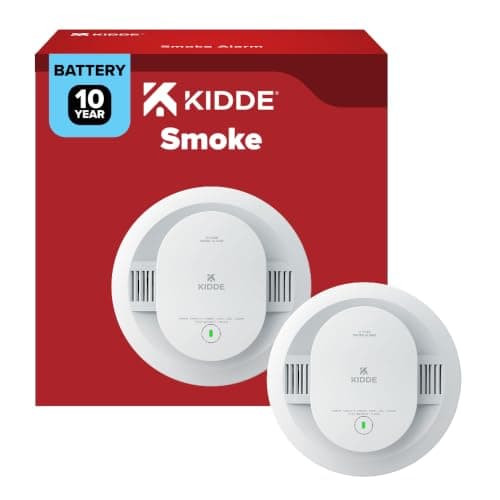 Kidde 20SD10 10-Year Battery Smoke Alarm A sealed ten-year photoelectric alarm listed to the newest edition of UL 217. | Most rooms in most houses | 8.6/ 10 | $32.47 · View on Amazon #ad how we are funded · price as of October 19, 2026 |
| 2 | 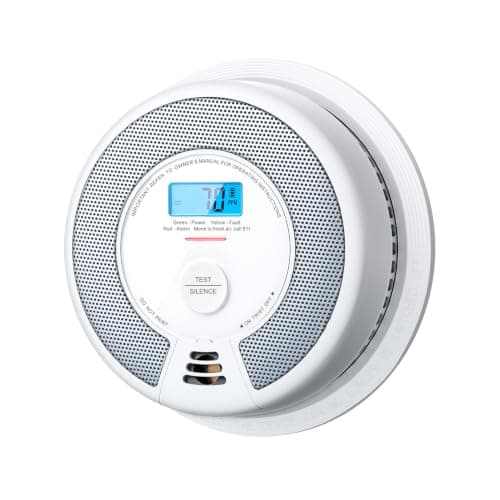 X-Sense SC07-W Wireless Interconnected Smoke & CO Alarm Battery power and wireless interconnect together — the combination that makes battery viable in a real house. | A house with more than one floor | 9.0/ 10 | $44.99 · View on Amazon #ad how we are funded · price as of October 19, 2026 |
| 3 | 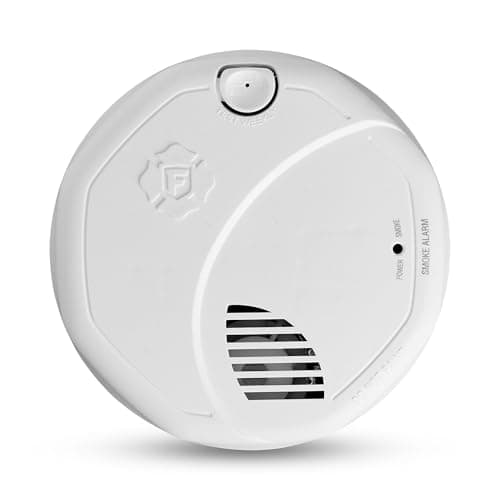 First Alert SM310 10-Year Sealed Battery Dual Sensor Smoke Alarm Photoelectric and ionization chambers in one sealed ten-year housing. | Not choosing between sensor types | 8.2/ 10 | |
| 4 | 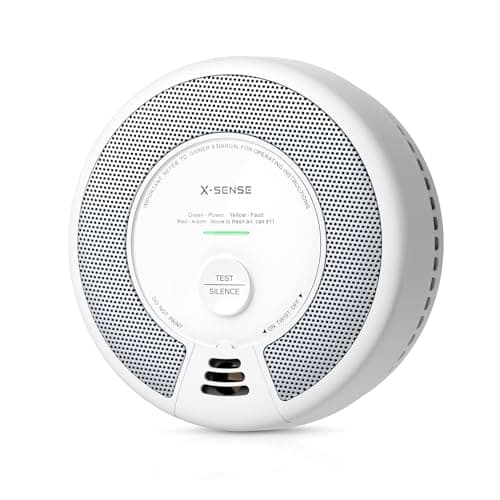 X-Sense SC06 Smoke & Carbon Monoxide Alarm The dust-resistant housing, which is the cheap fix for the most common nuisance trigger. | A dusty basement, utility room or unfinished space | 7.8/ 10 |
1. Most rooms in most houses
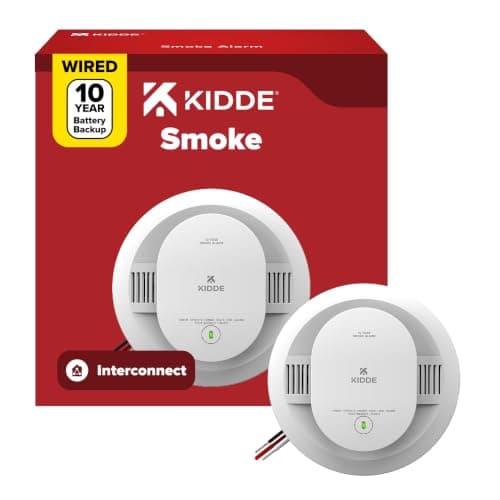
Kidde 20SD10 10-Year Battery Smoke Alarm
A sealed ten-year photoelectric alarm listed to the newest edition of UL 217.
- Listed to
- UL 217, 10th edition (UL 217-2024 Ed.10)
- Sensing / agent
- Photoelectric smoke sensing only — no CO cell
- Power / service life
- Sealed 10-year lithium battery; 10-year limited warranty
This is the alarm to buy if you are replacing a dead unit and want the decision to be over for a decade. The sealed cell is the whole argument: a smoke alarm's sensing chamber is only certified for ten years anyway, so a battery that lasts exactly that long removes the one maintenance task people actually skip. Nobody has ever failed to replace a sealed battery at 2am, because there is nothing to replace.
The listing edition is worth understanding, because it is new and it is the only spec on this page that changed what these products do. UL 217's 10th edition adds a cooking-nuisance test — a listed alarm now has to be subjected to smoke from cooking food at a defined distance without alarming, while still passing every fire test it always had to pass. That requirement did not exist in the editions most alarms currently in service were listed to. If you have ever pulled an alarm off a hallway ceiling because it went off every time you cooked, this is the change that addresses it.
What it does not do is cover both fire profiles. Photoelectric chambers respond sooner to smoldering fires — a cigarette in upholstery, a slow electrical fault — and later to fast flaming ones. That is the right trade for most domestic positions, and it is the trade ionization versus photoelectric goes through properly. If you would rather not make the trade at all, the First Alert dual-sensor unit further down is the answer.
One practical note on fitting: it uses a twist-and-click bracket, so if you are replacing an older Kidde the existing screw positions will not necessarily line up. Budget for filling two holes.
What it does well
- Listed to UL 217 10th edition (UL 217-2024 Ed.10) — the edition that introduced the cooking-nuisance test
- Sealed ten-year lithium cell: no battery to buy, and no low-battery chirp until the unit is genuinely finished
- Kidde's own claim is that the sensing reduces false alarms often caused by cooking, and the listing edition is the evidence behind it
- Self-tests rather than relying on you to remember the button
- Ten-year limited warranty, which matches the ten-year service life rather than undercutting it
The downside
- Photoelectric only — no ionization chamber, so nothing is optimized for fast flaming fires
- Smoke only. It has no CO cell, so it is half of what a ceiling position could be doing
- **No interconnect of any kind.** It protects the room it is in and nothing else
- When the ten years are up the whole unit goes in the bin, sensor and battery together
Do not buy this if: a house with more than one floor and no other plan for interconnection. A standalone alarm in a downstairs hallway does not reliably wake someone asleep upstairs behind a closed door, and that is the exact failure this product category exists to prevent.
- Listed to the 10th edition of UL 217, which carries the cooking-nuisance test the 8th edition introduced
- Kidde's own wording: enhanced sensing technology reduces false alarms often caused by cooking
- No low-battery chirps for ten years — the first end-of-life beep is the replacement signal
- Three long beeps and a red flash on smoke, so the pattern tells you which hazard it is
- Twist-and-click bracket, and it self-tests rather than waiting for you to press the button
#ad how we are funded · price as of October 19, 2026
2. A house with more than one floor
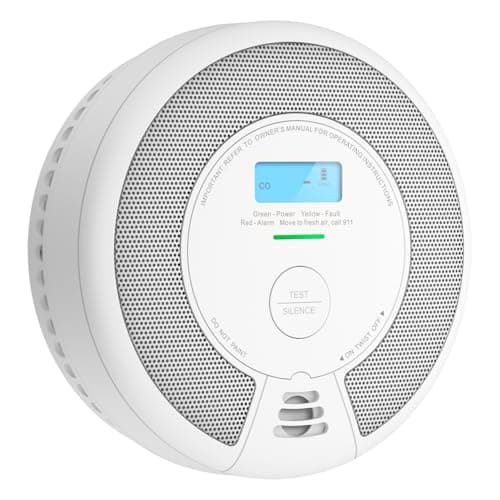
X-Sense SC07-W Wireless Interconnected Smoke & CO Alarm
Battery power and wireless interconnect together — the combination that makes battery viable in a real house.
- Listed to
- UL 217 and UL 2034
- Sensing / agent
- Photoelectric smoke sensing plus an electrochemical CO cell
- Power / service life
- 10-year sealed lithium battery, not hardwired
Interconnection is the feature that changes outcomes and the one battery buyers most often skip, because until recently going battery meant giving it up. A fire that starts in a basement or a kitchen at night has to be loud enough, through two closed doors, to wake someone on another floor. A single standalone alarm in the room of origin is not that. A set that all sound together is.
Doing it wirelessly is what makes this practical as a retrofit. Wired interconnection means an alarm circuit at every ceiling position, which in a house that never had one means opening walls. This is a ceiling plate and a pairing sequence.
The proprietary-mesh objection is real and worth stating plainly: these alarms interconnect with each other, not with another brand's. If you buy into it you are buying into it for the house. In practice that matters less than it sounds, because you are replacing all of them on the same ten-year clock anyway — but it does mean you cannot mix in a cheaper unit for the spare room later.
Our full write-up of this alarm and the rest of the mainstream field is in the best smoke detectors.
What it does well
- Wireless interconnect for up to 24 units — one alarm sounding sounds every alarm, with no wiring
- UL 217 and UL 2034: it is a smoke alarm and a CO alarm in one listed device
- Ten-year sealed battery, same fit-and-forget logic as the Kidde
- The LCD reports the CO concentration rather than only alarming, which tells you whether to ventilate or to leave
The downside
- The mesh is proprietary — buying one commits you to X-Sense for every position in the house
- Photoelectric smoke sensing only, so it carries the same fast-flaming-fire trade as the Kidde
- Smoke sensor and CO cell reach end of life together, so a ten-year replacement is the whole set at once
- More expensive per position than a standalone alarm, and you need several before the interconnect means anything
Do not buy this if: a one-bedroom flat where every room is within earshot of a single ceiling. You would be paying for a mesh network to link one node to nothing.
- Wireless interconnect for up to 24 units — one alarm triggers the whole set
- No wiring, which is the point: it retrofits interconnection into a house that never had it
- LCD CO reading on each unit
- X-Sense recommends it for large or multi-story homes
#ad how we are funded · price as of October 19, 2026
3. Not choosing between sensor types
First Alert SM310 10-Year Sealed Battery Dual Sensor Smoke Alarm
Photoelectric and ionization chambers in one sealed ten-year housing.
- Listed to
- UL 217 — First Alert states compliance with the latest edition
- Sensing / agent
- Dual sensor: a photoelectric chamber and an ionization chamber in one housing
- Power / service life
- Sealed 10-year lithium battery; 10-year limited warranty
Most alarms make you pick a side. Photoelectric sensing sees smoldering fires sooner; ionization sensing sees fast flaming fires sooner; the research is consistent on both halves and inconsistent about which matters more in a given room. A dual-sensor unit refuses the question by carrying both chambers, and that is a legitimate answer rather than a marketing one — provided the unit really has two chambers, which this one does.
The locking feature deserves more attention than First Alert gives it. In a rental, the most common failure is not a dead sensor — it is a tenant taking the alarm down because it chirped or because it went off while they were cooking, and never putting it back. A bracket the unit locks onto turns that from a thirty-second action into a deliberate one.
The honest cost of choosing this over the X-Sense is the CO cell. If this is going on a bedroom-floor ceiling in a house with gas appliances, an attached garage or any fuel-burning heat, you are leaving the second hazard uncovered at that position — see do I need a CO detector for what decides that.
What it does well
- Genuinely dual sensor — a photoelectric chamber AND an ionization chamber, not one chamber marketed as covering both
- First Alert's Precision Detection sensing, which the company states reduces cooking nuisance alarms
- Sealed ten-year lithium battery with a ten-year limited warranty
- An optional locking feature that stops the unit being lifted off its bracket — the single most useful spec on this page for a landlord
- 85 dB at 10 ft, the standard residential output
The downside
- **No CO cell.** In a house that needs both, this occupies a ceiling position without covering the second hazard
- No interconnect, wired or wireless
- The ionization half is the chamber historically associated with cooking nuisance alarms, which puts more weight on the sensing software to sort it out
- Stock is inconsistent at First Alert's own store, though it is reliably available through the major retailers
Do not buy this if: a position near a kitchen or a bathroom if you have any history of nuisance alarms in the house. In that spot a photoelectric-only unit is the safer pick — see [the best smoke detectors for kitchens](/smoke-detectors/best-smoke-detectors-for-kitchens).
- The only dual-sensor unit here — photoelectric and ionization, so it is not trading one fire type for the other
- First Alert calls the sensing Precision Detection, and states it reduces cooking nuisance alarms
- 85 dB at 10 ft
- Optional locking feature that stops the alarm being lifted off its bracket
- 5 x 5 x 2 in, 0.54 lb
First Alert product documentation
4. A dusty basement, utility room or unfinished space
X-Sense SC06 Smoke & Carbon Monoxide Alarm
The dust-resistant housing, which is the cheap fix for the most common nuisance trigger.
- Listed to
- UL 217 and UL 2034
- Sensing / agent
- Photoelectric smoke sensing plus an electrochemical CO cell
- Power / service life
- 10-year sealed battery
Nuisance alarms in a utility space, a workshop or an unfinished basement are usually a dust problem rather than a cooking one. Sawdust, drywall dust and furnace lint drift into the sensing chamber and scatter light exactly the way smoke particles do, and the alarm cannot tell the difference. A housing designed to keep that out is a more direct fix than any amount of sensing software.
The awkward part is that a basement is also where interconnection matters most, because a basement fire is the classic case of a fire nobody upstairs hears about in time. This unit does not interconnect. If your basement is the position you are worried about, the honest recommendation is the X-Sense SC07-W above — accept a slightly more nuisance-prone housing and gain whole-house alerting, then keep the chamber clean by vacuuming the vents when you change the furnace filter.
Where this unit earns its place is a garage-adjacent utility room, a laundry room or a workshop: somewhere dirty, somewhere you want coverage, and somewhere a nuisance alarm would otherwise get the unit taken down and never replaced.
What it does well
- Dust-resistant housing, which addresses the nuisance trigger people blame on cooking and is usually actually dust
- UL 217 and UL 2034 in one battery unit, so a basement position covers both hazards
- Ten-year sealed battery
- Single test-and-silence control, which is the only control anyone uses
The downside
- No display, so a CO event tells you there is CO and not how much of it
- Standalone — no interconnect, which matters more in a basement than almost anywhere else
- Photoelectric smoke sensing only
- The dust resistance is a housing design, not a filter you can inspect or service
Do not buy this if: your main bedroom-floor position. It is a specialist answer to a specific problem, and the problem is a dirty air environment rather than a general-purpose ceiling.
- Dust-resistant housing — the cheap fix for nuisance alarms in a dusty utility space
- Dual smoke and CO detection in one ceiling position
- Single test and silence control
- No display: it alarms, it does not report a concentration
What the 10th edition of UL 217 changed
This is the most significant thing to happen to domestic smoke alarms in years, and it is almost invisible on packaging.
Every alarm sold in the US is listed to UL 217. The 10th edition of that standard adds a cooking-nuisance test: to earn the listing, an alarm has to be exposed to smoke from cooking food at a defined distance and not alarm, while still passing all the fire tests it always had to pass. Previous editions tested whether an alarm detected fires, not whether it could tell a fire apart from dinner.
Why that matters is behavioral rather than technical. A nuisance-prone alarm in a hallway next to a kitchen does not stay on the ceiling. It gets silenced, then battery-pulled, then taken down, and the room ends up with no alarm at all. An alarm that ignores a frying pan is an alarm that is still mounted in five years.
Two consequences for buying. First, a current-generation unit listed to the newer edition is worth choosing over old stock on a shelf, and both Kidde's Detect series and First Alert's Precision Detection line are that generation. Second, it does not make an alarm immune — a pan actually on fire is a fire, and an alarm three feet from a hob is still badly placed. Kitchen and bathroom placement covers the distances.
Where battery alarms go, and where they do not
Battery alarms are easy to mount anywhere, which is exactly why they end up in the wrong places. The required positions come from NFPA 72; the exclusions are what most people get wrong.
- Inside every bedroom, so a sleeping occupant is alerted by an alarm in the room with them
- Outside each separate sleeping area, in the hallway or on the landing serving those bedrooms
- On every level of the house, including a finished basement — a level with no alarm is a level with no warning
- Not within 10 ft of a cooking appliance measured as a straight-line radius, unless the unit carries one of the newer nuisance-resistant listings and there is no alternative position
- Not within 36 in of a bathroom door, a supply register or the blade tip of a paddle fan — steam and moving air both upset sensing chambers
- Not in an unconditioned attic or an uninsulated garage, where the temperature range is outside what the alarm is listed for. Those spaces want a heat alarm instead
The ten-year date is not a suggestion
Every alarm on this page is finished ten years after its date of manufacture — not ten years after you fitted it, and not ten years after you bought it. The date is printed on the back of the unit, and on an alarm bought from slow-moving retail stock it can already be a year or two old before you open the box.
The reason is the sensing chamber rather than the battery. A photoelectric chamber accumulates dust and its optics degrade; an ionization chamber's source decays on a known schedule. The test button does not measure any of that. It confirms the horn works and the power is connected, which is worth doing monthly and is not the same as confirming the alarm can still see smoke.
So the monthly test is still worth doing, and it is evidence of nothing except that the alarm makes a noise. When to replace smoke detectors covers reading the date stamp and what the end-of-life chirp sounds like, which is different from the low-battery chirp and is frequently mistaken for it.
Questions people actually ask
Are battery smoke detectors as good as hardwired ones?
How long do battery smoke detectors last?
Why does my smoke alarm chirp at night?
Should I get a photoelectric or a dual-sensor battery alarm?
Do battery smoke alarms satisfy the building code?
Can I mix battery alarms from different brands in one house?
What does the 10th edition of UL 217 mean on a box?
How these picks were chosen. On published specifications, safety listings and manufacturer documentation — plus the findings of organizations that do run tests. We have no laboratory and we do not burn anything. Read the full methodology.
Sources
- UL Solutions — UL 217 — smoke alarms
- NFPA — NFPA 72, National Fire Alarm and Signaling Code (2025 edition)
- NFPA — Smoke alarms — installation and placement guidance
- NFPA — Smoke Alarms in US Home Fires
- Kidde — Smoke Alarm, 10-Year Battery Powered (20SD10) — product specifications
- First Alert — 10-Year Sealed Battery Dual Sensor Smoke Alarm (SM310) — product specifications
- UpCodes — Specific location requirements for smoke alarms (NFPA 72 §29.11.3.4)
Read next
Smoke Detectors
The Best Hardwired Smoke Detectors
Four current hardwired alarms, the backup-battery decision, and the compatibility rule that breaks interconnects.
Smoke Detectors
The Best Smoke Detectors for a Home
Four alarms, what UL 217 tests, and why interconnection beats every other feature.
Smoke Detectors
The two mechanisms, the fires each sees first, and why photoelectric wins at home.
Smoke Detectors
When to Replace Smoke Detectors
Where the date is, why the test button proves little, and what to replace with.
Smoke Detectors
The diagnostic in order, and why a new battery often is not the answer.
Placement & Code
How Many Smoke Detectors Do I Need?
Worked counts for real house shapes, including split levels and open plans.