Smoke Detectors
Can You Paint a Smoke Detector?
No. Not the cover, not the rim, not "just a light coat". Here is what the paint actually does, and the three legitimate ways to make an alarm disappear into a ceiling.
By Ryder M.Last reviewed
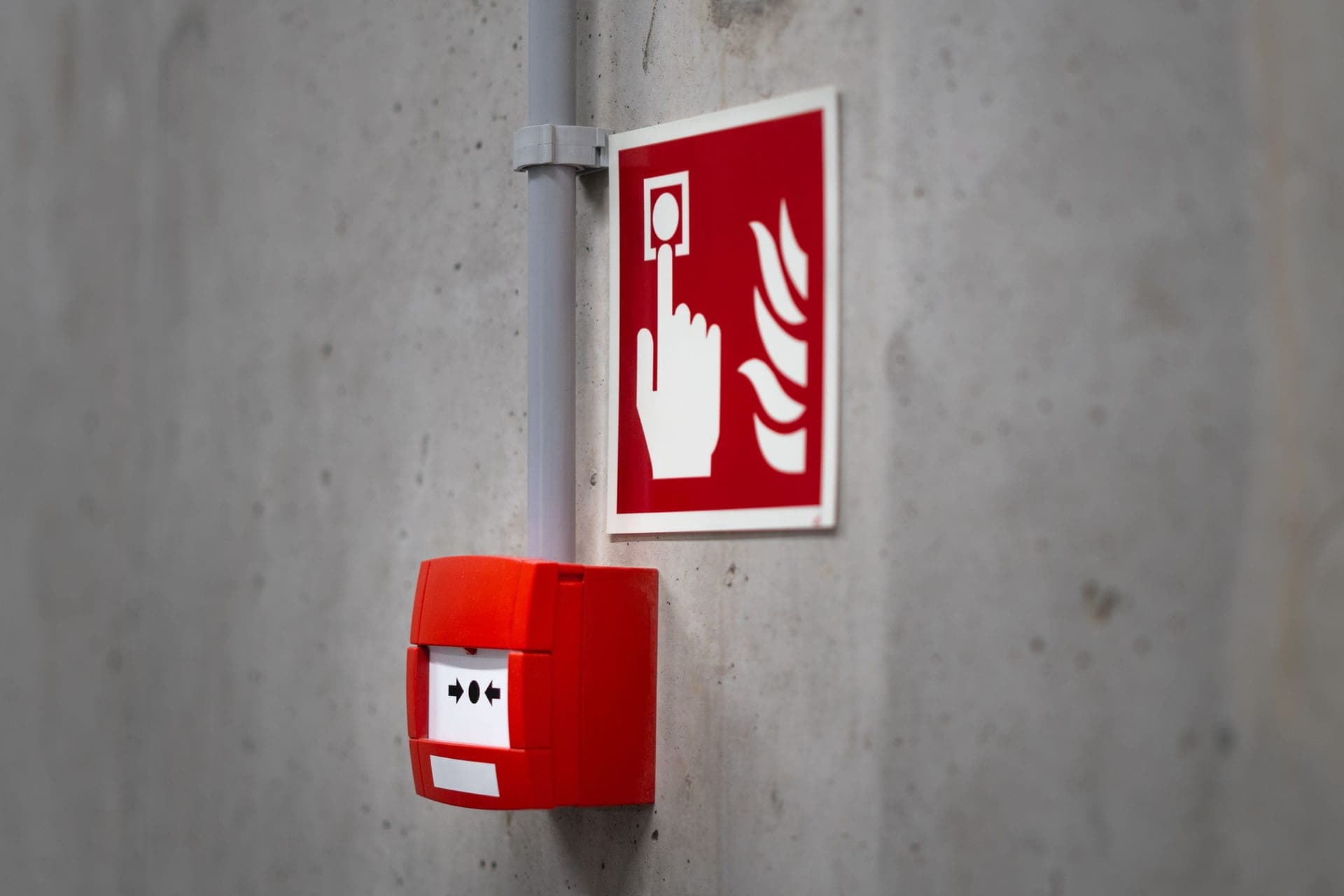
Do not paint a smoke alarm or any part of it. A smoke alarm works by letting air carry smoke particles into a sensing chamber through vents in the housing, and paint bridges those vents — sometimes immediately, sometimes slowly as several coats of overspray build up. Manufacturers prohibit it in their own instructions, painting voids the UL listing the alarm was sold under, and the failure is silent: a painted alarm still passes its test button, because the button tests the horn and the circuit rather than the chamber. If you are decorating, mask the alarms or take them down, and replace any alarm that has already been painted.
Siren & Safe is reader-funded. We earn a commission on some links on this page, at no cost to you. It does not change what we recommend or the order we rank it in. Full disclosure.
What the paint actually does
A smoke alarm is not a sealed box with a sensor behind a window. It is a housing with vents around its edge, and the whole mechanism depends on room air drifting through those vents into a sensing chamber. In a photoelectric alarm, smoke particles entering the chamber scatter a beam of light onto a sensor that would otherwise see nothing. In an ionization alarm, particles disrupt a small current flowing across the chamber. Either way, if air cannot get in, the alarm cannot detect anything — and it has no way of telling you that.
Paint attacks that in two ways. Sprayed paint or heavy overspray closes the vent slots directly, which can take a single coat. Brushed paint on the rim wicks into the gap between housing and bracket and dries there. And because ceilings get repainted every few years, the damage is cumulative: a rim that has taken four coats of ceiling white over fifteen years has a visibly narrower vent gap than it started with.
The second problem is the one people find genuinely surprising. The test button does not test the chamber. Pressing test triggers the horn and verifies the circuit and the power source. It tells you nothing at all about whether smoke can reach the sensor. So a painted alarm chirps obediently every time somebody checks it, right up until the night it matters. How to test a smoke alarm covers what the button does and does not prove.
And the listing goes. Every alarm on the market is sold under a UL 217 listing, which is an assertion that this specific product, in this specific configuration, was tested against fire by an independent laboratory. Modify the housing — paint, stickers, tape, a decorative cover — and the tested configuration no longer exists. Manufacturers say so plainly in their own instructions, and a home inspector or an insurer is entitled to say so too.
What to do when you are decorating
The right order, and it takes about three minutes per alarm. Do this on the day rather than deciding mid-roller.
Take the alarm down if it is battery powered
Most current alarms twist off a bracket. Take the unit down, put it on a shelf in another room, and leave the bracket in place as a marker. There is nothing to disconnect and nothing to remember.
Isolate and unplug if it is hardwired
Turn off the circuit at the breaker, twist the alarm off the bracket, and unplug the harness connector behind it. Do not cut, tape over or leave the connector dangling where paint can get into it. If you are not comfortable at the panel, mask the alarm in place instead.
If it stays up, mask it completely and tightly
Cover the whole unit with a plastic bag taped at the rim, or wrap it in painter's tape. A loose cover lets overspray in around the edges, which is exactly what you were trying to prevent.
Paint, and do not cut in against the alarm
Paint the ceiling right up to the bracket, not up to the alarm rim. A clean line against the bracket looks the same from the floor and leaves the housing untouched.
Remove every cover and refit the same day
This is the step that gets missed, and a house with bagged alarms overnight is a house with no alarms overnight. Refit each unit, restore the breaker, and press the test button on every one before you go to bed.
Quick picks
Scored against replacement cost, ten-year upkeep, nuisance resistance and low profile. Tap a row for the full write-up. The price in each buy button is the live Amazon price at the last check, stamped with the date it was taken.
| # | Product | Best for | Score | Price |
|---|---|---|---|---|
| 1 | 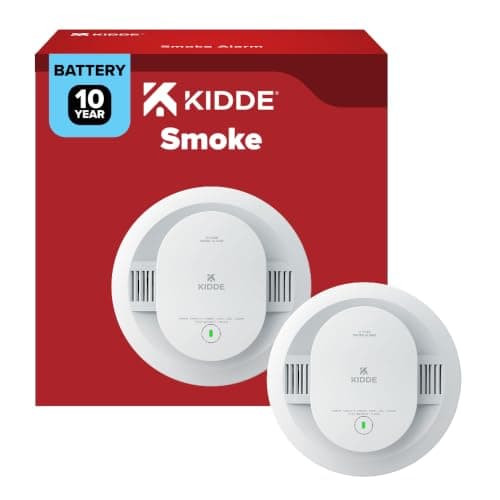 Kidde 20SD10 10-Year Battery Smoke Alarm Sealed ten-year battery, UL 217 10th edition, self-testing. The straightforward swap for an alarm somebody has sprayed. | Replacing a painted alarm, cheaply | 8.2/ 10 | $32.47 · View on Amazon #ad how we are funded · price as of October 19, 2026 |
| 2 | 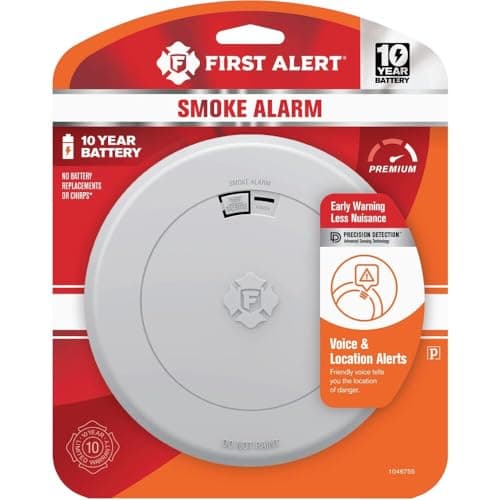 First Alert SM210V 10-Year Battery Smoke Alarm with Voice Alerts Sealed ten-year cell and a spoken alert. The unit to put back up when the reason you wanted to paint it was aesthetic. | A hallway where you want a flatter, quieter-looking unit | 8.0/ 10 | $40.82 · View on Amazon #ad how we are funded · price as of October 19, 2026 |
If an alarm has already been painted
1. Replacing a painted alarm, cheaply
Kidde 20SD10 10-Year Battery Smoke Alarm
Sealed ten-year battery, UL 217 10th edition, self-testing. The straightforward swap for an alarm somebody has sprayed.
- Listed to
- UL 217, 10th edition (UL 217-2024 Ed.10)
- Sensing / agent
- Photoelectric smoke sensing only — no CO cell
- Power / service life
- Sealed 10-year lithium battery; 10-year limited warranty
If an alarm has been painted, the honest answer is to replace it rather than try to clean it. You cannot see into the chamber, solvent will damage the housing and may contaminate the sensor, and the listing is gone either way.
This is the cheap, current, well-listed unit to swap in. Note the date of installation on the housing in pencil — on the bracket side where nobody will ever paint it — and read when to replace smoke detectors for the ten-year clock.
What it does well
- Listed to the 10th edition of UL 217, the edition that added the cooking-nuisance test
- Sealed ten-year battery, so a replacement alarm is a decade-long decision rather than an annual one
- No low-battery chirps for ten years — the first end-of-life beep is the replacement signal
- Twist-and-click bracket, which makes it genuinely quick to take down before the next decorating job
- Self-tests rather than waiting for somebody to press the button
The downside
- No interconnect, so it is a local alarm rather than part of a system
- Photoelectric only — no CO cell
- Standard white housing: there is no finish option that matches a colored ceiling
Do not buy this if: a house that needs interconnected alarms. If you are replacing one painted unit in an interconnected set, replace it with a compatible unit from the same family instead.
- Listed to the 10th edition of UL 217, which carries the cooking-nuisance test the 8th edition introduced
- Kidde's own wording: enhanced sensing technology reduces false alarms often caused by cooking
- No low-battery chirps for ten years — the first end-of-life beep is the replacement signal
- Three long beeps and a red flash on smoke, so the pattern tells you which hazard it is
- Twist-and-click bracket, and it self-tests rather than waiting for you to press the button
#ad how we are funded · price as of October 19, 2026
2. A hallway where you want a flatter, quieter-looking unit
First Alert SM210V 10-Year Battery Smoke Alarm with Voice Alerts
Sealed ten-year cell and a spoken alert. The unit to put back up when the reason you wanted to paint it was aesthetic.
- Listed to
- UL 217 — First Alert states compliance with the latest edition
- Sensing / agent
- Photoelectric smoke sensing, with spoken annunciation
- Power / service life
- Sealed 10-year lithium battery
Most people asking whether an alarm can be painted are not trying to sabotage it — they are repainting a hallway and want the ceiling to look finished. This is the unit we would put back on that ceiling: current, sealed for ten years, and it announces what the problem is instead of just shrieking.
Then use the three legitimate approaches in the section below, none of which involve paint touching the alarm.
What it does well
- Speaks rather than only sounding a horn, which removes the 3 am question of what the noise means
- Photoelectric sensing — the right sensor for a hallway or a landing
- Sealed ten-year cell, so the alarm never asks to be reached
- Part of First Alert's current SM series rather than the outgoing SMI line
The downside
- More expensive than a basic alarm, for a feature that is about clarity rather than detection
- No interconnect
- Still white, still visible — no alarm is invisible, and that is deliberate
Do not buy this if: somebody whose real objection is that the alarm is visible at all. No listed alarm can be made to disappear, and the three legitimate options below are the whole list.
- Speaks rather than only sounding a horn, which removes the 3am question of what the noise means
- Photoelectric sensing — the right sensor for a hallway or a landing
- Sealed ten-year cell, so the alarm never asks to be reached
- Part of First Alert's current SM-series rather than the outgoing SMI line
First Alert product documentation
#ad how we are funded · price as of October 19, 2026
Three legitimate ways to make an alarm less obtrusive
None of them involve paint on the housing. All three are things we would actually do.
- Move it, within the rules. Alarms have to be in the right room and clear of specific obstructions, but there is usually latitude within that. A ceiling alarm must be at least 4 in from the wall; a wall-mounted alarm sits between 4 in and 12 in from the ceiling. Keep 3 ft from supply vents and bathroom doorways, and 20 ft from cooking appliances unless the unit is photoelectric or has a hush function, in which case 10 ft is allowed. Inside those constraints, a quieter position is often available — see where to install smoke detectors and smoke detector distance from vents.
- Buy a lower-profile current model. Alarm housings have got noticeably flatter and plainer over the last decade. A 2026 sealed-battery unit is a smaller object on a ceiling than the 1990s alarm it replaces, and it is a better alarm as well.
- Paint the ceiling, not the alarm. A clean cut against the bracket reads as finished from anywhere in the room. Nobody standing in a hallway can see a 2 mm white rim against a white ceiling; everybody can see a badly masked alarm with ceiling paint dried on its vents.
The honest version of the question
Sometimes the question behind "can I paint it" is really "can I make this alarm stop being here". It is worth answering that directly. NFPA's own fire statistics are blunt: the death rate in reported home fires is dramatically lower where working smoke alarms are present, and the commonest reason an alarm fails in a real fire is not a design flaw but a disabled, missing or obstructed unit.
If the alarm goes off when you cook, the answer is a photoelectric unit placed at a legal distance from the hob, not a coat of paint — best smoke detectors for fewer false alarms and smoke alarm false alarms both deal with that properly. If it chirps, that is a specific, diagnosable signal and not a reason to muffle it: smoke detector chirping.
And if an alarm in your house has already been painted — by you, a decorator or a previous owner — replace it. It is a cheap component, the listing is void, and the failure mode is one you cannot detect by looking.
Questions people actually ask
Can you paint a smoke detector?
Can you paint a smoke detector cover?
What happens if a smoke detector gets painted?
How do you protect smoke detectors when painting a ceiling?
Can you paint a smoke detector black to match a dark ceiling?
How these picks were chosen. On published specifications, safety listings and manufacturer documentation — plus the findings of organizations that do run tests. We have no laboratory and we do not burn anything. Read the full methodology.
Sources
- UL Solutions — UL 217 — smoke alarms
- UL Solutions — UL 217, Standard for Smoke Alarms, published with new technical requirements
- NFPA — NFPA 72, National Fire Alarm and Signaling Code (2025 edition)
- NFPA — Smoke alarms — installation and placement guidance
- NFPA — Smoke Alarms in US Home Fires
- UpCodes — Specific location requirements for smoke alarms (NFPA 72 §29.11.3.4)
Read next
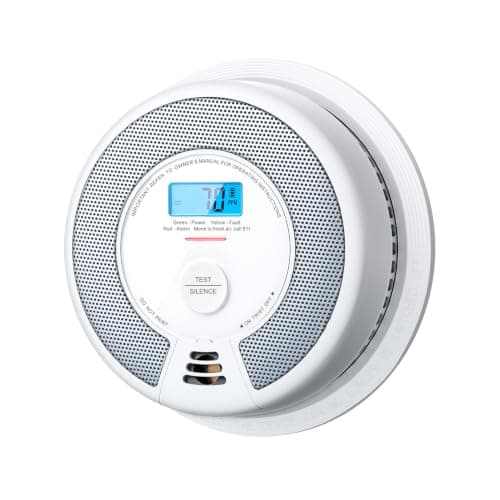
Smoke Detectors
The monthly button test, the aerosol chamber test, the interconnect test, and why open flame is never a test method.
Smoke Detectors
When to Replace Smoke Detectors
Where the date is, why the test button proves little, and what to replace with.
Smoke Detectors
Why Your Smoke Alarm Goes Off for No Reason
Position first, contamination second, faulty alarm a distant third.
Placement & Code
Smoke Detector Placement, Room by Room
The three requirements, the four exclusions, and an original placement diagram.
Placement & Code
Smoke Detector Distance From Vents
3 ft from a supply register, measured horizontally. Returns, extracts and fans are each different.