Escape Ladders
The Best Escape Ladders for Apartments and Balconies
A rented apartment rules out half the options before you start. What is left depends on your floor, your sill, and whether you are allowed to put a screw in anything.
By Ryder M.Last reviewed

For a second-floor apartment the Kidde 2-Story 13 ft ladder is the pick: it hooks over a window sill, needs no fixing and no tools, weighs 7.7 lb, and leaves nothing behind when you move out. On the third floor a 25 ft strap ladder such as the Hausse is the honest option. **Above the fourth floor, a portable ladder is not a realistic escape plan** — the climb is beyond most people and the building's protected stairway is the route. Measure your sill before buying anything, because sill-hook ladders need a sill of the right width and many apartment windows do not have one.
Siren & Safe is reader-funded. We earn a commission on some links on this page, at no cost to you. It does not change what we recommend or the order we rank it in. Full disclosure.
The three questions that decide whether you can use a ladder at all
What floor are you on? Thirteen to 14 ft reaches the ground from a standard second floor. Twenty-four to 25 ft reaches a third. Above a fourth floor, portable ladders stop being a credible plan — the descent is longer than most people can physically manage and the products available in mainstream retail are not intended for it.
Do you have a sill a hook will fit? Sill-hook ladders are specified for a sill of a given width — First Alert publishes 6 to 10 in for the EL52-2. Many apartment windows, particularly in newer buildings with flush aluminum or uPVC frames, have no projecting internal sill at all. Measure before you buy anything, because nothing else about the ladder matters if it cannot hook.
Are you allowed to fix anything to the building? If you rent, probably not without written consent, which rules out anchored ladders and leaves the hook-over options. If you own the apartment, check the building's rules as well as your own preference — balcony and facade modifications are usually a management committee matter.
Answer those three and the choice is usually made for you. What size escape ladder do I need covers the measuring properly, including how to measure the drop rather than guessing from the floor number.
A balcony is a different attachment problem from a window, because escape-ladder hooks are specified for window sills rather than railings. Best escape ladders for balconies covers what actually seats on a railing and the anchored alternative.
Quick picks
Scored against needs no fixing, weight to deploy, reaches a 2nd floor, stability mid-climb and storage footprint. Tap a row for the full write-up. The price in each buy button is the live Amazon price at the last check, stamped with the date it was taken.
| # | Product | Best for | Score | Price |
|---|---|---|---|---|
| 1 | 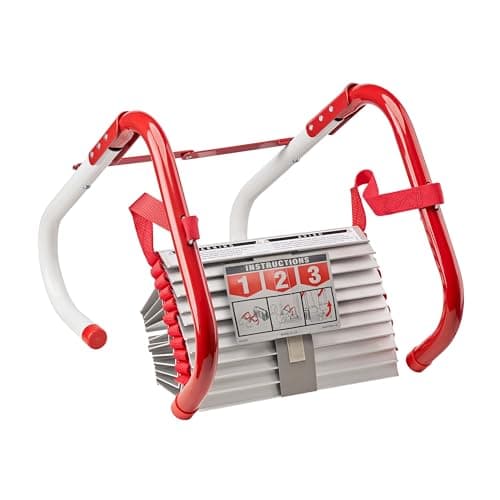 Kidde 2-Story Fire Escape Ladder (13 ft) 13 ft, 7.7 lb, hooks over the sill. No tools, no fixings, no landlord conversation. | A second-floor apartment, with nothing drilled | 8.9/ 10 | $53.99 · View on Amazon #ad how we are funded · price as of October 19, 2026 |
| 2 | 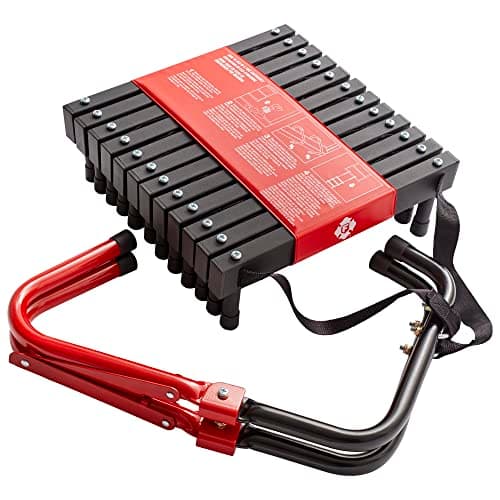 First Alert EL52-2 2-Story Fire Escape Ladder (14 ft) 14 ft, steel rungs and steel stabilizers. Steadier underfoot. | A second floor where the sill is wide | 8.8/ 10 | $56.99 · View on Amazon #ad how we are funded · price as of October 19, 2026 |
| 3 | 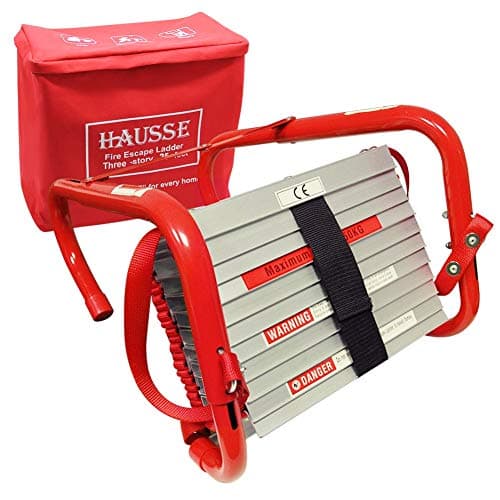 Hausse Retractable 3-Story Fire Escape Ladder (25 ft) 25 ft, same hook-and-drop mechanism, over a much longer descent. | A third-floor apartment | 7.0/ 10 | $89.99 · View on Amazon #ad how we are funded · price as of October 19, 2026 |
| 4 | 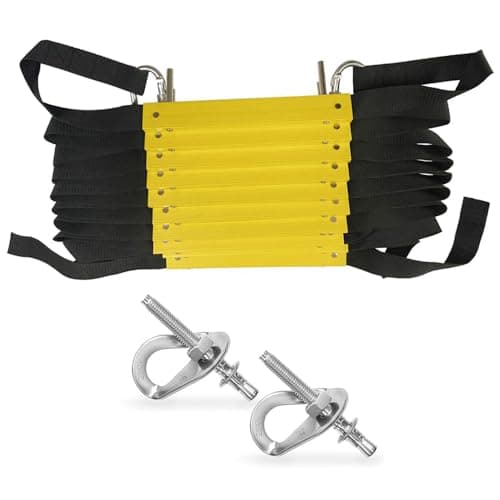 ISOP 32 ft Rope Fire Escape Ladder with Mounting Anchors 32 ft rope ladder with mounting anchors. Needs a permanent fixing. | A balcony, where there is something to anchor to | 5.9/ 10 | $159.88 · View on Amazon #ad how we are funded · price as of October 19, 2026 |
The ladders in full
1. A second-floor apartment, with nothing drilled
Kidde 2-Story Fire Escape Ladder (13 ft)
13 ft, 7.7 lb, hooks over the sill. No tools, no fixings, no landlord conversation.
- Listed to
- Kidde states the ladder is tested to 1,000 pounds, published as 750 lb on a single rung and 1,000 lb spread over more than one
- Sensing / agent
- Zinc-plated 1 ft wide anti-slip metal rungs on red nylon strap rails, window hooks
- Power / service life
- Single use — Kidde says discard when unfolded or used. 5-year limited warranty; inspect annually
For a rented second-floor apartment this is close to the only sensible answer, and the reason is the thing it does not require: a fixing. No anchors, no screws, no holes, nothing to make good when you leave, and no conversation with a landlord or a management company.
The weight is the second argument. Deploying an escape ladder is something you may be doing in the dark, in smoke, from a sitting position on a window sill, possibly with a child beside you. 7.7 lb is liftable in that position. A 24 ft ladder is not, for many people.
What it will not do is feel steady. Strap-rail ladders hang flat against the wall and twist as you put weight on them, which is unnerving even when you know it is normal and nothing is wrong. How to use a fire escape ladder covers the technique, and reading it once is worth more than the choice between brands.
Measure the sill first. Sill-hook ladders are specified for a sill of a particular width, and apartment windows with no projecting sill at all are common. If yours has none, this whole category is out and the honest answer is that the stairway is your route.
What it does well
- **No assembly and no tools** — hook it over the sill and pull the release strap
- 7.7 lb, light enough that most adults can lift and hook it from a seated position on the sill
- 13 ft, which is the length that reaches ground from a standard second-floor window
- Tested to 1,000 lb: 750 lb on a single rung, 1,000 lb spread over more than one rung
The downside
- **Strap rails twist against the wall**, which is the part that frightens people mid-climb
- Needs a sill the hooks actually fit — measure before buying
- Single use: discard after any real deployment
Do not buy this if: your window has no usable sill, or you are above the second floor. A sill-hook ladder with nowhere to hook is a bag in a cupboard, and 13 ft does not reach the ground from a third-floor window.
- 13 ft, which is the length that reaches ground from a standard second-floor window
- Fits most common windows up to 11 in deep and 16 in wide, casement windows included — measure before you order
- No assembly and no tools: hook it over the sill and release the rungs
- Tangle-free design, which is the specification that matters when you deploy it once, in the dark, for real
- Strap rails twist against the wall, which is the part that frightens people mid-climb
#ad how we are funded · price as of October 19, 2026
2. A second floor where the sill is wide
First Alert EL52-2 2-Story Fire Escape Ladder (14 ft)
14 ft, steel rungs and steel stabilizers. Steadier underfoot.
- Listed to
- Tested to ASTM standards. First Alert states the ladder is tested to 375 pounds, and quotes 1,125 lb on the listing title
- Sensing / agent
- Steel anti-slip rungs on nylon strapping, with steel stabilizers and window-sill hooks
- Power / service life
- Single-use emergency ladder; inspect annually
The published sill range is why this one is worth considering ahead of its rivals in an apartment: 6 to 10 in is a number you can take a tape measure to before you spend anything, and in a rented flat where you cannot modify the window, fit is the whole question.
The steel stabilizers are the other real difference. They hold the rungs away from the wall, and the subjective result is a ladder that feels less like climbing a rope and more like climbing a ladder. For anyone nervous about heights, that is not a trivial improvement.
The 375 lb working limit is stated more honestly than the test figures competitors quote, and it has a practical consequence: one person at a time. A parent carrying a child is within it; two adults descending together are not.
Kidde versus First Alert is the head-to-head if you are choosing between these two directly.
What it does well
- 14 ft, a foot longer than the common 13 ft unit, which helps where the drop is awkward
- **Fits a standard window sill between 6 and 10 in wide** — a specification you can actually check against your window
- Steel anti-slip rungs and steel stabilizers on nylon strapping, which feels steadier underfoot than plain webbing
- Rated to hold up to 375 lb at a time, stated plainly rather than as a four-figure test number
The downside
- 375 lb at a time is a working limit worth knowing if two people need to descend together — they cannot
- Still a strap-rail ladder, so it still twists against the wall
- Single use after any real deployment
Do not buy this if: your sill is narrower than 6 in or has no projection at all. The published sill range is the specification that decides whether this ladder is usable in your apartment.
- 14 ft, a foot longer than the common 13 ft unit
- Designed for window sills between 6 and 10 in wide — measure yours before ordering
- **Steel stabilizers hold the ladder away from the wall**, which is the single biggest difference between a ladder you can climb and one that pins your toes
- Tested to 375 lb at a time, which is the figure to plan around rather than the 1,125 lb in the title
- Arrives fully assembled and folds flat for storage
#ad how we are funded · price as of October 19, 2026
3. A third-floor apartment
Hausse Retractable 3-Story Fire Escape Ladder (25 ft)
25 ft, same hook-and-drop mechanism, over a much longer descent.
- Listed to
- Hausse states the ladder is tested for up to 1,000 lbs
- Sensing / agent
- Slip-resistant rungs on strap rails, with retractable hooks that secure over the window frame or sill
- Power / service life
- Hausse recommends replacing it every three years to ensure usability; inspect annually
Third-floor apartments are where this category gets genuinely difficult, and it is worth being blunt about it: a 25 ft descent on a strap-rail ladder is hard. Not impossible, not unreasonable for a fit adult who has practiced the motion, but hard.
The deployment is the first obstacle. A 25 ft ladder is bulky, it takes two hands and clear floor space to pay out, and doing that in a small bedroom with the door closed against smoke is a different exercise to doing it in a hallway in daylight.
The climb is the second. Twenty-five feet is roughly twenty rungs, hanging flat against a wall with no standoffs, with the rails twisting as you transfer weight.
So the honest advice for a third-floor apartment is to own one and to treat the building's protected stairway as the primary route. A ladder is the fallback for the night the corridor is impassable, not the plan. What size escape ladder do I need covers the measuring, and escape ladders for kids and older adults is the read if the household includes either.
What it does well
- 25 ft for a genuine third-floor window
- Same hook-and-drop deployment as the 2-story unit, with no fixings required
- Zinc-plated anti-slip rungs 1 ft wide on red nylon strap rails
- Tested to 1,000 lb: 750 lb on a single rung, 1,000 lb spread over more than one
The downside
- **Heavier and bulkier — deploying it takes both hands and real space**, which a small bedroom may not have
- A 25 ft climb is beyond what many people can physically do, and that is not a criticism of the ladder
- Substantial storage footprint for an apartment
Do not buy this if: the likely user is a child, an older adult, or anyone with a grip, shoulder or balance problem. Twenty-five feet of twisting strap ladder is a serious physical task and an honest plan says so.
- 25 ft for a genuine third-floor window
- Retractable hooks — they must be fully extended before use, which is one more thing to get right in the dark
- No assembly or tools; a red canvas storage bag is in the box so it lives under a bed or by the window
- Heavier and bulkier than the 13 ft — deploying it takes both hands and real space
- A 25 ft climb is beyond what many people can physically do; plan accordingly
#ad how we are funded · price as of October 19, 2026
4. A balcony, where there is something to anchor to
ISOP 32 ft Rope Fire Escape Ladder with Mounting Anchors
32 ft rope ladder with mounting anchors. Needs a permanent fixing.
- Listed to
- ISOP names no standard and no test house for this ladder; everything below is a seller claim
- Sensing / agent
- Continuous webbing strap rails with aluminum rungs, anchored to a permanent wall fixing
- Power / service life
- Reusable per the seller; inspect before and after any use
This is the balcony answer, and it comes with the one condition that rules it out for most renters: it anchors to the structure.
Where a balcony has a solid wall, a concrete upstand or a structural rail, an anchored ladder is genuinely better than a sill hook — the fixing does not depend on a window sill existing, and it does not move when you load it the way a hooked ladder does.
Where you rent, this is a written-permission conversation with a landlord or management company before you drill anything, and the answer is frequently no. It is also a poor fit for a one-year tenancy: you leave holes in somebody's structure and take the ladder with you.
The honest caveat on the product itself is the evidence. ISOP publishes no load rating and names no standard for this ladder, which is weaker evidence than the sill-hook ladders offer even though those figures are manufacturer claims too. What it does publish is rung stabilizers, which hold it off the wall and make the climb easier than a flat-hanging ladder. Permanent versus portable is the full comparison of the two approaches.
What it does well
- 32 ft, marketed for a 3- to 4-story house, which is longer than the sill-hook ladders reach
- Ships with mounting anchors for a permanent fixing rather than relying on a sill hook
- Continuous webbing top to bottom with smooth aluminum rungs, and reusable rather than single-use
- Readily available through mainstream retail, which the longer steel ladders are not
The downside
- **Requires drilling into structure**, which most tenancy agreements do not permit without written consent
- **Rung stabilizers** hold it off the wall, which a sill-hook strap ladder at this length does not do
- Listing described by the seller as certified without naming a standard or a test house
Do not buy this if: you rent and cannot fix into the building, or you want a ladder you can deploy without preparation. An anchored ladder is a decision you make once, with permission, and it is the wrong product for a short tenancy.
- 32 ft (10 m), marketed for a 3- to 4-story house
- Ships with heavy-duty mounting anchors for a permanent fixing rather than a sill hook
- **Rung stabilizers** hold the ladder off the wall, so there is somewhere to put your toes
- Continuous webbing running top to bottom rather than separate rope sections
- Smooth-finished aluminum rungs with a textured anti-slip pattern, and no sharp edges on the hands
#ad how we are funded · price as of October 19, 2026
Side by side for an apartment
Lengths, ratings and sill specifications exactly as each manufacturer publishes them. Prices are shown live inside each buy button, dated.
| Kidde 2-Story | First Alert EL52-2 | Hausse 3-Story | ISOP 32 ft | |
|---|---|---|---|---|
| Length | 13 ft | 14 ft | 25 ft | 32 ft |
| Floors | 2nd | 2nd | 3rd | 3rd to 4th |
| Needs a fixing | No | No | No | Yes — anchors into structure |
| Suitable for a rental | Yes | Yes | Yes | Usually not |
| Published sill spec | Check the listing | 6 to 10 in | Check the listing | n/a — anchored |
| Stated load | Tested to 1,000 lb | Tested to 375 lb | Tested to 1,000 lb | None published |
| Standoffs | No | Yes, steel stabilizers | None published | Yes, rung stabilizers |
| Weight to deploy | 7.7 lb | Light | Heavy | Moderate |
| Reusable | No — single use | No — single use | No — single use | Reusable per the seller |
| Works from a balcony | Only over a rail with a fit | Only over a rail with a fit | Only over a rail with a fit | Yes, anchored |
No consumer escape-ladder standard exists in the US for this product class, so load figures are manufacturer test claims rather than certifications to a common standard.
Balconies are a different problem to windows
A balcony looks like the easier case and is often the harder one. A window gives you a sill a hook is designed for; a balcony gives you a rail that may or may not be structural and may or may not be yours to attach anything to.
Check what the rail is made of and how it is fixed. A glass balustrade in aluminum channel is not an anchor point. A welded steel rail into a concrete upstand may be. If you cannot establish it, do not assume it.
Check the clearance below. A balcony above another balcony means the ladder lands on somebody else's floor, not on the ground, and the descent continues from there. That may still be worth having — one floor down and inside is a better position than where you started — but it is not the same as reaching ground.
Check whose property the facade is. In most apartment buildings the external wall and the balcony structure are common property, and drilling into them is a management committee decision rather than a resident one.
Where none of that resolves, a balcony's real value in a fire is as a place of relative safety: outside the smoke, visible to the fire service, with a door you can close behind you. That is worth a great deal and it does not require a ladder.
What to do instead, or as well, in an apartment building
A portable ladder is one item in a plan. In a multi-story building the rest of the plan matters more than it does in a house.
- Know both stairwells. Walk them, both of them, once. The one you use every day may be the one that is full of smoke, and finding the second one for the first time in an emergency is not a plan.
- Never the elevator. Elevator shafts carry smoke, elevators can be recalled or lose power, and a stopped car between floors is the worst place in the building.
- Count the doors to the stairwell from your own. In smoke you may be on your hands and knees and unable to read numbers. A count is something you can use blind.
- Close your door behind you. A closed apartment door measurably slows the spread of fire and smoke into the corridor you have just used, and into your home if the fire is out there.
- If the corridor is impassable, stay put and seal in. Towels at the door gap, call 911, tell them your apartment number and that you cannot leave, and make yourself visible at a window. In a building with compartmentation this is frequently the correct decision rather than the desperate one.
- Make sure the alarms work, in your apartment and not only in the corridor. Where to install them and rental and landlord requirements cover what should be there and who is responsible for it.
Practice the hooking motion once, with the window open
Not the climb — nobody should climb a single-use emergency ladder for practice, and doing so may compromise it. The hooking motion is the part worth rehearsing, and it takes two minutes.
Take the ladder out of the bag. Work out which way up it goes, how the hooks sit on your sill, and how the release strap pays the rungs out. Do that once, in daylight, with no urgency, and then put it back in a way that lets you repeat it.
Then store it in the room it serves, not in a hall cupboard. A ladder two rooms away from the bedroom is a ladder you will not reach if the bedroom door is the thing holding smoke back.
Tell everyone in the apartment where it is and what it is. How to use a fire escape ladder is the full technique, including the detail most people get wrong — going out backwards, feet first, facing the wall.
Questions people actually ask
What is the best fire escape ladder for an apartment?
Can you use a fire escape ladder on a balcony?
How high is too high for a fire escape ladder?
Can I install a fire escape ladder in a rented apartment?
Where should I store an escape ladder in a small apartment?
Do apartment escape ladders meet a safety standard?
How these picks were chosen. On published specifications, safety listings and manufacturer documentation — plus the findings of organizations that do run tests. We have no laboratory and we do not burn anything. Read the full methodology.
Sources
- US Fire Administration — Home fire escape planning
- NFPA — Making and practicing a home fire escape plan
- International Code Council — IRC Chapter 3 — building planning (R310, R314, R315)
- NFPA — Smoke Alarms in US Home Fires
Read next
Escape Ladders
The Best 2-Story Fire Escape Ladders
Two ladders for a second-floor window, and why standoffs beat weight ratings.
Escape Ladders
What Size Fire Escape Ladder Do I Need?
Measure sill to ground, check the sill width, and read the right capacity number.
Escape Ladders
How to Use a Fire Escape Ladder
The deployment sequence, the three mistakes at the sill, and how to practice safely.
Escape Ladders
Permanent vs Portable Escape Ladders
The permanent unit deletes the hardest step. Whether that is worth the cost and the install.

Placement & Code
A fill-in template: two exits per room, a meeting place, and who helps whom.