Escape Ladders
The Best 2-Story Fire Escape Ladders
Thirteen to fourteen feet reaches the ground from a standard second floor. The feature that decides whether anyone can actually climb it is not the weight rating — it is whether the rungs stand off the wall.
By Ryder M.Last reviewed

Buy the First Alert EL52-2 if you want the ladder that is easiest to climb, and the Kidde 13-foot if weight and storage are your constraints. Both reach the ground from a normal second-floor window. The difference that matters is construction: the First Alert has rigid alloy steel steps and standoff stabilizers that hold the rungs clear of the siding, and the Kidde has metal rungs on nylon strap rails that lie flat and twist. Measure your own sill height before you order either — floor joists and a raised foundation add up.
Siren & Safe is reader-funded. We earn a commission on some links on this page, at no cost to you. It does not change what we recommend or the order we rank it in. Full disclosure.
Measure before you order
Do not buy by floor count. Two-story houses vary by several feet depending on joist depth and how high the foundation sits. The full sizing guide covers the sill-width constraint and what the two capacity figures on the box actually measure.
Pick the window you would actually use
Usually the one furthest from the bedroom door, because the door is where smoke arrives. Check it opens fully and that nothing is stored in front of it.
Measure from the sill to the ground outside
Drop a tape from the sill. Measure to the ground, not to a deck rail or a window well lip that you would not want to land on.
Add a foot and round up to the next size
A ladder that ends two feet short is a drop; a ladder that coils a foot on the ground is fine. If your measurement is 13 ft 6 in, buy the 14 ft.
Check what is directly below
Air-conditioning units, shrubs, bins, a deck edge and basement window wells all change where the ladder can land. Move what you can move now.
What the weight ratings actually mean
This category quotes capacity inconsistently and it is worth understanding before you compare two numbers. Some manufacturers publish a total weight-bearing capacity for the assembly — the load the hooks and rails are built to carry, which is why four-figure numbers appear. Others publish a working load per climber, which is a much smaller and much more useful figure.
A 1,000 lb assembly figure does not mean four adults can descend together, and a 375 lb figure does not mean the ladder is weaker. They are answers to different questions.
The same disclosure problem runs through every height in this category, and the main escape ladder roundup compares what each brand is willing to specify side by side. Our review of the Kidde KL-2S works through exactly which figures Kidde publishes for the 13 ft ladder and which it does not.
What to do about it: read the label on the unit that arrives, and plan for one person on the ladder at a time, which is what every manufacturer instructs anyway. If you need two people down from the same window, the second waits.
One per bedroom, stored in the bedroom
This is the part people push back on, and it is the part that matters most. A ladder in a hall cupboard is a ladder you cannot reach, because the hall is where the smoke and the fire will be. The US Fire Administration's escape-planning guidance is built around two ways out of every room for exactly this reason: the first way out is the door, and the second way out has to work when the door does not.
So the ladder lives in the room it serves, within reach of the bed, not behind a wardrobe. If that means buying two or three, buy two or three — and if the budget only stretches to one, put it in the room where the person least able to get out sleeps.
In a rented apartment that is frequently the only option available, because anchored ladders mean holes in somebody else's building — escape ladders for apartments and balconies covers what is left once drilling is ruled out.
It also means everyone who sleeps in that room needs to have hooked it over the sill at least once, with the window open, in daylight. Not climbed it — hooked it. That is the step that gets fumbled.
Quick picks
Scored against climb stability, deployment speed, storage footprint, published capacity and who can use it. Tap a row for the full write-up. The price in each buy button is the live Amazon price at the last check, stamped with the date it was taken.
| # | Product | Best for | Score | Price |
|---|---|---|---|---|
| 1 | 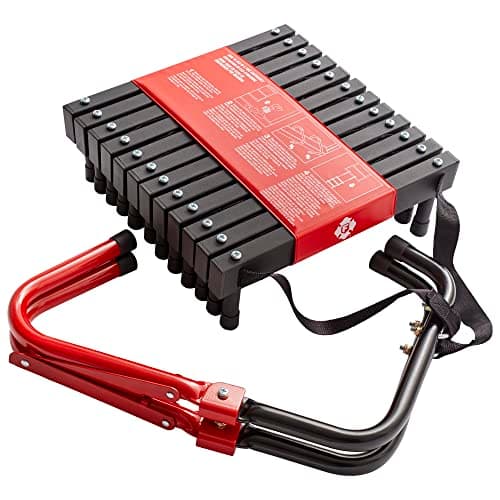 First Alert EL52-2 2-Story Fire Escape Ladder (14 ft) Rigid steps and standoffs make the descent survivable rather than terrifying. | Anyone who has to climb it | 7.9/ 10 | $57.99 · View on Amazon #ad how we are funded · price as of November 11, 2026 |
| 2 | 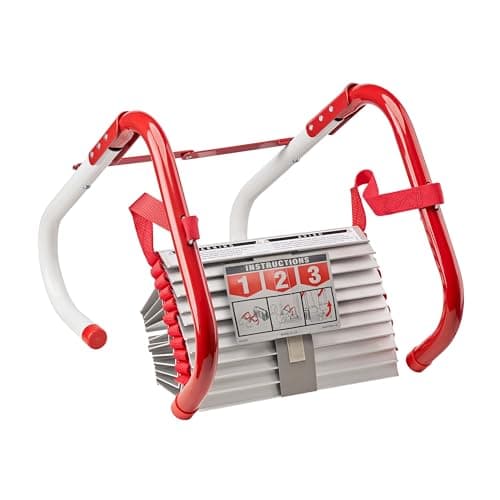 Kidde 2-Story Fire Escape Ladder (13 ft) Light enough that almost any adult can hook it. Climbs like a rope ladder. | Weight and storage | 7.4/ 10 | $59.00 · View on Amazon #ad how we are funded · price as of November 11, 2026 |
The two ladders in full
1. Anyone who has to climb it
First Alert EL52-2 2-Story Fire Escape Ladder (14 ft)
Rigid steps and standoffs make the descent survivable rather than terrifying.
- Listed to
- Tested to ASTM standards. First Alert states the ladder is tested to 375 pounds, and quotes 1,125 lb on the listing title
- Sensing / agent
- Steel anti-slip rungs on nylon strapping, with steel stabilizers and window-sill hooks
- Power / service life
- Single-use emergency ladder; inspect annually
The standoffs are the whole argument. A ladder that lies flat against siding presses your toes into the wall and gives the ball of your foot nowhere to rest, which is the single most common reason people stop halfway down and freeze. Holding the rungs a few inches clear changes the descent from a scramble to a climb.
The rigid steps compound that. Strap-rail ladders move with you: every step shifts your weight, the rails twist, and the whole assembly swings against the wall. Steel steps with a fixed geometry feel like a ladder rather than a rope.
On the capacity figure — 375 lb — read it as a working load per climber rather than comparing it to the four-figure numbers other manufacturers quote for a whole assembly. Those are different measurements, and the escape-ladder category is unusually careless about which one it prints. Check the label that arrives.
One ladder per upstairs bedroom, stored in that bedroom. You cannot cross a landing that is on fire to fetch one. If that sounds expensive, the honest discussion of who can use a ladder at all may change which rooms you buy for.
What it does well
- Standoff stabilizers hold the rungs clear of the siding, so your feet have somewhere to go
- Rigid alloy steel steps do not twist or swing the way strap rails do
- 14 ft, a foot of margin over the common 13 ft unit
- Publishes a per-climber capacity figure of 375 lb rather than an assembly total
The downside
- Bulkier than a strap ladder, so it needs real storage space in the bedroom
- Heavier to lift onto a sill from a seated position
- Awkward at a narrow window — practice the hooking motion before you need it
Do not buy this if: the window is small, high off the floor, or the person sleeping in that room cannot lift around 10 lb overhead. In those cases a permanently-installed ladder removes the lift entirely and is worth the extra cost.
- 14 ft, a foot longer than the common 13 ft unit
- Designed for window sills between 6 and 10 in wide — measure yours before ordering
- **Steel stabilizers hold the ladder away from the wall**, which is the single biggest difference between a ladder you can climb and one that pins your toes
- Tested to 375 lb at a time, which is the figure to plan around rather than the 1,125 lb in the title
- Arrives fully assembled and folds flat for storage
#ad how we are funded · price as of November 11, 2026
2. Weight and storage
Kidde 2-Story Fire Escape Ladder (13 ft)
Light enough that almost any adult can hook it. Climbs like a rope ladder.
- Listed to
- Kidde states the ladder is tested to 1,000 pounds, published as 750 lb on a single rung and 1,000 lb spread over more than one
- Sensing / agent
- Zinc-plated 1 ft wide anti-slip metal rungs on red nylon strap rails, window hooks
- Power / service life
- Single use — Kidde says discard when unfolded or used. 5-year limited warranty; inspect annually
This is the ladder most households buy, and its advantages are real: it is light, it stores almost nowhere, and the deployment is as fast as this category gets. If the constraint is that someone with limited strength has to get it onto a sill unaided, it wins on that alone.
The trade is the climb. Metal rungs on nylon webbing means the ladder has no torsional stiffness — it rotates under load and presses flat to the wall. Confident adults manage it. People who are frightened, injured or small often do not.
On the 1,000 lb figure Kidde publishes: that is a weight-bearing capacity for the assembly, not a per-climber working load, and quoting it next to First Alert's 375 lb is comparing two different numbers. Neither manufacturer is being dishonest; the category just prints whichever figure looks better.
Buy it if the alternative is no ladder. Do not buy it for a child's bedroom on the assumption that light equals usable.
What it does well
- 7.75 lb — light enough to lift and hook from a seated position
- No assembly: unfold, hook over the sill, drop
- Folds small enough to live in a bedside cupboard or under a bed
- 13 ft reaches the ground from a standard second-floor window
The downside
- Nylon strap rails twist and swing against the wall during the climb
- No standoffs, so your toes are pressed against the siding
- The manufacturer quotes a 1,000 lb assembly figure, which is not a per-climber rating
Do not buy this if: the climber is a child, an older adult, or anyone with balance, knee or shoulder problems. A swinging strap ladder in the dark is genuinely hard, and the ladder being light does not make the descent easier.
- 13 ft, which is the length that reaches ground from a standard second-floor window
- Fits most common windows up to 11 in deep and 16 in wide, casement windows included — measure before you order
- No assembly and no tools: hook it over the sill and release the rungs
- Tangle-free design, which is the specification that matters when you deploy it once, in the dark, for real
- Strap rails twist against the wall, which is the part that frightens people mid-climb
#ad how we are funded · price as of November 11, 2026
Shopping to a cap
Every second-floor ladder on this page fits inside a familiar price band, and so do both three-story options. Best fire escape ladders under $100 sets them side by side on standoffs, tread width and the per-section weight limit, and makes the case that for a second-floor window the stabilizers are the feature worth paying for.
Side by side
| First Alert EL52-2 | Kidde 13 ft | |
|---|---|---|
| Length | 14 ft | 13 ft |
| Step construction | Rigid alloy steel steps | Metal rungs on nylon strap rails |
| Standoff stabilizers | Yes | No |
| Weight | Heavier | 7.75 lb |
| Published capacity | 375 lb (per climber) | 1,000 lb (assembly total) |
| Storage | Bulkier | Folds very small |
| Best for | The climb | The lift and the cupboard |
The two capacity figures are not comparable — see the section above on what each manufacturer is actually measuring.
Who should buy neither
If the bedroom window is a genuine third floor, a 13 or 14 ft ladder is dangerous rather than inadequate — it ends in mid-air. Three-story ladders covers the 24 to 25 ft units.
If the occupant is a young child, or an adult who cannot climb a domestic ladder unaided, a portable ladder is not the answer and pretending otherwise is worse than admitting it. The honest options there are a ground-floor sleeping arrangement, an adult-assisted route, or a permanently-installed ladder — permanent versus portable works through the trade.
And if the window in question is a basement window rather than an upstairs one, the problem is different again: shorter, but with a lip and often a grate. Basement window well escape covers it.
Questions people actually ask
What length fire escape ladder do I need for a 2-story house?
Are standoff stabilizers worth paying for on an escape ladder?
Can two people climb a fire escape ladder at once?
How often should I check an escape ladder?
Do I need an escape ladder if my bedroom window is over a porch roof?
How these picks were chosen. On published specifications, safety listings and manufacturer documentation — plus the findings of organizations that do run tests. We have no laboratory and we do not burn anything. Read the full methodology.
Sources
- US Fire Administration — Home fire escape planning
- NFPA — Making and practicing a home fire escape plan
- NFPA — Smoke Alarms in US Home Fires
Read next
Escape Ladders
The Best 3-Story Fire Escape Ladders
Twenty-five feet, the two options, and who genuinely cannot use one.
Escape Ladders
Kidde vs First Alert Escape Ladders
Light and fast to deploy versus rigid and easy to climb — who each one suits.
Escape Ladders
How to Use a Fire Escape Ladder
The deployment sequence, the three mistakes at the sill, and how to practice safely.
Escape Ladders
Escape Ladders for Kids and Older Adults
Why the ladder often is not the answer for children or older adults, and what is.
Placement & Code
A fill-in template: two exits per room, a meeting place, and who helps whom.