Escape Ladders
What Size Fire Escape Ladder Do I Need?
Buying by floor count is how people end up with a ladder that stops four feet short. The number you need is the one you measure yourself, and there are two other dimensions that matter as much as length.
By Ryder M.Last reviewed

Measure from the window sill to the ground at the window you would actually use, add a foot, and round up to the next available length. In practice that means 13 to 14 ft for a standard second-floor window and 24 to 25 ft for a genuine third floor. Two dimensions nobody checks matter just as much: the sill must be within the width the hooks are built for — First Alert specifies 6 to 10 in for its two-story ladder — and the capacity figure on the box is usually a tested load for the whole assembly, not the weight one person may put on a rung.
Siren & Safe is reader-funded. We earn a commission on some links on this page, at no cost to you. It does not change what we recommend or the order we rank it in. Full disclosure.
How to measure, properly
Do this at the window you would actually escape from, not the most convenient one. That is usually the window furthest from the bedroom door, because the door is where smoke arrives.
Open the window fully and clear the opening
All the way, with the insect screen out. You are measuring the route you would really use, and a screen that does not come out changes the answer.
Drop a tape from the sill to the ground outside
From the top of the sill — the surface the hooks will sit on — straight down to the ground. Have someone hold the bottom, or weight the tape.
Measure to the ground you would land on, not the nearest surface
Not a deck rail, not the lip of a basement window well, not the top of an air-conditioning unit. If the ground below slopes away from the wall, measure at the low point.
Add a foot, then round up to the next available length
A ladder that coils a foot on the ground is fine. A ladder two feet short is a fall. If you measure 13 ft 6 in, buy the 14 ft rather than the 13 ft.
Measure the sill width too
The depth of the surface the hooks grip. First Alert specifies 6 to 10 in for its two-story ladder. A deep stone sill or a thick insulated reveal can fall outside what the hooks are built for.
Look at what is directly below the window
Shrubs, bins, a deck edge, an air-conditioning condenser, a basement window well. Move what you can move now, and note anything you cannot — it changes where the ladder can land.
Write the measurement down per window
Every upstairs bedroom without a second exit needs its own ladder, and the sill heights will not all be identical. The escape plan template has somewhere to record them.
The lengths, and what each one actually suits
Common retail lengths. Match these to your measurement rather than to a floor count.
| Length | Typical measured sill height | What it suits |
|---|---|---|
| 13 ft | Up to about 12 ft | A standard second-floor window. The lightest and smallest option, and the one with the least margin |
| 14 ft | Up to about 13 ft | A second floor with a raised foundation, deep joists or ground that slopes away. The safer default |
| 24 ft | Up to about 23 ft | A genuine third floor. Large stored bundle; the descent is the real constraint, not the length |
| 25 ft | Up to about 24 ft | A tall third floor, or where you want margin. Longest of the common lengths |
| Basement / window well | Short, but upward | A different problem — standard hook-over ladders are the wrong tool. See basement window well escape |
Excess length is not free: surplus ladder coils on the ground and gets underfoot at the bottom of the descent. Buy the next size up from your measurement, not the longest you can find.
The two capacity numbers, and which one to read
This category publishes capacity inconsistently, and comparing the headline figures across brands tells you almost nothing. There are two different measurements in circulation.
A tested assembly load is what the whole ladder was tested to carry — the hooks, the rails and the rungs together. This is where four-figure numbers come from. Kidde publishes tested to 1,000 lb for both its two-story and three-story ladders, and helpfully splits it: 750 lb on a single rung, 1,000 lb spread over more than one rung. First Alert publishes tested to 1,125 lb for its 24 ft ladder.
A working load is the weight the manufacturer says may be on the ladder at a time. First Alert quotes 375 lb at a time for both its two-story and three-story ladders. That is the number that describes a person using it.
So a 375 lb rating is not a weaker ladder than a 1,000 lb one — they are answers to different questions. What you should take from either figure is the same instruction every manufacturer gives: one climber at a time. The next person waits at the window, which is another reason the ladder belongs in the room rather than down the hall.
When the ladder arrives, read the label on the unit rather than the retail listing. Listings in this category copy each other's numbers and frequently mix the two measurements up.
Length is one specification and load is the other, and the load claims in this category are a mess. Escape ladder weight limits explained sets out which published figure to actually plan around.
The sill-fit constraint almost nobody checks
Length gets all the attention and sill width gets none, which is odd, because the hooks either seat on your sill or they do not.
First Alert publishes a range for its two-story ladder: it attaches to a standard window sill between 6 and 10 in wide. Treat that as representative rather than universal — check your own ladder's instructions — but the principle holds across the category, because every hook-over ladder is shaped for a sill of roughly domestic thickness.
Where it goes wrong: a deep stone or concrete sill, a masonry reveal, a modern wall with external insulation and a thick render, or a sill with a pronounced projecting nose. In any of those the hooks may sit proud instead of gripping, or only one may seat. Both failures show up at the worst moment, because you cannot see them from inside once the ladder is over the edge.
Apartment windows are the worst case for this: flush aluminum and uPVC frames frequently have no internal sill at all, which rules the whole category out. Escape ladders for apartments and balconies covers what to do then.
Two minutes with a tape settles it. Measure the depth of the surface the hooks will grip, before you order. If it is outside the range, a permanently-installed ladder fixed to the structure is the honest alternative — permanent versus portable covers the trade.
And whatever you buy, hook it over the sill once, in daylight, with the window open. That single rehearsal is how you discover a fit problem on a Sunday afternoon instead of at three in the morning. How to use a fire escape ladder walks through the sequence.
Quick picks
Scored against reaches a standard 2nd floor, lift and deploy effort, climb stability, storage footprint and capacity clearly stated. Tap a row for the full write-up. The price in each buy button is the live Amazon price at the last check, stamped with the date it was taken.
| # | Product | Best for | Score | Price |
|---|---|---|---|---|
| 1 | 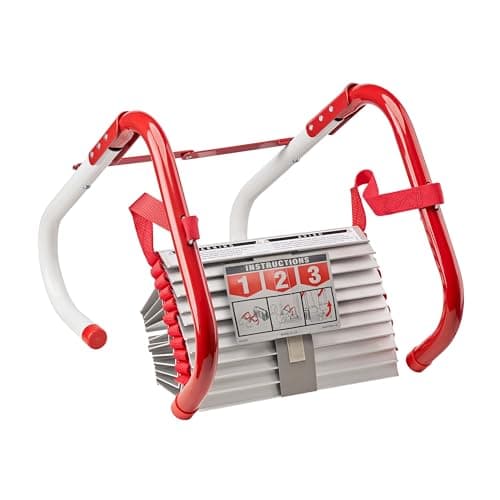 Kidde 2-Story Fire Escape Ladder (13 ft) 13 ft and 7.7 lb — the length and the lift most second floors need. | A standard second floor | 8.0/ 10 | $53.99 · View on Amazon #ad how we are funded · price as of October 19, 2026 |
| 2 | 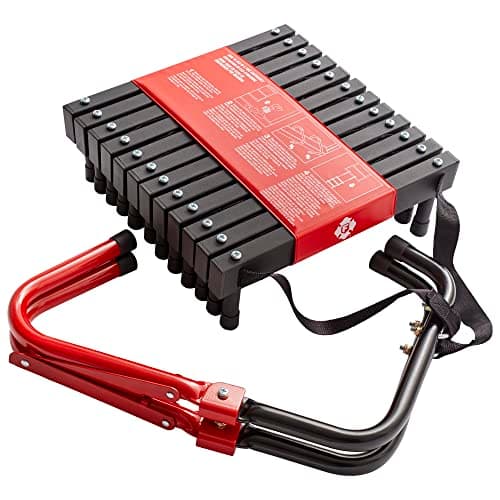 First Alert EL52-2 2-Story Fire Escape Ladder (14 ft) 14 ft, steel rungs and stabilizers, and a published sill-width range. | A second floor with a foot of margin | 8.3/ 10 | $56.99 · View on Amazon #ad how we are funded · price as of October 19, 2026 |
| 3 | 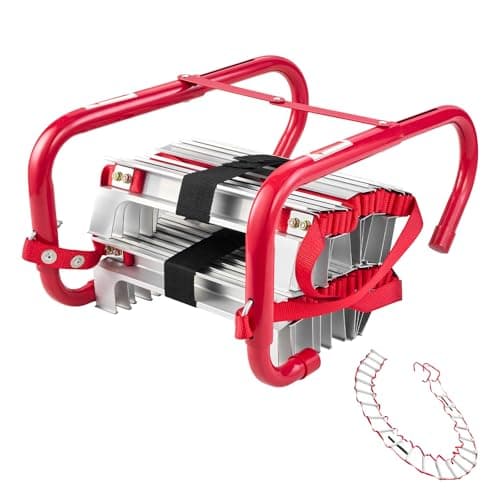 VEVOR 3-Story Retractable Fire Escape Ladder (25 ft) 25 ft, with the widest step of any ladder here. | A genuine third floor | 7.3/ 10 | $82.99 · View on Amazon #ad how we are funded · price as of October 19, 2026 |
| 4 | 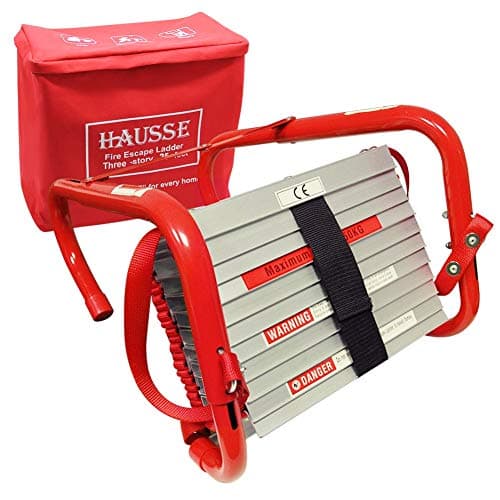 Hausse Retractable 3-Story Fire Escape Ladder (25 ft) 25 ft, folds small, ships in a bag. You pay for that on the way down. | A third floor where the lift is the constraint | 7.0/ 10 | $89.99 · View on Amazon #ad how we are funded · price as of October 19, 2026 |
The lengths in full
1. A standard second floor
Kidde 2-Story Fire Escape Ladder (13 ft)
13 ft and 7.7 lb — the length and the lift most second floors need.
- Listed to
- Kidde states the ladder is tested to 1,000 pounds, published as 750 lb on a single rung and 1,000 lb spread over more than one
- Sensing / agent
- Zinc-plated 1 ft wide anti-slip metal rungs on red nylon strap rails, window hooks
- Power / service life
- Single use — Kidde says discard when unfolded or used. 5-year limited warranty; inspect annually
This is the default for a second floor because it matches the two numbers that matter: 13 ft of length and 7.7 lb of lift. Length gets you to the ground; the low weight is what makes the hardest step — raising a folded bundle onto a sill while leaning out of a window — something an ordinary adult can actually do.
Kidde publishes both capacity figures, which is unusually clear for this category: tested to 1,000 lb, with 750 lb on a single rung and 1,000 lb when the load is spread over more than one rung. Read the 750 lb figure as the one that applies to a person standing on one rung, and note that every manufacturer still instructs one climber at a time.
The trade is the climb. Metal rungs on nylon webbing have no torsional stiffness, so the ladder rotates as your weight shifts and lies flat against the wall, leaving nowhere for the front of your foot. The two-story roundup goes through why that matters more than the headline capacity.
Measure before you buy it. 13 ft is the shortest of the common second-floor lengths and it is the one most likely to come up short on a house with a raised foundation or deep floor joists.
What it does well
- 13 ft is the length that reaches ground from a typical second-floor sill
- 7.7 lb, so the lift-and-hook step is realistic for most adults from a seated position
- No tools and no assembly — hook it over the sill and pull the release strap
- Tested to 1,000 lb, with the per-rung figure published as well (750 lb on one rung)
The downside
- Nylon strap rails twist and press flat against the siding during the descent
- Single use — it is discarded after any real deployment, not re-packed
- 13 ft leaves little margin if your sill is higher than average
Do not buy this if: your measured sill height is over about 12 ft, or the window is a third floor. At 13 ft this ladder has almost no slack, and a ladder that ends above the ground turns a controlled climb into a drop in the dark.
- 13 ft, which is the length that reaches ground from a standard second-floor window
- Fits most common windows up to 11 in deep and 16 in wide, casement windows included — measure before you order
- No assembly and no tools: hook it over the sill and release the rungs
- Tangle-free design, which is the specification that matters when you deploy it once, in the dark, for real
- Strap rails twist against the wall, which is the part that frightens people mid-climb
#ad how we are funded · price as of October 19, 2026
2. A second floor with a foot of margin
First Alert EL52-2 2-Story Fire Escape Ladder (14 ft)
14 ft, steel rungs and stabilizers, and a published sill-width range.
- Listed to
- Tested to ASTM standards. First Alert states the ladder is tested to 375 pounds, and quotes 1,125 lb on the listing title
- Sensing / agent
- Steel anti-slip rungs on nylon strapping, with steel stabilizers and window-sill hooks
- Power / service life
- Single-use emergency ladder; inspect annually
The extra foot is the point. Most people who discover their ladder is too short discover it by measuring after they bought, and 14 ft absorbs the common surprises — a raised foundation, deep joists, a garden that slopes away from the wall.
First Alert is also one of the few manufacturers that publishes the sill width its hooks are designed for: 6 to 10 in. That is a genuine fit constraint and almost nobody checks it. A sill much thicker than 10 in — a stone sill, a deep masonry reveal, a modern wall with external insulation — can stop the hooks seating properly, and hooks that are not seated are the failure that shows up when somebody is already on the ladder.
On capacity, First Alert quotes 375 lb at a time, which is a working load rather than a tested assembly total. It is a smaller number than the four-figure figures on strap ladders and it is not a weaker ladder — the two brands are publishing different measurements. The section below sets out which figure to read.
It is tested to ASTM standards, which is more than most of this category can say — there is no US consumer escape-ladder standard, so an ASTM reference is the nearest thing to independent evidence here.
What it does well
- 14 ft gives a foot of slack over the common 13 ft unit, which covers most measuring surprises
- Steel stabilizers hold the ladder away from the wall, which is what makes it steadier underfoot than plain webbing
- First Alert publishes the sill fit: it attaches to a standard sill between 6 and 10 in wide
- Rated to hold up to 375 lb at a time — a working figure rather than an assembly total
The downside
- Bulkier to store than the 13 ft strap ladder, and it has to live in the room it serves
- Heavier to raise onto a sill, which is the step some people cannot manage unaided
- 375 lb is a single-climber limit, so nobody follows you until you are down
Do not buy this if: the occupant cannot lift a heavier bundle overhead while leaning out of an open window, or your sill is outside the 6 to 10 in range the hooks are built for. In the first case a lighter ladder that gets deployed beats a better one that does not.
- 14 ft, a foot longer than the common 13 ft unit
- Designed for window sills between 6 and 10 in wide — measure yours before ordering
- **Steel stabilizers hold the ladder away from the wall**, which is the single biggest difference between a ladder you can climb and one that pins your toes
- Tested to 375 lb at a time, which is the figure to plan around rather than the 1,125 lb in the title
- Arrives fully assembled and folds flat for storage
#ad how we are funded · price as of October 19, 2026
3. A genuine third floor
VEVOR 3-Story Retractable Fire Escape Ladder (25 ft)
25 ft, with the widest step of any ladder here.
- Listed to
- VEVOR states a 1,000 lb maximum load, with each ladder section supporting up to 330 lb
- Sensing / agent
- Aluminum alloy rungs on polyester strapping, with high-strength fastening screws and window hooks
- Power / service life
- Reusable per VEVOR; inspect annually and after any deployment
For a third floor this is the length to buy, and the reason it scores well on clarity is that VEVOR publishes both numbers: 1,000 lb maximum load and 330 lb per ladder section. Those measure different things, and having both is more honest than a single headline figure. Plan around the 330.
Everything about a 25 ft ladder is harder than a 14 ft one — the storage, the lift, and above all the climb, which takes long enough for arms to tire. The three-story roundup covers why climb stability should outrank deployment weight at this height.
Measure this one carefully. Third-floor sill heights vary more than second-floor ones, because the variation in two stories of joists plus a foundation compounds, and the measuring steps above are worth following exactly at this height.
What it does well
- 25 ft reaches the ground from most third-floor windows
- Publishes both figures — 1,000 lb for the assembly, 330 lb per section
- 11.8 in wide anti-slip aluminum steps on polyester strapping, over a long descent
- Folds flat for storage, which at this length is not a small thing
The downside
- Large stored bundle that has to live in the third-floor room it serves
- Heavy and awkward to raise onto a sill, especially at a narrow window
- A 25 ft descent is beyond many capable adults, never mind children
Do not buy this if: the occupant cannot lift a bulky assembly overhead and hook it while leaning out. At this length that is a real physical task, and a permanently-installed ladder that deploys with a pull is the option to price first.
- 25 ft (7.5 m) for third-floor windows
- 11.8 in wide steps rather than bare rungs — the widest tread of any ladder on this page
- 1,000 lb overall, 330 lb per section — the per-section figure is the one to plan around
- Aluminum alloy rather than steel: lighter to lift to the sill, and it folds flat for storage
- Practice the hooking motion; the length makes it awkward at a narrow window
#ad how we are funded · price as of October 19, 2026
4. A third floor where the lift is the constraint
Hausse Retractable 3-Story Fire Escape Ladder (25 ft)
25 ft, folds small, ships in a bag. You pay for that on the way down.
- Listed to
- Hausse states the ladder is tested for up to 1,000 lbs
- Sensing / agent
- Slip-resistant rungs on strap rails, with retractable hooks that secure over the window frame or sill
- Power / service life
- Hausse recommends replacing it every three years to ensure usability; inspect annually
There is a real case for this ladder and it is about deployment rather than descent. If the person in that third-floor room cannot lift a bulky wide-step bundle onto a sill, a lighter ladder they can actually deploy beats a better ladder they cannot.
Hausse states the ladder is tested for up to 1,000 lbs, which is an assembly figure rather than a per-climber working load. The hooks are retractable and have to be fully extended before use — one more thing to get right in the dark.
Be clear about what you are accepting. Twenty-five feet of webbing under load rotates and swings toward the wall, and there is nothing standing the rungs off the siding. Experienced climbers find it awkward; frightened, barefoot and in the dark it is worse. Hausse also asks you to replace it every three years, which is a recurring cost most people will not plan for.
What it does well
- 25 ft — the longest of the common lengths, with margin on a tall third floor
- Folds far smaller than a wide-step ladder of the same length
- Lighter to raise onto the sill, which is the step some people cannot do at all
- Slip-resistant rungs, a canvas storage bag, and a stated 1,000 lb test figure
The downside
- Twenty-five feet of strap rail moves considerably under load
- Nothing holds the rungs clear of the siding for the whole descent
- Hausse recommends replacing it every three years whether or not it is ever used
Do not buy this if: the climber is a child or an older adult. We would not put a 25 ft strap ladder with no standoffs in either of those rooms at any price — see the honest discussion linked below.
- 25 ft for a genuine third-floor window
- Retractable hooks — they must be fully extended before use, which is one more thing to get right in the dark
- No assembly or tools; a red canvas storage bag is in the box so it lives under a bed or by the window
- Heavier and bulkier than the 13 ft — deploying it takes both hands and real space
- A 25 ft climb is beyond what many people can physically do; plan accordingly
#ad how we are funded · price as of October 19, 2026
What else changes the length you need
A raised foundation or a walk-out basement. Adds a surprising amount at the sill — often the difference between 13 ft being adequate and being short.
Deep floor joists. Modern engineered floors are thicker than older timber ones, so a newer house can sit higher at the same nominal floor count.
Ground that slopes away from the wall. Measure at the low point. A garden falling away behind a house can add a couple of feet on one elevation and nothing on another.
A porch or garage roof under the window. This can shorten what you need, or remove the need entirely — getting onto a low roof is easier than a 14 ft descent. Check that the roof is reachable from the sill, that you could get down from it, and that it is not directly above the likely fire.
A basement bedroom. Not a length problem at all. You are climbing up out of a window well, which is a different task with different hardware — basement window well escape.
Length is not the only question
Getting the length right makes a ladder usable. Three other decisions determine whether it gets used.
Once you know the length you need, the best fire escape ladders ranks the units at each height and sets out what each manufacturer actually publishes about load.
One per upstairs bedroom, stored in that room. You cannot cross a landing that is on fire to fetch a ladder from somewhere else, so a ladder in a hall cupboard is not a second exit. If that means buying two or three, buy two or three.
Who is in the room. A correctly-sized ladder is still a demanding unassisted climb. For a young child or a frail adult it is usually not a realistic plan at any length, and saying so is more useful than selling a ladder — escape ladders for kids and older adults works through what does help.
Whether the window is a legal escape opening at all. A correctly-sized ladder is no use at a window nobody can climb through. IRC R310 sets minimum clear opening dimensions and a maximum sill height for emergency escape and rescue openings in sleeping rooms, and older houses frequently miss them. Open the window fully and look at the actual hole.
Questions people actually ask
What size fire escape ladder do I need for a 2-story house?
How long should a 3-story escape ladder be?
What happens if my escape ladder is too short?
Can an escape ladder be too long?
Will an escape ladder fit my window sill?
What does the weight rating on an escape ladder mean?
Do I need a different ladder for each bedroom?
How these picks were chosen. On published specifications, safety listings and manufacturer documentation — plus the findings of organizations that do run tests. We have no laboratory and we do not burn anything. Read the full methodology.
Sources
- US Fire Administration — Home fire escape planning
- International Code Council — IRC R310 — emergency escape and rescue openings
- NFPA — Making and practicing a home fire escape plan
- NFPA — Smoke Alarms in US Home Fires
- First Alert — Two-story portable fire escape ladder, 14 feet — product specifications
Read next
Escape Ladders
The Best 2-Story Fire Escape Ladders
Two ladders for a second-floor window, and why standoffs beat weight ratings.
Escape Ladders
The Best 3-Story Fire Escape Ladders
Twenty-five feet, the two options, and who genuinely cannot use one.
Escape Ladders
How to Use a Fire Escape Ladder
The deployment sequence, the three mistakes at the sill, and how to practice safely.
Escape Ladders
Permanent vs Portable Escape Ladders
The permanent unit deletes the hardest step. Whether that is worth the cost and the install.
Escape Ladders
Why the short climb is the hard one: opening size, well depth, and grates that do not open.
Placement & Code
A fill-in template: two exits per room, a meeting place, and who helps whom.
Escape Ladders
The Best 4-Story Fire Escape Ladders
What exists above 25 ft, why standoffs matter more the higher you go, and how to check you need one.