Escape Ladders
The Best Fire Escape Ladders
One decision decides this, and it is not the brand. Measure the drop from the sill you would actually use, then buy the ladder that reaches it.
By Ryder M.Last reviewed

The Kidde 2-Story Fire Escape Ladder is the pick for most houses: 13 ft reaches the ground from a standard second-floor window, it is light enough that an average adult can hook it from a seated position on the sill, and it needs no tools and no fixing. For a genuine third floor, the VEVOR 25 ft with its 11.8 in steps. For a fourth floor, a 32 to 33 ft specialist ladder. Measure the drop before you buy anything — two houses both called two-story can differ by three feet at the sill, and a ladder that ends short is a fall rather than an escape.
Siren & Safe is reader-funded. We earn a commission on some links on this page, at no cost to you. It does not change what we recommend or the order we rank it in. Full disclosure.
The one thing that decides this purchase
Measure the drop from the sill you would actually escape through, to the ground you would actually land on. Not the floor count.
Two houses both described as two-story can differ by three feet or more at the sill, because joist depth, foundation height and ground slope all stack up. A raised foundation or a walk-out basement adds a surprising amount. Modern engineered floors are thicker than older timber ones. Ground that falls away behind the house changes the answer depending on where you measure.
Do it at the window furthest from the bedroom door, because the door is where smoke arrives. Open the window all the way with the insect screen out, drop a tape from the top of the sill — the surface the hooks will sit on — and read the number at the low point of the ground.
A ladder that coils a foot on the ground is fine. A ladder that ends two feet short is a fall. If your measurement is 13 ft 6 in, buy the 14 ft. The full sizing guide works through the measuring properly, including sill width, which is the dimension that silently rules out a purchase.
Because no US consumer standard exists for this product, the most useful way to compare brands is by what each discloses. Escape ladder brands compared does exactly that, and escape ladder weight limits explained works through the four different ways these brands state capacity.
Quick picks
Scored against reaches a 2nd floor, weight to deploy, published load evidence, stability mid-climb and storage footprint. Tap a row for the full write-up. The price in each buy button is the live Amazon price at the last check, stamped with the date it was taken.
| # | Product | Best for | Score | Price |
|---|---|---|---|---|
| 1 | 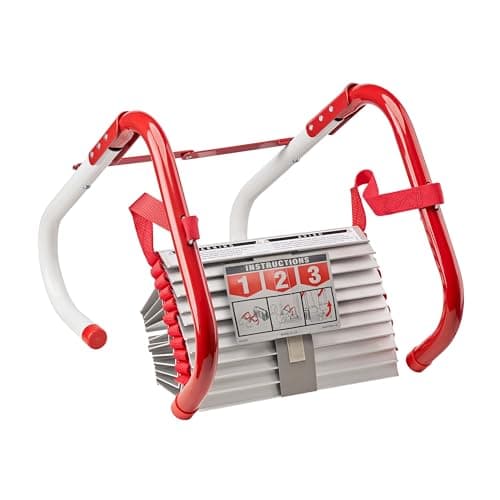 Kidde 2-Story Fire Escape Ladder (13 ft) 13 ft, 7.7 lb, hook and drop. The one most houses should own. | Most second-floor windows | 8.6/ 10 | $53.99 · View on Amazon #ad how we are funded · price as of October 20, 2026 |
| 2 | 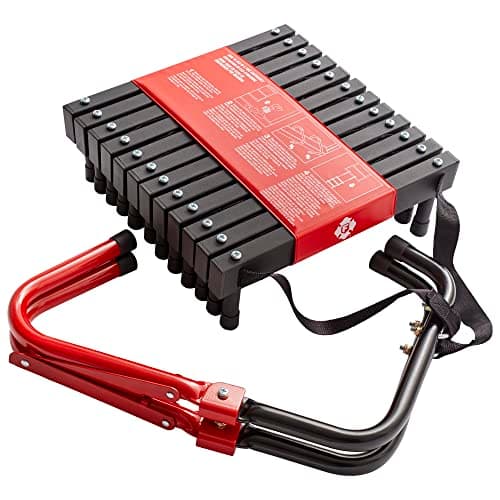 First Alert EL52-2 2-Story Fire Escape Ladder (14 ft) 14 ft, steel rungs and stabilizers. The one you can check against your window. | A second floor with a published sill spec | 8.4/ 10 | $56.99 · View on Amazon #ad how we are funded · price as of October 20, 2026 |
| 3 | 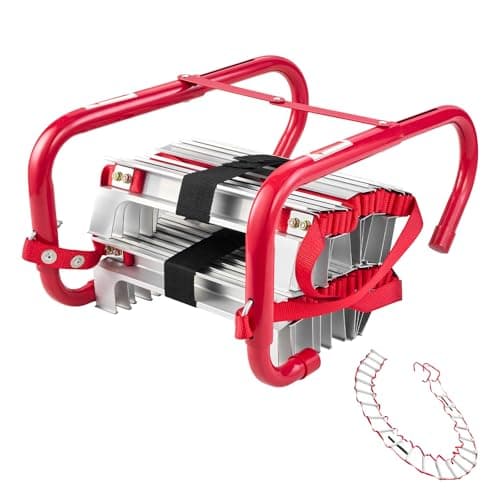 VEVOR 3-Story Retractable Fire Escape Ladder (25 ft) 25 ft, wide aluminum steps. The third-floor pick, with the caveats stated. | A genuine third floor | 7.1/ 10 | $82.99 · View on Amazon #ad how we are funded · price as of October 20, 2026 |
| 4 | 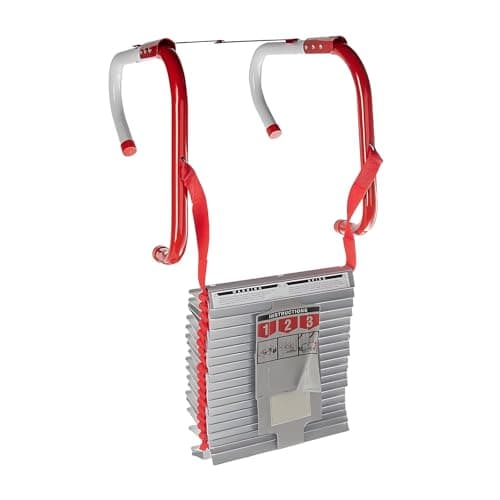 BANGBANGJI 4-Story Fire Escape Ladder (32.8 ft) 32.8 ft of aluminum rungs on rope, stated to 1,000 lb. | A fourth floor, and the only length that reaches one | 6.9/ 10 | $233.99 · View on Amazon #ad how we are funded · price as of October 20, 2026 |
| 5 | 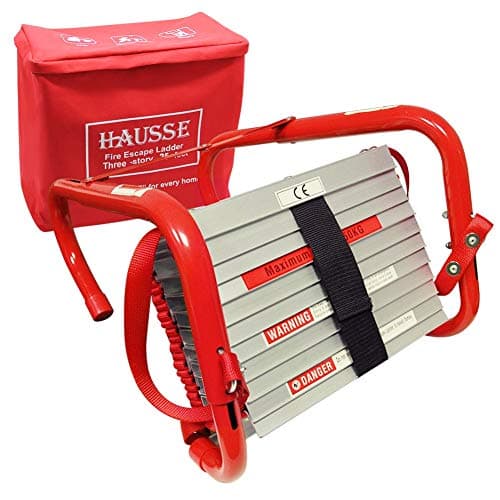 Hausse Retractable 3-Story Fire Escape Ladder (25 ft) 25 ft on strap rails, with a canvas bag. The alternative third-floor unit. | A third floor, if the lift is the constraint | 7.0/ 10 | $89.99 · View on Amazon #ad how we are funded · price as of October 20, 2026 |
The ladders in full
1. Most second-floor windows
Kidde 2-Story Fire Escape Ladder (13 ft)
13 ft, 7.7 lb, hook and drop. The one most houses should own.
- Listed to
- Kidde states the ladder is tested to 1,000 pounds, published as 750 lb on a single rung and 1,000 lb spread over more than one
- Sensing / agent
- Zinc-plated 1 ft wide anti-slip metal rungs on red nylon strap rails, window hooks
- Power / service life
- Single use — Kidde says discard when unfolded or used. 5-year limited warranty; inspect annually
This is the default answer for the same reason it keeps appearing across this hub: the second floor is where almost every household's problem actually is, and 13 ft is the length that solves it.
The weight is what separates it from the longer ladders. Deploying an escape ladder is something you may be doing in the dark, in smoke, from a seated position on a window sill, possibly with a child beside you. 7.7 lb is liftable in that position. Twenty-five feet of steel and webbing is not, for a lot of people.
Kidde also publishes its load figures in a form you can reason about — 750 lb on a single rung and 1,000 lb spread across more than one — rather than a single marketing number. In a category with no consumer standard, a manufacturer that separates the two is telling you more than one that does not.
What it does not do is feel steady. Strap-rail ladders hang flat against the wall and twist as you transfer weight, which is unnerving even when nothing is wrong. How to use a fire escape ladder covers the technique, and reading it once is worth more than the choice between brands.
What it does well
- 13 ft, the length that reaches ground from a standard second-floor window
- 7.7 lb — light enough that most adults can lift and hook it from a seated position on the sill
- No assembly and no tools: hook it over the sill and pull the release strap
- Tested to 1,000 lb, with the breakdown published: 750 lb on a single rung, 1,000 lb spread over more than one
The downside
- Strap rails twist against the wall, which is the part that frightens people mid-climb
- No standoffs, so your knuckles and toes are against the siding the whole way down
- Hausse recommends replacing it every three years regardless of use
- Needs a sill the hooks actually fit; measure before ordering
Do not buy this if: the window is above a second floor, or the sill has no usable projection. Thirteen feet does not reach the ground from a third-floor window, and a hook ladder with nowhere to hook is a bag in a cupboard.
- 13 ft, which is the length that reaches ground from a standard second-floor window
- Fits most common windows up to 11 in deep and 16 in wide, casement windows included — measure before you order
- No assembly and no tools: hook it over the sill and release the rungs
- Tangle-free design, which is the specification that matters when you deploy it once, in the dark, for real
- Strap rails twist against the wall, which is the part that frightens people mid-climb
#ad how we are funded · price as of October 20, 2026
2. A second floor with a published sill spec
First Alert EL52-2 2-Story Fire Escape Ladder (14 ft)
14 ft, steel rungs and stabilizers. The one you can check against your window.
- Listed to
- Tested to ASTM standards. First Alert states the ladder is tested to 375 pounds, and quotes 1,125 lb on the listing title
- Sensing / agent
- Steel anti-slip rungs on nylon strapping, with steel stabilizers and window-sill hooks
- Power / service life
- Single-use emergency ladder; inspect annually
The published sill range is why this is the pick for anyone whose window is unusual. 6 to 10 in is something you can measure tonight, and in a category where almost nothing is specified, a manufacturer that publishes the dimension its product depends on is worth rewarding.
The steel stabilizers are the other real difference. They hold the rungs away from the wall, and the subjective result is a ladder that feels less like climbing a rope and more like climbing a ladder. For anyone nervous about heights, that is not a trivial improvement.
The 375 lb working limit is stated more honestly than the four-figure test loads competitors quote, and it has a practical consequence worth planning around: one person at a time. A parent carrying a small child is within it; two adults descending together are not.
Kidde versus First Alert is the head-to-head if you are choosing between these two directly.
What it does well
- 14 ft, a foot longer than the common 13 ft unit, which covers an awkward drop
- Fits a standard window sill between 6 and 10 in wide — a specification you can take a tape measure to before you order
- Steel anti-slip rungs and steel stabilizers on nylon strapping, which feels steadier underfoot than plain webbing
- Rated to hold up to 375 lb at a time, stated plainly rather than as a four-figure test number
The downside
- 375 lb at a time means one person on the ladder, which matters if two people need to leave together
- Still a strap-rail ladder, so it still twists against the wall
- No standoffs
- Single use after any real deployment
Do not buy this if: your sill is narrower than 6 in or has no projection at all. The published sill range is the specification that decides whether this ladder works in your house, and it is the one number most buyers never check.
- 14 ft, a foot longer than the common 13 ft unit
- Designed for window sills between 6 and 10 in wide — measure yours before ordering
- **Steel stabilizers hold the ladder away from the wall**, which is the single biggest difference between a ladder you can climb and one that pins your toes
- Tested to 375 lb at a time, which is the figure to plan around rather than the 1,125 lb in the title
- Arrives fully assembled and folds flat for storage
#ad how we are funded · price as of October 20, 2026
3. A genuine third floor
VEVOR 3-Story Retractable Fire Escape Ladder (25 ft)
25 ft, wide aluminum steps. The third-floor pick, with the caveats stated.
- Listed to
- VEVOR states a 1,000 lb maximum load, with each ladder section supporting up to 330 lb
- Sensing / agent
- Aluminum alloy rungs on polyester strapping, with high-strength fastening screws and window hooks
- Power / service life
- Reusable per VEVOR; inspect annually and after any deployment
Third floors are where this category gets genuinely difficult, and it is worth being blunt: a 25 ft descent on a strap-rail ladder is hard. Not impossible for a fit adult who has rehearsed the hooking motion, but hard. The wide step helps; it does not make it easy.
The deployment is the first obstacle. A 25 ft ladder is bulky, it takes two hands and clear floor space to pay out, and doing that in a small bedroom with the door shut against smoke is a different exercise to doing it in a hallway in daylight.
So the honest advice for a third floor is to own one and to treat the staircase as the primary route, with the ladder as the fallback for the night the landing is impassable.
What size escape ladder do I need covers the measuring, and escape ladders for kids and older adults is the read if the household includes either.
What it does well
- 25 ft for third-floor windows
- 11.8 in wide anti-slip aluminum steps on polyester strapping
- 1,000 lb for the assembly, with a stated 330 lb per ladder section
- Hook-and-drop deployment with no fixings required, and it folds flat for storage
The downside
- Substantial storage footprint — this does not live in a bedside drawer
- The length makes it awkward to hook at a narrow window; practice the motion
- Two different load numbers published, which is confusing until you know one is an assembly figure and one a per-section limit
- No standoffs are published, so the steps hang flat against the wall
Do not buy this if: the likely user is a child, an older adult, or anyone with a grip, shoulder or balance problem. Twenty-five feet of twisting strap ladder is a serious physical task, and an honest plan says so rather than buying the ladder and calling the problem solved.
- 25 ft (7.5 m) for third-floor windows
- 11.8 in wide steps rather than bare rungs — the widest tread of any ladder on this page
- 1,000 lb overall, 330 lb per section — the per-section figure is the one to plan around
- Aluminum alloy rather than steel: lighter to lift to the sill, and it folds flat for storage
- Practice the hooking motion; the length makes it awkward at a narrow window
#ad how we are funded · price as of October 20, 2026
4. A fourth floor, and the only length that reaches one
BANGBANGJI 4-Story Fire Escape Ladder (32.8 ft)
32.8 ft of aluminum rungs on rope, stated to 1,000 lb.
- Listed to
- Seller-stated 1,000 lb capacity. No consumer escape-ladder standard exists in the US for this product class, so that figure is a seller claim rather than a certification
- Sensing / agent
- Aluminum rungs on flame-retardant red nylon rope rails, with a reinforced V-shaped steel hook and extendable window hooks
- Power / service life
- Reusable per the seller; inspect before and after any use
The length is the reason this is on the list, and it is close to the only reason. It hangs flat against the wall, which means the rungs sit against siding or brick and you climb with your toes jammed into the gap and your knuckles against the masonry — the same compromise every portable ladder here makes except the anchored ISOP.
Rung stabilizers hold a ladder a few inches clear of the wall, and they are the difference between climbing a ladder and climbing a rope. Over a 33 ft descent that matters enormously, which is why the 4-story page argues for the anchored ISOP ahead of this one if you are able to fit the anchors.
The honest caveats are the seller and the bulk. This is not a household brand, and it is physically a lot of ladder to store in a bedroom even folded flat.
There is also no US consumer standard for this product class, so the 1,000 lb figure is the seller's own claim rather than a certification. That is true of every ladder on this page, and it is worth knowing before you compare numbers across brands.
What it does well
- 32.8 ft (10 m), the longest length sold as a consumer portable escape ladder in mainstream channels
- A reinforced V-shaped steel hook and extendable window hooks that fit most frames
- Seller-stated 1,000 lb capacity, aluminum rungs on flame-retardant nylon rope rails
- Folds completely flat, which at 33 ft is what makes storing it in the room realistic
The downside
- Heavy and bulky — the deployment is a two-handed job needing real floor space
- **No standoffs are published**, and at this length that is the specification we would least want to give up
- A 33 ft climb is a serious physical undertaking under any conditions
- From a seller with no track record in safety equipment, and nothing here is independently certified
Do not buy this if: you are on a second floor. This is a specialist length bought for a specific height, and the weight and bulk are a real cost that only a genuine fourth-floor drop justifies.
- 32.8 ft (10 m) — the longest portable escape ladder in mainstream retail, and genuinely a fourth-floor length
- Seller states 1,000 lb and up to three people descending at once
- Extendable hooks must be fully extended before use, and they fit most window frames
- Folds completely flat, which matters at this length — a 33 ft ladder has to live somewhere
- Aluminum rungs on rope rails: lighter than steel, but the rails still twist
#ad how we are funded · price as of October 20, 2026
5. A third floor, if the lift is the constraint
Hausse Retractable 3-Story Fire Escape Ladder (25 ft)
25 ft on strap rails, with a canvas bag. The alternative third-floor unit.
- Listed to
- Hausse states the ladder is tested for up to 1,000 lbs
- Sensing / agent
- Slip-resistant rungs on strap rails, with retractable hooks that secure over the window frame or sill
- Power / service life
- Hausse recommends replacing it every three years to ensure usability; inspect annually
This and the VEVOR are the two realistic third-floor options in mainstream retail, both 25 ft, and they are close enough that the decision usually comes down to tread width against stored bulk.
Hausse quotes a single 1,000 lb test figure. VEVOR splits its figure into a 1,000 lb assembly load and 330 lb per section. Both are seller claims rather than certifications — there is no consumer escape-ladder standard in the US — so the useful comparison is how specific each seller is willing to be, not whose number is bigger.
Neither length beats the other, so measure first: a ladder that coils a foot on the ground is fine, and one that ends two feet short is a drop. Hausse also asks you to replace this one every three years, which the VEVOR does not.
What it does well
- 25 ft for a genuine third-floor window, the same length as the VEVOR
- Slip-resistant rungs and retractable hooks that secure over most frames or sills
- Hausse states it is tested for up to 1,000 lbs, and it ships in a canvas storage bag
- Hook-and-drop deployment with no fixings
The downside
- Heavier and bulkier than the 13 ft — deploying it takes both hands and real space
- Same hook-and-drop mechanism over a much longer descent, with no standoffs
- A 25 ft climb is beyond what many people can physically do
- A seller-stated capacity with no independent certification behind it, as with everything in this category
Do not buy this if: storage space is tight or the window is narrow. At 25 ft this is a bulky strap ladder, and a narrow casement makes the hooking motion awkward enough to be worth rehearsing.
- 25 ft for a genuine third-floor window
- Retractable hooks — they must be fully extended before use, which is one more thing to get right in the dark
- No assembly or tools; a red canvas storage bag is in the box so it lives under a bed or by the window
- Heavier and bulkier than the 13 ft — deploying it takes both hands and real space
- A 25 ft climb is beyond what many people can physically do; plan accordingly
#ad how we are funded · price as of October 20, 2026
Every ladder side by side
Lengths, loads and sill specifications exactly as each manufacturer publishes them. There is no US consumer standard for this product class, so every load figure below is a manufacturer test claim rather than a certification. Prices are shown live inside each buy button, dated.
| Kidde 2-Story | First Alert EL52-2 | VEVOR 3-Story | BANGBANGJI 4-Story | Hausse 3-Story | |
|---|---|---|---|---|---|
| Length | 13 ft | 14 ft | 25 ft | 32.8 ft | 25 ft |
| Floors | 2nd | 2nd | 3rd | 4th | 3rd |
| Weight to deploy | Lightest | Light | Heavy | Heaviest | Heavy |
| Rails | Nylon strap | Nylon strap | Polyester strap | Nylon rope | Strap |
| Standoffs | No | Yes, steel stabilizers | None published | None published | None published |
| Published load | Tested to 1,000 lb | Tested to 375 lb (1,125 lb in the title) | 1,000 lb / 330 lb per section | 1,000 lb stated | Tested to 1,000 lb |
| Published window spec | Up to 11 in deep, 16 in wide | Sills 6 to 10 in | Check the listing | Check the listing | Check the listing |
| Needs a fixing | No | No | No | No | No |
| Reusable | No — single use | No — single use | Seller says yes | Seller says yes | Replace every 3 years |
| Mainstream stock | Yes | Yes | Yes | Yes | Yes |
How these were judged
We run no tests. Every criterion below is something a manufacturer publishes or a buyer can verify, which is the only kind of claim this site makes.
- Does it reach? Length against the real drop from a sill, not a floor count. This outranks everything else, because a ladder that does not reach is not a ladder.
- Can the likely user deploy it? Weight, bulk and whether the hooking motion is possible from a seated position on a sill. A ladder nobody can lift is storage.
- What does the manufacturer actually publish? There is no consumer standard here, so specificity is the signal: a brand that separates single-rung load from spread load, or publishes a sill width range, is telling you more than one quoting a single number.
- Will it fit the window? Sill depth and width decide whether a hook ladder seats at all, and almost nobody checks before ordering.
- What is the climb actually like? Standoffs, rung width and rail type. Flat-against-the-wall ladders are harder than people expect.
- Can you buy it? Specialist channels and intermittent stock are a real cost on a product you want in the house before you need it.
What none of these ladders fix
They are single use and they are hard to climb. Every portable escape ladder here is rated for one real deployment, and the descent is a demanding physical act in the dark, often barefoot, frequently with the rails twisting against a wall.
They do not suit everybody. A young child, an older adult, or anyone with a grip, shoulder or balance problem may not be able to use one unassisted, and buying a ladder does not change that. For those households the plan has to be a ground-floor sleeping arrangement, a rescue plan the fire service knows about, or both — escape ladders for kids and older adults is the honest version of that conversation.
They are useless at a window nobody can open. A painted-shut sash, a window with a security bar, or an opening below the code minimum for emergency escape is the problem to fix first, and it costs less than the ladder.
And they are the wrong priority if the alarms are old. NFPA's analysis of US home fires is unambiguous that working smoke alarms are the single biggest determinant of surviving a house fire. If the alarms in your house are more than ten years old, replace those before you buy a ladder. The smoke alarm roundup is where that starts.
What to do the day it arrives
Fifteen minutes, once, and the ladder goes from an object in a box to something that will actually be used.
Take it out of the bag and open it indoors
Work out which way up it goes, how the hooks sit, and how the release strap pays the rungs out. Do it in daylight with no urgency. Do not climb it — these are single-use ladders and a practice descent may compromise it.
Hook it over the real sill, with the window open
The one rehearsal that matters. Confirm the hooks seat on your sill, that the window opens far enough, and that the insect screen comes out. If any of those fail, you have found it now rather than at 3am.
Store it in the room it serves
Under the bed, in the bottom of a wardrobe, in a window seat — within reach of the window it is for. A ladder in a hall cupboard is useless if the bedroom door is what is holding the smoke back.
Tell everyone who sleeps in that room
Where it is, which window it is for, and that you go out backwards, feet first, facing the wall. A ladder nobody knows about is decoration.
Put it on the escape plan
Which window, who uses it, where everyone meets outside. The ladder is one line in a plan, not the plan. The fire escape plan page is the template.
One ladder per upstairs bedroom, stored in that room
This is the recommendation people push back on hardest, and it is the one that matters most.
You cannot cross a landing that is on fire to fetch a ladder. The scenario a ladder exists for is precisely the scenario where the hallway is impassable, which means a single ladder shared between three bedrooms covers one of them.
If that means buying the cheaper 13 ft unit three times rather than one premium ladder, buy the cheaper one three times. Length and position beat build quality in this category by a wide margin.
The exception is a room nobody sleeps in. A box room, a home office or a spare room used twice a year does not need its own ladder — put the ladders where the people are.
Apartments have a different calculation again, because a protected stairway changes the hierarchy and a rented building usually rules out anything that needs drilling. Escape ladders for apartments and balconies covers that case.
Questions people actually ask
What is the best fire escape ladder?
How do I know what length fire escape ladder to buy?
Do fire escape ladders meet a safety standard?
Can you reuse a fire escape ladder?
How many fire escape ladders does a house need?
Are fire escape ladders hard to climb?
Where should a fire escape ladder be stored?
How these picks were chosen. On published specifications, safety listings and manufacturer documentation — plus the findings of organizations that do run tests. We have no laboratory and we do not burn anything. Read the full methodology.
Sources
- US Fire Administration — Home fire escape planning
- NFPA — Making and practicing a home fire escape plan
- International Code Council — IRC R310 — emergency escape and rescue openings
- NFPA — Smoke Alarms in US Home Fires
Read next
Escape Ladders
What Size Fire Escape Ladder Do I Need?
Measure sill to ground, check the sill width, and read the right capacity number.
Escape Ladders
The Best 2-Story Fire Escape Ladders
Two ladders for a second-floor window, and why standoffs beat weight ratings.
Escape Ladders
The Best 3-Story Fire Escape Ladders
Twenty-five feet, the two options, and who genuinely cannot use one.
Escape Ladders
How to Use a Fire Escape Ladder
The deployment sequence, the three mistakes at the sill, and how to practice safely.
Escape Ladders
The Best Escape Ladders for Apartments and Balconies
No drilling, an uncertain sill and a floor number that may rule a ladder out entirely.