Escape Ladders
Escape Ladder Brands Compared
Six brands, judged on the one thing a buyer can actually check: what each of them is willing to publish about how its ladder was tested.
By Ryder M.Last reviewed
On published evidence, Kidde is the brand to buy from: it states 1,000 lb tested overall with 750 lb on a single rung, which is the clearest load statement in this category. First Alert is next, and it is a mixed picture — the EL52-2 is tested to ASTM standards and First Alert states 375 pounds, while the Amazon listing title quotes 1,125 lb; plan around 375. Jomy is a different business altogether: permanent, retractable, anodized marine-grade aluminum ladders engineered for a 30-year building life, sold B2B on request for pricing and not available on Amazon. The generic retail brands — Hausse, VEVOR and ISOP — make usable ladders and publish the least, and that is the honest ranking.
Siren & Safe is reader-funded. We earn a commission on some links on this page, at no cost to you. It does not change what we recommend or the order we rank it in. Full disclosure.
The problem with ranking escape ladder brands
Start with what is missing. A residential smoke alarm is listed to UL 217. A portable fire extinguisher is rated under UL 711. A portable escape ladder sold to a US consumer has no equivalent standard at all — no listing, no rating, no mandated test, no label that means anything specific. Whatever a seller writes about capacity is what you get.
That changes how a comparison has to work. We cannot rank these brands by test result, because there is no common test. What we can do is rank them by how specific and how internally consistent each brand's published claims are, and then look at the hardware you can see in the photographs and the specification list.
On that basis the order is: Kidde, which separates spread load from single-rung load and gives a number for each; First Alert, which names ASTM testing and the best standoff design in the category but publishes two contradictory load figures; and then the generic retail tier — Hausse, VEVOR, BANGBANGJI, ISOP — which publishes round numbers with no test house behind them and competes on length, price and features instead. Jomy sits outside the comparison entirely, and the next section explains why.
None of this means the generic ladders are unsafe. It means you cannot verify them, so you should plan conservatively: one person at a time, the lowest published figure as your working limit, and a physical inspection before and after any deployment.
Brand by brand, on published evidence
Every claim column is quoted as the brand publishes it. Where a brand names no test house, the table says so rather than filling the cell.
| Brand | Lengths in the mainstream range | Published load claim | Test house named? | Reusable? |
|---|---|---|---|---|
| Kidde | 13 ft (2-story) | 1,000 lb tested; 750 lb on a single rung | No test house named, but the claim is specific and split by loading | No — discard once unfolded |
| First Alert | 14 ft (2-story) | 375 lb tested per First Alert; 1,125 lb in the listing title | ASTM standards named | No — single-use emergency ladder |
| Hausse | 25 ft (3-story) | Tested for up to 1,000 lbs | No | Replace every three years per Hausse |
| VEVOR | 25 ft (3-story) | 1,000 lb maximum; 330 lb per section | No | Yes, per VEVOR |
| ISOP | 32 ft (3-4 story) | None published | No | Yes, per the seller |
| Jomy | Permanent retractable; Mini-JOMY for residential up to 25 ft | Not published on the public site; marine-grade aluminum engineered for 30+ years | Not published publicly | Permanent installation |
The split in Kidde's figure and the contradiction in First Alert's are both quoted deliberately. In a category with no standard, how a brand words a claim is most of the information available.
Quick picks
Scored against published evidence, climbability, reach, reusability and availability. Tap a row for the full write-up. The price in each buy button is the live Amazon price at the last check, stamped with the date it was taken.
| # | Product | Best for | Score | Price |
|---|---|---|---|---|
| 1 | 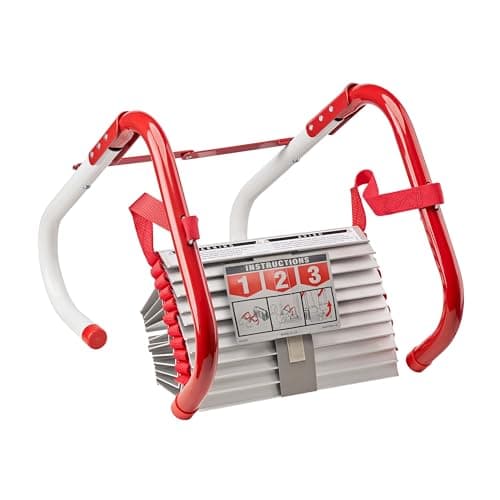 Kidde 2-Story Fire Escape Ladder (13 ft) 1,000 lb tested, 750 lb on a single rung, stated plainly. In a category with no standard, that is the strongest signal available. | The brand with the clearest published evidence | 7.6/ 10 | $53.99 · View on Amazon #ad how we are funded · price as of October 20, 2026 |
| 2 | 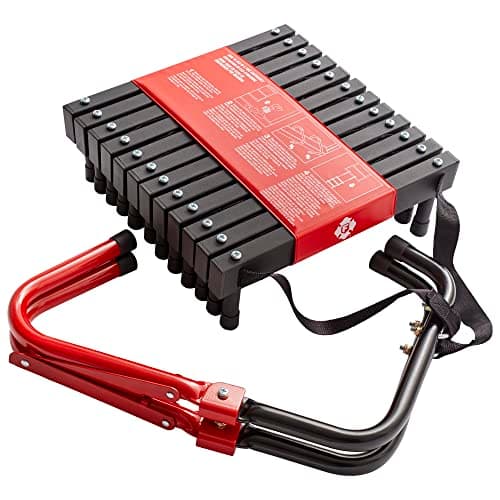 First Alert EL52-2 2-Story Fire Escape Ladder (14 ft) Steel stabilizers make this the most climbable mainstream ladder. Plan around the 375 lb figure, not the listing title. | The brand with the best climb, and two different numbers | 7.4/ 10 | $56.99 · View on Amazon #ad how we are funded · price as of October 20, 2026 |
| 3 | 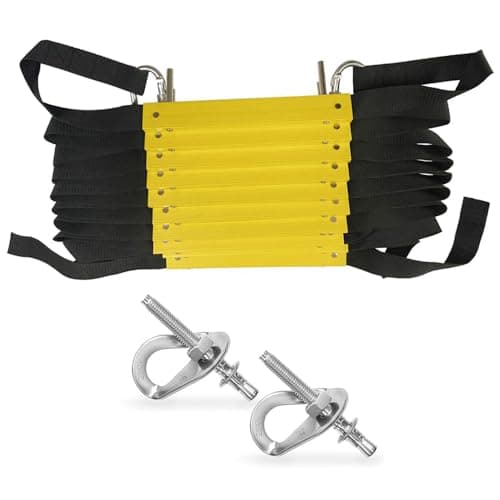 ISOP 32 ft Rope Fire Escape Ladder with Mounting Anchors 32 ft, rung stabilizers and permanent anchors. No standard and no test house named. Judge it on the hardware. | The generic retail tier — longest reach, least evidence | 7.0/ 10 | $149.88 · View on Amazon #ad how we are funded · price as of October 20, 2026 |
The three brands worth buying from
1. The brand with the clearest published evidence
Kidde 2-Story Fire Escape Ladder (13 ft)
1,000 lb tested, 750 lb on a single rung, stated plainly. In a category with no standard, that is the strongest signal available.
- Listed to
- Kidde states the ladder is tested to 1,000 pounds, published as 750 lb on a single rung and 1,000 lb spread over more than one
- Sensing / agent
- Zinc-plated 1 ft wide anti-slip metal rungs on red nylon strap rails, window hooks
- Power / service life
- Single use — Kidde says discard when unfolded or used. 5-year limited warranty; inspect annually
Why documentation is the right way to rank these brands. There is no US consumer certification for a portable escape ladder. A smoke alarm has UL 217 and an extinguisher has UL 711; an escape ladder has whatever the seller chose to write. In that vacuum, the only thing a buyer can evaluate is which brand is willing to be specific — and specificity under a brand name is a commercial commitment in a way a round number in a listing title is not.
Kidde's statement is specific in the right way. It separates the spread load from the single-rung load. That distinction matters because a real descent puts most of one person's weight on one rung at a time, so the single-rung figure is the one that describes the actual loading. A brand that publishes 750 lb on one rung has thought about how the ladder is used.
The single-use clause is the real cost. Kidde says to discard the ladder once it has been unfolded. That makes a full rehearsal an expensive exercise, and it is the main argument for buying a reusable ladder from another brand if practice matters more to you than paperwork. Our compromise: own the documented ladder for the emergency, and rehearse everything short of a climb — finding it, hooking it, checking the seat.
What it does well
- **Kidde states the ladder is tested to 1,000 pounds, published as 750 lb on a single rung and 1,000 lb spread over more than one** — the most useful load statement any brand in this category makes
- Tangle-free design, which is the specification that matters when you deploy it once, in the dark, for real
- 13 ft reaches the ground from a standard second-floor window
- Fits most common windows up to 11 in deep and 16 in wide, casement windows included
- No assembly and no tools; compact enough to live under a bed
- Stocked everywhere, so replacement is never a special order
The downside
- **Single use — Kidde says discard the ladder once it is unfolded or used**, which makes practicing with it expensive
- Only 13 ft, so Kidde's mainstream unit does not cover a third floor
- Strap rails twist against the wall, with no stabilizers to hold it off
- 5-year limited warranty with an annual inspection expectation
Do not buy this if: a third-floor window or a balcony. Kidde's strength is documentation at second-floor height; for greater reach you are into the generic retail brands or a permanent installation.
- 13 ft, which is the length that reaches ground from a standard second-floor window
- Fits most common windows up to 11 in deep and 16 in wide, casement windows included — measure before you order
- No assembly and no tools: hook it over the sill and release the rungs
- Tangle-free design, which is the specification that matters when you deploy it once, in the dark, for real
- Strap rails twist against the wall, which is the part that frightens people mid-climb
#ad how we are funded · price as of October 20, 2026
2. The brand with the best climb, and two different numbers
First Alert EL52-2 2-Story Fire Escape Ladder (14 ft)
Steel stabilizers make this the most climbable mainstream ladder. Plan around the 375 lb figure, not the listing title.
- Listed to
- Tested to ASTM standards. First Alert states the ladder is tested to 375 pounds, and quotes 1,125 lb on the listing title
- Sensing / agent
- Steel anti-slip rungs on nylon strapping, with steel stabilizers and window-sill hooks
- Power / service life
- Single-use emergency ladder; inspect annually
First Alert is the brand that gets the mechanics right. Stabilizers are the feature that most changes a real descent. Without them, a strap-rail ladder lies flat against the wall and the rungs press your toes into the brickwork, which is where people stop climbing. Steel standoffs create a gap to put a foot into, and that is worth more than any load figure.
And it is the brand whose numbers we trust least. A 375 lb tested figure and an 1,125 lb title figure cannot both be the operative number. Three hundred and seventy-five pounds is a credible single-person-plus-margin rating; 1,125 is three times that and looks like a spread or triple-section figure pressed into service as a headline. We plan around 375 lb and recommend you do too. Escape ladder weight limits explained works through this and the other brands' claims in detail.
Two Search Console queries about this site specifically ask about First Alert and escape ladders, so to answer it plainly: First Alert makes a good, well-engineered second-floor escape ladder with the best standoff design in the mainstream market, and its published load figures are inconsistent. Buy it for the stabilizers, plan around the lower number, and read Kidde vs First Alert escape ladders for the head-to-head.
What it does well
- **Steel stabilizers hold the ladder away from the wall**, which is the single biggest difference between a ladder you can climb and one that pins your toes
- Tested to ASTM standards per First Alert, which is more than the generic brands claim
- 14 ft, a foot longer than the common 13 ft unit
- Steel anti-slip rungs on nylon strapping, arriving fully assembled and folding flat
- Designed for window sills between 6 and 10 in wide, which First Alert states explicitly
The downside
- **Two different load figures exist: First Alert states 375 pounds, and the listing title quotes 1,125 lb.** Plan around 375
- A discrepancy like that is itself a mark against the brand's documentation, even though the ladder is good
- Single-use emergency ladder, so practice is again expensive
- 14 ft does not cover a third floor
- Sill width range is narrower than Kidde's, so measure before ordering
Do not buy this if: somebody who wants one unambiguous number to rely on. The ladder is excellent; the published figures contradict each other, and we would rather say so than pick the flattering one.
- 14 ft, a foot longer than the common 13 ft unit
- Designed for window sills between 6 and 10 in wide — measure yours before ordering
- **Steel stabilizers hold the ladder away from the wall**, which is the single biggest difference between a ladder you can climb and one that pins your toes
- Tested to 375 lb at a time, which is the figure to plan around rather than the 1,125 lb in the title
- Arrives fully assembled and folds flat for storage
#ad how we are funded · price as of October 20, 2026
3. The generic retail tier — longest reach, least evidence
ISOP 32 ft Rope Fire Escape Ladder with Mounting Anchors
32 ft, rung stabilizers and permanent anchors. No standard and no test house named. Judge it on the hardware.
- Listed to
- ISOP names no standard and no test house for this ladder; everything below is a seller claim
- Sensing / agent
- Continuous webbing strap rails with aluminum rungs, anchored to a permanent wall fixing
- Power / service life
- Reusable per the seller; inspect before and after any use
The generic tier — ISOP, VEVOR, Hausse and BANGBANGJI among others — is where the long ladders live. Kidde and First Alert simply do not sell a mainstream 32 ft consumer unit, so if you need that reach you are in this tier whether you like the documentation or not.
Judge them on hardware instead of claims, because hardware is visible. Rung stabilizers, step width, hook construction, whether the rails are continuous webbing or jointed rope, and whether the thing folds flat enough to actually store. On those criteria this unit is genuinely good: stabilizers, continuous webbing, smooth rungs and an anchored fixing.
What you do not get is anybody's signature on a load figure. Treat the published numbers as marketing, keep one person on the ladder at a time, and inspect it before and after any use. Best 4-story fire escape ladders covers this tier at full length.
What it does well
- 32 ft (10 m), marketed for a 3- to 4-story house — a reach neither Kidde nor First Alert offers in their mainstream units
- **Rung stabilizers** hold the ladder off the wall, the same feature that makes the First Alert climbable
- Ships with heavy-duty mounting anchors for a permanent fixing rather than a sill hook
- Continuous webbing running top to bottom rather than separate rope sections
- Reusable per the seller, which makes rehearsal affordable in a way the single-use brands do not
The downside
- **ISOP names no standard and no test house for this ladder.** Everything in the listing is a seller claim
- Generic retail brands come and go, so a replacement in five years is not guaranteed
- A permanent anchor means drilling into structure — not an option for most renters
- 32 ft is a serious climb that many people cannot physically make
Do not buy this if: a buyer who wants a brand to stand behind a number. If documentation is your priority, the length is not worth the loss of it, and a Kidde unit at second-floor height plus a planned refuge is the better system.
- 32 ft (10 m), marketed for a 3- to 4-story house
- Ships with heavy-duty mounting anchors for a permanent fixing rather than a sill hook
- **Rung stabilizers** hold the ladder off the wall, so there is somewhere to put your toes
- Continuous webbing running top to bottom rather than separate rope sections
- Smooth-finished aluminum rungs with a textured anti-slip pattern, and no sharp edges on the hands
#ad how we are funded · price as of October 20, 2026
Jomy is a different product category
Jomy comes up in searches alongside the retail brands, and it does not belong in the same list — so here is what it actually is. Jomy manufactures aluminum safety constructions: stairs, ladders, platforms, walkways and building maintenance units, for industrial and commercial buildings. Its retractable ladder line is described as discreet, robust and burglar-resistant, engineered in marine-grade aluminum for a service life of more than 30 years, and the Mini-JOMY is the variant aimed at residential and light commercial use.
Three things follow from that, and all three matter to a homeowner comparing options. It is a permanent installation, not a product you store. A retractable ladder mounted to the outside of the building, folded away until released, is a different proposition from a bundle under a bed: nothing to find, nothing to hook, nothing to deploy incorrectly. It is sold business-to-business. Jomy's site asks you to request pricing and works through distributors; there is no Amazon listing and no shelf price, so comparing it on cost against a $40 retail ladder is not a meaningful exercise. And its public site does not publish a consumer load rating, which is normal for specified building hardware — the numbers live in the specification documents a distributor provides.
Should a homeowner consider it? If you are building, extending or renovating, genuinely yes. A permanent retractable ladder removes every deployment failure mode that portable ladders have, and the 30-year design life compares favorably with a portable unit that one manufacturer suggests replacing every three years. If you want a second way out of a bedroom this weekend for under a hundred dollars, it is not the answer. Permanent vs portable escape ladders is the decision in full.
What to judge a ladder on when nobody certifies it
Six things, all visible in a specification list or a photograph. These matter more than the capacity number.
- Standoffs or stabilizers. Does something hold the ladder off the wall? Without it the rungs press your toes into the brickwork. First Alert's steel stabilizers and ISOP's rung stabilizers both do this; the bare strap-rail ladders do not.
- Tread width. A flat step takes a whole foot; a bare round rung takes the ball of one. VEVOR's 11.8 in steps are the widest here, Kidde's 1 ft metal rungs the best of the mainstream.
- Hook fit, in numbers. A brand that publishes the sill dimensions its hooks fit has thought about installation. One that shows a photograph has not.
- Rail construction. Continuous webbing top to bottom beats jointed rope sections, because every joint is a failure point and a tangle point.
- Whether it tangles. "Tangle-free" is a real specification, not marketing. You will deploy this once, in the dark, with adrenaline.
- What the brand says about reuse and replacement. Single-use, three-year replacement and reusable are three very different ownership costs, and only one of them lets you rehearse properly.
What we would actually buy
For a second-floor bedroom window: the Kidde 13 ft, for the documentation, or the First Alert EL52-2 if the climb matters more to you than the paperwork and your sill is 6 to 10 in wide. Either is a sound purchase.
For a third or fourth floor: you are in the generic tier by necessity. Pick on hardware — stabilizers, step width, continuous webbing — and plan around the lowest published figure. Best 3-story fire escape ladders.
For a renovation or a new build: price a permanent retractable installation. It removes the deployment problem, which is the actual failure mode in real fires, and it lasts the life of the building.
And in every case: two ways out of every room, a meeting point outside, and a run-through twice a year. The US Fire Administration has said the same thing for decades and it remains the highest-value thing on this page. Fire escape plan.
Questions people actually ask
What is the best escape ladder brand?
Are First Alert escape ladders good?
Is Jomy a good fire escape ladder?
Are cheap escape ladders safe?
Do escape ladders have a safety certification?
How these picks were chosen. On published specifications, safety listings and manufacturer documentation — plus the findings of organizations that do run tests. We have no laboratory and we do not burn anything. Read the full methodology.
Sources
- Jomy — Retractable ladders and fire escapes
- NFPA — Making and practicing a home fire escape plan
- US Fire Administration — Home fire escape planning
- US Fire Administration — Home fire prevention
- International Code Council — IRC Chapter 3 — building planning (R310, R314, R315)
Read next
Escape Ladders
Kidde vs First Alert Escape Ladders
Light and fast to deploy versus rigid and easy to climb — who each one suits.
Escape Ladders
Escape Ladder Weight Limits Explained
Five ladders, four different ways of stating capacity, and one brand publishing two contradictory numbers. How to read them.
Escape Ladders
Permanent vs Portable Escape Ladders
The permanent unit deletes the hardest step. Whether that is worth the cost and the install.
Escape Ladders
Buy the length your sill actually needs. The picks for 2, 3 and 4 stories, and what none of them fix.
Escape Ladders
What Size Fire Escape Ladder Do I Need?
Measure sill to ground, check the sill width, and read the right capacity number.