Escape Ladders
Kidde KL-2S Escape Ladder Review
The escape ladder most American households own. It is light, it stores almost nowhere, and the thing it is worst at is the part you would be doing in the dark.
By Ryder M.Last reviewed

Buy the Kidde KL-2S if you need a second-floor escape route for a confident adult and you want it to cost very little and take up almost no space. Kidde publishes the figures that matter: it extends to 13 feet, it is load tested to 1,000 lb, it fits window sills from 5.5 to 11 inches deep with a minimum opening width of 16 inches, the ladder itself measures 12.25 inches wide, it arrives fully assembled, and it is a tangle-free single-use design — discard it after any real use. Two honest reasons it may not be your ladder: the rails are nylon webbing, so it twists and presses flat against the siding during the climb, and Kidde publishes no per-climber working load, only an assembly figure.
Siren & Safe is reader-funded. We earn a commission on some links on this page, at no cost to you. It does not change what we recommend or the order we rank it in. Full disclosure.
Measure these three things before you order
Almost every bad outcome with this ladder is a fit problem, not a quality problem, and all three measurements take a tape and two minutes.
Sill depth. Kidde gives compatibility as window sills from 5.5 to 11 inches, with 11 inches stated as the maximum window frame capacity. Measure from the inside face of the frame, over the sill, to the outside — including any trim or stool the hooks have to clear. A deep sill, a window seat or heavy exterior trim can put you over 11 inches, and there is no extension available.
Opening width. The published minimum is 16 inches, and the ladder itself measures 12.25 inches wide. If your sash opening is narrower than 16 inches the hooks will not seat properly, which is a real constraint on older casements and some basement-style windows.
Drop height. 13 feet is what the ladder extends to, and it is sized for a standard second-floor window. Measure from the sill to the ground, not from the floor inside. Anything meaningfully taller than 13 feet and you are buying a longer ladder, not stretching this one.
While the tape is out, check the window actually opens far enough to climb through and that the person using it can open it unaided. The residential code's emergency escape and rescue opening requirements exist precisely because a window that is technically openable is not always escapable — what size escape ladder do I need works through the geometry.
Quick picks
Scored against deployment speed, storage footprint, climb stability, published documentation, who can actually use it and value for money. Tap a row for the full write-up. The price in each buy button is the live Amazon price at the last check, stamped with the date it was taken.
| # | Product | Best for | Score | Price |
|---|---|---|---|---|
| 1 | 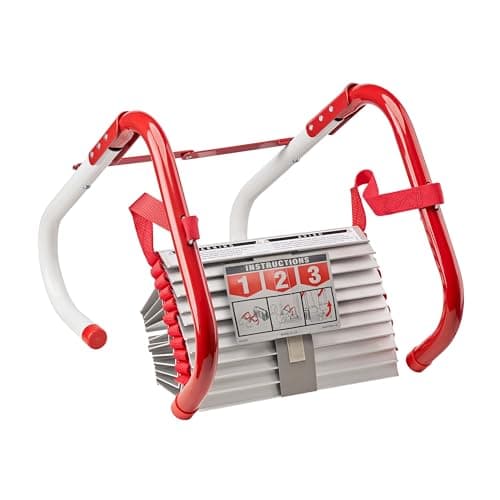 Kidde 2-Story Fire Escape Ladder (13 ft) The right ladder if the alternative is no ladder. It deploys faster than anything rigid, stores under a bed, and asks more of the climber than most buyers expect. | A second-floor bedroom with a confident adult in it | 7.4/ 10 | $59.00 · View on Amazon #ad how we are funded · price as of November 11, 2026 |
The verdict
1. A second-floor bedroom with a confident adult in it
Kidde 2-Story Fire Escape Ladder (13 ft)
The right ladder if the alternative is no ladder. It deploys faster than anything rigid, stores under a bed, and asks more of the climber than most buyers expect.
- Listed to
- Kidde states the ladder is tested to 1,000 pounds, published as 750 lb on a single rung and 1,000 lb spread over more than one
- Sensing / agent
- Zinc-plated 1 ft wide anti-slip metal rungs on red nylon strap rails, window hooks
- Power / service life
- Single use — Kidde says discard when unfolded or used. 5-year limited warranty; inspect annually
What you are buying. Strip the branding off and a portable escape ladder is a set of rungs, a pair of rails and a hook assembly. The KL-2S puts anti-slip metal rungs 12.25 in wide onto heavy-duty nylon straps, with window hooks at the top, and folds the whole thing into a bundle that fits in a bedside cupboard. Kidde's own page describes the design as tangle-free and single-use, says it comes fully assembled, and says no tools are needed to deploy it. That is the product. There is no mechanism, nothing to inflate, nothing to unlock.
Where the published figures are solid. Kidde is unusually specific for this category on the dimensions that actually determine whether the thing works on your house. It extends to 13 feet. It is compatible with window sills from 5.5 to 11 inches, with 11 inches given as the maximum window frame capacity. The minimum opening width is 16 inches. Those are the three numbers to measure before you order, and most of the returns in this category come from somebody not measuring them.
Where the published figures are soft. The load claim is "load tested to 1000 lbs" and "supporting up to 1000 lbs (453 kg)". That is an assembly figure. It is not a per-climber working load, and Kidde does not publish one. First Alert's competing ladder publishes 375 lb, which reads worse and is measured differently. Neither brand is lying; the category simply prints whichever number flatters it, and no US consumer standard forces consistency. Escape ladder weight limits explained is the page that sorts those claims out properly.
The climb is the review. Everything above is about buying. What people actually want to know is what it is like to go down it, and the honest answer is: harder than you think and easier than nothing. Webbing rails mean the ladder twists as you transfer weight, so each step rotates slightly and the rungs sit flat against the wall with no gap for your toes. You end up climbing with your feet turned out and your weight pulled in toward the siding. A fit adult who has thought about it beforehand will be fine. Somebody woken at 3 a.m. who has never seen the ladder deployed will struggle, and that is an argument for reading how to use a fire escape ladder tonight rather than for buying a different product.
One per bedroom, stored in the bedroom. This is the part that gets ignored because it costs money. A ladder in the hall closet is useless: you cannot cross a landing that is on fire to fetch it. If buying one per upstairs bedroom is not realistic, buy for the room with the person least able to get out another way, and make the stairs the plan everywhere else.
What it does well
- **Extends to 13 feet**, which is the length that reaches the ground from a standard second-floor window rather than leaving you to drop the last part
- **Load tested to 1,000 lb** by Kidde's own published claim — the highest figure any manufacturer in this category puts in print, whatever you make of how it is measured
- **Arrives fully assembled and needs no tools** — you hook it over the sill and let it fall, which is about as few decisions as a product can ask of a frightened person
- **Tangle-free design.** This is not a marketing word in this category: a rung ladder that knots on the way down is a ladder that does not work, and it is the commonest failure in cheap imitations
- **Anti-slip metal rungs, 12.25 in wide**, on heavy-duty straps Kidde describes as flame-resistant
- **Fits sills from 5.5 to 11 in deep** with a 16 in minimum opening width, which covers the large majority of US double-hung and casement windows
- Light enough and small enough to live in the bedroom it protects — which is the only place an escape ladder is any use
The downside
- **The rails are nylon webbing, so the ladder has no torsional stiffness.** It rotates under load and presses flat to the wall, which means your toes go against the siding and your weight swings. Confident adults manage it; frightened, injured or small people often do not
- **No standoffs.** Nothing holds the rungs away from the wall, which is the single biggest difference between this and a rigid-rail ladder, and the reason the climb feels so different from a stepladder
- **Single use.** Kidde says to discard it after it has been used, so this is a product you buy, store and ideally never deploy — and you cannot practice on it without consuming it
- **The 1,000 lb figure is an assembly load test, not a per-climber working load.** Kidde does not publish a working load per person, and comparing its 1,000 lb to another brand's 375 lb is comparing two different measurements
- **Kidde's own product page does not state the ladder's weight or its warranty term.** Distributor listings publish 7.75 lb and a 5-year limited warranty; Kidde's page carries neither, so treat both as seller-published rather than manufacturer-published
- **Amazon's listing title calls it a rope ladder.** It is not rope — it is metal rungs on nylon webbing straps — and the difference matters if you are picturing something stiffer
- **11 in is a real sill limit.** Deep sills, thick trim, window-seat builds and some tilt-and-turn frames put the hooks outside their range, and there is no adapter
Do not buy this if: a child's bedroom, an older adult, or anybody with balance, knee, shoulder or grip problems. A swinging webbing ladder in the dark is genuinely hard, and the ladder being light does not make the descent easier — if that describes the person who would be climbing, read [escape ladders for kids and older adults](/escape-ladders/escape-ladders-for-kids-and-older-adults) before you buy anything. It is also the wrong ladder for a third-floor window: 13 ft does not reach, and [the best 3-story escape ladders](/escape-ladders/best-3-story-fire-escape-ladders) covers that height.
- 13 ft, which is the length that reaches ground from a standard second-floor window
- Fits most common windows up to 11 in deep and 16 in wide, casement windows included — measure before you order
- No assembly and no tools: hook it over the sill and release the rungs
- Tangle-free design, which is the specification that matters when you deploy it once, in the dark, for real
- Strap rails twist against the wall, which is the part that frightens people mid-climb
#ad how we are funded · price as of November 11, 2026
Kidde KL-2S specification
Figures as published. Everything in the first block comes from Kidde's own product page for the KL-2S, fetched 2026-10-30. The two rows marked as seller-published appear on distributor listings but not on Kidde's page, and are flagged rather than presented as manufacturer specifications.
| Specification | Published figure |
|---|---|
| Model | KL-2S (Kidde part number 468093) |
| Extended length | Extends to 13 feet |
| Stories | 2-story — a standard second-floor window |
| Load claim | Load tested to 1,000 lb; "supporting up to 1000 lbs (453 kg)" |
| Per-climber working load | Not published by Kidde |
| Ladder width | 12.25 in |
| Window sill compatibility | 5.5 - 11 in sill depth; 11 in maximum window frame capacity |
| Minimum opening width | 16 in |
| Rungs | Anti-slip metal rungs |
| Rails | Heavy-duty straps, described as flame-resistant |
| Assembly | Comes fully assembled; no tools needed |
| Deployment | Hook over the window frame and release |
| Reusable | No — tangle-free, single-use design; discard after use |
| Weight (seller-published) | 7.75 lb on distributor listings; not stated by Kidde |
| Warranty (seller-published) | 5-year limited on distributor listings; not stated by Kidde |
Specifications can change without a model number changing, and the same ladder is sold under several SKUs and listing titles. Check the listing and the box before you order, and measure your window first.
How it is meant to be used
Four steps, which is the whole operation. Read them now, because the one time you need them you will not be reading anything.
Get everyone out of the room and close the door
The door between you and the fire is worth more than the ladder. Close it, stuff the gap if you have anything, and open the window. If smoke is coming in around the door, you are already on the clock.
Hook it over the window frame
The hooks go over the sill from inside, seated against the frame. Kidde's design needs no tools and no assembly, and the ladder is sized for a sill between 5.5 and 11 inches deep. Make sure the hooks are flat against the frame and not sitting on trim.
Let the ladder fall and check it has run clear
Drop the bundle out of the window and look. A tangle-free design means it should unroll clean; if a rung has caught, shake it out before anyone puts weight on it. This is the 5 seconds that the tangle-free claim buys you.
Go down facing the wall, one person at a time
Face in, hands on the rungs rather than the straps, feet turned slightly out because the rungs will be close to the siding. Send the most capable person first if there is any chance of needing to help from below, and never put two people on the ladder at once.
How it compares to the ladders people buy instead
Against the First Alert EL52-2. First Alert's 14 ft two-story ladder has rigid steel steps with a fixed geometry, which makes the climb feel far more like a ladder and far less like a rope. It is heavier and it costs more, and its published capacity figure — 375 lb — reads worse than Kidde's 1,000 lb while almost certainly describing a stricter measurement. If the climber is nervous, that is the one to buy. Kidde vs First Alert escape ladders is the full head-to-head.
Against a 25 ft three-story ladder. The KL-2S does not reach a third-floor window and no amount of specification reading changes 13 feet. If you have a third story, buy for the third story — the best 3-story fire escape ladders covers the field, and the extra length means a bulkier, heavier product you will need a plan to store.
Against a permanently installed ladder. A mounted escape ladder — the kind that bolts under a window and folds out — is the right answer for a house somebody will live in for twenty years with a bedroom that genuinely has no second egress. It costs an order of magnitude more and it needs a landlord's or an HOA's agreement. Permanent vs portable escape ladders is the honest comparison.
Against nothing. This is the real comparison for most households, and it is why the KL-2S scores as well as it does. The ladder has genuine weaknesses and all of them are better than a second-floor bedroom with one way out. Buy it, put it in the room, and then spend the far more valuable half hour on a home fire escape plan that does not depend on it.
What owning one involves
There is almost no maintenance, which is both the appeal and the trap — a product nobody touches for eight years is a product nobody has checked.
- Store it in the room it is for, not in a hall closet, a basement or a garage. One per upstairs bedroom is the standard, and the reason is that you cannot walk through a fire to fetch a ladder.
- Look at it once a year. Straps intact and not sun-rotted if it has been near a window, rungs not bent, hooks not deformed, bundle still folded the way it came. Do this the same day you check the smoke alarms.
- Do not deploy it to practice. Kidde's design is single use and the company says to discard it after use. Practice the window, the door and the route instead — open the window, talk through the order people go in, and let children see where the bundle lives.
- Replace it after any real deployment, including a false one. A used single-use ladder is a decoration.
- Tell everybody it exists. An escape ladder nobody in the household knows about protects nobody. This is the maintenance step that gets skipped, and it is free.
Who should buy it, and who should not
Buy it if you have a second-floor bedroom, the occupant is a reasonably able adult, your window sill measures between 5.5 and 11 inches with a 16 inch or wider opening, and the alternative on the table is no ladder at all. At this price there is no good reason for an able-bodied household with a second story not to own one per bedroom, and the deployment really is as fast as this category gets.
Do not buy it for a child's room, for an older adult, or for anyone whose balance, knees, shoulders or grip would be tested by a swinging webbing ladder in the dark. Do not buy it for a third-floor window, because 13 feet does not reach. And do not buy it for a window you have not measured, because 11 inches of sill depth is a hard limit with no workaround.
The thing worth remembering is what an escape ladder is for. It is the backup to a plan, not the plan. Both the NFPA and the US Fire Administration put the emphasis on two ways out of every room and a practiced route — the ladder is what makes the second way out real for an upstairs bedroom that otherwise has none. On that narrow job the KL-2S does well, cheaply, and with the fewest moving parts of anything in this hub. The best fire escape ladders puts it against the rest of the field.
Questions people actually ask
Is the Kidde KL-2S escape ladder any good?
How much weight can the Kidde KL-2S hold?
Can the Kidde escape ladder be reused?
What size window does the Kidde KL-2S fit?
Is the Kidde KL-2S a rope ladder?
How many escape ladders does a house need?
How these picks were chosen. On published specifications, safety listings and manufacturer documentation — plus the findings of organizations that do run tests. We have no laboratory and we do not burn anything. Read the full methodology.
Sources
- Kidde — KL-2S two-story escape ladder — product specifications
- NFPA — Making and practicing a home fire escape plan
- US Fire Administration — Home fire escape planning
- International Code Council — IRC Chapter 3 — building planning (R310, R314, R315)
Read next
Escape Ladders
Buy the length your sill actually needs. The picks for 2, 3 and 4 stories, and what none of them fix.
Escape Ladders
The Best 2-Story Fire Escape Ladders
Two ladders for a second-floor window, and why standoffs beat weight ratings.
Escape Ladders
Kidde vs First Alert Escape Ladders
Light and fast to deploy versus rigid and easy to climb — who each one suits.
Escape Ladders
Escape Ladder Weight Limits Explained
Five ladders, four different ways of stating capacity, and one brand publishing two contradictory numbers. How to read them.
Escape Ladders
How to Use a Fire Escape Ladder
The deployment sequence, the three mistakes at the sill, and how to practice safely.
Escape Ladders
Escape Ladders for Kids and Older Adults
Why the ladder often is not the answer for children or older adults, and what is.