Fire Blankets
Fire Blankets for Lithium Battery Fires
This is a containment question dressed as an extinguishing question. Understanding which one you are asking changes what you should buy and what you should do.
By Ryder M.Last reviewed
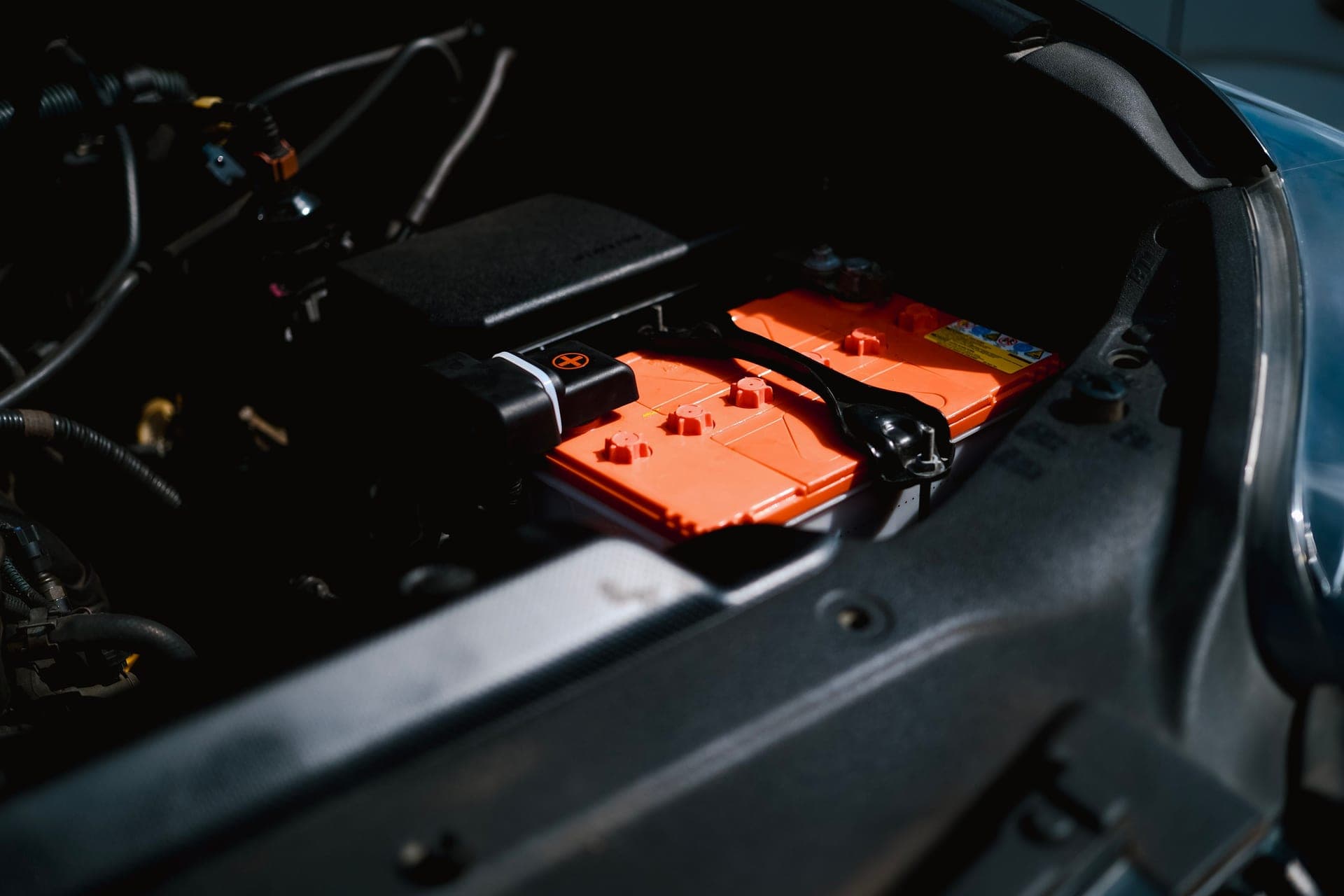
A fire blanket will not put out a lithium-ion battery in thermal runaway. Smothering works by cutting off oxygen, and a cell in runaway is producing its own — which is why it can reignite hours later and why no blanket on the market claims otherwise. What a blanket can do is contain flame and burning debris for long enough to get a small device out of the building, and shield you while you do it. If the battery is larger than a laptop, the honest answer is not a blanket at all: get out and call 911.
Siren & Safe is reader-funded. We earn a commission on some links on this page, at no cost to you. It does not change what we recommend or the order we rank it in. Full disclosure.
Why smothering cannot work
A fire blanket works on one principle: it cuts off the oxygen supply. Drape it over a pan of burning oil, the flame has nothing left to react with, and it goes out. EN 1869 exists to test exactly that, and against a cooking fire it works.
A lithium-ion cell in thermal runaway is not that kind of fire. Once a cell is hot enough, its own chemistry begins to decompose exothermically, and that decomposition releases oxygen inside the cell. The reaction is self-sustaining: it feeds itself heat and it supplies its own oxidizer. Removing the air around it does not stop it, because the air around it is not what it is consuming.
This is also why these fires reignite. A device that appears to have gone out can be a pack in which one cell has finished and the cell next to it is still heating toward its own runaway threshold. That process can take minutes or hours, which is why fire services take damaged lithium batteries outside and watch them rather than declaring the incident over.
So the honest framing for this whole page: a blanket is a containment and shielding tool here, not an extinguishing one. Anything sold to you as a fire blanket that extinguishes lithium battery fires is claiming something the chemistry does not support.
If what you are really looking for is something that acts without a person present, automatic fire extinguishers assesses that category on published evidence and finds very little of it.
What each tool actually does to a lithium fire
By mechanism rather than by marketing. The column that matters is the middle one.
| Tool | Mechanism | Effect on a cell in runaway |
|---|---|---|
| Fire blanket | Excludes oxygen | Contains flame and debris. Does not stop the reaction. Buys time to move a small device outside |
| Dry chemical (ABC) extinguisher | Interrupts the flame chain reaction | Knocks down surrounding flame. Does not cool the cell or stop propagation |
| CO2 extinguisher | Displaces oxygen and cools slightly | Little lasting effect; the pack reheats |
| Water, in volume | Cools | The right mechanism, and it takes far more water than a household has. This is what fire services use |
| Encapsulator agent | Cools and encapsulates fuel | The best consumer-adjacent option, and still not a reason to stay in the room with a large pack |
| Sand or a metal bucket | Contains | Useful for containment on a bench. Does nothing to the reaction |
Quick picks
Scored against contains flame, extinguishes the cell, temperature headroom, size for a device and honest labeling. Tap a row for the full write-up. The price in each buy button is the live Amazon price at the last check, stamped with the date it was taken.
| # | Product | Best for | Score | Price |
|---|---|---|---|---|
| 1 | 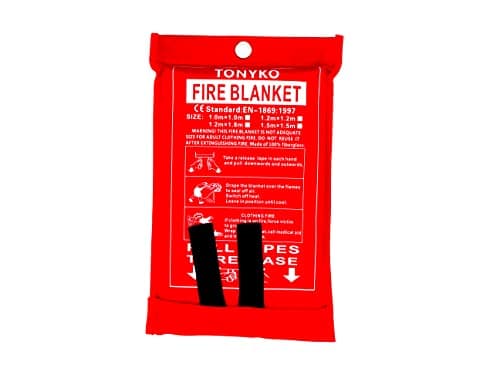 Tonyko Fiberglass Fire Blanket A certified kitchen blanket, used for containment rather than extinguishing. | Containing a small device on a bench | 6.8/ 10 | $21.99 · View on Amazon #ad how we are funded · price as of October 19, 2026 |
| 2 | 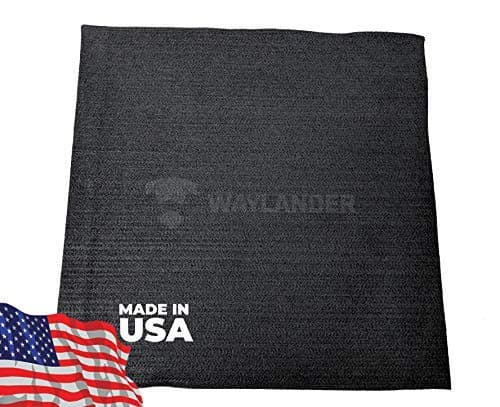 Waylander Carbon Felt Welding Blanket (36 x 36 in) Carbon felt rated to 1800°F, which is a meaningful margin over woven fiberglass. | A charging bench with real temperature headroom | 7.0/ 10 | $44.95 · View on Amazon #ad how we are funded · price as of October 19, 2026 |
| 3 | 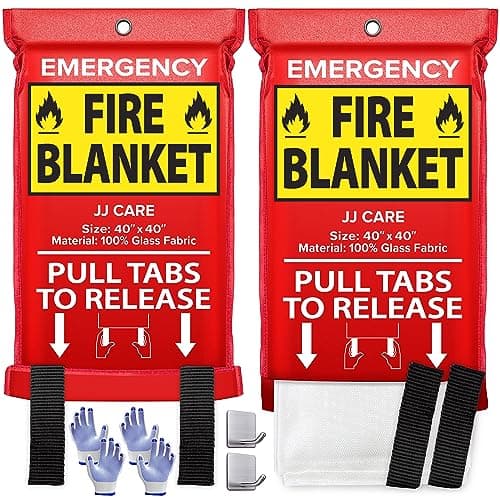 JJ CARE Fire Blanket Kit A 4.9 ft blanket and heat-resistant gloves — and the gloves are the important half here. | The larger size, and the gloves | 6.6/ 10 | |
| 4 | 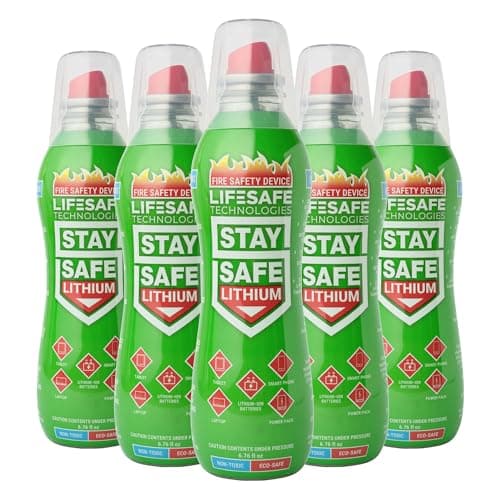 StaySafe Lithium Fire Extinguishing Spray A fluid that cools rather than smothers, which is the only mechanism with a story against this fire. | The thing built for a lithium fire rather than repurposed for one | 6.9/ 10 | $99.95 · View on Amazon #ad how we are funded · price as of October 19, 2026 |
1. Containing a small device on a bench
Tonyko Fiberglass Fire Blanket
A certified kitchen blanket, used for containment rather than extinguishing.
- Listed to
- Tonyko states the blanket meets EN 1869:1997 for cooking-fire suppression
- Sensing / agent
- Woven fiberglass
- Power / service life
- Single use on a real fire
Used correctly, this is a useful thing to have on a charging bench. Correctly means: the device is small, you caught it immediately, and your plan is to smother the visible flame, pick the whole bundle up with gloves, and put it outside on concrete away from anything that can catch.
That is containment. It stops the flame spreading to the bench, the curtains or the carpet in the thirty seconds you need to get it out of the building. It does not stop the cell doing what it is doing.
Be clear about what the EN 1869 certification means in this context. It tells you the blanket was tested against burning cooking oil and performed. It tells you nothing about a lithium fire, because no consumer blanket standard tests one. We are recommending a certified blanket because certified material is better material, not because the certificate covers this use.
What it does well
- States conformity to EN 1869:2019, so the material has been through a real fire test rather than a marketing one
- 39.3 x 39.3 in covers a phone, a power bank, a tool battery or a laptop
- Cheap in multi-packs, which matters because this is a single-use item and you may be treating a bench, not a pan
- Produces no residue, unlike a dry chemical discharge over a workbench
The downside
- **It will not extinguish the cell.** Nothing that works by smothering will
- The fire can and does reignite after the blanket goes on, and can do so much later
- EN 1869 tests cooking oil, not battery fires — the certification is evidence about the material, not about this application
- Woven fiberglass rated well below the peak temperature a cell in runaway can reach
- Single use, and in this application you should assume it is used the moment it touches the device
Do not buy this if: an e-bike, a scooter, an EV, or a battery you cannot pick up with one gloved hand. Those are evacuation events, and a blanket is not a reason to stay in the room with one.
- Tonyko names a specific EN 1869 edition, which is more than most sellers in this category do
- 47.2 x 47.2 in (1.2 x 1.2 m) in the size linked here — large enough to wrap around a body as a heat shield, which the smaller hob blankets are not
- Also sold in a 47.2 x 70.9 in and a 78.7 x 78.7 in, so check which size you are adding to the basket
- Plain blanket — no pouch or hooks in the pack, so plan the fixing yourself
- Tonyko names the kitchen, fireplace, grill, car and camping as the intended uses
#ad how we are funded · price as of October 19, 2026
2. A charging bench with real temperature headroom
Waylander Carbon Felt Welding Blanket (36 x 36 in)
Carbon felt rated to 1800°F, which is a meaningful margin over woven fiberglass.
- Listed to
- An industrial welding blanket. It is NOT certified to EN 1869, the cooking-fire blanket standard, and is not intended for pan fires
- Sensing / agent
- Carbon felt, rated by the manufacturer to 1800°F
- Power / service life
- Reusable for spark and slag protection; discard after any real fire deployment
If you charge tool batteries, RC packs, e-bike packs or anything else that spends hours unattended on a bench, this is the more sensible material to have under and over them.
The temperature headroom is the argument. A woven fiberglass kitchen blanket is working near its limit against a cooking oil fire; a cell in thermal runaway goes considerably hotter. A carbon felt blanket rated to 1800°F is not going to fail structurally in the window you care about, which means it keeps containing rather than becoming part of the fire.
The honest limit is the same as every other product on this page, and it is worth repeating rather than softening: it contains, it does not extinguish. Use it to keep a bench fire on the bench while you get the device outside.
What it does well
- Rated by the manufacturer to 1800°F — far more headroom than a kitchen blanket, which matters when the thing underneath is a runaway cell
- Carbon felt rather than woven fiberglass, so it does not shed glass fiber when handled or cut
- Made in USA, and can be cut to fit a specific bench or charging area
- Reusable for spark and slag work, so it is not a single-purpose purchase sitting in a drawer
The downside
- **Still does not extinguish anything.** A higher temperature rating buys containment margin, not suppression
- 36 x 36 in, and it is a mat rather than a grab-and-throw product — no pouch, no pull tab
- Not certified to EN 1869, so it is the wrong blanket to also keep for the kitchen
- Costs more than an imported kitchen blanket of similar size
Do not buy this if: a kitchen. If you own one blanket and it lives near a hob, it should be an EN 1869 blanket. This is a workshop and charging-bench product.
- Explicitly Made in USA, which almost nothing else in this category is
- Carbon felt rather than woven fiberglass, so it sheds no glass fiber
- 1800°F rating — far above the woven fiberglass blankets sold for kitchens
- 36 x 36 in, and it can be cut to size without unravelling
- Sold for welding, glass blowing, auto body work and wood stoves — not marketed as a kitchen blanket
Waylander product documentation
#ad how we are funded · price as of October 19, 2026
3. The larger size, and the gloves
JJ CARE Fire Blanket Kit
A 4.9 ft blanket and heat-resistant gloves — and the gloves are the important half here.
- Listed to
- JJ CARE does not name a listing number or test standard on its listing
- Sensing / agent
- Dual-layer woven fiberglass
- Power / service life
- Single use on a real fire; JJ CARE states the blankets themselves do not expire in storage
The reason this is on the page is the gloves, and it is not a throwaway point. The entire practical value of a blanket against a small lithium fire depends on you picking the burning bundle up and carrying it outside. Bare hands cannot do that. It is not a question of toughness; the heat transmits through the material in seconds.
So a kit that puts gloves next to the blanket, at the charging bench, is a kit that matches the actual procedure. If you own a blanket and no gloves, you own half a plan.
The size is genuinely useful too — a laptop or a large tool pack needs more material than a 39 in square once you account for gathering it up rather than just laying it over.
What it does well
- The 4.9 x 4.9 ft size is large enough to bundle a laptop or a tool battery and still have material to hold
- Ships with welding-style gloves, which is what makes picking the bundle up survivable
- The manufacturer references the EN 1869 standard
- Adhesive hooks included for mounting near the charging area
The downside
- **No extinguishing capability**, same as everything else here
- References EN 1869 without naming an edition or a certificate
- Woven fiberglass, with the same temperature ceiling as the Tonyko
- The adhesive hooks are weak; use a screw fixing
Do not buy this if: somebody expecting the large size to make this viable against a bigger battery. A 4.9 ft blanket over an e-bike is a blanket on fire, not a contained e-bike.
- Ships as a kit: two 40 x 40 in blankets, protective gloves and adhesive hooks
- 40 x 40 in is hob-sized — enough for a pan, not enough to wrap an adult
- Gloves are the part people skip and then regret, because a blanket transmits heat
- Adhesive hooks fail on textured walls; use a screw fixing if you can
- Sold in pack sizes from two upwards, so the second blanket can go in the garage or the car
4. The thing built for a lithium fire rather than repurposed for one
StaySafe Lithium Fire Extinguishing Spray
A fluid that cools rather than smothers, which is the only mechanism with a story against this fire.
- Listed to
- Not a UL-rated A:B:C portable extinguisher. LifeSafe states the product is tested and approved with recognized standards bodies and third-party test facilities, without naming a rating
- Sensing / agent
- Patented non-toxic extinguishing fluid, sprayed from a hand-held canister
- Power / service life
- Single use — discharge the unit fully and replace it
We have included this because a page about lithium battery fires that only lists blankets is misleading by omission. If you genuinely want a tool with a mechanism against this hazard rather than a tool that contains it, this is the category — with the caveat that the evidence behind the retail products in it is thin.
The mechanism matters. Dry chemical, CO2 and smothering all target oxygen, and a cell in runaway is generating its own. A sprayed fluid works on heat — cooling the cell and interrupting the chain reaction that propagates from one cell to the next inside a pack. That is a real answer to a real mechanism, which is more than "rated for lithium" on a blanket listing ever is. What LifeSafe does not publish is a named test protocol, so take the mechanism seriously and the marketing with care.
Our full treatment of the category, including what we will not claim for it, is in the best fire extinguishers for lithium battery fires.
What it does well
- Works by cooling rather than smothering, which is the only mechanism with a coherent story against a self-oxidizing reaction
- Addresses the actual failure mode — runaway is a heat problem, and removing heat is what interrupts propagation to adjacent cells
- Formulated for phones, laptops and power banks specifically, which is more than any blanket listing can say
The downside
- **LifeSafe names no UL rating and no test protocol** — it cites recognized standards bodies without saying which, so the evidence is weaker than the mechanism
- Expensive relative to every other item on this page, and single use
- Still not a license to fight a large battery fire. A pack bigger than a laptop is an evacuation, whatever you are holding
- Requires you to understand what you bought — it is not a rated extinguisher and does not satisfy a requirement for one
Do not buy this if: a household that does not already have working smoke alarms, an escape plan and a standard extinguisher. This is the last thing to buy, not the first.
- Formulated specifically for fires started by lithium-ion batteries in phones, laptops, power banks and other electronics
- LifeSafe states it is safe on electrical fires up to 1000V from a stated minimum distance
- No pin and no gauge: remove the cap, point and spray until the canister is empty
- Non-toxic with no residue to clean up, which is the practical difference from dry chemical indoors
- It will not stop a large pack already in full thermal runaway, and nothing sold to consumers will
#ad how we are funded · price as of October 19, 2026
If a small device starts venting or burning
Small means something you can lift with one gloved hand — a phone, a power bank, a tool battery, a laptop. Anything larger, skip all of this and evacuate.
Decide in the first two seconds whether it is small
A phone or a tool battery is a device you can carry. An e-bike, a scooter, a power station or anything mounted in a vehicle is not. If it is the second kind, stop reading this list, get everybody out and call 911.
Do not breathe the smoke
A venting cell produces hydrogen fluoride and other highly toxic products. This is not ordinary smoke you can work through for a moment. If the room is filling, leave — the device is replaceable.
Gloves on, blanket over
Cover the device to knock down visible flame and stop burning material spitting onto anything else. The blanket is doing containment work here, not extinguishing work.
Carry the whole bundle outside
Blanket and device together, onto concrete or bare ground, well away from the building, vehicles, fences and anything combustible. This is the step that actually protects the house.
Call the fire service and leave it alone
Do not put it in a bin, do not put it in water on the ground, do not bring it back inside because it looks finished. It can reignite hours later. Tell the fire service it is a lithium battery — that changes how they handle it.
Do not use the blanket again
It is finished, whatever it looks like. Replace it and note the date.
What actually reduces this risk
Prevention does considerably more here than equipment, because the equipment options are all poor. Four things matter.
Charge on a hard surface, away from the exit route. Not on a bed, not on a sofa, not in a hallway you would need to walk down. A cell failing on a tiled floor is an incident; the same cell failing on a duvet is a house fire.
Do not charge unattended overnight. Most reported failures happen during charging, and the difference between catching it in the first minute and finding it in the morning is the whole outcome.
Use the manufacturer's charger and stop using damaged packs. Swollen, dented, dropped, water-damaged or aftermarket-charged packs are the population these incidents come from. A battery that has puffed up is telling you something and the correct response is to stop using it, not to get one more cycle out of it.
Keep e-bikes and scooters out of the house entirely where you can, and never in a hallway or by the only exit. The NFPA's guidance on lithium-ion batteries is worth reading in full, and it is consistent on this point.
Questions people actually ask
Will a fire blanket put out a lithium battery fire?
What actually puts out a lithium-ion battery fire?
Can I use a fire blanket on an e-bike battery fire?
Why do lithium battery fires reignite?
Is a carbon felt blanket better than fiberglass for battery fires?
Should I keep a fire blanket where I charge batteries?
Are lithium fire blankets and EV fire blankets the same thing?
How these picks were chosen. On published specifications, safety listings and manufacturer documentation — plus the findings of organizations that do run tests. We have no laboratory and we do not burn anything. Read the full methodology.
Sources
- NFPA — Lithium-ion battery safety
- British Standards Institution — BS EN 1869: Fire blankets — specification
- Hazard Control Technologies — F-500 EA encapsulator agent fire extinguishers
- CDC / NIOSH — Synthetic vitreous fibers — occupational health guidance
- US Fire Administration — Cooking fire safety
Read next
Fire Extinguishers
The Best Fire Extinguishers for Lithium Battery Fires
Why no consumer unit stops a pack in runaway, and what genuinely helps instead.
Fire Blankets
The Best Fire Blankets for a Home
Three blankets worth mounting, plus the woven-fiberglass issue the sellers leave out.
Fire Blankets
Fire Blanket vs Fire Extinguisher
Contact range versus projected agent — and the fires where each one is the wrong choice.
Fire Extinguishers
The full class chart, what the numbers measure, and which agent suits which fire.
Fire Blankets
No EN 1869 kitchen blanket is US-made. What is, what only claims to be, and which to buy for which job.
Fire Blankets
Height, distance and fixing — plus the one position that makes a blanket useless.