Fire Blankets
Fire Blankets Made in the USA
This page does not end where you expect it to. The honest finding is that the kitchen fire blanket category has no US-made option, and the US-made blankets that do exist are a different product.
By Ryder M.Last reviewed
We could not find a kitchen fire blanket certified to EN 1869 — the cooking-fire standard — that is manufactured in the United States. That category is essentially all imported, and several listings that read as American say "designed in USA" rather than made here. What genuinely is US-made is industrial welding and fire blanket material: the Waylander carbon felt blanket is Made in USA and sold retail, and Steel Guard's Arc-Tex fiberglass blankets are manufactured in the USA and sold direct. Neither is a substitute for an EN 1869 blanket on a pan fire.
Siren & Safe is reader-funded. We earn a commission on some links on this page, at no cost to you. It does not change what we recommend or the order we rank it in. Full disclosure.
Two different products are both called a fire blanket
The confusion this page has to clear up first is that "fire blanket" names two separate product categories that share a shelf on search results and almost nothing else.
The kitchen fire blanket is a square of woven fiberglass, usually 39 to 40 in, in a pull-tab pouch, sold to smother a pan fire. The meaningful certification is EN 1869, which tests exactly that: the blanket goes over a defined quantity of burning cooking oil, has to put it out, and has to keep it out without the fire re-establishing when the blanket is left in place. This is an overwhelmingly imported category.
The industrial fire or welding blanket is a heavier material — thicker fiberglass, silica, carbon felt — sold by the roll or the sheet to catch sparks and slag, protect surfaces and contain hot work. The certifications are things like NFPA 701 for flame retardancy and FM Global approval. This is where American manufacturing actually lives in this product space.
They overlap physically and not functionally. An industrial blanket is generally rated to a far higher temperature than a kitchen blanket, which sounds like it should be better and is not the relevant question. A pan fire is not defeated by temperature rating — it is defeated by a blanket that drapes and seals to cut off oxygen, and that stays put while the oil cools below its auto-ignition temperature. EN 1869 tests that behavior. A temperature rating does not.
Which blanket for which job
If US manufacturing is your requirement, this table is the trade you are making.
| Job | Right product | US-made available? |
|---|---|---|
| Pan or cooking oil fire in a kitchen | EN 1869 certified kitchen blanket | No — we found none |
| Welding, grinding, glass blowing, hot work | Industrial welding blanket (carbon felt, heavy fiberglass) | Yes — Waylander, Steel Guard |
| Wood stove or fireplace hearth protection | Industrial blanket or hearth mat | Yes |
| Vehicle or garage grab-and-throw | EN 1869 kitchen blanket (size and pouch matter more than rating) | No |
| Wrapping a person whose clothing is alight | Large EN 1869 blanket, 4 ft or more | No |
| Lithium battery fire | Neither. A blanket contains and delays; it does not extinguish | Not applicable |
The last row matters enough to say twice. A fire blanket does not put out a lithium cell in thermal runaway, because the reaction supplies its own oxygen. See the best fire blankets for lithium battery fires.
Quick picks
Scored against us manufacturing, temperature rating, fit for a pan fire, fiber safety and availability. Tap a row for the full write-up. The price in each buy button is the live Amazon price at the last check, stamped with the date it was taken.
| # | Product | Best for | Score | Price |
|---|---|---|---|---|
| 1 | 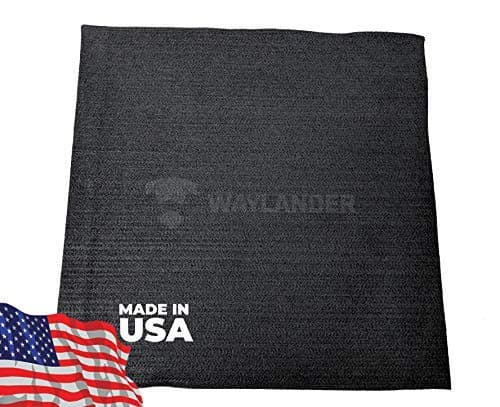 Waylander Carbon Felt Welding Blanket (36 x 36 in) Carbon felt, Made in USA, rated to 1800°F — and sold for a workshop rather than a kitchen. | The genuinely US-made option | 7.6/ 10 | $44.95 · View on Amazon #ad how we are funded · price as of October 19, 2026 |
| 2 | 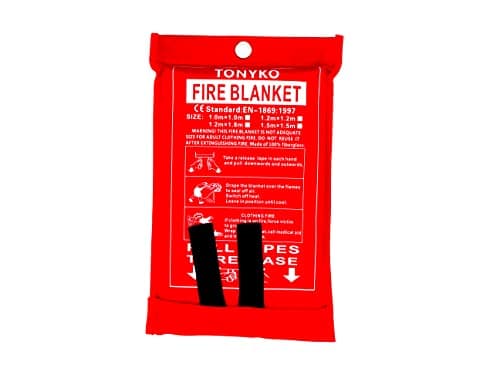 Tonyko Fiberglass Fire Blanket Imported, and it names a specific EN 1869 edition — which is the spec that matters over a hob. | The kitchen, if you want the standard rather than the origin | 7.8/ 10 | $21.99 · View on Amazon #ad how we are funded · price as of October 19, 2026 |
| 3 | 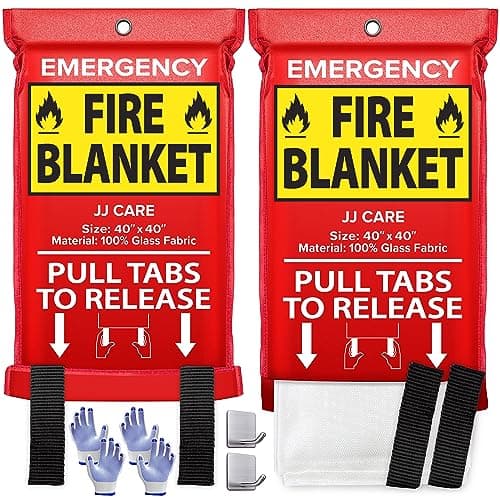 JJ CARE Fire Blanket Kit Imported as well, and it ships with the gloves that make a blanket usable. | A kit rather than a bare blanket | 7.4/ 10 |
1. The genuinely US-made option
Waylander Carbon Felt Welding Blanket (36 x 36 in)
Carbon felt, Made in USA, rated to 1800°F — and sold for a workshop rather than a kitchen.
- Listed to
- An industrial welding blanket. It is NOT certified to EN 1869, the cooking-fire blanket standard, and is not intended for pan fires
- Sensing / agent
- Carbon felt, rated by the manufacturer to 1800°F
- Power / service life
- Reusable for spark and slag protection; discard after any real fire deployment
This is the blanket to buy if American manufacturing is the requirement and the job is a workshop one: sparks from a grinder, slag from welding, a wood stove hearth, a soldering bench.
Carbon felt is genuinely a better material than woven fiberglass for that work, and it is better on the one issue that makes people uneasy about fiberglass blankets — fiber shedding. A woven fiberglass blanket sheds glass fibers when it is handled, cut or damaged, which is the subject of are fire blankets toxic and fiberglass-free fire blankets. Carbon felt does not have that problem.
What it has not done is pass the test that matters for a kitchen. EN 1869 puts a blanket over a defined quantity of burning cooking oil and requires it to extinguish the fire and keep it out. That is a specific and demanding test, and a blanket that has not taken it is an unknown quantity on a pan of oil regardless of its temperature rating. A high temperature rating tells you the material survives; it does not tell you the blanket smothers a liquid fuel fire without letting it re-ignite.
What it does well
- Explicitly Made in USA, which is the thing this page is about and which almost nothing else in the category can claim
- Carbon felt rather than woven fiberglass, so it does not shed glass fiber when handled or cut
- Rated by Waylander to 1800°F, far above the woven fiberglass blankets sold for kitchens
- Can be cut to size without unravelling, which fiberglass weave cannot
- Available through mainstream retail rather than only by quote
The downside
- **Not certified to EN 1869.** It has not been tested against the cooking-oil fire the kitchen standard exists to test
- Sold as a welding blanket — for glass blowing, auto body work and wood stoves, not for a chip pan
- 36 x 36 in is smaller than the 39 to 40 in most kitchen blankets use, and size matters for smothering
- No pull-tab pouch, no wall hooks, no one-handed deployment — it is a mat, not a grab-and-throw product
- Costs more than an imported kitchen blanket of similar area
Do not buy this if: the wall beside your hob. If the job is a pan fire, buy a blanket that has been tested against a pan fire — this one has not been, and the fact that it is made here does not change that.
- Explicitly Made in USA, which almost nothing else in this category is
- Carbon felt rather than woven fiberglass, so it sheds no glass fiber
- 1800°F rating — far above the woven fiberglass blankets sold for kitchens
- 36 x 36 in, and it can be cut to size without unravelling
- Sold for welding, glass blowing, auto body work and wood stoves — not marketed as a kitchen blanket
Waylander product documentation
#ad how we are funded · price as of October 19, 2026
2. The kitchen, if you want the standard rather than the origin
Tonyko Fiberglass Fire Blanket
Imported, and it names a specific EN 1869 edition — which is the spec that matters over a hob.
- Listed to
- Tonyko states the blanket meets EN 1869:1997 for cooking-fire suppression
- Sensing / agent
- Woven fiberglass
- Power / service life
- Single use on a real fire
If the reason you searched for a US-made blanket was quality rather than principle, this is the resolution: the certification is the quality signal in this category, and it is available to you.
EN 1869 is a European standard rather than an American one, which is itself part of why the US-made supply is thin — there is no equivalent US certification for a domestic cooking fire blanket that manufacturers can build to, so the products that carry a meaningful test carry a European one, and they are made where that market is served.
Tonyko naming the 2019 edition is worth more than it sounds. A great many blanket listings say "EN 1869 certified" with no edition, no certificate and no test house named. Our page on the best fire blankets goes through how to read those claims.
What it does well
- Tonyko states conformity to EN 1869:2019 — naming the edition, which most sellers in this category do not do
- Sold in the sizes that suit a hob, including 39.3 x 39.3 in and a 1 x 1 m
- Cheap enough in multi-packs to cover a kitchen, a garage and a car
- The correct product for the job most people are shopping for
The downside
- **Not made in the USA**, and there is no version of it that is
- Woven fiberglass, so the fiber-shedding question applies — wear gloves and bag it after use
- Some packs ship without a pouch or hooks, so check the listing before assuming it comes ready to mount
- Single use on a real fire, like every blanket here
Do not buy this if: a buyer for whom US manufacturing is a hard requirement. We are including it because the honest answer to this search is that you have to choose between origin and certification, and we think most people should choose certification.
- Tonyko names a specific EN 1869 edition, which is more than most sellers in this category do
- 47.2 x 47.2 in (1.2 x 1.2 m) in the size linked here — large enough to wrap around a body as a heat shield, which the smaller hob blankets are not
- Also sold in a 47.2 x 70.9 in and a 78.7 x 78.7 in, so check which size you are adding to the basket
- Plain blanket — no pouch or hooks in the pack, so plan the fixing yourself
- Tonyko names the kitchen, fireplace, grill, car and camping as the intended uses
#ad how we are funded · price as of October 19, 2026
3. A kit rather than a bare blanket
JJ CARE Fire Blanket Kit
Imported as well, and it ships with the gloves that make a blanket usable.
- Listed to
- JJ CARE does not name a listing number or test standard on its listing
- Sensing / agent
- Dual-layer woven fiberglass
- Power / service life
- Single use on a real fire; JJ CARE states the blankets themselves do not expire in storage
Worth mentioning here because the kit format solves the failure that actually happens with fire blankets: people own one, it is folded in a drawer under the sink, and in the moment they either cannot find it or grab it barehanded and drop it.
Gloves and a hook by the door — not above the hob, which is the mistake where to mount a fire blanket exists to correct — are what turn a blanket from an object you own into a thing you can use.
On origin: same answer as the Tonyko. There is no American-made version of this product to point you at.
What it does well
- Ships as a kit with welding-style gloves and adhesive hooks, so you are not improvising at the moment you need it
- Two sizes including a 4.9 x 4.9 ft, which is large enough to wrap a person
- The manufacturer references the EN 1869 standard
- Gloves are the component people skip and then regret, because a blanket conducts heat to your hands
The downside
- **Not made in the USA**
- The adhesive hooks do not hold on textured or painted-over wallpaper — use a screw fixing
- Woven fiberglass, with the same fiber considerations as the Tonyko
- The manufacturer references EN 1869 without naming an edition or a certificate
Do not buy this if: somebody who already owns heat-resistant gloves and a wall hook. You would be paying for accessories you have.
- Ships as a kit: two 40 x 40 in blankets, protective gloves and adhesive hooks
- 40 x 40 in is hob-sized — enough for a pan, not enough to wrap an adult
- Gloves are the part people skip and then regret, because a blanket transmits heat
- Adhesive hooks fail on textured walls; use a screw fixing if you can
- Sold in pack sizes from two upwards, so the second blanket can go in the garage or the car
The US-made industrial option we did not list as a pick
Steel Guard Safety's Arc-Tex 35 oz fiberglass fire blankets are manufactured in the USA and are the most substantial American-made blanket material we found. The company states the blankets are FM Global and NFPA-701 flame retardancy certified, made from 35 oz heat-cleaned fiberglass at 0.080 in thick, rated to 1,000°F — nearly double the material weight of the standard 18 oz fiberglass used in most welding blankets.
We have not listed it as a pick for a practical reason rather than a quality one: it is sold direct by quote rather than through the retail channels this site links to, and blanket sizes are quoted nominally with the finished product running two to four inches shorter. That makes it a specification purchase for a workshop rather than something you add to a basket.
If you are outfitting a shop and want American-made material with real flame-retardancy certification behind it, it is worth a quote. It is still not a kitchen blanket.
How to check a Made in USA claim on a fire blanket
This category is full of language that is technically true and not what you think it means. Four things to look for.
- "Designed in USA" is not "Made in USA." It tells you where the specification was written. The weaving, coating and sewing can be anywhere, and usually are
- "Assembled in USA" means imported material was cut, folded or packed here. For a blanket, where the fabric comes from is the whole product
- A US business address is not a factory. Almost every brand in this category is a US or UK company selling imported goods, which is normal and is not the same claim
- Ask which standard, not which country. EN 1869 with a named edition and a test certificate tells you the blanket works. A flag on the packaging tells you nothing about whether it smothers burning oil
What we would actually buy
If the kitchen is the concern, buy the EN 1869 blanket and accept that it is imported. The certification is the thing that makes a fire blanket work, it is the only meaningful quality signal available in this category, and no amount of preferring domestic manufacturing changes what happens over a pan of burning oil.
If the workshop is the concern, buy American — the Waylander carbon felt blanket for a bench-sized job, or a Steel Guard Arc-Tex for a shop. Both are better products for hot work than any kitchen blanket, and in that application the US-made option is genuinely the better buy rather than a compromise.
If you want both, that is two blankets and they cost less together than most people expect. They belong in different rooms anyway: one on a hook near the kitchen door, one in the garage. Where to mount a fire blanket covers why near the door and not above the hob.
Questions people actually ask
Are any fire blankets made in the USA?
Why are most fire blankets made in China?
Can I use a welding blanket for a kitchen fire?
What does "Designed in USA" mean on a fire blanket?
Is an American-made fire blanket better quality?
What certification should I look for on a fire blanket?
How these picks were chosen. On published specifications, safety listings and manufacturer documentation — plus the findings of organizations that do run tests. We have no laboratory and we do not burn anything. Read the full methodology.
Sources
- British Standards Institution — BS EN 1869: Fire blankets — specification
- Waylander Welding — Carbon felt welding blanket — product specifications
- Steel Guard Safety — Arc-Tex 35 oz heavy duty fiberglass fire blankets — manufactured in the USA
- NFPA — Cooking equipment fires in US homes
- US Fire Administration — Cooking fire safety
- CDC / NIOSH — Synthetic vitreous fibers — occupational health guidance
Read next
Fire Blankets
The Best Fire Blankets for a Home
Three blankets worth mounting, plus the woven-fiberglass issue the sellers leave out.
Fire Blankets
The alternative materials, and a straight answer about what you can actually buy today.
Fire Blankets
Not poisonous, not inert. The fiber-handling question answered without the hand-waving.
Fire Blankets
Fire Blankets for Lithium Battery Fires
Why smothering cannot work on thermal runaway, what a blanket genuinely buys you, and where the line is.
Fire Blankets
Height, distance and fixing — plus the one position that makes a blanket useless.
Fire Blankets
The Best Fire Blanket for a Kitchen
Why a blanket beats an extinguisher at the hob, and what the cooking-fire standard really covers.