Fire Blankets
Can a Fire Blanket Catch Fire?
The cloth will not ignite at the temperatures a pan fire reaches. The things that do fail are the stitching, the coating and the hands holding it.
By Ryder M.Last reviewed
No, not at the temperatures a household fire produces. Woven fiberglass softens somewhere above 1000°F and does not support combustion, and a carbon felt blanket is rated by its manufacturer to 1800°F — both well above the roughly 600 to 700°F of burning cooking oil. What can fail is everything around the cloth: stitched edges and binding tape, any silicone or PU coating, and the blanket's ability to seal if it has been folded, abraded or already used. A blanket does not catch fire. It degrades, and a degraded blanket lets air through.
Siren & Safe is reader-funded. We earn a commission on some links on this page, at no cost to you. It does not change what we recommend or the order we rank it in. Full disclosure.
Why the cloth does not ignite
A fire blanket is made of a material that does not support combustion at household fire temperatures. There are two in common use.
Woven fiberglass is drawn glass filament. Glass does not burn; at very high temperatures it softens and eventually melts, and the softening point of E-glass fiber is above 1000°F. Below that it is dimensionally stable and inert.
Carbon felt is a carbonized fiber mat. The Waylander blanket in this registry is rated by its manufacturer to 1800°F. Carbon can oxidize at sustained high temperature with ample oxygen, which is precisely the condition a smothering blanket is preventing.
For scale: burning cooking oil sits roughly in the 600 to 700°F range, and a flame above it is hotter but brief and localized. Both materials have substantial headroom over a pan fire, which is why the honest answer to the title question is no.
What that does not mean is that a blanket is indefinitely good. The cloth is the most durable part of the product, and the product is more than the cloth.
What actually fails on a fire blanket
Five real failure modes, in rough order of how often they matter. None of them is the cloth igniting.
- Stitching and edge binding. Edges are bound with tape and sewn, often with a thread less heat-tolerant than the cloth. Scorched binding unravels, the blanket frays, and a frayed edge cannot be pressed down to seal.
- Coatings. Some blankets are silicone or PU coated for handling and fiber containment. Coatings degrade, char and smell long before glass does, and a charred coating sheds in handling.
- Loss of seal. The whole mechanism is excluding oxygen. A blanket that has been folded hard for years, abraded in a drawer or already used has creases, stiff patches and holes that let air through. Air under the blanket means the fire is still running.
- The hands holding it. The commonest actual injury and the commonest reason a deployment goes wrong. Heat conducts through a thin blanket quickly. Gloves, and press the edges down.
- Not being found in time. A blanket in a drawer under tea towels is a blanket that arrives after the fire has reached the extractor. Where to mount a fire blanket is the highest-value page in this hub, and it is not about the blanket at all.
Materials and what their numbers mean
Figures as published by manufacturers and standards bodies. The right-hand column is the thing to take away.
| Material | Stated tolerance | Behavior at temperature | What to read it as |
|---|---|---|---|
| Woven fiberglass | Softening above 1000°F for E-glass fiber | Does not support combustion; softens and eventually melts | Ample headroom over a pan fire; the cloth is not the weak point |
| Carbon felt | Manufacturer-rated to 1800°F | Can oxidize at sustained high temperature with ample oxygen | Highest stated tolerance here, but it is a material rating not a fire-blanket listing |
| Silicone or PU coating | Usually not stated | Degrades and chars well below the cloth's limit | The part that visibly fails first on a coated blanket |
| Stitching and binding tape | Usually not stated | Scorches and unravels, releasing the edge | The most common real failure, and the reason to inspect edges |
A cooking oil fire is roughly 600 to 700°F. Every material row above exceeds that. Every non-material row is a reason to inspect a blanket rather than assume it.
Quick picks
Scored against evidence quality, heat tolerance, edge durability and reusable. Tap a row for the full write-up. The price in each buy button is the live Amazon price at the last check, stamped with the date it was taken.
| # | Product | Best for | Score | Price |
|---|---|---|---|---|
| 1 | 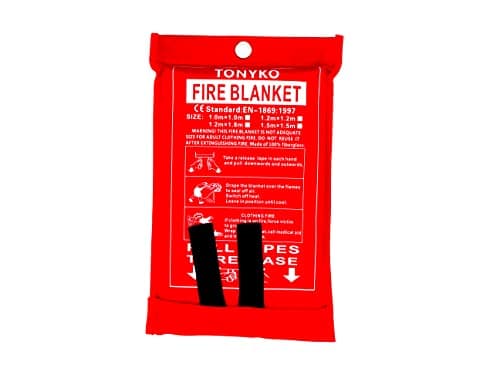 Tonyko Fiberglass Fire Blanket States conformity to EN 1869:2019, which is a tested result rather than a number on a label. | A named standard rather than a temperature claim | 7.8/ 10 | $21.99 · View on Amazon #ad how we are funded · price as of October 19, 2026 |
| 2 | 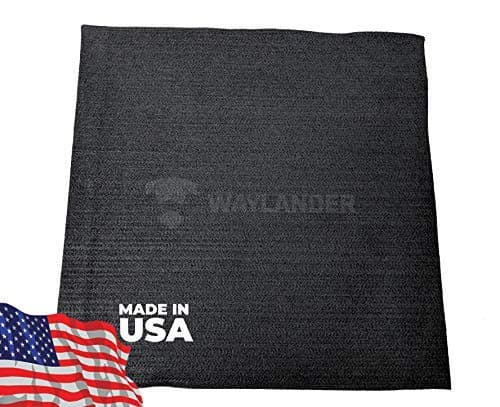 Waylander Carbon Felt Welding Blanket (36 x 36 in) Carbon felt rated by the manufacturer to 1800°F, and reusable against sparks rather than fire. | The highest stated temperature tolerance | 7.6/ 10 | $44.95 · View on Amazon #ad how we are funded · price as of October 19, 2026 |
| 3 | 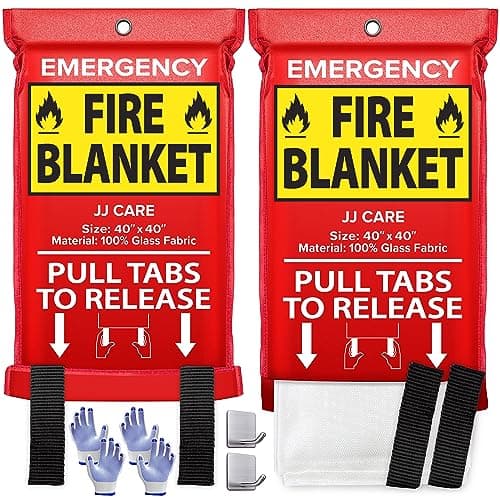 JJ CARE Fire Blanket Kit Includes welding-style gloves. The blanket will not burn; your hands are a different matter. | Protecting your hands, which is the real failure point | 7.4/ 10 |
Blankets, by what the evidence supports
One with a named standard, one with the highest stated temperature rating, and one that protects the part most likely to be hurt.
1. A named standard rather than a temperature claim
Tonyko Fiberglass Fire Blanket
States conformity to EN 1869:2019, which is a tested result rather than a number on a label.
- Listed to
- Tonyko states the blanket meets EN 1869:1997 for cooking-fire suppression
- Sensing / agent
- Woven fiberglass
- Power / service life
- Single use on a real fire
A standard beats a temperature figure, and this is the clearest illustration of why. EN 1869 is a specification for fire blankets intended for cooking fires: it covers what the blanket has to do on a test fire, not just what the cloth tolerates in isolation.
That distinction matters because the cloth is almost never the weak point. A blanket fails at its edges, through its stitching, or because it cannot be made to seal — and a test against a real fire catches those failures where a material temperature rating does not.
Check whether the pack you are buying includes a pouch. A blanket with nowhere to live ends up in a drawer under the tea towels, and a blanket you have to rummage for arrives after the fire has spread.
What it does well
- Names a specific EN 1869 edition — a checkable claim rather than a marketing temperature
- Several sizes, including 1 x 1 m and 39.3 x 39.3 in
- Multi-packs, so a used blanket can be replaced without a second thought
- No residue and nothing to clean up after use
The downside
- Some packs ship without a pouch or hooks, so check what you are buying
- No gloves included
- Woven fiberglass, so the fiber question applies to handling and disposal
Do not buy this if: you want something reusable. This is single-use on a real fire, like every woven fiberglass blanket here.
- Tonyko names a specific EN 1869 edition, which is more than most sellers in this category do
- 47.2 x 47.2 in (1.2 x 1.2 m) in the size linked here — large enough to wrap around a body as a heat shield, which the smaller hob blankets are not
- Also sold in a 47.2 x 70.9 in and a 78.7 x 78.7 in, so check which size you are adding to the basket
- Plain blanket — no pouch or hooks in the pack, so plan the fixing yourself
- Tonyko names the kitchen, fireplace, grill, car and camping as the intended uses
#ad how we are funded · price as of October 19, 2026
2. The highest stated temperature tolerance
Waylander Carbon Felt Welding Blanket (36 x 36 in)
Carbon felt rated by the manufacturer to 1800°F, and reusable against sparks rather than fire.
- Listed to
- An industrial welding blanket. It is NOT certified to EN 1869, the cooking-fire blanket standard, and is not intended for pan fires
- Sensing / agent
- Carbon felt, rated by the manufacturer to 1800°F
- Power / service life
- Reusable for spark and slag protection; discard after any real fire deployment
If the question behind the question is "what will survive the most heat", this is the answer in this registry — carbon felt, 1800°F by the manufacturer's own figure, and genuinely reusable against sparks and slag.
That makes it the right product beside a welder, a grinder or a workbench, where the duty cycle is repeated spark exposure rather than one smothering event. Best fire blankets for grills covers the same reasoning for a different heat source.
The honest limitation is evidence. A manufacturer's maximum-temperature figure tells you about the material, not about whether the finished blanket passes a fire test — and the two are not the same claim. Reusable for sparks does not mean reusable after a real fire: discard any blanket that has smothered a fire.
What it does well
- Manufacturer-rated to 1800°F, a higher stated tolerance than woven fiberglass
- Carbon felt rather than fiberglass, so the respirable-fiber question does not arise the same way
- Thick felt construction holds up to repeated spark and slag exposure
- Reusable for spark protection, which woven blankets are not
The downside
- No named fire-blanket standard — 1800°F is a manufacturer rating, not a listing
- A welding blanket by design intent rather than a cooking-fire blanket
- Thicker and heavier, which makes it slower to deploy over a pan
Do not buy this if: a kitchen as the primary blanket. The temperature headroom is real, the design intent is welding, and for a pan fire a thin EN 1869 square deploys faster.
- Explicitly Made in USA, which almost nothing else in this category is
- Carbon felt rather than woven fiberglass, so it sheds no glass fiber
- 1800°F rating — far above the woven fiberglass blankets sold for kitchens
- 36 x 36 in, and it can be cut to size without unravelling
- Sold for welding, glass blowing, auto body work and wood stoves — not marketed as a kitchen blanket
Waylander product documentation
#ad how we are funded · price as of October 19, 2026
3. Protecting your hands, which is the real failure point
JJ CARE Fire Blanket Kit
Includes welding-style gloves. The blanket will not burn; your hands are a different matter.
- Listed to
- JJ CARE does not name a listing number or test standard on its listing
- Sensing / agent
- Dual-layer woven fiberglass
- Power / service life
- Single use on a real fire; JJ CARE states the blankets themselves do not expire in storage
The reason this belongs on a page about blankets catching fire is that it addresses the thing that actually gets burned.
A fire blanket is a thin woven barrier, not insulation. Heat conducts through it quickly. You are holding your hands within inches of a fire with a layer of glass cloth between, and the material will be uncomfortable in seconds. Unprotected hands make people let go early, or stop short of pressing the blanket down around the base — and that gap is what keeps the fire alive.
So the blanket does not catch fire, and the blanket is not usually what fails. The person holding it is. Gloves fix that for a few dollars, and almost nobody buys them separately.
What it does well
- Ships with welding-style gloves, which is the part people skip and then regret
- Two sizes, 40 x 40 in and 4.9 x 4.9 ft, so it covers a pan and a person
- Manufacturer references the EN 1869 cooking-fire blanket standard
- Adhesive hooks included for mounting
The downside
- Adhesive hooks fail on textured walls — use a screw fixing where you can
- A kit in a box deploys more slowly than a pull-tab pouch
- Woven fiberglass construction
Do not buy this if: you need the fastest possible deployment. A pouch beats a box for speed, and on a pan fire speed is the dominant variable.
- Ships as a kit: two 40 x 40 in blankets, protective gloves and adhesive hooks
- 40 x 40 in is hob-sized — enough for a pan, not enough to wrap an adult
- Gloves are the part people skip and then regret, because a blanket transmits heat
- Adhesive hooks fail on textured walls; use a screw fixing if you can
- Sold in pack sizes from two upwards, so the second blanket can go in the garage or the car
Inspecting a blanket you already own
Two minutes, once a year, and after anything that might have disturbed it. Do it with the blanket unfolded on a table.
Unfold it fully and look at the edges
Binding tape intact, stitching unbroken, no fraying and no loose threads. The edge is the part you press down to seal, so an edge that has started to come apart is a blanket that has lost its one job.
Hold it up to a light
Pinholes, thin patches and worn creases show up immediately. A blanket works by excluding air; light through it means air through it.
Feel for stiffness and check for charring
Stiff patches mean the coating has degraded or the weave has been damaged. Any scorching, melting or black crumbling means the blanket has been near heat already, whatever anyone remembers about it.
Check the pouch, the hooks and the position
A pouch that no longer grips, a hook that has let go of a textured wall, a blanket that has migrated into a drawer. All three are more likely than material failure and all three take a minute to fix.
Refold it loosely and put it back where it belongs
Loose folds rather than hard creases, somewhere reachable in one step without crossing the cooker. Never above the hob — getting it means putting your arm through the flame plume.
Questions people actually ask
Can a fire blanket catch fire?
How hot can a fire blanket get before it fails?
Can a fire blanket be reused?
Why did my fire blanket smell burnt after use?
How these picks were chosen. On published specifications, safety listings and manufacturer documentation — plus the findings of organizations that do run tests. We have no laboratory and we do not burn anything. Read the full methodology.
Sources
- British Standards Institution — BS EN 1869: Fire blankets — specification
- CDC / NIOSH — Synthetic vitreous fibers — occupational health guidance
- NFPA — Cooking equipment fires in US homes
- US Fire Administration — Home fire prevention
Read next
Fire Blankets
Not poisonous, not inert. The fiber-handling question answered without the hand-waving.
Fire Blankets
The alternative materials, and a straight answer about what you can actually buy today.
Fire Blankets
Cover it, leave it covered for 15 minutes, never lift a corner to look. Six steps.
Fire Blankets
Height, distance and fixing — plus the one position that makes a blanket useless.
Fire Blankets
Which blanket survives a trunk and fits a car, plus the honest limit on vehicle fires.