Smoke Detectors
The Best Smoke Detectors for the Hard of Hearing
Standard alarms sound at roughly 3,100 Hz — close to the worst possible frequency for most hearing loss. Louder does not fix a frequency problem. Different does.
By Ryder M.Last reviewed

For a sleeping person, the thing that works is a bedside device with a bed shaker under the mattress, and the Sonic Alert HomeAware II is the mainstream option — waking-effectiveness research found a low-frequency 520 Hz signal woke 92 percent of participants with hearing difficulties, and vibration bypasses the frequency problem entirely. For living areas, add a strobe alarm such as the First Alert 7030BSL. Neither replaces your smoke alarms; both are extra alerting layered on top of alarms that still have to be present, in date and correctly placed.
Siren & Safe is reader-funded. We earn a commission on some links on this page, at no cost to you. It does not change what we recommend or the order we rank it in. Full disclosure.
The frequency problem, and why volume does not solve it
A standard household smoke alarm sounds at around 3,100 Hz. Most hearing loss — age-related, noise-induced, and a good deal of congenital loss — affects high frequencies first and hardest. The alarm signal sits squarely in the band that goes.
This is why the instinctive response fails. Buying a louder alarm, or a second alarm, or four more alarms, produces more sound energy in the same frequency band. If that band is the problem, more of it is not the answer.
What works is changing the frequency. A square-wave tone centered on 520 Hz — far lower, and rich in harmonics — was found in waking-effectiveness research to be substantially more effective than the conventional alarm across people with hearing loss, older adults, children and heavy sleepers. One widely cited figure is 63 to 69 percent more effective. In testing with participants who had hearing difficulties, the 520 Hz signal woke 92 percent of them. Older adults also woke to it at a markedly lower volume, around a 45 dBA median.
That evidence has already changed the code for buildings. NFPA 72 requires a low-frequency 520 Hz square wave for audible appliances in sleeping areas of protected-premises fire alarm systems — apartment buildings, hotels, care facilities. It does not reach the single- and multiple-station alarms sold for houses, which still use the conventional tone. Closing that gap in a private home is exactly what the bedside device on this page does.
Which alert works when
The honest ranking. A complete plan uses more than one row, because no single channel covers both being awake and being asleep.
| Alert type | Awake, in the room | Asleep | Survives a power cut |
|---|---|---|---|
| Standard 3,100 Hz horn | Depends entirely on the degree of loss | Unreliable | Yes |
| Voice announcement | Better — speech is lower and broader | Unreliable | Yes |
| 520 Hz square wave | Good | Good — this is the evidence-backed one | Yes, on a battery-backed device |
| Listed strobe (177 cd) | Very good | Poor — eyes are shut | No, if mains powered |
| Bed shaker | Not applicable | Very good — bypasses hearing entirely | Yes, on a battery-backed device |
| Phone notification | Only if the phone is to hand and audible | No — phones are on silent at night | No |
Quick picks
Scored against wakes a sleeper, alerting channels, works with what you own, power resilience and cost per bed. Tap a row for the full write-up. The price in each buy button is the live Amazon price at the last check, stamped with the date it was taken.
| # | Product | Best for | Score | Price |
|---|---|---|---|---|
| 1 | 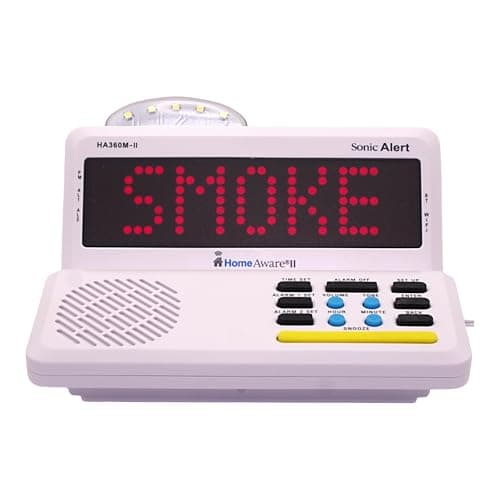 Sonic Alert HomeAware II Basic Starter Kit A bed shaker, a strobe, loud tones and a lit display, all at once. | A sleeping person — the one that matters most | 8.4/ 10 | $269.99 · View on Amazon #ad how we are funded · price as of October 19, 2026 |
| 2 | 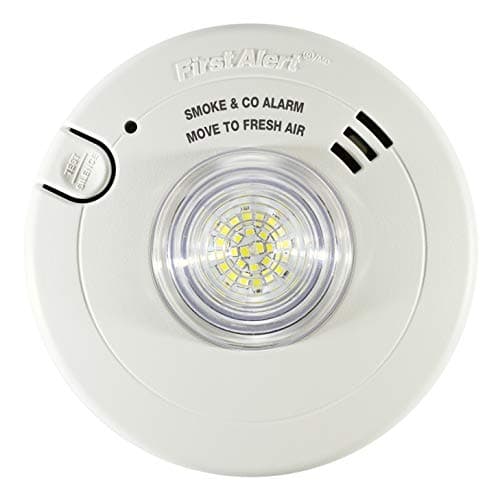 First Alert BRK 7030BSL Hearing-Impaired Smoke + CO Alarm with Strobe A published candela figure on a combination alarm, flashing in unison across the house. | Living areas, on a wired circuit | 8.0/ 10 | $139.17 · View on Amazon #ad how we are funded · price as of October 19, 2026 |
| 3 | 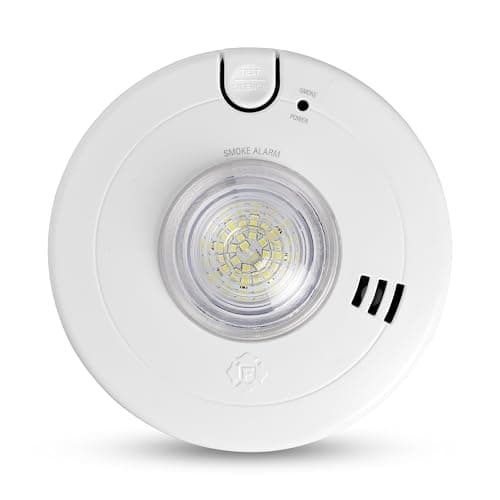 First Alert SM110LED-AC Hardwired Smoke Alarm with LED Strobe The smoke-only strobe alarm, for positions that do not need a second CO cell. | A strobe where CO is already covered | 7.6/ 10 | $110.07 · View on Amazon #ad how we are funded · price as of October 19, 2026 |
| 4 | 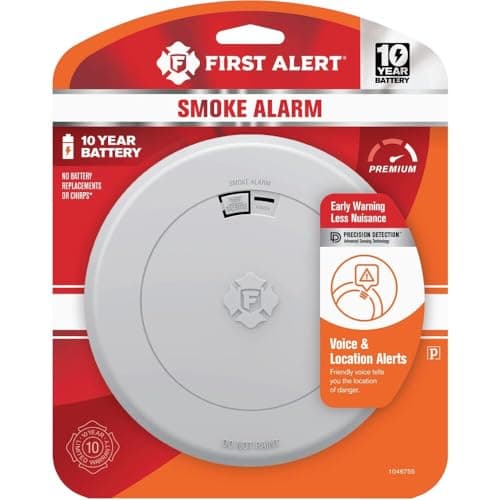 First Alert SM210V 10-Year Battery Smoke Alarm with Voice Alerts A voice alarm for the positions that just need to be right, with a spoken word on top of the horn. | The alarms underneath the alerting | 7.2/ 10 | $40.82 · View on Amazon #ad how we are funded · price as of October 19, 2026 |
1. A sleeping person — the one that matters most
Sonic Alert HomeAware II Basic Starter Kit
A bed shaker, a strobe, loud tones and a lit display, all at once.
- Listed to
- An assistive alerting system, NOT a listed smoke alarm. Sonic Alert states plainly that it does not detect smoke or CO, does not replace a UL 217 alarm and does not satisfy any code requirement
- Sensing / agent
- Acoustic monitor: it listens for the T3 smoke pattern and the T4 CO pattern from your existing alarms in the same room
- Power / service life
- Mains powered with a rechargeable battery backup; it sits on a bedside table rather than a ceiling
This is the product that addresses the actual problem, and most "best smoke detector for the deaf" lists leave it out because it is not a smoke detector.
What it does is sit on a nightstand and listen for the standard three-beep fire pattern, or the four-beep carbon monoxide pattern. When it hears one — from any alarm, any brand, in the same room — it alerts on every channel that has a chance of working. The bed shaker is the one to focus on, because it is the only alert in this entire category that does not route through hearing or through open eyes.
Two setup details decide whether it works. Sonic Alert says to put it in the same room as the alarm and test regularly to confirm it triggers — which means there has to be an alarm in the bedroom, something you should have anyway, per how many smoke detectors do I need. And the shaker pad goes under the mattress rather than under the fitted sheet, which is where it transmits properly rather than being damped.
The rechargeable backup is the specification that quietly makes it better than a hardwired strobe for overnight alerting. A hardwired strobe depends on live AC power. This does not.
What it does well
- Four simultaneous channels: loud audio tones, a bed shaker under the mattress, a bright strobe, and a large scrolling display that spells out which alarm sounded
- Reads both patterns: the T3 three-beep smoke signal and the T4 four-beep carbon monoxide signal
- The bed shaker does not depend on hearing at all, which is the only channel that is true of
- Works with the smoke alarms you already own — any brand sounding the standard patterns
- Mains powered with a rechargeable battery backup, so it keeps working through a power cut when a hardwired strobe may not
The downside
- **It is not a smoke detector.** It detects nothing itself, satisfies no code requirement, and is useless without working smoke alarms to listen to
- One unit covers one bed, so a household with two bedrooms in use needs two
- Costs several times what a smoke alarm costs
- It is a starter kit bundling phone and caller-ID features, so you pay for more than the fire alerting
- Sonic Alert says to put it in the same room as the alarm, so one unit does not cover a house
Do not buy this if: a household without working smoke alarms in the required positions. Buying this first is the wrong order. Get the alarms right, then add this on top.
- Alerts four ways at once: a bed shaker under the mattress, a bright strobe, loud audio tones and a large scrolling display that spells out which alarm sounded
- Reads the alarm you already own — it detects nothing itself, so the alarm on the ceiling is still the thing doing the detecting
- Works with any brand sounding the standard T3 smoke pattern or T4 CO pattern
- Also shows incoming calls and texts over Bluetooth, which is why it costs what a starter kit costs
- Sonic Alert's own instruction: put it in the same room as the alarm and test regularly to confirm it triggers
#ad how we are funded · price as of October 19, 2026
2. Living areas, on a wired circuit
First Alert BRK 7030BSL Hearing-Impaired Smoke + CO Alarm with Strobe
A published candela figure on a combination alarm, flashing in unison across the house.
- Listed to
- Hardwired combination smoke and carbon monoxide alarm with an integrated LED strobe
- Sensing / agent
- Smoke sensing through First Alert's Optipath 360 chamber plus a carbon monoxide cell, with an LED strobe
- Power / service life
- 120V AC hardwired; 10-year limited warranty
A strobe earns its place where an 85 dB horn genuinely competes with background noise: a sitting room with the television on, a kitchen with an extractor running, a workshop, a basement.
The specification worth asking for is a candela figure, because that is the measure of how much light a strobe actually puts out. First Alert publishes 77 candela for this one. If a product offers you a "bright flashing light" with no candela figure at all, you are being sold an indicator lamp.
The flash-in-unison behavior across interconnected units is the underrated part. A single strobe alerts one room. A linked set means wherever you are in the house, something in your field of view is flashing.
We would still not rely on it overnight, and neither would Kidde — the AC-power caveat is theirs, and it is on their own product page.
What it does well
- Smoke alarm, carbon monoxide alarm and strobe in one hardwired device, on one ceiling position
- First Alert publishes the synchronized LED strobe at 77 candela
- Interconnected units flash in unison as well as sounding together, so the visual alert follows you around the house
- Smart strobe: separate flash patterns distinguish a smoke event from a carbon monoxide event
- Optipath 360 gives the sensing chamber 360 degrees of direct access, and the warranty runs ten years
The downside
- **The strobe does not flash without live AC power.** In a power cut you get the horn only — the exact failure a household relying on the flash cannot absorb
- A strobe is weak at waking somebody whose eyes are shut, which is most of the night
- Hardwired, so it needs an existing alarm circuit at that position
- Enough light output to be genuinely unpleasant in a small room on a benign trip
- Considerably more expensive per position than a plain alarm
Do not buy this if: the only measure for somebody asleep. Fit it in the rooms people are awake in, and put the tactile device at the bed.
- Smoke alarm, CO alarm and strobe in one device, so one ceiling position and one install covers all three
- First Alert publishes the synchronized LED strobe at 77 candela, intended to wake hearing-impaired residents
- Smart strobe: separate flash patterns distinguish a smoke event from a carbon monoxide event
- Interconnected units flash in unison as well as sounding together
- Optipath 360 gives the sensing chamber 360 degrees of direct access
- **The strobe needs live AC power** — it is a hardwired appliance, not a battery alarm
#ad how we are funded · price as of October 19, 2026
3. A strobe where CO is already covered
First Alert SM110LED-AC Hardwired Smoke Alarm with LED Strobe
The smoke-only strobe alarm, for positions that do not need a second CO cell.
- Listed to
- Hardwired smoke alarm with an integrated LED strobe light
- Sensing / agent
- First Alert Precision Detection smoke sensing with an LED strobe
- Power / service life
- 120V AC with a sealed 10-year backup battery
The reason to choose this over the combination model is not saving money, it is position logic. Smoke alarms and CO alarms sometimes want different heights and different rooms — which is the subject of combo versus separate alarms.
If you have already put a good CO alarm where it belongs, a smoke-only strobe at the landing position is the tidier answer and you are not paying twice for a CO cell you are not using.
Do check the whole-house picture before deciding. The most common mistake we see in hearing-loss households is thorough attention to the alerting and a gap in the basic coverage underneath it.
What it does well
- The same integrated LED strobe approach as the combination model, smoke sensing only
- Hardwired with a sealed ten-year backup battery
- Interconnects with compatible Kidde alarms
- Cheaper than the combination version where a CO alarm already covers that hazard nearby
The downside
- **No CO cell**, so this position covers one hazard of two
- Same AC-power dependency for the strobe as every mains visual appliance
- Hardwired only
- Same limited value overnight as any strobe
Do not buy this if: a bedroom-floor position in a house with gas appliances or an attached garage and no separate CO alarm. There, the combination version above is the better use of the ceiling.
- Smoke alarm and strobe integrated in one device — First Alert's stated purpose is a visual warning for hearing-impaired residents
- Smoke only — the version to fit where a separate CO alarm already covers that hazard
- Interconnects with most First Alert and BRK alarms, so the alert is not confined to one room
- Precision Detection sensing, which First Alert states reduces cooking nuisance alarms
- Sealed ten-year backup battery rather than an annual 9V, and a test/silence button that holds the hush for up to eight hours
#ad how we are funded · price as of October 19, 2026
4. The alarms underneath the alerting
First Alert SM210V 10-Year Battery Smoke Alarm with Voice Alerts
A voice alarm for the positions that just need to be right, with a spoken word on top of the horn.
- Listed to
- UL 217 — First Alert states compliance with the latest edition
- Sensing / agent
- Photoelectric smoke sensing, with spoken annunciation
- Power / service life
- Sealed 10-year lithium battery
Every specialist alerting device on this page is a layer on top of a normal smoke alarm system, and the layer is worth nothing if the system underneath has gaps.
So before spending on a bed shaker, make sure there is a working, in-date alarm inside every bedroom, outside every sleeping area and on every level. That is what detects the fire. The bed shaker only knows there is a fire because an alarm told it.
A voice model is a reasonable choice for those positions in this specific household. Speech occupies a lower and broader frequency range than the alarm tone, so for mild to moderate high-frequency loss a spoken alert can be understood where the horn is only an ambiguous noise — and knowing what the noise means is a real gain once somebody is awake.
What it does well
- A spoken alert as well as the horn, which sits lower in frequency and can be intelligible to somebody who struggles with the tone
- Sealed ten-year lithium battery, nothing to maintain
- Photoelectric sensing, the right sensor for a hallway or landing
- Cheap enough to put in every required position, which is the foundation everything else on this page sits on
The downside
- **The primary alerting is still a high-frequency horn** — the voice supplements it, it does not replace it
- No strobe, no tactile alert, no interconnect on this model
- Smoke only, no CO cell
- For significant hearing loss this is a good alarm and not an alerting solution
Do not buy this if: being the answer on its own. It is here because the specialist devices above are worthless without a complete set of ordinary alarms beneath them, and this is a sensible ordinary alarm.
- Speaks rather than only sounding a horn, which removes the 3am question of what the noise means
- Photoelectric sensing — the right sensor for a hallway or a landing
- Sealed ten-year cell, so the alarm never asks to be reached
- Part of First Alert's current SM-series rather than the outgoing SMI line
First Alert product documentation
#ad how we are funded · price as of October 19, 2026
Building a plan that actually works
In this order. The first two steps are the ones people skip on the way to buying a gadget, and they matter more than the gadget.
Get the ordinary alarms right first
Inside every bedroom, outside every separate sleeping area, on every level. Then read the manufacture date on the back of each one — anything past ten years is finished regardless of how it sounds. The specialist devices below are all layered on top of this.
Test whether the person can hear the alarm from bed
With the bedroom door shut, as it would be at night, have somebody press the test button on the nearest alarm. If it is faint or ambiguous while awake, it will not wake them from sleep. This five-minute test tells you how much of the rest of this list you need.
Put a 520 Hz bedside unit with a bed shaker at each occupied bed
This is the step that addresses the problem rather than working around it, and the shaker pad goes under the mattress rather than under the sheet. One unit per bed.
Add listed strobes in the rooms people are awake in
Sitting room, kitchen, workshop, basement. Look for a published candela figure, not a marketing description of a bright light. Interconnected strobes flash in unison, which is worth arranging.
Interconnect everything you can
The alert has to originate somewhere. A fire in the kitchen has to sound the alarm on the bedroom floor for the bedside unit to hear anything. Interconnection is what makes that reliable — see interconnected smoke alarms.
Ask your fire department about free equipment
Many US fire departments run programs that supply and install alarms and specialist alerting equipment for deaf and hard-of-hearing residents at no cost. It is worth a phone call before you spend anything.
What to be skeptical of
This category attracts products that gesture at the problem without solving it, and a few things are worth naming.
A flashing light with no candela figure. Candela is the measure of a strobe's light output, and a manufacturer that will not publish one is describing a "super bright LED" rather than specifying a signaling appliance. An indicator lamp is not a fire alert.
"Extra loud" alarms. More decibels at 3,100 Hz does not address a loss centered on 3,100 Hz. Some of these units are genuinely uncomfortable for everyone else in the house while still being inaudible to the person they were bought for.
Smart alarms and phone alerts as the alerting plan. A notification to a phone on a nightstand set to silent, which is how almost everyone sleeps, is not a plan. Phone alerts are genuinely valuable for a family member elsewhere who can call the fire service — they are not the thing that wakes the person in the house.
Any device sold as a replacement for a smoke alarm. Bedside units and strobes are alerting appliances. If a listing says it replaces your smoke alarms, that is either a misunderstanding or a misrepresentation, and either way it is not a product to buy.
Questions people actually ask
What is the best smoke alarm for a deaf person?
Do smoke detectors with strobe lights work for sleeping?
Why is 520 Hz better for hearing loss?
Do I need to replace my smoke alarms to add a bed shaker?
Does NFPA 72 require 520 Hz alarms in homes?
Can I get free smoke alarms for a deaf or hard-of-hearing household?
How many bed shakers does a household need?
How these picks were chosen. On published specifications, safety listings and manufacturer documentation — plus the findings of organizations that do run tests. We have no laboratory and we do not burn anything. Read the full methodology.
Sources
- NFPA Fire Protection Research Foundation — Audible Alarm Signal Waking Effectiveness: Literature Review
- Strategic Fire / Dorothy Bruck — Towards a Better Smoke Alarm Signal
- First Alert — Hearing-impaired alarms and strobe lights
- NFPA — NFPA 72, National Fire Alarm and Signaling Code (2025 edition)
- UL Solutions — UL 217 — smoke alarms
Read next
Smoke Detectors
The Best Smoke Detectors for Seniors
Why 3,100 Hz is the wrong frequency after 70, and four alarms chosen around reach and hearing.
Smoke Detectors
Why interconnection matters most, and the wired, wireless and hybrid routes.
Smoke Detectors
The Best Hardwired Smoke Detectors
Four current hardwired alarms, the backup-battery decision, and the compatibility rule that breaks interconnects.
Placement & Code
A fill-in template: two exits per room, a meeting place, and who helps whom.
Placement & Code
How Many Smoke Detectors Do I Need?
Worked counts for real house shapes, including split levels and open plans.
Smoke Detectors
When to Replace Smoke Detectors
Where the date is, why the test button proves little, and what to replace with.