Carbon Monoxide Detectors
The Best CO Detectors for Generator Use
The alarm has to work when the grid does not. That one requirement rules out most of the carbon monoxide detectors on sale.
By Ryder M.Last reviewed

Buy the Kidde COPD if you run a generator: a plug-in alarm with two AA backup batteries and a backlit display, so it keeps monitoring straight through the outage that made you start the generator in the first place — which is the single requirement most CO alarms fail. The First Alert CO710 is the pick if you would rather not depend on an outlet at all: a sealed ten-year battery, a digital display, and total freedom over where it sits. The budget pick is the Kidde KN-COPP-B-LPM, battery-only with a digital display and peak-level memory, which is also the one to carry to a cabin or a job site. And if the household includes young children, older adults or anyone pregnant, the Kidde COBDL alerts from 30 to 70 ppm — below the level at which a standard alarm is permitted to sound. Read the warning first: no alarm makes a generator safe indoors.
Siren & Safe is reader-funded. We earn a commission on some links on this page, at no cost to you. It does not change what we recommend or the order we rank it in. Full disclosure.
The one requirement that eliminates most CO alarms
A generator is not a product you use on an ordinary evening. You start it because the power has gone — after a storm, during an outage, at a cabin with no service. That single fact decides which carbon monoxide alarms are suitable, and it eliminates a large share of what is on sale: a plug-in-only CO alarm is dead at the exact moment a generator is running. It is not degraded or slower; it has no power.
So the shortlist for a generator household is narrow and easy to state. Either an alarm with its own battery — ideally a sealed ten-year cell, so there is nothing to forget — or a plug-in alarm with real battery backup whose cells you actually check. Kidde's own buying guidance points the same way: people in outage-prone areas or who own a gas-powered generator should be looking at a battery-powered alarm with a backlit digital display.
The display is the second requirement, and it is not decoration. During an outage you are reading the alarm by flashlight, often in a hallway, often while deciding whether a smell or a headache is a problem. A digital readout turns a yes/no device into information: a number that climbs while the generator runs tells you something very different from a one-off reading, and it is what you report to a responder or an engineer. All four alarms on this page have one.
And the third thing worth having is peak-level memory, which only one alarm here offers. A CO alarm stops sounding once air clears, so without peak memory you can come home to a silent alarm and no idea that the back bedroom reached a serious concentration while the generator ran. If the generator runs while people are asleep or alone in the building, that is the feature to pay for.
How we scored these
Five criteria for a buyer whose alarm has to work during a power cut. Alarm thresholds are not a scoring criterion for three of these four: UL 2034 sets them, and all four alarms are listed to it.
- Works during an outage. Whether the alarm has its own power and, if the power is a replaceable backup cell, how likely that cell is to be good when it is needed. Weighted first, because it is the reason this page exists.
- Readability in the dark. A digital concentration readout and a backlight, because you will be reading this by flashlight.
- Placement freedom. Whether the alarm can go at the height the room needs, or only where there is an outlet.
- Certification clarity. Whether the manufacturer names UL 2034 and its edition in writing.
- Upkeep burden. Sealed cell against replaceable cells, and what a flat battery looks like from the outside — the silent failure is the one that matters.
Quick picks
Scored against works during an outage, readability in the dark, placement freedom, certification clarity and upkeep burden. Tap a row for the full write-up. The price in each buy button is the live Amazon price at the last check, stamped with the date it was taken.
| # | Product | Best for | Score | Price |
|---|---|---|---|---|
| 1 | 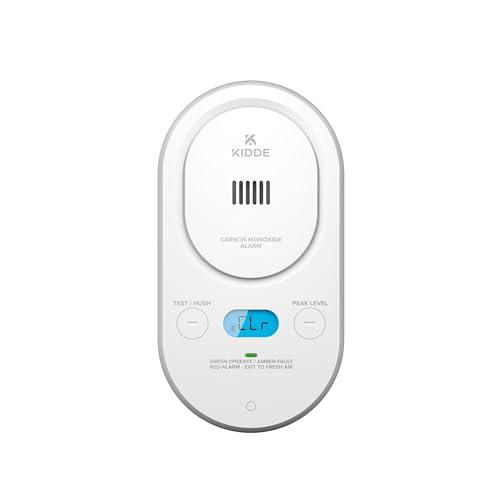 Kidde COPD Plug-In CO Alarm with Digital Display A plug-in alarm with two AA backup batteries and a backlit display, so it keeps reading through a power cut. The arrangement a generator household actually needs. | Most generator owners — plug-in convenience that survives the outage | 8.9/ 10 | $43.97 · View on Amazon #ad how we are funded · price as of November 22, 2026 |
| 2 | 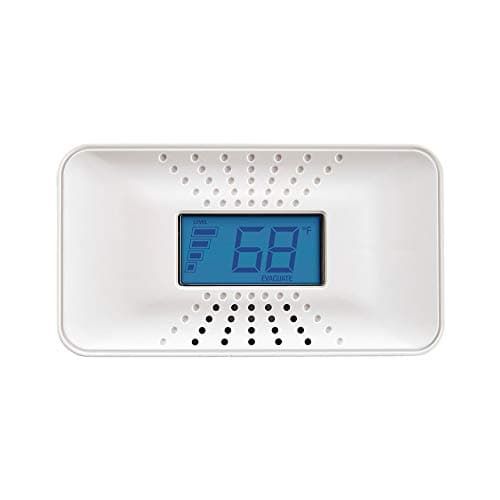 First Alert CO710 Sealed-Battery CO Alarm A sealed ten-year battery with a digital display and no outlet dependency at all. Nothing to change, nothing to plug in, and it sits at whatever height the room requires. | Freedom from outlets — the sealed ten-year alarm you put where the room needs it | 9.4/ 10 | |
| 3 | 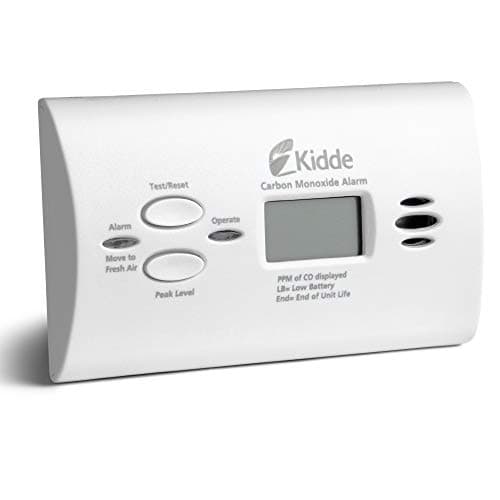 Kidde KN-COPP-B-LPM Battery CO Alarm with Digital Display Battery-only with a digital display and peak-level memory, so it goes anywhere there is no outlet and tells you the highest level it saw while you were away. | The budget pick — and the one to carry to a cabin, camper or job site | 8.7/ 10 | $27.79 · View on Amazon #ad how we are funded · price as of November 22, 2026 |
| 4 | 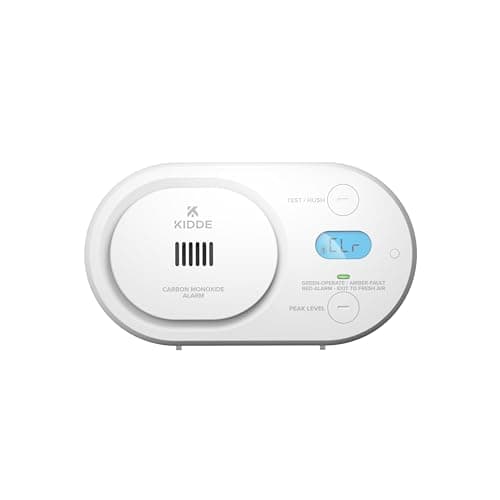 Kidde COBDL Low-Level Carbon Monoxide Alarm Alerts from 30 to 70 ppm — below the concentration at which a standard UL 2034 alarm is permitted to sound — with a separate full alarm at 70 ppm as the standard requires. | Households with young children, older adults, anyone pregnant, or pets | 9.0/ 10 |
The picks
1. Most generator owners — plug-in convenience that survives the outage
Kidde COPD Plug-In CO Alarm with Digital Display
A plug-in alarm with two AA backup batteries and a backlit display, so it keeps reading through a power cut. The arrangement a generator household actually needs.
- Listed to
- UL 2034 5th edition; ETL listed
- Sensing / agent
- Electrochemical CO sensor
- Power / service life
- 120V AC with two AA backup batteries, included; 10-year limited warranty on the alarm
Why battery backup is the whole specification here. A generator is a device you start because the power has failed. A plug-in-only CO alarm, at that moment, is an ornament. This is the most common and most consequential mistake in generator safety shopping: buying the alarm that was cheapest at the hardware store without checking whether it has a cell in it. Plug-in *with* backup is the right compromise — mains power for the 99% of the time the grid is up, batteries for the hours that actually matter.
Check the backup cells before storm season, not after. The backup is only real if the AAs are good, and a flat backup battery in a plug-in alarm is a silent failure: the alarm looks alive because the outlet is feeding it. Put it on the same autumn checklist as the generator's oil and fuel. Generator CO safety covers the rest of that checklist.
What it does well
- **Plug-in with AA battery backup, so it keeps monitoring through a power cut** — which is exactly when generators come out, and exactly when a plug-in-only alarm has already stopped working
- **Backlit display shows the level of CO the alarm is sensing** rather than only sounding, so you can read a concentration by flashlight and tell a drifting exhaust problem from a spike
- **Listed to UL 2034 5th edition and ETL listed**, named explicitly — the clearest certification statement of any alarm on this page
- **Rotating plug fits a vertical or a horizontal outlet**, with published power-surge immunity, which matters on a circuit being fed by a generator through a transfer switch
- **No low-battery chirps and a single test/hush button**, so quick checks before and after a run are genuinely quick
The downside
- **Tied to an outlet position**, so it cannot go wherever the room needs it — and outlet height is not always the right height for the room
- **Replaceable AA batteries mean an annual check is genuinely required**, and the backup is worthless if those cells are flat when the grid goes down
- **Kidde does not publish a peak-level memory for this model**, and no current Kidde CO alarm does — so you cannot come home and read the highest level reached while you were out
- **10-year limited warranty on the alarm**, which is also roughly its service life — this is a replace-the-unit product
- **An alarm by an outlet near the generator's transfer point is not a substitute for alarms near sleeping areas**
Do not buy this if: a cabin, RV or job site with no reliable outlet — the battery picks below are the right answer there. For travel use specifically see [best CO detectors for RV and travel](/carbon-monoxide-detectors/best-co-detectors-for-rv-and-travel).
- Backlit display shows the level of CO the alarm is sensing, rather than only sounding
- Plug-in with AA battery backup, so it keeps monitoring through a power cut — which is exactly when generators come out
- Rotating plug fits a vertical or a horizontal outlet, with published power-surge immunity
- No low-battery chirps, and one test/hush button for quick checks
- Kidde does not publish a peak-level memory for this model, and no current Kidde CO alarm does
#ad how we are funded · price as of November 22, 2026
2. Freedom from outlets — the sealed ten-year alarm you put where the room needs it
First Alert CO710 Sealed-Battery CO Alarm
A sealed ten-year battery with a digital display and no outlet dependency at all. Nothing to change, nothing to plug in, and it sits at whatever height the room requires.
- Listed to
- UL 2034
- Sensing / agent
- Electrochemical CO sensor
- Power / service life
- 10-year sealed battery
The strongest argument on this page, on reflection. The Kidde COPD is the better *plug-in*, but a sealed ten-year battery alarm sidesteps the outage question entirely rather than managing it. There is no backup to maintain, nothing that goes flat unnoticed, and no outlet dictating where the alarm lives. For a household that wants to think about this once, this is the alarm.
Height matters, and this is the pick that lets you choose it. Carbon monoxide mixes roughly evenly with air rather than rising like smoke, so the usual guidance is to site alarms near sleeping areas at a height that suits the room and to follow the manufacturer's instruction for that model. An outlet-bound alarm gives you no choice; this one does. Where to install CO detectors covers the positions properly.
What it does well
- **Sealed ten-year battery, so grid power is irrelevant to it.** There is no outage mode and no backup to go flat — it simply runs for a decade
- **No low-battery chirp until it is genuinely done**, which removes the main reason households disable CO alarms
- **Digital display showing the measured concentration**, so you get a number rather than a binary alarm
- **Placement is completely free: no outlet required**, so it can sit at the height the room actually needs rather than at outlet height
- **Listed to UL 2034**, the carbon monoxide alarm standard
The downside
- **End of life means replacing the whole unit**, by design — there is nothing to service
- **No peak-level memory published**, so it will not tell you the highest concentration reached while the house was empty
- **No interconnect and no app**, so a reading in a basement is a reading in a basement
- **First Alert names UL 2034 without an edition number**, which is less specific than Kidde's 5th-edition statement
- **A sealed unit cannot be moved between properties as cheaply as a battery unit** — you are siting it for ten years
Do not buy this if: anyone who wants a portable alarm to carry between a house, a cabin and a camper — the KN-COPP-B-LPM below is that product. For the sealed-battery field in general see [best battery CO detectors](/carbon-monoxide-detectors/best-battery-co-detectors).
- Sealed 10-year battery — nothing to change, and no low-battery chirp until it is genuinely done
- Digital display showing the measured concentration
- Placement is free: no outlet required, so it can sit at the height the room actually needs
- End of life means replacing the whole unit, by design
3. The budget pick — and the one to carry to a cabin, camper or job site
Kidde KN-COPP-B-LPM Battery CO Alarm with Digital Display
Battery-only with a digital display and peak-level memory, so it goes anywhere there is no outlet and tells you the highest level it saw while you were away.
- Listed to
- UL 2034
- Sensing / agent
- Electrochemical CO sensor
- Power / service life
- Battery powered; 10-year unit life
Peak-level memory is the feature worth understanding. A CO alarm sounds at concentrations and durations defined by UL 2034, then stops when the air clears. Without peak memory you can come home to a silent alarm and a room that had 120 ppm in it two hours ago. With it, you can read what happened. If you run a generator while the house is occupied but not supervised — people asleep, a sick relative in a back bedroom — that is genuinely useful information.
It is the right alarm for the places a generator actually goes. Generators travel: to cabins, to trailers, to job sites, to a tailgate. A battery alarm with a display goes with it, and it costs little enough that you can leave one in each place. Best CO detectors for RV and travel covers the mobile case in full.
What it does well
- **Cheapest CO alarm in this registry**, which makes covering a house, a cabin and a camper a realistic single purchase
- **Battery only, so it goes where there is no outlet** — a bedroom wall, a cabin, a rental, a trailer, a job site
- **Digital display plus peak-level memory**, which is the one feature here that answers "was there a problem while we were out?" — and the only alarm on this page that has it
- **Portable enough to travel with**, which matters more than most buying guides admit if your generator does too
- **Listed to UL 2034** with a 10-year unit life
The downside
- **Replaceable batteries mean an annual check is genuinely required** — this is the highest-maintenance alarm here, and a flat battery is a dead alarm rather than a degraded one
- **It will chirp when the battery is low**, which is the behavior that gets alarms removed. Change the cells on a schedule instead of waiting for the chirp
- **No mains power at all**, so there is no redundancy — the battery is the only power source
- **No interconnect and no app**
- **Kidde names UL 2034 without an edition number for this model**
Do not buy this if: a household that will forget the batteries — buy the sealed First Alert CO710 instead, because an alarm with a flat cell is worse than no alarm at all, since it looks like protection.
- Battery only, so it goes where there is no outlet — a bedroom wall, a cabin, a rental
- Digital display plus peak-level memory
- Portable enough to travel with, which matters more than most buying guides admit
- Replaceable batteries mean an annual check is genuinely required
#ad how we are funded · price as of November 22, 2026
4. Households with young children, older adults, anyone pregnant, or pets
Kidde COBDL Low-Level Carbon Monoxide Alarm
Alerts from 30 to 70 ppm — below the concentration at which a standard UL 2034 alarm is permitted to sound — with a separate full alarm at 70 ppm as the standard requires.
- Listed to
- UL 2034, 5th edition; ETL listed
- Sensing / agent
- Electrochemical CO sensor
- Power / service life
- Two AA batteries; 10-year limited warranty on the alarm
Why a generator household in particular should consider this. The standard UL 2034 alarm thresholds are built around healthy-adult exposure, and generator incidents are not gentle — they tend to produce fast-rising concentrations in attached or partly enclosed spaces. An alarm that speaks up in the 30-to-70 ppm band gives a household with a small child or an elderly resident more of the thing that matters most, which is time.
It is an addition, not a substitute. It still carries the full 70 ppm alarm the standard requires, so it behaves like a compliant alarm and then adds an earlier band on top. That is the right architecture, and it is why this belongs on a generator page rather than only on a low-level page.
What it does well
- **Alerts earlier, at 30 to 70 ppm, with a distinct light and sound pattern** — below the level a standard alarm is permitted to sound at, which is the entire point of a low-level alarm
- **Kidde names the people that early band is for**: young children, older adults, pregnant women and pets — the manufacturer's own list, not our inference
- **Separate full alarm at 70 ppm**, as UL 2034 requires, so the early warning is an addition to compliant behavior rather than a replacement for it
- **Listed to UL 2034 5th edition and ETL listed**, named explicitly
- **Digital backlit display, a test/hush button and no wiring**, so it sits at whatever height the room needs
The downside
- **Two AA batteries**, so the same annual check applies as the budget pick — and the same silent-failure risk if they are flat
- **It is a listed alarm, not a professional monitor.** It does not read single-figure ppm, so it will not characterize a very low chronic leak
- **Earlier alerting means more alerts**, including from sources you will decide are harmless. That is the trade you are buying
- **More expensive than a standard battery alarm** for a narrower, if important, benefit
- **No interconnect and no app**
Do not buy this if: a household that simply wants code-compliant CO coverage at the lowest cost — a standard UL 2034 alarm does that, and this one is for the specific case of wanting warning below the standard threshold. [Best low-level CO monitors](/carbon-monoxide-detectors/best-low-level-co-monitors) covers the category in full.
- Alerts earlier, at 30 to 70 ppm, with a distinct light and sound pattern — below the concentration at which a standard UL 2034 alarm is permitted to sound
- Kidde names the people that early band is for: young children, older adults, pregnant women and pets
- Digital backlit display and a test/hush button; no wiring, so it can sit at the height the room needs
- Separate full alarm at 70 ppm, as the standard requires
- It is a listed alarm in its own right, not a professional monitor — it does not read single-figure ppm
The four alarms side by side
Power, listings and features exactly as the manufacturers publish them, checked on 2026-11-21. Prices are not in this table — the live figure and its "as of" date sit in each buy button above.
| Alarm | Power | Works in an outage | Display | Peak memory | Listing as published |
|---|---|---|---|---|---|
| Kidde COPD | 120V AC plus two AA backup | Yes, on the AA backup | Backlit, shows measured level | Not published | UL 2034 5th edition; ETL |
| First Alert CO710 | Sealed 10-year battery | Yes — no mains dependency at all | Digital, shows measured level | Not published | UL 2034 |
| Kidde KN-COPP-B-LPM | Replaceable batteries | Yes — no mains dependency at all | Digital, shows measured level | Yes | UL 2034 |
| Kidde COBDL | Two AA batteries | Yes — no mains dependency at all | Digital backlit | Not published | UL 2034 5th edition; ETL |
Three of these four need no mains power at all, which is the honest shape of this category: for generator use, a battery alarm is structurally the right answer and a plug-in with backup is the convenient compromise. A plug-in with no backup cell is not on this page for a reason.
What the alarm cannot do for you
It cannot make an indoor generator safe. This bears repeating because people try it every storm season: a running generator in a garage, a basement, a crawl space, a carport or a shed produces carbon monoxide fast enough to be lethal in minutes, and an open door or a fan does not fix it. The alarm is the thing that tells you the plan has failed, not the thing that makes the plan work. Outdoors, well clear of the building, exhaust pointed away from every door, window and vent.
It cannot cover a house from one position. CO mixes roughly evenly with air rather than collecting at the ceiling, and a generator running outside a wall can push exhaust in through one specific opening. Coverage near sleeping areas and on each level with fuel-burning appliances is the baseline, and your local code may require more — how many CO detectors do I need works it through.
And it cannot tell you about the rest of the outage risk. The same storm that starts the generator also brings out space heaters, gas ranges used for heat, charcoal, and cars left running in attached garages — all CO sources, and together they are why outage weeks produce CO incidents. Generator CO safety and carbon monoxide poisoning symptoms are the two pages to read before the next storm rather than during it.
Questions people actually ask
What is the best carbon monoxide detector for generator use?
Will a plug-in CO detector work when the power is out?
Where should I put a CO detector if I run a generator?
How far from the house should a generator be?
Do I need a low-level CO monitor for generator use?
What does peak level memory do on a CO alarm?
How these picks were chosen. On published specifications, safety listings and manufacturer documentation — plus the findings of organizations that do run tests. We have no laboratory and we do not burn anything. Read the full methodology.
Sources
- CPSC — Carbon Monoxide Fact Sheet
- UL Solutions — UL 2034 — single and multiple station carbon monoxide alarms
- CDC / NIOSH — Occupational exposure guidance and chemical databases
- NFPA — NFPA 72, National Fire Alarm and Signaling Code (2025 edition)
- UpCodes — Specific location requirements for smoke alarms (NFPA 72 §29.11.3.4)
Read next
Carbon Monoxide Detectors
Generator Carbon Monoxide Safety
Outdoors only, well clear of openings — and why an open garage door changes nothing.
Carbon Monoxide Detectors
The Best Battery Carbon Monoxide Detectors
Three certified battery CO alarms, compared on placement freedom, display, peak memory and alarm threshold. Sealed ten-year versus replaceable cells, settled.
Carbon Monoxide Detectors
The Best CO Detectors for RVs and Travel
A battery unit for the bag, and why an RV needs an RV-listed alarm instead.
Carbon Monoxide Detectors
The Best Low-Level CO Monitors
Why the 30 ppm floor exists, who it fails, and what a low-level monitor adds.
Carbon Monoxide Detectors
The Best CO Detectors With a Digital Display
A readout plus a stored peak tells you what happened while you were out. What UL 2034 hides.
Carbon Monoxide Detectors
Room by room, and a straight answer to the high-or-low question.