Carbon Monoxide Detectors
The Best Carbon Monoxide Detectors for a Kitchen
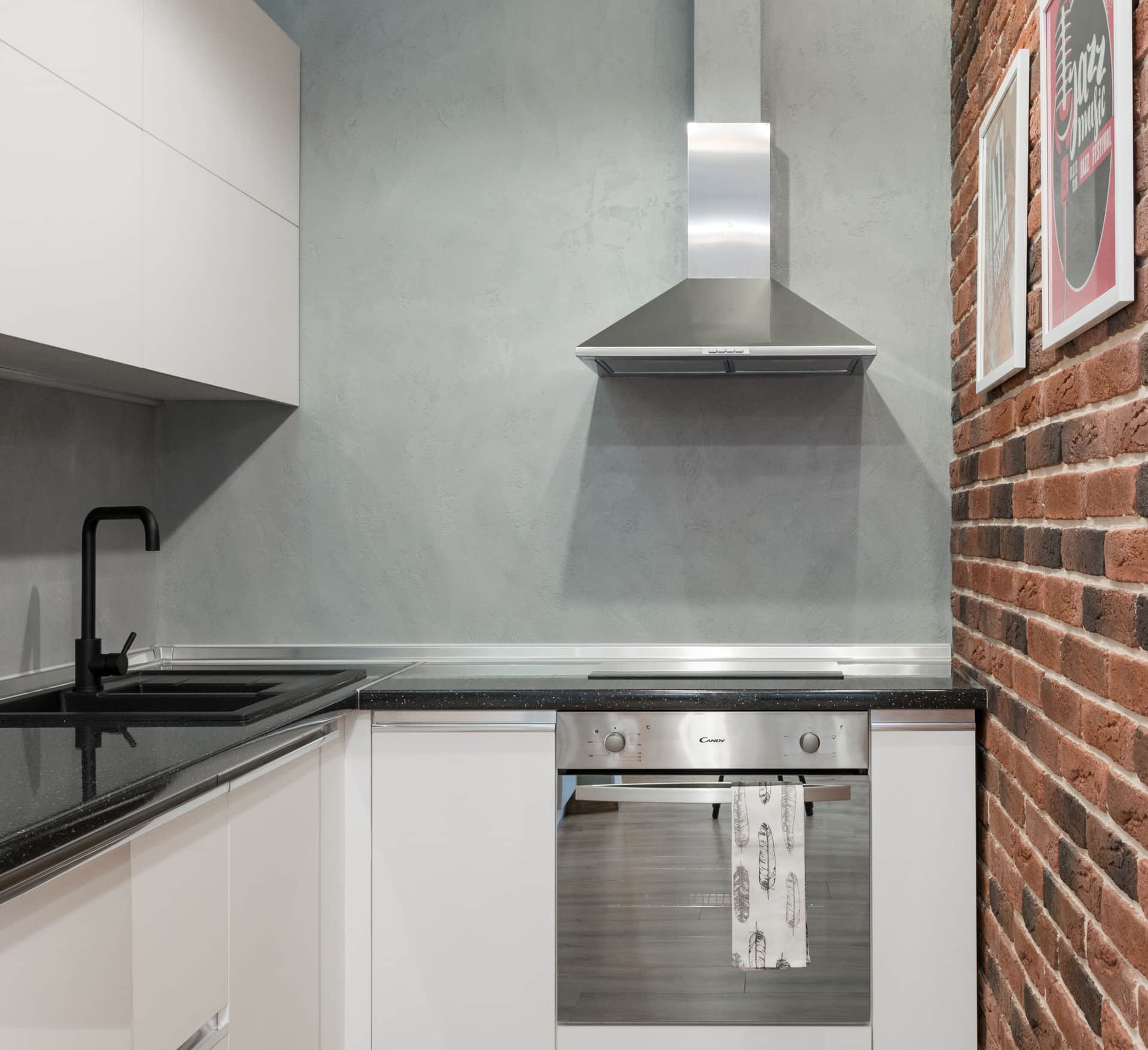
A gas hob burns fuel a few feet from where you stand. The alarm for that room has to be readable, close enough to be useful and far enough away not to cry wolf.
By Ryder M.Last reviewed
Buy the Kidde COPD plug-in alarm for a kitchen with a gas range: it sits at outlet height where you can read the concentration while you cook, keeps a AA backup for a power cut, and its rotating plug fits the awkward sockets kitchens actually have. The budget pick is the Kidde KN-COPP-B-LPM, which costs the least of any certified CO alarm here and can be positioned anywhere on a wall - useful when every kitchen outlet is behind an appliance. If the kitchen opens onto a living space and you would rather cover both hazards from one ceiling position, the X-Sense SC06 is a certified smoke and CO alarm in a dust-resistant housing. One clearance rule governs all three: keep the alarm as far from the hob as the room allows, or you will be silencing it instead of trusting it.
Siren & Safe is reader-funded. We earn a commission on some links on this page, at no cost to you. It does not change what we recommend or the order we rank it in. Full disclosure.
Why a kitchen needs its own answer
A gas range, a gas oven, a gas griddle - these are combustion appliances in the room where people stand for hours. They are usually unflued, which means their products of combustion go into the room rather than up a chimney, and a burner running badly or a pan boiling dry over a lit ring can push the carbon monoxide concentration in a small kitchen up quickly. That is not a reason for alarm; properly adjusted gas cooking appliances are safe, and millions of homes use them daily. It is a reason to have a certified alarm in the room and to read what it says.
The complication is that the same room produces more nuisance alarms than any other part of the house. Steam, grease aerosol and toast smoke all look like a fire to a smoke sensor, and the standard clearance guidance keeps smoke alarms out of a 10 foot radius of a fixed cooking appliance for exactly that reason. CO alarms are less affected - they are chemical sensors, not particulate ones - but a combination unit inherits the smoke side's problem.
So the kitchen answer splits. If you want a reading, use a CO-only alarm with a display, positioned clear of the hob. If you want one device covering both hazards in an open-plan space, use a certified combination alarm and put it at the far end of the room. What does not work is a combination alarm three feet from a gas ring: it will go off while you cook, and then it will come down.
None of this replaces servicing the appliance. An annual check by a qualified engineer on anything that burns fuel is the control that actually prevents CO incidents; the alarm is the backstop for when it fails. Do I need a CO detector is the five-minute version of that argument.
Quick picks
Scored against readable while cooking, fits a kitchen, power-cut cover, nuisance resistance and install simplicity. Tap a row for the full write-up. The price in each buy button is the live Amazon price at the last check, stamped with the date it was taken.
| # | Product | Best for | Score | Price |
|---|---|---|---|---|
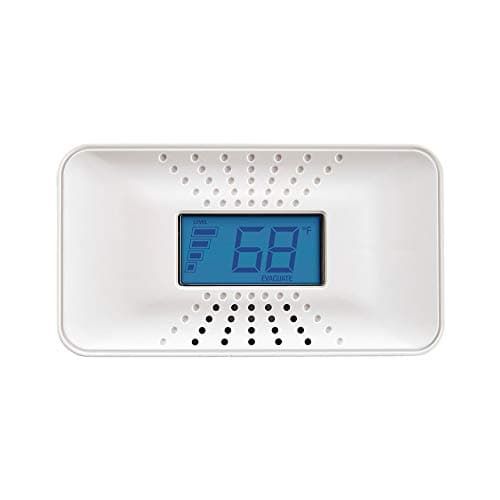
| 1 | 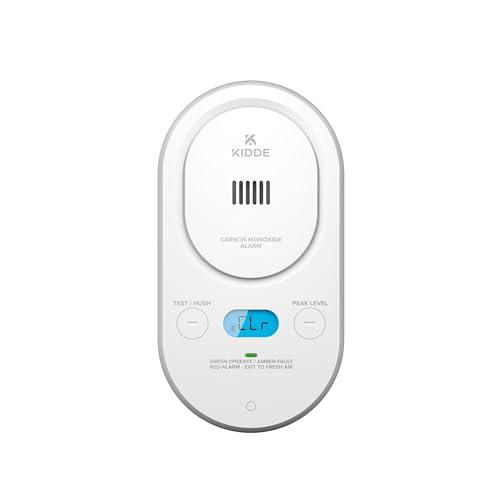 Kidde COPD Plug-In CO Alarm with Digital Display A plug-in alarm with a backlit concentration display and a rotating plug that fits a kitchen's awkward sockets. Battery backup keeps it measuring through an outage. | A kitchen with a gas range and a spare outlet | 9.0/ 10 | $43.97 · View on Amazon #ad how we are funded · price as of November 11, 2026 |
| 2 | 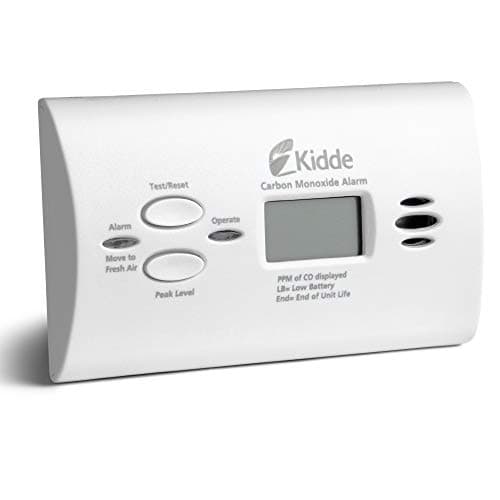 Kidde KN-COPP-B-LPM Battery CO Alarm with Digital Display The cheapest certified CO alarm here, free to mount anywhere on a wall, and the only one that stores the highest level it has seen. | The budget pick, and any kitchen with no usable outlet | 8.5/ 10 | $27.97 · View on Amazon #ad how we are funded · price as of November 11, 2026 |
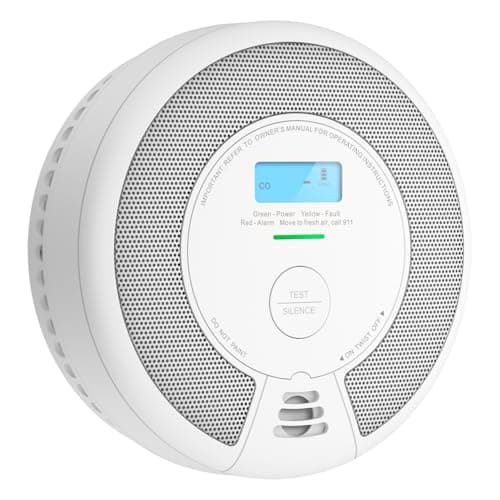
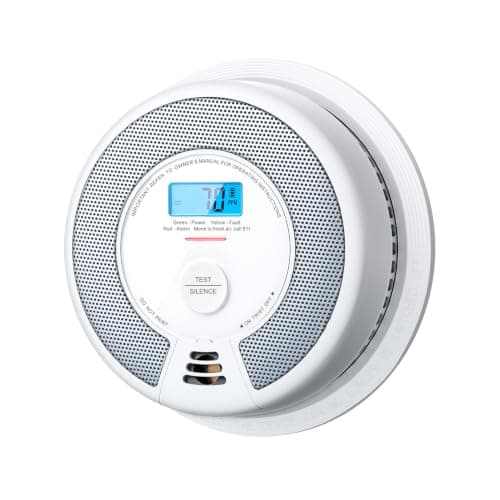
| 3 | 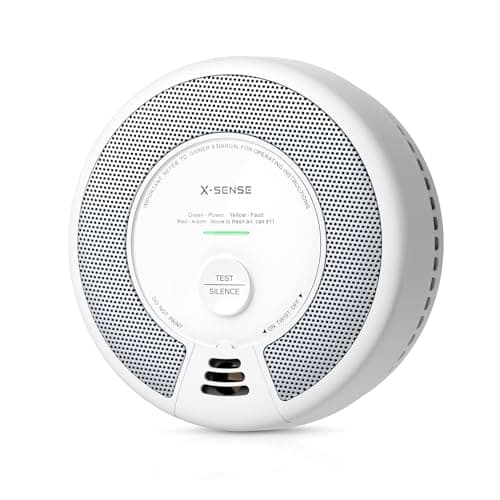 X-Sense SC06 Smoke & Carbon Monoxide Alarm A certified smoke and CO alarm in a dust-resistant housing, for less than most smoke-only alarms. One position, two hazards, no wiring. | An open-plan kitchen - both hazards from one ceiling position | 8.3/ 10 |
The picks
1. A kitchen with a gas range and a spare outlet
Kidde COPD Plug-In CO Alarm with Digital Display
A plug-in alarm with a backlit concentration display and a rotating plug that fits a kitchen's awkward sockets. Battery backup keeps it measuring through an outage.
- Listed to
- UL 2034 5th edition; ETL listed
- Sensing / agent
- Electrochemical CO sensor
- Power / service life
- 120V AC with two AA backup batteries, included; 10-year limited warranty on the alarm
Why a display, specifically here. The kitchen is the one room where you are present and awake while a combustion appliance runs. That makes a number useful in a way it is not elsewhere: a reading that creeps up every time the oven is on is a service call for the appliance, and you would never learn it from an alarm that only ever sits silent.
The backup battery is not optional. An outage, a storm, a generator in the garage, a camping stove brought indoors because the power is out - that whole chain is the classic CO incident, and a plug-in alarm with no backup is asleep for all of it. Keep the AA cells fresh and test on the first of the month.
Pair it, do not substitute it. A CO alarm in a kitchen does not replace a smoke alarm covering the cooking area, and a smoke alarm does not detect CO. If one device for both is what you want, the SC06 below is that device.
What it does well
- **Backlit display showing the measured concentration**, which is the feature that matters in a kitchen - you want to see 15 ppm climbing, not wait for a horn
- **Rotating plug** fits a vertical or horizontal outlet, with published power-surge immunity. Kitchen sockets are rarely where you would choose
- **AA battery backup**, so it keeps monitoring through a power cut - which is also when a generator comes out and the real CO risk begins
- **Certified to UL 2034 5th edition and ETL listed**
- **No low-battery chirping** in normal use, and a single test and hush control
- Plugs in - no drilling into tile, no fixings in a splashback
The downside
- **Tied to an outlet position.** If the only free socket in the kitchen is behind the toaster at counter height, that is where the alarm lives
- **No peak-level memory.** Kidde does not publish one for this model, and no current Kidde CO alarm has it
- **Occupies a socket** in the room with the fewest spare sockets in the house
- **It is a CO alarm only** - it will not detect the smoke from a pan fire, which is the commonest kitchen fire by a wide margin
- An alarm at outlet height in a kitchen is also at child height, which is worth a thought with a hush button on it
Do not buy this if: a kitchen whose only outlets are behind appliances, or a galley where every socket is within a few feet of the hob - go to the battery unit below. For the smoke side of a kitchen, [best smoke detectors for kitchens](/smoke-detectors/best-smoke-detectors-for-kitchens) is the page you actually need.
- Backlit display shows the level of CO the alarm is sensing, rather than only sounding
- Plug-in with AA battery backup, so it keeps monitoring through a power cut — which is exactly when generators come out
- Rotating plug fits a vertical or a horizontal outlet, with published power-surge immunity
- No low-battery chirps, and one test/hush button for quick checks
- Kidde does not publish a peak-level memory for this model, and no current Kidde CO alarm does
#ad how we are funded · price as of November 11, 2026
2. The budget pick, and any kitchen with no usable outlet
Kidde KN-COPP-B-LPM Battery CO Alarm with Digital Display
The cheapest certified CO alarm here, free to mount anywhere on a wall, and the only one that stores the highest level it has seen.
- Listed to
- UL 2034
- Sensing / agent
- Electrochemical CO sensor
- Power / service life
- Battery powered; 10-year unit life
Mounting beats specification in a kitchen. The hardest part of covering a kitchen is finding a position that is close enough to the appliance to be meaningful and far enough from the hob and the extractor to avoid nuisance alarms. A battery unit solves that by removing the socket from the equation, and this is the cheapest certified way to do it.
Keep it out of the steam. Away from the dishwasher vent, away from the kettle, away from the extractor's intake path. Humidity and grease aerosol are what kill alarms early in this room, and no CO alarm sold for domestic use is rated for a steam bath.
Read the peak once a month. It takes five seconds when you press the test button anyway, and it is the single most useful habit in this whole category.
What it does well
- **Lowest price of any certified CO alarm in this registry**, so covering the kitchen does not mean leaving a landing uncovered
- **Peak-level memory.** In a kitchen this is the genuinely diagnostic feature - it is how you find out that the range spilled 60 ppm into the room last Sunday
- **Battery only**, so it mounts on any wall at any height: beside a doorway, above a cabinet run, away from the splashback
- **Digital display** of the current level
- **Certified to UL 2034** with a ten-year unit life
- **Immune to a power cut** by definition - no outlet, nothing to lose
The downside
- **Replaceable cells**, so there is an annual check and eventually a chirp
- **Small unlit display**, and the peak reading has to be called up rather than shown
- **Standard UL 2034 thresholds** - it stays quiet through the low-level band
- **Nothing kitchen-specific about it.** It is a good general alarm being used in a kitchen, not a unit designed for grease and steam
- No interconnect, so it sounds in the kitchen and nowhere else
Do not buy this if: a household that will not change a battery, where the sealed First Alert CO710 is the safer unit - see [best battery CO detectors](/carbon-monoxide-detectors/best-battery-co-detectors). It is also not the alarm for a vulnerable household; that is a low-level monitor.
- Battery only, so it goes where there is no outlet — a bedroom wall, a cabin, a rental
- Digital display plus peak-level memory
- Portable enough to travel with, which matters more than most buying guides admit
- Replaceable batteries mean an annual check is genuinely required
#ad how we are funded · price as of November 11, 2026
3. An open-plan kitchen - both hazards from one ceiling position
X-Sense SC06 Smoke & Carbon Monoxide Alarm
A certified smoke and CO alarm in a dust-resistant housing, for less than most smoke-only alarms. One position, two hazards, no wiring.
- Listed to
- UL 217 and UL 2034
- Sensing / agent
- Photoelectric smoke sensing plus an electrochemical CO cell
- Power / service life
- 10-year sealed battery
The open-plan case for one device. When the kitchen, dining area and living room are one volume, the useful alarm position is usually a ceiling spot ten or fifteen feet from the hob - and at that distance a combination alarm is both a legitimate smoke alarm for the living space and a legitimate CO alarm for the range. Two devices in that room is doing the same job twice.
Why dust resistance is the right feature to pay for here. Alarms near kitchens do not usually fail by missing a fire. They fail by going off while someone sears a steak, getting unhooked, and never going back up. Anything that lowers the nuisance rate is buying you an alarm that is still on the ceiling in two years.
Vacuum it twice a year. Two minutes with a nozzle on the vents beats every feature on this page for nuisance alarms, and in a kitchen it is the maintenance that actually matters.
What it does well
- **Certified to UL 217 and UL 2034**, which makes it a real smoke alarm and a real CO alarm rather than one with a sticker
- **Dust-resistant housing**, which addresses the actual cause of nuisance alarms in a cooking space: fine particulate settling in the sensing chamber
- **Photoelectric smoke sensing** named on the listing - the sensor type that nuisance-trips far less on cooking aerosol than ionization
- **Sealed 10-year lithium cell**, wall or ceiling mount, no wiring and no socket
- **One ceiling position covers both hazards**, which halves the hardest part of covering an open-plan room
- Among the cheapest combination alarms anywhere
The downside
- **No display at all.** It alarms; it does not report a concentration, so you lose the thing that makes a kitchen CO alarm interesting
- **Standalone only** - no interconnect, wired or wireless
- **"Dust-resistant" is a design claim, not a published ingress rating**
- **A combination alarm near a kitchen is a nuisance-alarm risk on the smoke side**, which is the price of covering both hazards from one position
- ETL certified to UL 217 rather than UL-listed - same standard, different mark, and worth checking if an inspector asked for UL specifically
Do not buy this if: a closed kitchen where the alarm would sit within a few feet of the hob - a combination unit there will nuisance-trip on cooking and get taken down. In that layout use a CO-only alarm in the kitchen and put the smoke alarm outside the room. [Kitchen and bathroom placement](/placement-and-code/kitchen-and-bathroom-placement) has the clearances.
- Dust-resistant housing — the cheap fix for nuisance alarms in a dusty utility space
- Dual smoke and CO detection in one ceiling position
- Single test and silence control
- No display: it alarms, it does not report a concentration
The three alarms side by side
Specifications as published by the manufacturers, checked on 2026-11-10. The live price sits in each buy button with the date it was taken.
| Alarm | Hazards covered | Power | Display | Best position in a kitchen |
|---|---|---|---|---|
| Kidde COPD plug-in | CO only | Plug-in, AA backup | Backlit digital | An outlet clear of the hob and the extractor path |
| Kidde KN-COPP-B-LPM | CO only | Replaceable cells | Digital, with stored peak | Any wall position away from steam |
| X-Sense SC06 | Smoke (UL 217) and CO (UL 2034) | Sealed 10-year lithium | None | Ceiling, at the far end of an open-plan room |
The 10 foot clearance in the smoke-alarm placement guidance applies to the smoke side of a combination alarm, not to a CO-only unit. Where the layout makes 10 feet impossible, the guidance allows a photoelectric alarm closer in - which is what the SC06 is.
Mounting a CO alarm in a kitchen
Three groups: where it goes, where it must not go, and what to do afterwards.
Where it goes
- Far enough from the hob that cooking does not reach it, and close enough to the room that a spill from the range is detected - the far wall of a kitchen, or just outside the doorway in a galley.
- At a height you can read without a stool. The point of a display is that you look at it.
- Also cover the sleeping areas and every story of the house. A kitchen alarm is an addition to that pattern, never a substitute for it.
Where it must not go
- Directly above or beside the range, boiler or water heater - every manufacturer publishes a minimum distance from the appliance itself.
- In the extractor's intake path, inside a cabinet, or behind a door that swings over it.
- Next to the dishwasher vent, the kettle or anything else that produces a steam plume.
- In a bathroom, or any position where it will be rained on by condensation.
After it is up
- Press the test button monthly on every alarm in the house, and read the stored peak if the unit has one.
- Vacuum the vents every six months - in a kitchen, make it every three.
- Write the install month on the back in permanent marker. The stamped date is the manufacture date.
- If it alarms, get everyone outside into fresh air and call the fire service or the gas emergency number before you investigate anything.
Questions people actually ask
Do I need a carbon monoxide detector in the kitchen?
Where should a CO detector go in a kitchen?
Will a gas stove set off a carbon monoxide detector?
Can one alarm cover smoke and carbon monoxide in a kitchen?
How far from the stove should a carbon monoxide alarm be?
How these picks were chosen. On published specifications, safety listings and manufacturer documentation — plus the findings of organizations that do run tests. We have no laboratory and we do not burn anything. Read the full methodology.
Sources
- UL Solutions — UL 2034 — single and multiple station carbon monoxide alarms
- CPSC — Carbon Monoxide Fact Sheet
- NFPA — NFPA 72, National Fire Alarm and Signaling Code (2025 edition)
- International Code Council — IRC Chapter 3 — building planning (R310, R314, R315)
Read next
Carbon Monoxide Detectors
The Best Carbon Monoxide Detectors
Four listed alarms, and why placement and a stored peak beat a fancier display.
Carbon Monoxide Detectors
The Best CO Detectors for Bedrooms
Five listed CO alarms for the hallway outside the bedrooms and for the nightstand inside them, scored on night legibility, power and whether they can be wall-mounted at all.
Carbon Monoxide Detectors
Room by room, and a straight answer to the high-or-low question.
Smoke Detectors
The Best Smoke Detectors for Kitchens
The exclusion distances first, then the alarms that belong near a cooker.
Placement & Code
Kitchen and Bathroom Placement
The cooking and bathroom exclusion distances, and how to satisfy them in an open plan.
Carbon Monoxide Detectors
Do I Need a Carbon Monoxide Detector?
The five sources all-electric homes forget, and the one case where no is honest.