Fire Extinguishers
The Best Fire Extinguishers Under $50
Three units, three different jobs, and one honest warning: the cap buys reach and usability rather than rating.
By Ryder M.Last reviewed

Buy the First Alert HOME1 if you have under $50 for one extinguisher: UL rated 1-A:10-B:C, rechargeable, with a metal head and pull pin, at 2.5 lb - the lightest cylinder most people can aim accurately. The budget pick is the First Alert EZ Fire Spray, an aerosol can that is not a rated extinguisher at all but is genuinely easier for someone who will never practice, and wipes up with a cloth instead of leaving corrosive powder across a kitchen. For a car, van or boat the First Alert AUTOMAR10 is rated 10-B:C with a vehicle bracket in the box. What the cap costs you is rating: the all-metal 2-A and 4-A tier starts just above it, and [best fire extinguishers under $100](/fire-extinguishers/best-fire-extinguishers-under-100) is where that begins.
Siren & Safe is reader-funded. We earn a commission on some links on this page, at no cost to you. It does not change what we recommend or the order we rank it in. Full disclosure.
What the $50 cap actually costs you
Honestly: rating. This is the one price band in this category where the cap costs you something measurable. Under $50 the registry holds one full household cylinder at 1-A:10-B:C, one vehicle unit at 10-B:C and one unrated aerosol can. The all-metal, rechargeable tier that reaches 2-A:10-B:C and 4-A:60-B:C starts just above this line - the Amerex B500 and the First Alert PRO10 both sit comfortably under $100 - so if you can stretch, stretching buys more fire extinguished per cylinder and better hardware.
What the cap does buy is reach, and reach matters more than most buying guides admit. Two light units on two floors cover more realistic fires than one heavy unit in a hall, because the only extinguisher that helps is the one somebody can get to in the first half minute. At these prices a house can have a rated cylinder on each floor, a spray can by the hob and a unit in the car, which is a better-protected home than one with a single excellent extinguisher in a cupboard.
It also buys usability. A 2.5 lb cylinder can be aimed by people who cannot hold a 10 lb one steady, and an aerosol can can be used by someone who has never pulled a pin. That is not a consolation prize - an extinguisher that is too heavy or too complicated for the person holding it has a rating of zero in practice.
What no budget changes is the decision rule. An extinguisher is for a small, contained fire caught early, with a clear exit behind you. Anything larger than a wastebasket, anything between you and the door, anything producing smoke you cannot see through - leave, close the door and call the fire service. How to use a fire extinguisher covers the decision as well as the technique.
Quick picks
Scored against rated coverage, one-handed usability, serviceability, cost per covered floor and mounting and storage. Tap a row for the full write-up. The price in each buy button is the live Amazon price at the last check, stamped with the date it was taken.
| # | Product | Best for | Score | Price |
|---|---|---|---|---|
| 1 | 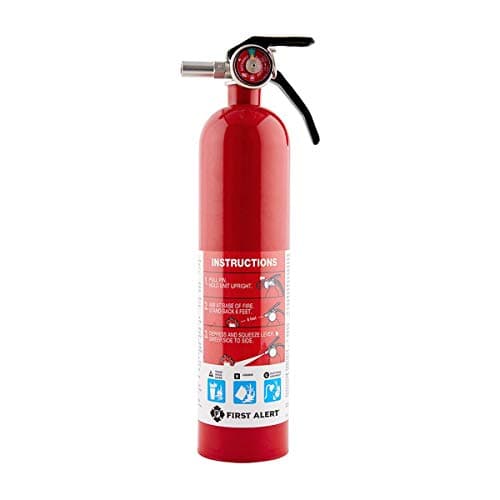 First Alert HOME1 Rechargeable Home Extinguisher (2.5 lb) UL rated 1-A:10-B:C, rechargeable, 2.5 lb, with a metal head and pull pin. The only full household unit that fits this cap. | The best rated extinguisher under $50 | 8.7/ 10 | $26.98 · View on Amazon #ad how we are funded · price as of November 11, 2026 |
| 2 | 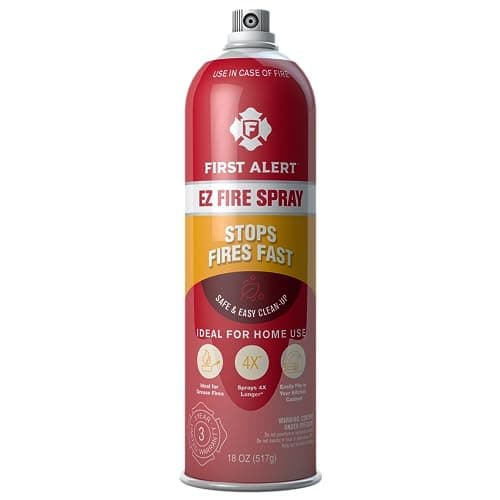 First Alert EZ Fire Spray AF400 An aerosol extinguishing spray: no pin, no gauge, aim and spray. Not a rated extinguisher, and the easiest thing in this category to actually use. | The budget pick - a kitchen can for someone who will never practice | 7.4/ 10 | $11.99 · View on Amazon #ad how we are funded · price as of November 11, 2026 |
| 3 | 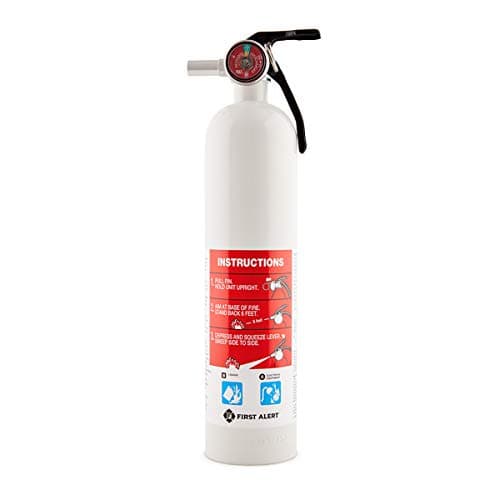 First Alert AUTOMAR10 Auto/Marine Fire Extinguisher UL rated 10-B:C with a metal head, a sodium bicarbonate agent and a vehicle bracket in the box. No Class A rating, by design. | A car, van or boat | 8.2/ 10 |
The picks
1. The best rated extinguisher under $50
First Alert HOME1 Rechargeable Home Extinguisher (2.5 lb)
UL rated 1-A:10-B:C, rechargeable, 2.5 lb, with a metal head and pull pin. The only full household unit that fits this cap.
- Listed to
- UL rated 1-A:10-B:C
- Sensing / agent
- Monoammonium phosphate dry chemical
- Power / service life
- Rechargeable by a certified professional; metal head and pull pin
Buy two rather than one. This is the main reason to shop at this price. What decides the outcome of a small fire is whether an extinguisher is within reach, and two units on two floors cover more realistic scenarios than any single cylinder.
Weight is a safety specification, not a convenience. The technique assumes you can hold the cylinder steady at 6 to 8 feet and sweep the nozzle. Everyone in the household should be able to do that with at least one extinguisher in the house.
Mount it on the escape route. On the way out, at a height anybody can reach - where to mount a fire extinguisher covers the positions.
What it does well
- **UL rated 1-A:10-B:C** - ordinary combustibles, flammable liquids and live electrical, which is full household class coverage
- **Metal head and metal pull pin with a safety seal**, not the plastic valve of the true disposable tier
- **Rechargeable by a certified professional**, unusual at this price
- **2.5 lb - the lightest cylinder most people can aim accurately one-handed**
- **Color-coded corrosion-resistant gauge and a mounting bracket in the box**
- Cheap enough to buy two, which is the right move
The downside
- **1-A is half the Class A rating of a 2-A unit**, which is the direct cost of the cap
- **Less agent means less run time** and less margin if the first attempt misses the base of the fire
- **Dry chemical residue** is corrosive and slow to clean
- **Refill economics are weak at this size** - a recharge can approach the price of a new unit
- No Class K rating, so it is the wrong tool for cooking oil
Do not buy this if: a garage, workshop or anywhere holding fuel and solvents, where the rating is too low - that needs the 4-A:60-B:C tier just above this cap. See [best garage fire extinguishers](/fire-extinguishers/best-garage-fire-extinguishers).
- 2.5 lb — the lightest unit most people can aim accurately with one hand
- Metal head and a metal pull pin with a safety seal, not the plastic valve of the disposable tier
- Color-coded corrosion-resistant gauge and a mounting bracket in the box
- 1-A is half the ordinary-combustible rating of a 2-A unit, which is the trade for the size
First Alert product documentation
#ad how we are funded · price as of November 11, 2026
2. The budget pick - a kitchen can for someone who will never practice
First Alert EZ Fire Spray AF400
An aerosol extinguishing spray: no pin, no gauge, aim and spray. Not a rated extinguisher, and the easiest thing in this category to actually use.
- Listed to
- Aerosol extinguishing spray — not a UL-rated A:B:C portable extinguisher
- Sensing / agent
- Sodium-bicarbonate-based extinguishing aerosol
- Power / service life
- Single use; check the stamped expiry
Why it earns a place despite not being rated. The extinguisher that works is the one somebody picks up and uses correctly in the first thirty seconds. Surveys of households consistently find that almost nobody has ever discharged an extinguisher, and a cylinder with a pin, a gauge and a technique is a lot to ask of a frightened person. A spray can removes every step except aiming.
Scope it honestly. A pan starting to smoke, a wastebasket, a toaster. Not a chip pan in full flame, not a sofa, not anything you cannot see across.
For the hob, a blanket is the better companion. How to use a fire blanket covers the technique, and it is the one domestic answer to a cooking-oil fire that does not involve throwing anything at hot oil.
What it does well
- **Aerosol can format** - no pin to pull, no gauge to read, no technique to remember. Point and spray
- **Wipes up with a cloth** instead of leaving the corrosive mess dry chemical spreads across a kitchen
- **Genuinely easier for someone who will never practice with a real extinguisher**, which describes most households
- **Sodium-bicarbonate-based agent**, the gentler of the two common dry chemistries
- **Cheapest item on this page by a wide margin**, so one in the kitchen and one in a car is trivial
- Small enough to live in a drawer by the hob rather than on a wall
The downside
- **It is not a rated extinguisher** and does not satisfy a code requirement for one - First Alert does not claim a UL rating for it
- **Single use**, with a stamped expiry to check
- **Far less agent than any cylinder here**, so its useful scope is a very small, very early fire
- **No gauge**, so there is no way to confirm it is still good other than the date
- It must not be the only fire device in a house
Do not buy this if: a household's primary fire cover, or any situation where a rated extinguisher is required. Keep it alongside a rated unit, not instead of one - [aerosol spray versus traditional extinguishers](/fire-extinguishers/aerosol-spray-vs-traditional-extinguishers) is the honest comparison.
- Aerosol can format — no pin, no pressure gauge, aim and spray
- Wipes up with a cloth instead of the corrosive mess dry chemical leaves
- Genuinely easier for someone who will never practice with a real extinguisher
- It is not a rated extinguisher and does not satisfy a code requirement for one
#ad how we are funded · price as of November 11, 2026
3. A car, van or boat
First Alert AUTOMAR10 Auto/Marine Fire Extinguisher
UL rated 10-B:C with a metal head, a sodium bicarbonate agent and a vehicle bracket in the box. No Class A rating, by design.
- Listed to
- UL rated 10-B:C
- Sensing / agent
- Sodium bicarbonate dry chemical
- Power / service life
- Rechargeable by a certified professional; mounting bracket included
Why no Class A is deliberate. A vehicle fire is fuel, oil and electrics - Class B and C. The rating reflects the realistic hazard rather than being a cut-down household unit, and the sodium bicarbonate agent is chosen because it is less corrosive to what it lands on.
Mount it, do not leave it in the trunk. An extinguisher in the boot of a burning car is unreachable. Bracket it in the cabin, within reach of a seated adult.
Know the limit. Modern vehicle fires involving fuel lines or battery packs are beyond a hand extinguisher. Get out, get clear, call for help.
What it does well
- **UL rated 10-B:C** - flammable liquids and energized electrical equipment, which is what a vehicle fire usually is
- **Sodium bicarbonate rather than monoammonium phosphate**, the less corrosive of the two dry chemicals
- **Metal head and metal pull pin with a safety seal**, plus a corrosion-resistant gauge
- **First Alert publishes 5.3 lb total weight and a 14.1 in body**, with a vehicle bracket included
- **Rechargeable by a certified professional**
- Sized and bracketed for a vehicle, which a household cylinder is not
The downside
- **No Class A rating at all**, so it is the wrong unit for a sofa, a mattress or a wastebasket fire
- **Not a substitute for a household extinguisher** - it is a vehicle unit
- **Dry chemical residue**, even if the agent is the gentler one
- **A vehicle fire escalates fast**; the honest default is to get everyone away from the car and call the fire service
- Professional recharge only
Do not buy this if: indoor household cover, because the missing Class A rating is the one you need most in a house. For the vehicle case in full see [best car fire extinguishers](/fire-extinguishers/best-car-fire-extinguishers) and [best RV fire extinguishers](/fire-extinguishers/best-rv-fire-extinguishers).
- 10-B:C — flammable liquids and energized electrical equipment, with no A rating at all
- Sodium bicarbonate rather than monoammonium phosphate, which is the less corrosive of the two dry chemicals
- Metal head and metal pull pin with a safety seal, plus a corrosion-resistant gauge
- First Alert publishes 5.3 lb total weight and a 14.1 in body, with a vehicle bracket in the box
- No Class A rating means it is the wrong unit for a sofa, a mattress or a wastebasket fire
First Alert product documentation
The three units side by side
Ratings and construction as published by the manufacturers, checked on 2026-11-10. Prices are deliberately absent - the live figure and the date it was taken sit in each buy button.
| Unit | Rating | Agent | Rechargeable | Intended use |
|---|---|---|---|---|
| First Alert HOME1 | UL 1-A:10-B:C | Monoammonium phosphate | Yes, metal head and pin | The household cylinder |
| First Alert EZ Fire Spray | Not a rated extinguisher | Sodium-bicarbonate aerosol | No - single use | A kitchen drawer, as a supplement |
| First Alert AUTOMAR10 | UL 10-B:C | Sodium bicarbonate | Yes | Car, van or boat |
Only one of these three is a full household extinguisher. The aerosol can is a supplement and the vehicle unit has no Class A rating - a house needs at least one rated A:B:C cylinder regardless of budget.
Questions people actually ask
What is the best fire extinguisher under $50?
Is a cheap fire extinguisher worth buying?
Should I buy one good extinguisher or two cheap ones?
Is an aerosol fire spray a real fire extinguisher?
What does $25 more than this cap buy?
How these picks were chosen. On published specifications, safety listings and manufacturer documentation — plus the findings of organizations that do run tests. We have no laboratory and we do not burn anything. Read the full methodology.
Sources
- UL Solutions — Fire extinguisher testing and certification (UL 711)
- NFPA — NFPA 10, Standard for Portable Fire Extinguishers
- US Fire Administration — Home fire prevention
- US Fire Administration — Cooking fire safety
Read next
Fire Extinguishers
The Best Fire Extinguishers Under $100
Five rated extinguishers under $100, including the all-metal rechargeable tier and a lithium-specific spray. What each one is genuinely for.
Fire Extinguishers
The Best Fire Extinguishers for a Home
Four rated units, what the numbers mean, and why the valve material matters.
Fire Extinguishers
The Best ABC Fire Extinguishers
Four UL-rated ABC extinguishers compared on rating, weight and rechargeability, with a plain explanation of what the numbers before the letters mean.
Fire Extinguishers
Aerosol Spray vs Traditional Extinguishers
Rated capability against something an untrained person will actually use.
Fire Extinguishers
The Best Fire Extinguishers for a Car
Size, rating and the mount — plus why you should not open a smoking hood.
Fire Extinguishers
How to Use a Fire Extinguisher
PASS, the two decisions that come first, and why aiming at the flames wastes the charge.