Fire Extinguishers
How to Put Out a Grease Fire
Never water. That is the whole headline, and the reason is worth understanding because it explains what does work.
By Ryder M.Last reviewed
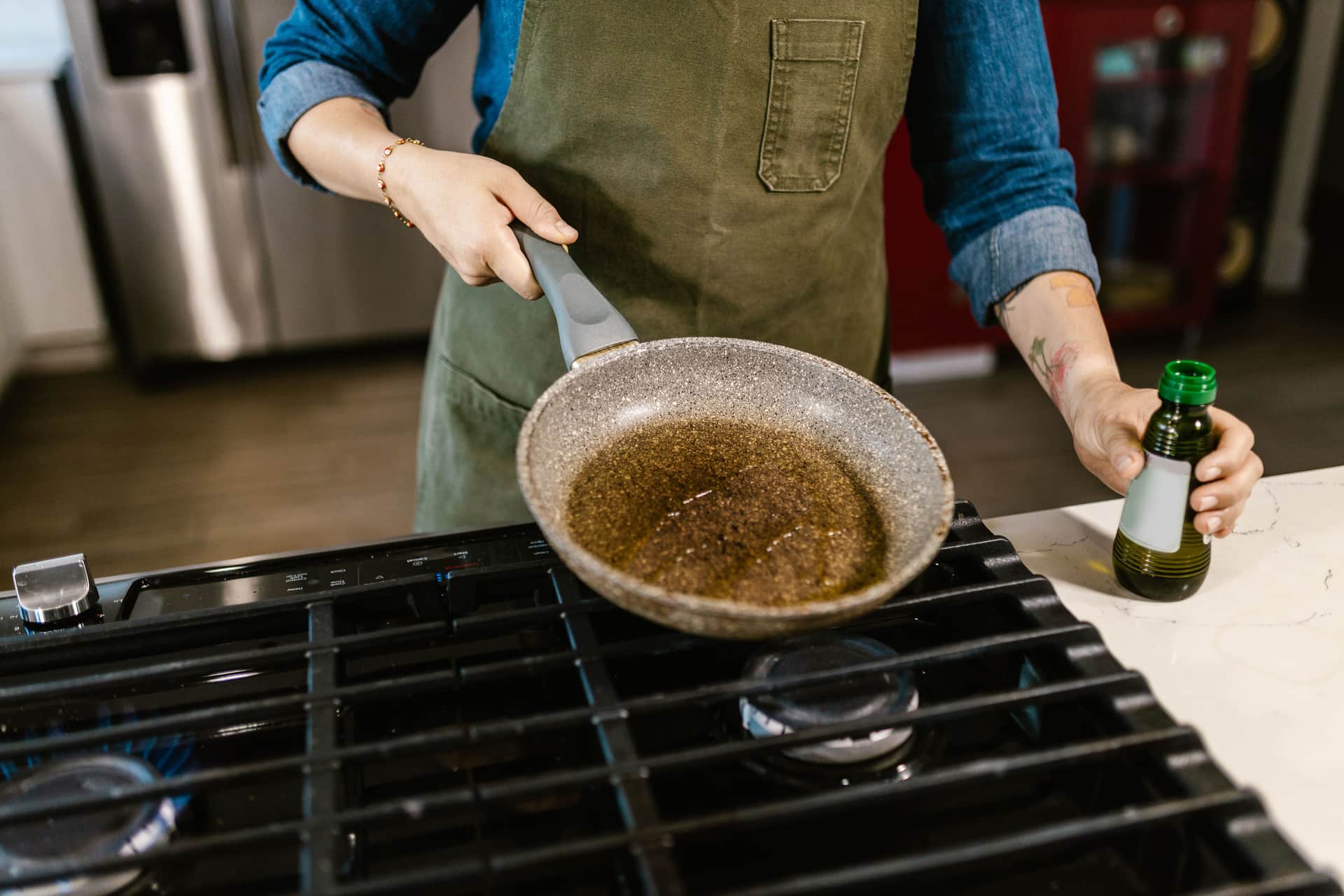
Turn off the heat if you can reach the control safely, cover the pan with a fire blanket or a metal lid, and leave it covered and untouched for at least half an hour. Do not use water — it flashes to steam beneath the burning oil and ejects the oil upward as a fireball. Do not move the pan. Do not use flour. If the fire has spread beyond the pan, or if you cannot cover it in one motion, get everyone out, close the kitchen door and call 911 from outside.
Siren & Safe is reader-funded. We earn a commission on some links on this page, at no cost to you. It does not change what we recommend or the order we rank it in. Full disclosure.
Why water is catastrophic
Understanding the mechanism is what makes the rule stick, and it takes one paragraph.
Burning cooking oil is far hotter than the boiling point of water. When water hits it, the water sinks — it is denser than oil — and then flashes instantly to steam beneath the burning layer. Steam occupies hugely more volume than the water it came from, so it expands violently upward, carrying the burning oil with it as an aerosol of flaming droplets.
That is the fireball in the videos. It is not a small effect and it is not conditional on technique: a cup of water into a pan of burning oil produces it reliably.
It is also why a wet cloth is wrong, why throwing a glass of water from the doorway is wrong, and why moving the pan to the sink is wrong twice over — you are carrying burning oil across the room toward a tap.
The correct sequence
Read it now, not during the fire. Six steps, and the last two are the ones people get wrong.
Turn off the heat, if the control is safely reachable
Removing the heat source is what stops the oil reheating and reigniting once it is covered. If the knobs are behind the flames, skip this and come back to it once the pan is covered.
Put gloves on if they are to hand
A second or two well spent. Woven fiberglass conducts heat to your fingers, and the reflex to let go is what leaves a gap at the pan rim.
Cover the pan — blanket, or a metal lid
A fire blanket held in front of you as a shield, approached from the side, laid over the pan and smoothed down so it contacts the rim all the way round. A close-fitting metal lid slid across from the side works too and is free. A baking tray is a workable improvisation.
Do not throw it, and do not use anything that can burn
Place rather than throw — a thrown cover lands unevenly and lets air in at one edge. And never a glass lid, which can shatter, or a tea towel, which will ignite.
Leave it covered for at least thirty minutes
This is the step people ruin. Hot oil reignites the instant it meets air again, and lifting the cover to check is the commonest way a controlled situation restarts. Leave the kitchen, open a window elsewhere in the house, and wait.
Do not move the pan, at all
Not to the sink, not outside, not off the hob. Carrying a pan of burning or recently-burning oil risks spilling it on you and spreading fire along your route. It stays where it is until it is completely cold.
What to use, and what never to use
| Option | Verdict |
|---|---|
| Fire blanket | Best. No velocity, no aim, no residue, seals against the pan rim |
| Close-fitting metal lid | Excellent and free. Slide it on from the side rather than dropping it |
| Baking tray or metal sheet | Good improvisation if it covers the pan fully |
| Class K wet-chemical extinguisher | Correct agent — saponifies and cools the fat, preventing reignition |
| ABC dry chemical extinguisher | Will extinguish it, but can splash burning oil at close range and does not cool the fat. Second choice |
| Water | Never. Flashes to steam under the oil and ejects it as a fireball |
| A wet cloth | Never. Same mechanism as water, plus it can ignite |
| Moving the pan | Never. Spreads burning oil along your escape route |
| Flour | Never. A fine combustible dust in air near an ignition source. Not the same as baking soda |
| Baking soda | Works on a very small fire in large quantity — but you will not have enough, so treat it as a last resort rather than a plan |
| Salt | Physically smothers in quantity, and again you will not have enough. Not a plan |
Flour and baking soda are frequently confused in kitchen advice. Sodium bicarbonate releases CO2 and smothers; flour is a combustible dust. They are not interchangeable.
What a kitchen should have, in order
A fire blanket within one step of the hob, on a side wall at about worktop height, never above the cooker. This is the tool that matches the fire the room is most likely to produce.
A close-fitting metal lid for your largest pan, kept somewhere you can reach without searching. It costs nothing and it is what people reach for anyway.
A rated ABC extinguisher near the kitchen exit, for the fire that has spread past the hob. Kitchen extinguishers, and a Class K unit if you deep-fry.
A smoke alarm outside the 10 ft exclusion from the cooker. Getting this wrong produces nuisance alarms, and nuisance alarms get disabled — which is how a household ends up with no warning at all. Kitchen placement.
Not having one in the first place
NFPA's cooking-fire research is consistent that unattended cooking is the leading factor in home cooking fires, which makes the prevention list short and boring and effective.
Stay in the kitchen when you are frying, grilling or boiling. If you have to leave, turn the heat off. The overwhelming majority of these fires start during an absence.
Use a thermometer when deep-frying, and never fill a pan more than a third with oil. Oil that boils over is the usual ignition event.
Dry food before it goes in hot oil. Water in oil ejects oil, which is the same mechanism as the fireball, just smaller.
Keep the hob and extractor clean. Accumulated grease on a hood or a backsplash is what turns a pan fire into a kitchen fire.
Keep tea towels, packaging and sleeves away from burners, and turn pan handles inward.
Questions people actually ask
How do you put out a grease fire?
Why can't you use water on a grease fire?
How do you put out a grease fire without an extinguisher?
Does baking soda put out a grease fire?
Can I move a burning pan outside?
Should I use a fire extinguisher on a pan of oil?
How these picks were chosen. On published specifications, safety listings and manufacturer documentation — plus the findings of organizations that do run tests. We have no laboratory and we do not burn anything. Read the full methodology.
Sources
- NFPA — Cooking equipment fires in US homes
- US Fire Administration — Cooking fire safety
- UL Solutions — Fire extinguisher testing and certification (UL 711)
- NFPA — NFPA 10, Standard for Portable Fire Extinguishers
Read next
Fire Blankets
The Best Fire Blanket for a Kitchen
Why a blanket beats an extinguisher at the hob, and what the cooking-fire standard really covers.
Fire Extinguishers
The Best Kitchen Fire Extinguishers
Class K versus ABC, and why the blanket is the kitchen's first tool.
Fire Blankets
Where to Mount a Fire Blanket
Height, distance and fixing — plus the one position that makes a blanket useless.
Fire Extinguishers
How to Use a Fire Extinguisher
PASS, the two decisions that come first, and why aiming at the flames wastes the charge.
Placement & Code
Kitchen and Bathroom Placement
The cooking and bathroom exclusion distances, and how to satisfy them in an open plan.