Fire Extinguishers
Kitchen Class K vs ABC
Class K exists because cooking oil reignites. That is the whole difference, and it is the reason the answer for a restaurant is not the answer for your kitchen.
By Ryder M.Last reviewed
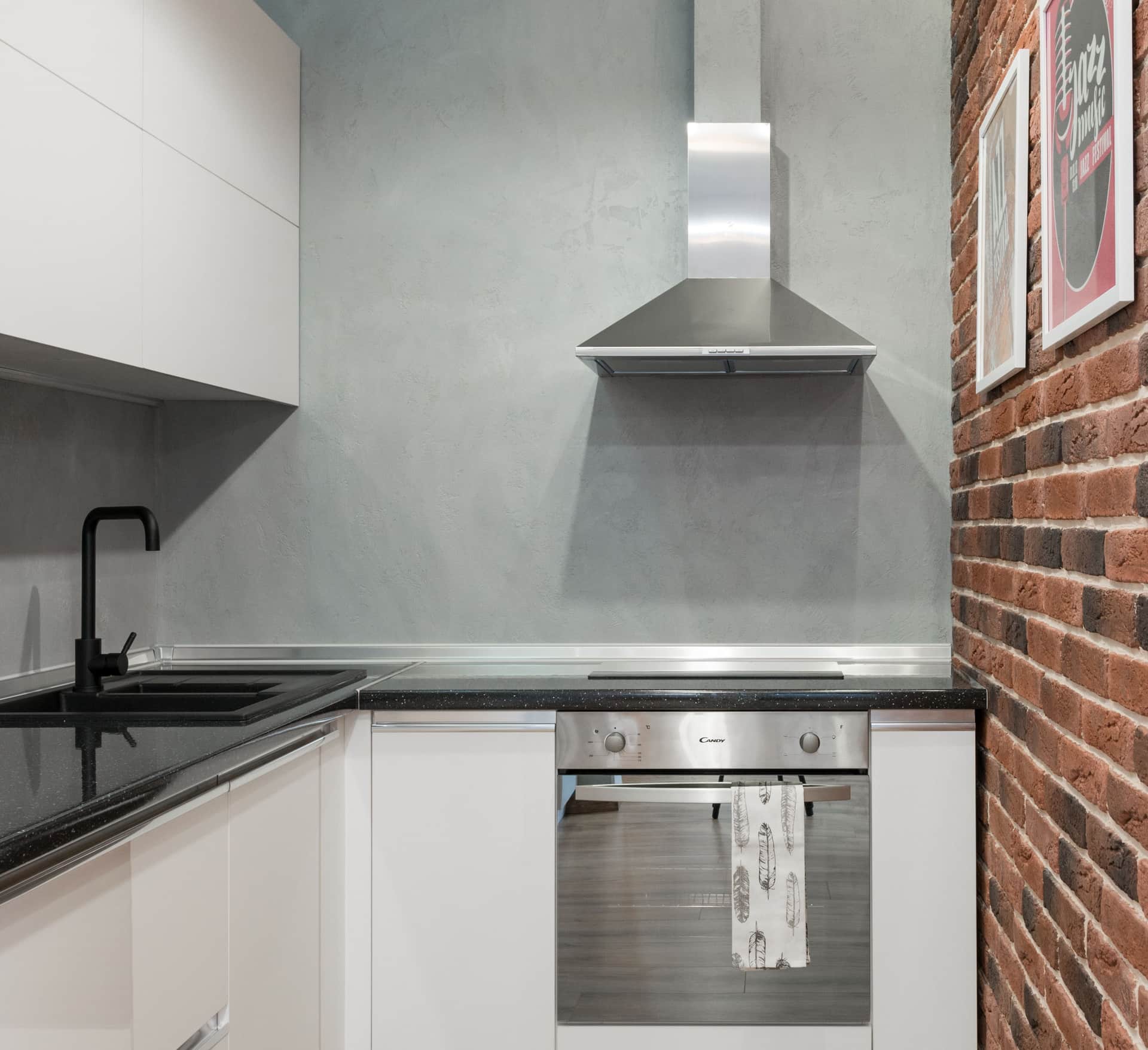
A Class K extinguisher uses a wet chemical agent that reacts with hot cooking oil to form a soapy crust on the surface — saponification — which both smothers the fire and holds the heat down so it cannot reignite. An ABC dry chemical unit knocks the flame out but leaves the oil above its ignition temperature, so it can relight. NFPA 10 requires Class K units in commercial kitchens using vegetable or animal fats. For a home kitchen, the right answer is almost always a lid or a fire blanket at the hob plus an ABC unit on the escape route, not a Class K cylinder.
Siren & Safe is reader-funded. We earn a commission on some links on this page, at no cost to you. It does not change what we recommend or the order we rank it in. Full disclosure.
What Class K is and why it exists
Class K is the fire class for cooking oils and fats — vegetable oil, animal fat, grease in a fryer. It was added to the classification system because commercial deep fryers were producing fires that the existing agents could knock down and not keep down.
The problem is heat, not flame. Cooking oil in a deep fryer holds an enormous amount of thermal energy and sits close to its auto-ignition temperature while it is in use. Blow the flame out with a dry chemical and the oil is still hot enough to ignite the vapor coming off it, so it relights, sometimes within seconds.
A Class K extinguisher uses a wet chemical agent — typically a potassium-salt solution — applied as a fine spray. When it hits the hot oil it reacts with it to form a thick soapy layer across the surface. That reaction is called saponification, and it does two jobs at once: the crust seals the surface against oxygen and vapor, and the water content of the agent carries heat away as it evaporates.
Smothering plus cooling is what makes it stick. Dry chemical does the first and not the second.
For the rating itself rather than the kitchen decision, Class K fire extinguishers sets out what the class covers, which occupancies NFPA 10 requires it in, and why a Class K unit carries no C rating.
Class K against ABC, side by side
| Class K (wet chemical) | ABC (dry chemical) | |
|---|---|---|
| Agent | Potassium-salt solution, applied as a mist | Monoammonium phosphate powder |
| Mechanism | Saponification — a soapy crust — plus evaporative cooling | Interrupts the flame chemistry; no meaningful cooling |
| Reignition risk on hot oil | Low — the oil is cooled and sealed | Real — the oil stays hot under the knocked-down flame |
| Risk of splashing the oil | Low — soft mist discharge | Higher — a powder jet can push burning oil out of the pan |
| Where it is required | Commercial kitchens with vegetable or animal fat appliances, under NFPA 10 | General purpose; the standard household unit |
| Ordinary combustibles and electrical | Limited — most Class K units carry little or no A rating | Covers A, B and C on one label |
| Sensible for a home kitchen | Rarely — oversized and single-purpose | Yes, as the escape-route unit — but not as the first thing you reach for |
Class designations and agent behavior as described by NFPA 10 and manufacturer documentation. The full class reference.
Quick picks
Scored against pan fire suitability, reignition control, ease under stress, aftermath and general kitchen cover. Tap a row for the full write-up. The price in each buy button is the live Amazon price at the last check, stamped with the date it was taken.
| # | Product | Best for | Score | Price |
|---|---|---|---|---|
| 1 | 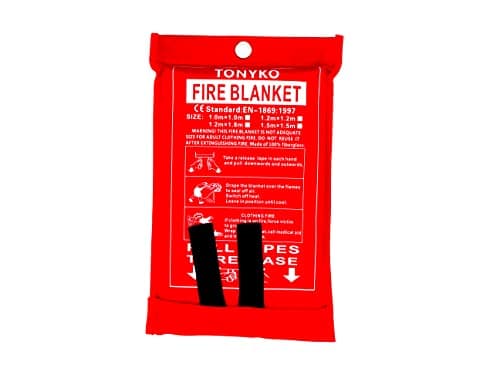 Tonyko Fiberglass Fire Blanket A lid you can throw. Faster than any extinguisher and it does not spread the oil. | The fire a home kitchen actually gets | 8.4/ 10 | $21.99 · View on Amazon #ad how we are funded · price as of October 19, 2026 |
| 2 | 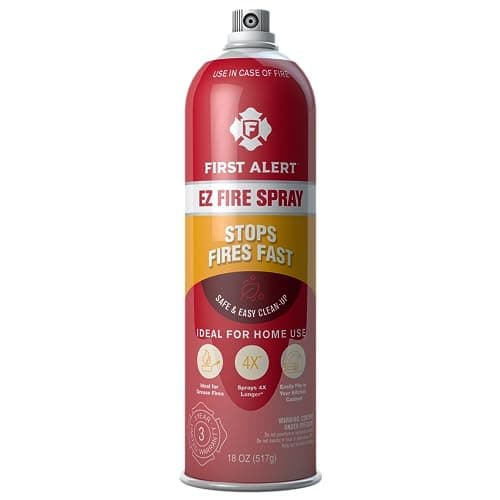 First Alert EZ Fire Spray AF400 Sodium bicarbonate, low discharge force and nothing to remember under stress. | The small kitchen fire that is not a pan | 7.8/ 10 | $11.98 · View on Amazon #ad how we are funded · price as of October 19, 2026 |
| 3 | 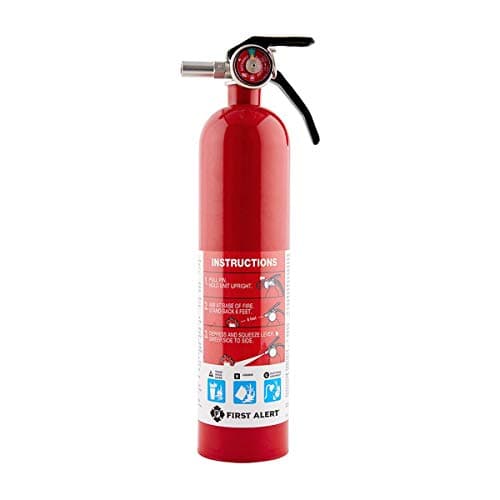 First Alert HOME1 Rechargeable Home Extinguisher (2.5 lb) 2.5 lb at 1-A:10-B:C — light enough to aim, rated enough to count. | The rated unit the kitchen still needs nearby | 6.8/ 10 | $19.98 · View on Amazon #ad how we are funded · price as of October 19, 2026 |
1. The fire a home kitchen actually gets
Tonyko Fiberglass Fire Blanket
A lid you can throw. Faster than any extinguisher and it does not spread the oil.
- Listed to
- Tonyko states the blanket meets EN 1869:1997 for cooking-fire suppression
- Sensing / agent
- Woven fiberglass
- Power / service life
- Single use on a real fire
This is the device a home kitchen should own, and it is not an extinguisher at all. Cooking fires are the leading cause of home fires, the overwhelming majority start on the hob, and the overwhelming majority of those are still in or just above the pan when somebody notices.
A blanket solves that specific fire better than any cylinder. It deposits nothing, it cannot splash the oil, and an untrained person can use it correctly on the first attempt — lay it over from the near edge, do not drop it from above, turn the heat off, walk away.
The weakness is the one Class K is designed around: a blanket smothers but does not cool. Oil at its auto-ignition temperature stays there under the blanket, so lifting too early relights it. Leave it covering the pan until the whole thing is cold, which in practice means leaving it for a long time.
Where to mount a fire blanket covers the positions, and best fire blankets for kitchens has the picks.
What it does well
- Smothers a pan fire by excluding oxygen, which is the same mechanism as the lid you should have used
- No discharge force, so there is no chance of blowing burning oil off the pan and across the kitchen
- Manufacturer states conformity to EN 1869:2019, the European cooking-fire blanket standard
- Nothing released into the room, so there is no cleanup beyond throwing the blanket away
The downside
- **Does not cool the oil**, so the pan can relight when you lift the blanket — leave it in place and let the hob go cold
- You have to get close to the fire to place it
- Woven fiberglass, which can shed glass fiber on handling
- Covers the pan and nothing else — no help with a wall, a cupboard or an extractor fire
Do not buy this if: a fire that has left the pan. Once a cupboard or the extractor hood is alight, a blanket is the wrong tool and you should be leaving rather than looking for a better one.
- Tonyko names a specific EN 1869 edition, which is more than most sellers in this category do
- 47.2 x 47.2 in (1.2 x 1.2 m) in the size linked here — large enough to wrap around a body as a heat shield, which the smaller hob blankets are not
- Also sold in a 47.2 x 70.9 in and a 78.7 x 78.7 in, so check which size you are adding to the basket
- Plain blanket — no pouch or hooks in the pack, so plan the fixing yourself
- Tonyko names the kitchen, fireplace, grill, car and camping as the intended uses
#ad how we are funded · price as of October 19, 2026
2. The small kitchen fire that is not a pan
First Alert EZ Fire Spray AF400
Sodium bicarbonate, low discharge force and nothing to remember under stress.
- Listed to
- Aerosol extinguishing spray — not a UL-rated A:B:C portable extinguisher
- Sensing / agent
- Sodium-bicarbonate-based extinguishing aerosol
- Power / service life
- Single use; check the stamped expiry
Pan fires are not the only kitchen fires. A toaster, an extractor filter loaded with grease, a tea towel against a hob, a microwave — these are small, they are not in a pan, and a blanket is awkward on all of them.
The aerosol is the sensible second device. Low discharge force matters here for the same reason it matters on oil: a powerful jet from a cylinder redistributes a burning mess rather than covering it.
Keep it in a cupboard near the door rather than beside the hob, and treat it as a first-thirty-seconds device. Aerosol spray vs traditional extinguishers is the longer argument.
What it does well
- Sodium-bicarbonate-based agent, which is the dry chemical family traditionally used on cooking fires
- Much lower discharge force than a cylinder, so less risk of pushing burning oil off the pan
- No pin, no gauge, no technique — the realistic kitchen operator will get it right
- Wipes up with a damp cloth rather than contaminating the whole room
The downside
- **Not a UL-rated A:B:C extinguisher** and not a Class K unit either — it satisfies no requirement
- Single use with a stamped expiry date
- Does not cool the oil any more than a blanket does
- Small quantity of agent, so there is no second attempt
Do not buy this if: anyone who needs a rated extinguisher for a landlord, an inspection or an insurer. It is a supplement, and the listings are not always clear about that.
- Aerosol can format — no pin, no pressure gauge, aim and spray
- Wipes up with a cloth instead of the corrosive mess dry chemical leaves
- Genuinely easier for someone who will never practice with a real extinguisher
- It is not a rated extinguisher and does not satisfy a code requirement for one
#ad how we are funded · price as of October 19, 2026
3. The rated unit the kitchen still needs nearby
First Alert HOME1 Rechargeable Home Extinguisher (2.5 lb)
2.5 lb at 1-A:10-B:C — light enough to aim, rated enough to count.
- Listed to
- UL rated 1-A:10-B:C
- Sensing / agent
- Monoammonium phosphate dry chemical
- Power / service life
- Rechargeable by a certified professional; metal head and pull pin
The uncomfortable truth about ABC powder in a kitchen is that it is the wrong tool for the most likely fire and the right tool for the second most likely one. That is an argument for owning both, not for skipping either.
Mount it by the exit, not by the cooker. The point of an extinguisher position is that you can reach it with the fire in front of you and the door behind you, and a bracket next to the hob fails that on the one occasion it matters.
If you want the full 2-A rating instead, what size fire extinguisher do I need covers the step up, and the kitchen extinguisher roundup has the picks in context.
What it does well
- A genuine UL rating — 1-A:10-B:C — which blankets and aerosols do not have
- Light enough for most people to hold out and sweep accurately
- Metal head and metal pull pin rather than the plastic-valve disposable tier
- Rechargeable, with a bracket in the box
The downside
- **Dry chemical on a pan of oil can splash it** if you aim badly or stand too close
- Does not cool the oil, so reignition is still possible after the flame is out
- Phosphate powder through the whole kitchen is a serious cleanup
- 1-A is half the ordinary-combustible rating of a 2-A unit
Do not buy this if: the pan itself, as a first choice. This is the unit for the fire that has spread off the hob and is still small — and for the requirement that says a kitchen must have a rated extinguisher.
- 2.5 lb — the lightest unit most people can aim accurately with one hand
- Metal head and a metal pull pin with a safety seal, not the plastic valve of the disposable tier
- Color-coded corrosion-resistant gauge and a mounting bracket in the box
- 1-A is half the ordinary-combustible rating of a 2-A unit, which is the trade for the size
First Alert product documentation
#ad how we are funded · price as of October 19, 2026
Why a home kitchen usually should not buy Class K
The honest answer here costs us a sale, and it is still the answer.
The hazard is a different size. NFPA 10 requires Class K protection within 30 ft of commercial cooking appliances using vegetable or animal fats, because a commercial fryer holds gallons of oil at temperature with a hood and ductwork above it. A domestic pan holds a fraction of that. The fire a Class K unit is engineered for is not the fire in your kitchen.
Class K units carry little or no A rating. They are single-purpose by design. Buying one as your kitchen extinguisher means the kitchen is now covered for oil and not covered for the bin, the curtains, the extension lead or anything else.
A lid or a blanket beats it on the realistic fire. For a pan still on the hob, covering it is faster, uses no agent, cannot splash and requires no technique. The thing that fails is reignition, and the fix for that is leaving the cover in place and letting the hob cool, which is free.
It is a second purchase, not a replacement. If you genuinely deep-fry at volume at home — a turkey fryer, a large outdoor fryer, a catering setup in a garage — then a Class K unit stops being theoretical. That is a specific circumstance, and the honest reading is that most readers do not have it.
What a home kitchen should actually keep
Four things, in the order we would buy them. Three of them are cheap and none of them is a Class K cylinder.
- A working smoke alarm outside the kitchen, not in it. Positioned at least 10 ft from the cooking appliance so it is not disabled by toast — kitchen and bathroom placement has the distances
- A pan lid you can reach without crossing the hob. The original Class K device, free, and the correct first move on a pan fire
- A fire blanket within one step of the cooker, on the approach side, in a pull-tab pouch
- A rated ABC extinguisher near the kitchen exit for the fire that has left the pan — mounted on the escape route, not beside the cooker
What to do with a pan fire, in order
This is the sequence that works. Everything above is context for it.
Turn the heat off
If the knob is reachable without leaning over the pan. If it is not, skip this and do not reach across flames to get to it.
Cover it
A metal lid, a baking tray or a fire blanket, slid across from the near edge rather than dropped from above. Dropping it pushes burning oil out at the sides.
Leave it covered and leave the kitchen
Do not lift the cover to check. The oil is still above its ignition temperature and admitting air relights it. Give it an hour, not a minute.
Never use water
Water on burning oil flashes to steam instantly and throws flaming oil across the room in a fireball. This is the single most dangerous thing a person can do in a kitchen, and it is the instinct most people have.
Never move the pan
Carrying a burning pan to the sink or the back door spills it, spreads the fire along your route and puts it between you and the exit.
If it is out of the pan, get out
Once the extractor, a cupboard or the ceiling is involved, the window for a household member to intervene has closed. Close the door behind you and call 911 from outside.
Where Class K does make sense at home
There is a real set of households for whom the answer flips, and it is worth naming them rather than pretending the product has no domestic use.
A turkey fryer. Several gallons of oil at temperature, outdoors, usually on an uneven surface, usually operated once a year by somebody who has not done it since last year. This is a commercial-scale oil hazard in a domestic setting, and it is the clearest case for a Class K unit.
A home catering or food-truck prep setup, where a domestic-looking kitchen is doing commercial-volume frying. If your insurer or your local authority has an opinion about your kitchen, assume the commercial requirement applies and ask them.
An accessory dwelling or rental with a fryer installed. Local requirements for rentals vary and some are specific about cooking-appliance protection. Rental and landlord requirements covers how to find out what yours says.
In all three cases a Class K unit sits alongside an ABC unit rather than replacing it, for the reason given above: it has little or no A rating, and the rest of the building still burns the ordinary way.
Questions people actually ask
Is a kitchen fire extinguisher different from an ABC extinguisher?
Do I need a Class K fire extinguisher at home?
What does saponification mean on a fire extinguisher?
Can I use an ABC extinguisher on a grease fire?
Why is Class K required in commercial kitchens?
What is the best fire extinguisher for a home kitchen?
How these picks were chosen. On published specifications, safety listings and manufacturer documentation — plus the findings of organizations that do run tests. We have no laboratory and we do not burn anything. Read the full methodology.
Sources
- NFPA — NFPA 10, Standard for Portable Fire Extinguishers
- Amerex — What is a Class K fire?
- NFPA — Cooking equipment fires in US homes
- US Fire Administration — Cooking fire safety
- UL Solutions — Fire extinguisher testing and certification (UL 711)
Read next
Fire Extinguishers
The Best Kitchen Fire Extinguishers
Class K versus ABC, and why the blanket is the kitchen's first tool.
Fire Extinguishers
The full class chart, what the numbers measure, and which agent suits which fire.
Fire Extinguishers
The correct sequence, why water is catastrophic, and when to leave instead.
Fire Blankets
The Best Fire Blanket for a Kitchen
Why a blanket beats an extinguisher at the hob, and what the cooking-fire standard really covers.
Fire Blankets
Fire Blanket vs Fire Extinguisher
Contact range versus projected agent — and the fires where each one is the wrong choice.
Fire Extinguishers
What Class B covers, what the number measures, and the rating a garage actually needs.