Smoke Detectors
The Best Talking Smoke Detectors
Seconds spent working out which noise is coming from which room are seconds out of an escape budget that is measured in minutes.
By Ryder M.Last reviewed

Buy the First Alert SM210V if you want one talking alarm: a sealed ten-year photoelectric unit that announces the location you programmed, and the only alarm here whose sensor type First Alert publishes on its own product page. The budget pick is the Kidde 30CUA10-V, which is the cheapest route to voice if your ceilings are already wired for alarms - it announces "Fire!" or "Warning! Carbon Monoxide" and interconnects over the existing wire. For a house with no alarm wiring at all, the Kidde 30CUAR-VRF adds a wire-free interconnect so the voice reaches rooms the cable never did. What no talking alarm does is detect better: every unit here is certified to the same UL 217 laboratory fires as a silent one.
Siren & Safe is reader-funded. We earn a commission on some links on this page, at no cost to you. It does not change what we recommend or the order we rank it in. Full disclosure.
What a voice actually buys you
There are two different features sold as "voice", and they are worth separating before you buy. The first is a spoken hazard: the alarm says "Fire" or "Warning, Carbon Monoxide" instead of sounding a horn. On a combination alarm that is genuinely important, because the two hazards demand opposite responses - leave the building for one, get into fresh air and call for help for the other - and one horn cannot tell you which.
The second is a spoken location: the alarm says the room name you programmed. That matters in a multi-story house where the stairs are the only way out, because knowing the fire is below you changes what you do next. In a one-bedroom apartment it tells you nothing.
What a voice does not buy is detection. Every alarm on this page carries a mark from a recognized testing laboratory against UL 217, which means it has passed the same smoke-entry and sensitivity tests as a silent $20 alarm. If the choice is one talking alarm or three plain certified ones for the same money, take the three - coverage beats features in this category every time, and how many smoke detectors do I need will tell you how short you currently are.
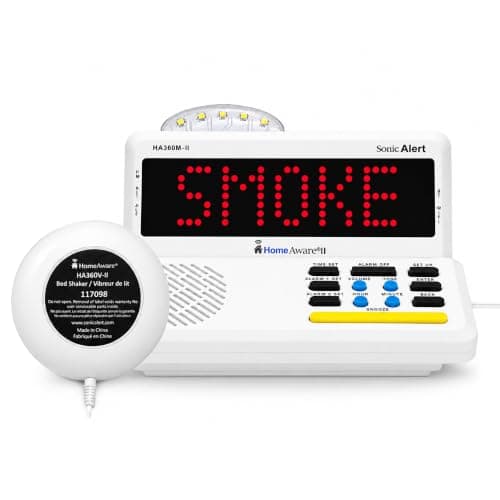
One group should not buy on voice at all. A spoken alert is no more audible to a deaf or severely hard-of-hearing person than a horn is, and the honest answer there is a strobe, a bed shaker or both.
Quick picks
Scored against what the voice tells you, install simplicity, ten-year upkeep, nuisance resistance and documented specification. Tap a row for the full write-up. The price in each buy button is the live Amazon price at the last check, stamped with the date it was taken.
| # | Product | Best for | Score | Price |
|---|---|---|---|---|
| 1 | 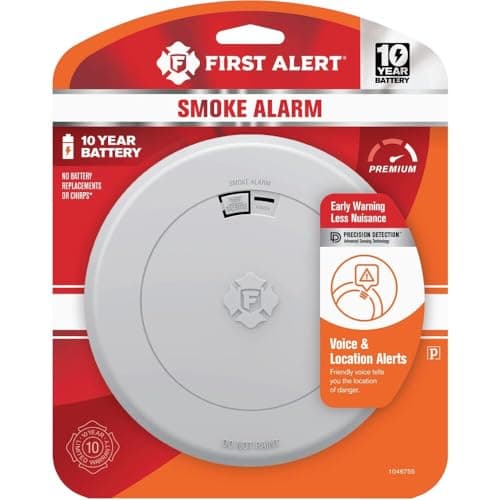 First Alert SM210V 10-Year Battery Smoke Alarm with Voice Alerts A sealed ten-year photoelectric alarm that announces the location you set. The best-documented alarm in this roundup and the easiest to fit. | One alarm, battery, with a spoken room name | 9.0/ 10 | $40.82 · View on Amazon #ad how we are funded · price as of November 11, 2026 |
| 2 | 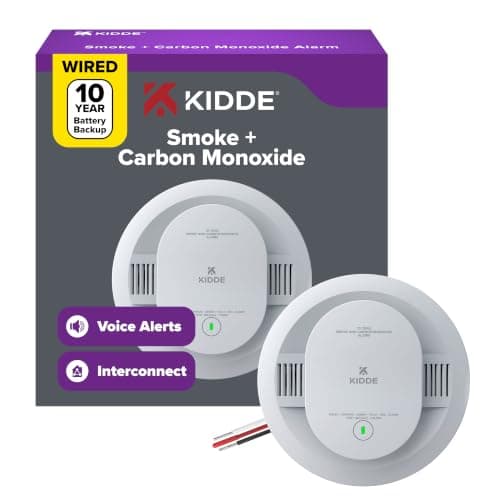 Kidde 30CUA10-V Hardwired Combination Smoke & CO Alarm Drops onto a wired alarm base, announces the hazard by name, covers smoke and carbon monoxide, and carries a sealed ten-year backup cell. | The budget pick - voice and CO on an existing alarm circuit | 8.7/ 10 | $73.99 · View on Amazon #ad how we are funded · price as of November 11, 2026 |
| 3 | 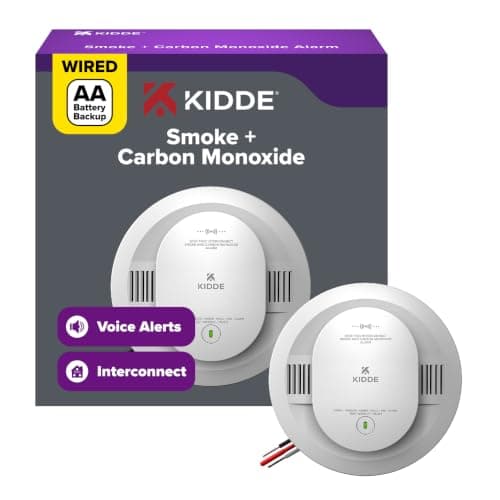 Kidde 30CUAR-VRF Wire-Free Interconnect Smoke & CO Alarm The same spoken smoke and CO alarm with a wire-free interconnect, which bridges a wired circuit upstairs to rooms with no alarm cable at all. | A half-wired house - voice that reaches the rooms the cable never did | 8.5/ 10 | $84.99 · View on Amazon #ad how we are funded · price as of November 11, 2026 |
| 4 | 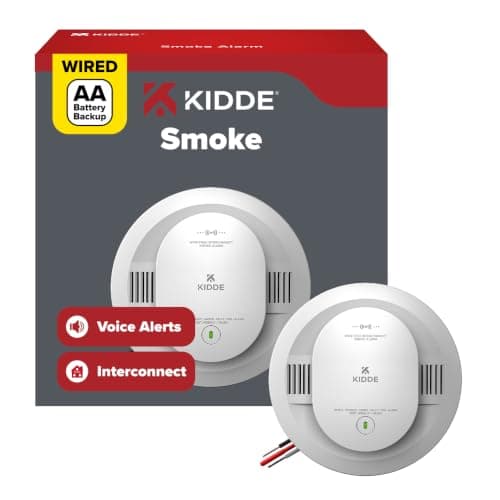 Kidde 20SAR-VRF Hardwired Smoke Alarm with Wire-Free Interconnect A hardwired photoelectric alarm that announces "Fire!", with both wired and wire-free interconnect. The one to fit where a separate CO alarm already exists. | Smoke-only voice on a wired circuit, where CO is covered elsewhere | 8.2/ 10 | $50.65 · View on Amazon #ad how we are funded · price as of November 11, 2026 |
The picks
1. One alarm, battery, with a spoken room name
First Alert SM210V 10-Year Battery Smoke Alarm with Voice Alerts
A sealed ten-year photoelectric alarm that announces the location you set. The best-documented alarm in this roundup and the easiest to fit.
- Listed to
- UL 217 — First Alert states compliance with the latest edition
- Sensing / agent
- Photoelectric smoke sensing, with spoken annunciation
- Power / service life
- Sealed 10-year lithium battery
Why orientation beats volume. An 85 dB horn in an unfamiliar dark hallway is a sound without a direction. Research into human behavior in fires keeps finding the same thing: people spend the first part of an alarm deciding what is happening rather than leaving. An alarm that says "basement" collapses that decision into a sentence.
Program it before it goes up. Set the location label on a table, test it, then mount it. Nobody enjoys doing that from a stepladder, and an alarm announcing the wrong room is worse than one announcing nothing.
It is still smoke only. That is the trade: you are paying for the announcement and giving up the CO cell. In an all-electric house with no attached garage that is defensible. In a gas house, buy a combination alarm as well.
What it does well
- **Voice alerts that name the location you programmed**, which orients a half-woken person before they have opened their eyes
- **First Alert publishes "Sensor Type Photoelectric"** on its own product page - rare now, and the sensor that responds sooner to smoldering fires
- **Sealed 10-year battery** with no low-battery chirps across the life of the alarm, plus an end-of-life warning
- **85 dB alarm and a 10-year limited warranty**, both published by First Alert rather than inferred from a retailer
- **No wiring.** Two screws, wall or ceiling, done in minutes
- A malfunction signal distinct from an alarm, so a fault reads as replace rather than reset
The downside
- **Smoke only.** No CO cell, so it does not replace a CO alarm in any house with a fuel-burning appliance
- **No interconnect**, so the voice tells you the room only when this is the alarm that sounded
- **The voice is a recorded location label**, not intelligence - people expect more from the word "voice" on a box than it delivers
- **Situational value.** In a studio apartment, naming the room tells you nothing you cannot see
- Sealed, so at ten years the whole unit is scrap
Do not buy this if: a hearing-impaired household, where a voice is no more audible than a horn and the answer is a strobe or a bed shaker - see [best smoke detectors for the hard of hearing](/smoke-detectors/best-smoke-detectors-for-hard-of-hearing). It is also the wrong unit if you need CO coverage from the same device.
- Speaks rather than only sounding a horn, which removes the 3am question of what the noise means
- Photoelectric sensing — the right sensor for a hallway or a landing
- Sealed ten-year cell, so the alarm never asks to be reached
- Part of First Alert's current SM-series rather than the outgoing SMI line
First Alert product documentation
#ad how we are funded · price as of November 11, 2026
2. The budget pick - voice and CO on an existing alarm circuit
Kidde 30CUA10-V Hardwired Combination Smoke & CO Alarm
Drops onto a wired alarm base, announces the hazard by name, covers smoke and carbon monoxide, and carries a sealed ten-year backup cell.
- Listed to
- UL 217 and UL 2034 — Kidde's data sheet states the unit meets UL 217, UL 2034, NFPA 72 and NFPA 101 at the date of manufacture
- Sensing / agent
- Photoelectric smoke sensing plus an electrochemical CO cell, with voice annunciation
- Power / service life
- 120V AC with a sealed 10-year backup battery; 10-year limited warranty and an end-of-life beep at ten years
Naming the hazard is worth more than naming the room. Smoke and carbon monoxide demand opposite responses: get out and stay out for one, get into fresh air and call for help for the other. A combination alarm with one horn cannot distinguish them, and households routinely guess wrong. A spoken hazard removes the guess, and that is the strongest safety argument for voice anywhere in this category.
If the wiring exists, use it. Dropping a wired house down to standalone battery alarms to save an hour is the worst trade available in this category, because every alarm sounding at once is the feature that gets a sleeping person out of a back bedroom.
Replace the whole loop. Alarms on a shared circuit age together, so one new unit on an old loop will have you back up the ladder next year. Best hardwired smoke detectors covers the wider field.
What it does well
- **Announces "Fire!" or "Warning! Carbon Monoxide"** rather than sounding one ambiguous horn for two completely different emergencies - the single most useful thing a voice can do
- **Smoke and CO in one device**, so one ceiling position covers both hazards
- **Wired interconnect for up to 24 compatible Kidde devices** - one sounds, they all sound, and they all say which hazard
- **Sealed ten-year backup battery** rather than the 2 AA cells its 30CUAR sibling uses: nothing to change for a decade
- **85 dB at 10 ft with Kidde's enhanced sensing** for the cooking-nuisance resistance the current residential standard tests
- Cheapest path to voice in this roundup if the wiring already exists, because the expensive part is in your ceiling
The downside
- **Needs an existing 120 V alarm circuit.** It is not a battery-only retrofit, and if you are not confident with the junction box that is an electrician rather than a Saturday
- **Kidde does not name the sensor type** on its published material for this model
- **Interconnect compatibility is per-brand and per-family**, not universal - mixing manufacturers on one loop is where retrofits go wrong
- **The announcement is fixed**, not a programmable room name
- A nuisance alarm now speaks in every room at once, which is the point and is still unpleasant at 2 a.m.
Do not buy this if: a rental or any home with no alarm wiring - the SM210V or the wire-free unit below are the alternatives. Before mixing brands on an existing loop, read [are smoke alarms interchangeable](/smoke-detectors/are-smoke-alarms-interchangeable).
- Drops straight onto an existing hardwired circuit and interconnects over the wire, with up to 24 compatible Kidde devices on one set
- Voice alerts announce "Fire!" or "Warning! Carbon Monoxide" rather than sounding an ambiguous horn
- Sealed ten-year backup battery rather than the 2 AA cells its 30CUAR sibling uses — nothing to change for a decade
- 85 dB at 10 ft, with Kidde's enhanced sensing technology for the cooking-nuisance resistance the latest residential standard tests
- Needs an existing 120V alarm circuit — it is not a battery-only retrofit
#ad how we are funded · price as of November 11, 2026
3. A half-wired house - voice that reaches the rooms the cable never did
Kidde 30CUAR-VRF Wire-Free Interconnect Smoke & CO Alarm
The same spoken smoke and CO alarm with a wire-free interconnect, which bridges a wired circuit upstairs to rooms with no alarm cable at all.
- Listed to
- UL 217 10th edition and UL 2034 5th edition; ETL listed
- Sensing / agent
- Photoelectric smoke sensing plus an electrochemical CO cell, with voice annunciation
- Power / service life
- 120V AC with two AA backup batteries
The half-wired house is extremely common. Original circuit on the bedroom floor, nothing in the basement, nothing in the loft conversion, nothing in the extension. This is the product category that exists for exactly that building, and the voice makes it more useful again: the basement alarm announces the basement hazard upstairs.
Pair the set on a table first. Every wireless interconnect problem is a range problem, and every range problem is cheaper to find before the holes are drilled.
Keep the AA cells on a calendar. The backup is the part that keeps this alarm working through a tripped breaker, and it is the one component here that will not look after itself.
What it does well
- **Wire-free interconnect bridges hardwired alarms to rooms with no alarm wiring** - Kidde names renovations, basements and lofts as the case for it
- **Voice announcement of "Fire" or "Warning, Carbon Monoxide"** on every unit in the set
- **Listed to UL 217 10th edition and UL 2034 5th edition, ETL listed** - the most specifically documented listing of any alarm on this page
- **Smoke and CO** from one ceiling position
- **Solves the commonest retrofit problem** without running cable through finished ceilings
- Pairs with Kidde's battery wire-free units for rooms with no AC at all
The downside
- **Still needs AC power at each hardwired position** - this unit is not the answer for a room with no electricity supply
- **AA backup batteries rather than a sealed cell**, so this one keeps the annual visit
- **Radio range is decided by your house.** Masonry, foil-backed insulation and steel cut into the link, so pair and test before drilling
- **It will not join a landlord's existing hardwired loop** - a wireless set is its own network alongside whatever is fitted
- More expensive than the plain wired version for a feature you only need if the wiring is incomplete
Do not buy this if: a fully wired house, where the plain 30CUA10-V does the same job for less, or a fully unwired one, where a battery wire-free set is simpler. [Interconnected smoke alarms](/smoke-detectors/interconnected-smoke-alarms) covers both routes.
- Wire-free interconnect bridges hardwired alarms to rooms with no alarm wiring
- Voice alerts announce "Fire" or "Warning, Carbon Monoxide" rather than an ambiguous horn
- Kidde names renovations, basements and lofts as the case for it — the half-wired house, original circuit upstairs and nothing below
- Still needs AC power at each hardwired position; pair it with Kidde's battery wire-free units for the rooms that have none
- AA backup batteries rather than a sealed cell, so this one still needs an annual visit
#ad how we are funded · price as of November 11, 2026
4. Smoke-only voice on a wired circuit, where CO is covered elsewhere
Kidde 20SAR-VRF Hardwired Smoke Alarm with Wire-Free Interconnect
A hardwired photoelectric alarm that announces "Fire!", with both wired and wire-free interconnect. The one to fit where a separate CO alarm already exists.
- Listed to
- UL 217 10th edition and UL 2034 5th edition; ETL listed
- Sensing / agent
- Photoelectric smoke sensing, with voice annunciation
- Power / service life
- 120V AC with two replaceable AA backup batteries
Why a smoke-only voice alarm still makes sense. Plenty of houses already have dedicated CO alarms at the right heights - plug-in units in hallways, a low-level alarm in a nursery. Fitting combination alarms on top of that means paying twice for the CO cell and replacing it on the smoke alarm's schedule. This is the unit for that house.
The interconnect is the real feature. Voice is useful; alarms that all sound together is the thing that moves the fatality statistics. Getting both from one unit on an existing circuit is the efficient buy.
Check the family before you order a set. Kidde's wire-free interconnect works with compatible Kidde units, and compatibility is per-family rather than per-brand.
What it does well
- **Hardwired and wire-free interconnect together**, joining wired alarms on its circuit to up to 12 compatible units in rooms with no wiring
- **Voice announcement of "Fire!"** rather than an ambiguous horn
- **Photoelectric sensing with voice annunciation**, published by Kidde
- **Listed to UL 217 10th edition**, which carries the cooking-nuisance test introduced in the 8th
- **85 dB with a red LED**, the standard specification done properly
- Fits the house where CO is already covered by dedicated alarms and doubling up would be waste
The downside
- **Smoke only** - no CO cell, so it is only the right choice where CO is handled separately
- **AA backup batteries**, not a sealed cell: the annual visit stays
- **Needs AC power** at each hardwired position
- **Twelve-unit interconnect limit** is lower than the combination model's twenty-four
- The announcement is fixed, not a programmable room name
Do not buy this if: a house with no CO coverage at all, where the combination models above are the better buy for the same install effort. See [combination or separate alarms](/carbon-monoxide-detectors/combo-vs-separate-alarms) for that decision.
- Hardwired AND wire-free interconnect: it joins the wired alarms on its circuit to alarms in rooms that have no wiring, up to 12 compatible units
- Voice alert announces "Fire!" rather than sounding an ambiguous horn
- 85 dB with a red LED
- Listed to UL 217 10th edition, which carries the cooking-nuisance test the 8th edition introduced
- AA backup batteries rather than a sealed cell — the one part of this alarm that still needs an annual visit
#ad how we are funded · price as of November 11, 2026
The four alarms side by side
Specifications as published by the manufacturers, checked on 2026-11-10. The live price and the date it was taken sit in each buy button rather than in this table.
| Alarm | What the voice says | Hazards | Power | Interconnect |
|---|---|---|---|---|
| First Alert SM210V | A room name you program | Smoke only | Sealed 10-year battery | None |
| Kidde 30CUA10-V | "Fire!" / "Warning! Carbon Monoxide" | Smoke and CO | 120 V, sealed 10-year backup | Wired, up to 24 units |
| Kidde 30CUAR-VRF | "Fire" / "Warning, Carbon Monoxide" | Smoke and CO | 120 V, two AA backup | Wired plus wire-free |
| Kidde 20SAR-VRF | "Fire!" | Smoke only | 120 V, two AA backup | Wired plus wire-free, up to 12 |
Only the First Alert unit announces a location you choose; the Kidde alarms announce the hazard. For a combination alarm the hazard announcement is the more valuable of the two.
Questions people actually ask
What is the best talking smoke detector?
Do talking smoke detectors work better than regular ones?
Can you change what a talking smoke detector says?
Is a voice alarm a good idea for children?
Do I need a talking alarm in every room?
How these picks were chosen. On published specifications, safety listings and manufacturer documentation — plus the findings of organizations that do run tests. We have no laboratory and we do not burn anything. Read the full methodology.
Sources
- UL Solutions — UL 217 — smoke alarms
- UL Solutions — UL 217, Standard for Smoke Alarms, published with new technical requirements
- UL Solutions — UL 2034 — single and multiple station carbon monoxide alarms
- First Alert — 10-year battery smoke alarm with voice alerts (SM210V) — product page
- NFPA — Smoke alarms — installation and placement guidance
- NFPA — NFPA 72, National Fire Alarm and Signaling Code (2025 edition)
- US Fire Administration — Home fire prevention
Read next
Smoke Detectors
The Best Smoke Detectors for a Home
Four alarms, what UL 217 tests, and why interconnection beats every other feature.
Smoke Detectors
The Best Hardwired Smoke Detectors
Four current hardwired alarms, the backup-battery decision, and the compatibility rule that breaks interconnects.
Smoke Detectors
Why interconnection matters most, and the wired, wireless and hybrid routes.
Smoke Detectors
The Best Smoke Detectors for the Hard of Hearing
Why 520 Hz and a bed shaker beat a louder horn, and the four devices that make up a real alerting plan.
Smoke Detectors
The Best Smoke and Carbon Monoxide Alarms Under $50
Four certified combination smoke and CO alarms under $50, including one with a wireless interconnect. What the price cap does and does not cost you.
Placement & Code
How Many Smoke Detectors Do I Need?
Worked counts for real house shapes, including split levels and open plans.