Smoke Detectors
Best Cigarette and Vape Detectors for Rentals
The device you already have on the ceiling is the wrong tool. A listed smoke alarm is engineered to ignore the things a no-smoking policy is about — and it has no way to tell you anything happened.
By Ryder M.Last reviewed
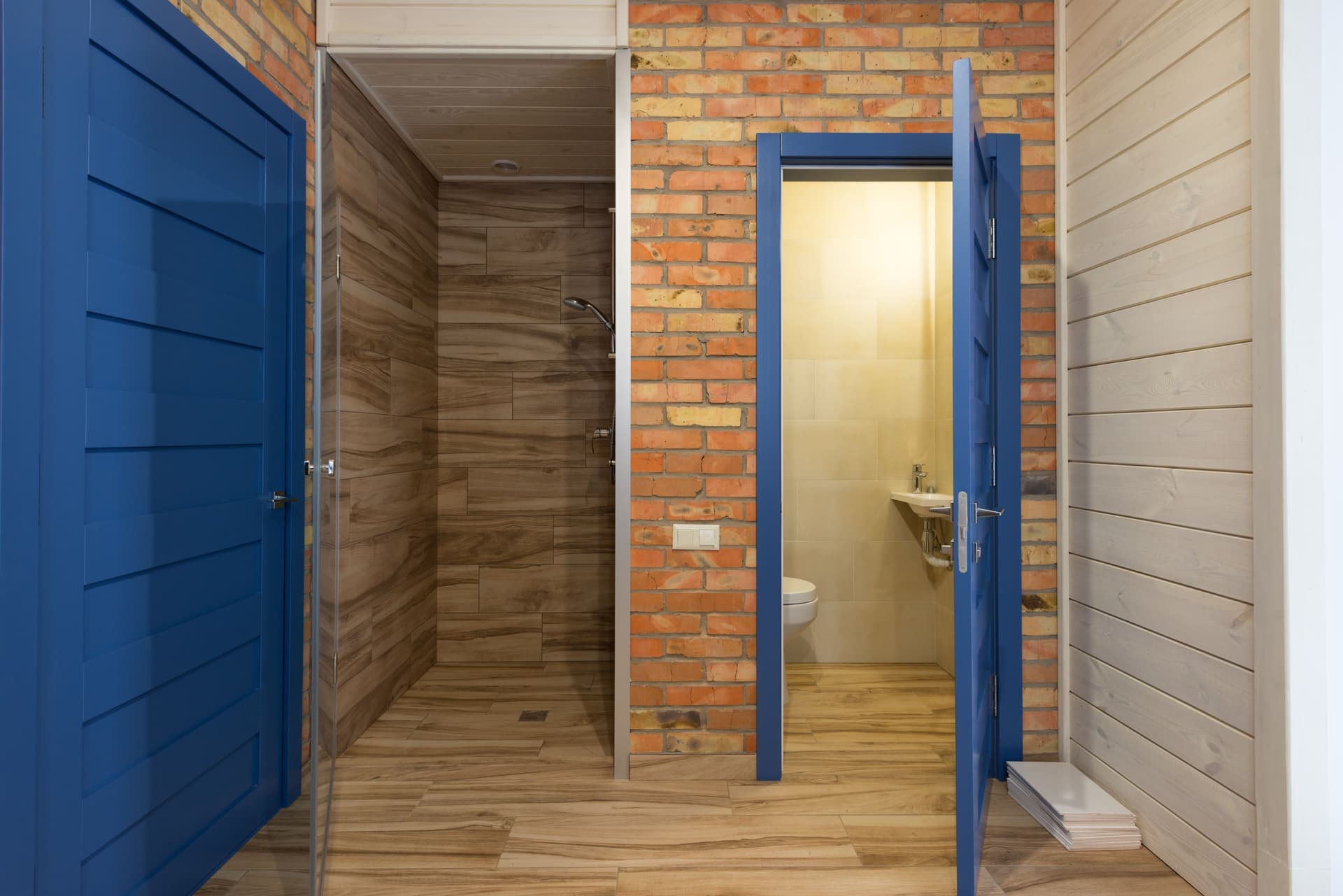
If you need to know whether someone smoked or vaped in your rental, you need a particulate monitor, not a smoke alarm. The Forensics Detectors FD-VAPE-WALL is the purpose-built option: a laser PM2.5 sensor that pushes a phone alert within seconds, covering 200 to 300 sq ft per unit. The Qingping Air Quality Monitor Gen 2 is the better choice when what you want is a record rather than an instant alert, and the Amazon Smart Air Quality Monitor is the cheapest way to put a particulate reading in a room. None of the three is a listed alarm, none of them is legal proof on its own, and none of them replaces the UL 217 smoke alarm your lease and your local code require.
Siren & Safe is reader-funded. We earn a commission on some links on this page, at no cost to you. It does not change what we recommend or the order we rank it in. Full disclosure.
Why a smoke alarm cannot do this job
The question "is there a cigarette smoke detector for landlords" usually comes from a reasonable assumption: there is a smoke alarm on the ceiling, cigarettes make smoke, so surely it can be made to notice. It cannot, and the reason is a design decision rather than a limitation.
A listed alarm is built to ignore ambient smoke. UL 217 10th edition, the current smoke-alarm standard, includes a cooking-nuisance test that an alarm has to pass to earn its listing: exposed to smoke from cooking food at a set distance, it must not alarm, while continuing to detect every fire it always had to. A sensor tuned tightly enough to flag a cigarette would alarm on dinner nightly, and an alarm that cries wolf gets taken down — which is the outcome the standard exists to prevent.
And an alarm has no memory and no voice. Even if a household alarm did react, it would sound for a minute and then stop, and nobody outside the building would ever know. There is no log, no timestamp and no notification. For a policy question — did somebody smoke in this unit on the 14th — a device with no record is no use.
So the market filled the gap with a different product class: particulate monitors. They count fine particles in the air, report numbers to an app, and some of them push an alert when a threshold is crossed. That is the right tool. It is also, importantly, not a safety device, and the rest of this page keeps those two jobs apart.
How we picked, and what we scored
We score monitors for this job on five things, in this order of weight. Does it notice aerosol quickly — a particulate sensor with a published response time and a published measurement range, not an air-quality "score". Does it reach your phone — because a reading nobody sees is not a detection. Does it keep a record — an app history or an API, since the practical use of these devices is almost always a conversation after the fact. Will it survive a tenancy — mains power, wall mounting, nothing a guest needs to maintain, nothing that chirps. And cost per room, because one monitor in a four-room unit is close to useless and the real figure is the room count times the unit price.
Everything in the specification table below is the manufacturer's own published figure, read on the date at the top of this page. We did not test these devices with a cigarette, and this page does not pretend otherwise: where a number is not published, it is not here. Our editorial scores are judgments about fitness for this specific job, and they are ours.
One criterion we deliberately did not score is accuracy against a reference instrument, because none of these is a reference instrument and the sensible way to read any of them is as a relative change in one room over time. A jump from 8 to 180 micrograms per cubic meter in a closed bathroom is meaningful. Whether the true figure was 174 or 191 does not matter to anybody's decision.
The four devices, side by side
Published specifications from each manufacturer. The last row is the one that decides which column you are really shopping in.
| Sensor | Alerting | Record | Listed alarm? | |
|---|---|---|---|---|
| Forensics FD-VAPE-WALL | Laser PM2.5, 0-999 ug/m3, response 5 s or less | Tuya Smart push; SMS and email at extra cost | App only | No |
| Qingping Gen 2 | Laser PM2.5 and PM10 plus SCD40 NDIR CO2 | App, not designed as an alerting device | App history plus an open API | No |
| Amazon Smart Air Quality Monitor | Particulate plus VOC, CO, temperature, humidity | Alexa app notifications and routines | Thin | No |
| X-Sense SC01 | Photoelectric smoke plus electrochemical CO | 85 dB horn in the room | None | Yes — UL 217 and UL 2034 |
Three monitors and one alarm. A rental needs the alarm regardless of what else is on the wall, and no monitor on this page is a substitute for it.
Quick picks
Scored against notices aerosol fast, alerts your phone, keeps a record, survives a tenancy and cost per room. Tap a row for the full write-up. The price in each buy button is the live Amazon price at the last check, stamped with the date it was taken.
| # | Product | Best for | Score | Price |
|---|---|---|---|---|
| 1 | 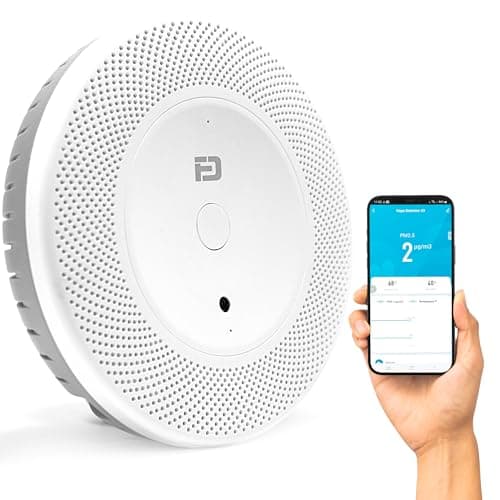 Forensics Detectors FD-VAPE-WALL Vape Detector A purpose-built vape and smoke particulate detector with a phone alert in seconds. Expensive per room, and the only one here designed for this job. | Catching it while it is happening | 7.8/ 10 | $475.00 · View on Amazon #ad how we are funded · price as of October 19, 2026 |
| 2 | 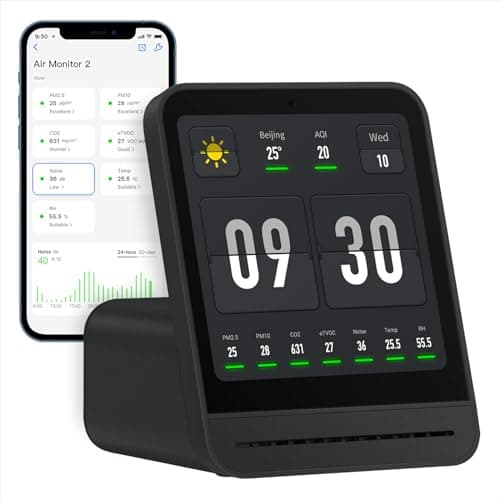 Qingping Air Quality Monitor Gen 2 Seven readings, a screen, history and an API. The best evidence trail here, and not an alerting device. | A record you can show somebody | 7.6/ 10 | $149.99 · View on Amazon #ad how we are funded · price as of October 19, 2026 |
| 3 | 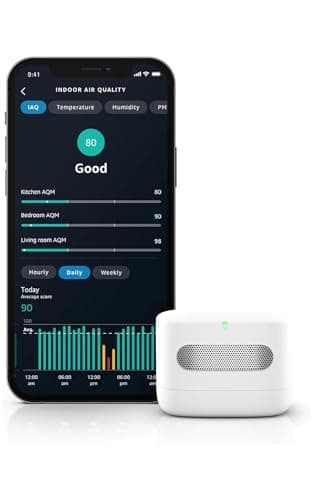 Amazon Smart Air Quality Monitor Cheap, mains powered, and it will notify you when a room's air gets bad. Vague about why, which is the trade. | A particulate reading in every room without a four-figure budget | 7.0/ 10 | $69.99 · View on Amazon #ad how we are funded · price as of October 19, 2026 |
| 4 | 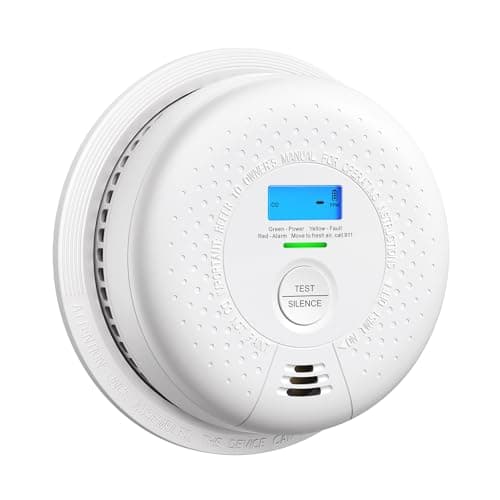 X-Sense SC01 Smoke & Carbon Monoxide Alarm A listed smoke and CO alarm with a sealed ten-year battery. It will not tell you about smoking, and it is still the most important device in the unit. | The device the law actually asks for | 8.0/ 10 |
The four devices
1. Catching it while it is happening
Forensics Detectors FD-VAPE-WALL Vape Detector
A purpose-built vape and smoke particulate detector with a phone alert in seconds. Expensive per room, and the only one here designed for this job.
- Listed to
- Not a fire or smoke alarm and not a listed alarm of any kind — an air-quality instrument
- Sensing / agent
- Laser-scattering particulate sensor, reading PM2.5 from 0 to 999 micrograms per cubic meter
- Power / service life
- Mains powered over USB; 1-year limited warranty
This is the only device on the page that was designed for the question in the title, and the design shows in two places: the response time and the alert path. A laser particulate sensor sampling continuously will see a vaping cloud within seconds, and the app will tell you while the person is still in the room. Nothing else here is that fast or that direct.
Where it goes matters more than which one you buy. Vaping in a rental happens in the bathroom with the extractor running, in a bedroom with a window open, and on a balcony threshold. Aerosol rises and collects, so a wall position high on the wall near the ceiling in a small enclosed room is the one that works. The manufacturer's 200 to 300 sq ft figure is a room figure, not a home figure — one unit in a bathroom is a sensible purchase, and one unit for a whole apartment is a false economy that produces nothing but ambiguity.
Be clear about what the alert is. It is a particulate reading crossing a threshold. Burnt toast crosses that threshold. A steamy shower can move a PM reading. An incense stick, a candle, a hair dryer in a dusty room — all of them look broadly similar to a sensor that only counts particles. What the device gives you is a timestamped signal that something aerosolized happened in that room, which is a strong prompt to go and look, and a weak thing to take to an arbitration panel on its own.
Cost honesty. At this price per room, this is a device for a property where a smoking incident has a real, quantified cost: a short-term let that has to be deep-cleaned and taken off the market, a non-smoking building with a contractual obligation to other residents, a unit that has already been smoked in once. For a standard long-term rental, the honest answer is that the money is better spent on a written policy, a deposit, and the listed alarms you are required to have anyway — best smoke detectors for rental property covers those.
What it does well
- Built for this specific job rather than adapted to it — the manufacturer publishes a response time of 5 seconds or less on its PM2.5 reading
- Laser-scattering particulate sensor reading 0 to 999 micrograms per cubic meter, which is the full range a vaping event moves through
- Push alerts to a phone through the Tuya Smart app over 2.4 GHz Wi-Fi; SMS and email are available through Tuya at extra cost
- Wall-mounted with the screw kit supplied, so it sits high where aerosol collects rather than on a shelf somebody can move
- One phone can hold several detectors, which is how a multi-unit property is actually managed
The downside
- **By far the most expensive option here** — at one unit per 200 to 300 sq ft, a two-bedroom apartment is a four-figure purchase
- Needs constant USB power, so every position must have an outlet and a cable you are happy to leave visible
- A detector pairs to one phone at a time, which makes handovers between a manager and an owner clumsy
- Tuya is a third-party cloud platform: the alerting depends on somebody else's servers and account policy
- **It is not a fire or smoke alarm** and is not a listed alarm of any kind, so it does nothing for code compliance
- One-year limited warranty, which is short for a device left powered continuously
Do not buy this if: a single long-term tenancy where what you really need is evidence at move-out rather than an alert at 2 am. The Qingping below keeps a better record for a fifth of the money, and a lease clause does more work than either.
- Purpose-built for vaping and smoking aerosol rather than general air quality, with a response time the manufacturer publishes as 5 seconds or less
- Phone push alerts through the Tuya Smart app over 2.4 GHz Wi-Fi, with SMS and email available through Tuya at extra cost
- Manufacturer recommends one unit per 200 to 300 sq ft, so a whole house is several units
- Wall-mounted with the screw kit in the box, and powered continuously from USB
- One detector pairs to one phone at a time, though a phone can hold several detectors
Forensics Detectors product documentation
#ad how we are funded · price as of October 19, 2026
2. A record you can show somebody
Qingping Air Quality Monitor Gen 2
Seven readings, a screen, history and an API. The best evidence trail here, and not an alerting device.
- Listed to
- Not a listed smoke or CO alarm — a monitoring instrument with a screen
- Sensing / agent
- Laser particulate sensor for PM2.5 and PM10 plus a Sensirion SCD40 NDIR sensor for carbon dioxide
- Power / service life
- USB powered with a small internal battery for short periods off the cable
The reason this earns a place over cheaper monitors is the record. A single reading proves very little; a logged particulate curve that spikes at 11:40 pm and decays over two hours, in a room with a closed door and a CO2 reading that says the window was shut, is a document. For a dispute over a cleaning fee or a policy breach, that is worth more than a notification nobody kept.
The CO2 sensor is more useful than it sounds. Ventilation is the variable that decides how long any smoke or aerosol lingers, and how far the residue travels into fabric. A room sitting at 1,800 ppm CO2 is a room with no air exchange, which is also a room where one cigarette becomes a week of smell in the curtains. The EPA's position on secondhand smoke is that there is no safe level of exposure and that ventilation does not eliminate it — the monitor's value is in telling you which rooms are not being aired at all.
Carbon dioxide is not carbon monoxide. This sentence exists on purpose, because the two get confused constantly and a monitor reading CO2 gives you no protection whatsoever from CO. A rental needs a listed CO alarm where the code requires one, and that is a separate device — do I need a CO detector answers the version of that question for a landlord.
It changes behavior, which is the quiet win. A visible screen reading 95 micrograms per cubic meter in front of a guest does more to end indoor smoking than any hidden sensor. Several short-term hosts use exactly that effect: a monitor in plain sight, disclosed in the listing, with a line in the house rules.
What it does well
- PM2.5 and PM10 on a laser sensor, published as 0 to 999 micrograms per cubic meter at plus or minus 10 micrograms or 10 percent
- Carbon dioxide on a Sensirion SCD40 NDIR sensor, published 400 to 9,999 ppm — the reading that tells you whether a room is ventilated at all
- History in the Qingping+ app plus an open API, so a pattern over a week is retrievable rather than a number you happened to see
- A color touchscreen means the tenant or guest can see the same reading you can, which changes behavior more than a hidden sensor does
- Also measures ambient noise level and TVOC, both useful in a short-term let for reasons that have nothing to do with smoking
The downside
- **Not an alerting device by design** — it is an instrument with a log, so a 2 am event is something you read about the next morning
- The internal battery runs only a few hours, so in practice it lives on a USB cable
- A portable desktop unit is a unit a guest can move, unplug or put in a drawer
- The noise-level reading raises a disclosure question in a short-term let even though it is a decibel figure and not a recording
- **Not a listed smoke or CO alarm**, and the CO2 reading is carbon dioxide, which is not carbon monoxide
Do not buy this if: catching someone in the act. If the goal is a phone alert while a guest is still in the building, buy the purpose-built detector above and accept the price.
- Seven readings on a color touchscreen: PM2.5, PM10, CO2, TVOC, temperature, humidity and ambient noise
- Published PM2.5 range of 0 to 999 micrograms per cubic meter at plus or minus 10 micrograms or 10 percent
- Published CO2 range of 400 to 9,999 ppm — useful for ventilation, and not a substitute for a CO alarm
- Qingping+ app with history, plus an open API, which is what makes a record rather than a snapshot
- Internal battery runs only a few hours, so it is a plugged-in device in practice
#ad how we are funded · price as of October 19, 2026
3. A particulate reading in every room without a four-figure budget
Amazon Smart Air Quality Monitor
Cheap, mains powered, and it will notify you when a room's air gets bad. Vague about why, which is the trade.
- Listed to
- Not a listed smoke or CO alarm — a monitoring device that reports to an app
- Sensing / agent
- Fan-assisted particulate sensor plus VOC, CO, temperature and humidity sensing
- Power / service life
- Mains powered over micro USB; no battery
The case for this one is arithmetic. One expensive detector in a four-room apartment tells you almost nothing, because the room it is in is probably not the room somebody used. Three cheap monitors in the three rooms that matter tell you where to look, and the cost of that is less than one purpose-built unit.
What a PM2.5 notification actually means. Fine particulate matter is the EPA's term for particles 2.5 micrometers and smaller, and it is the measurement that tobacco smoke and vaping aerosol both move sharply. It is also what cooking, candles, a dusty vacuum and an open window on a bad air day move. Treat the notification as a question, not an answer — and if the answer matters financially, pair it with something that keeps a log.
The carbon monoxide line deserves repeating. This device reports a CO value. It is not listed to UL 2034, it is not an alarm, and nobody should be relying on it to wake a household. The CO alarm in a rental is a code item with its own requirements; rental and landlord requirements sets out what a landlord is actually obliged to install.
Where this unit is genuinely the right purchase: a landlord who wants early warning across a whole unit, a host who wants to know a room was used in a way the listing forbids, or anybody testing whether a problem exists at all before spending real money on a detector that proves it.
What it does well
- Five readings — PM2.5, VOCs, carbon monoxide, temperature and humidity — at the lowest price per room here
- Push notifications through the Alexa app, plus routines and spoken announcements on an Echo device
- Cheap enough to put in several rooms, which is what makes an alert interpretable at all
- Permanently powered and physically small, so it disappears into a room rather than announcing itself
- Self-calibrating, with nothing for a tenant or guest to maintain
The downside
- **No display at all** — a single status LED, with every number living in the Alexa app
- Requires an Amazon account and the Alexa ecosystem, which is a real constraint for a property manager who does not use it
- History is thin: good for an alert, weak as the record you bring to a dispute
- **The carbon monoxide reading is not a CO alarm** and must not be treated as one; a listed UL 2034 alarm is a separate purchase
- An air-quality score is a composite, so a notification tells you something changed rather than that somebody smoked
Do not buy this if: evidence. This is a tripwire, not a witness. If the point of the exercise is to document a breach, buy the Qingping and keep the log.
- Reports five values — PM2.5, VOCs, carbon monoxide, temperature and humidity
- Push notifications through the Alexa app, plus Alexa routines and spoken announcements on an Echo device
- No display: a single LED indicates current air quality, and the numbers live in the app
- Permanently powered by a 5V adapter, so it cannot be moved around a property casually
- The cheapest way to put a particulate reading in a room — and the least specific about why the reading moved
#ad how we are funded · price as of October 19, 2026
4. The device the law actually asks for
X-Sense SC01 Smoke & Carbon Monoxide Alarm
A listed smoke and CO alarm with a sealed ten-year battery. It will not tell you about smoking, and it is still the most important device in the unit.
- Listed to
- UL 217 and UL 2034
- Sensing / agent
- Photoelectric smoke sensing plus an electrochemical CO cell
- Power / service life
- 10-year sealed battery, not hardwired
Every device above is a monitoring instrument. This is the alarm. The distinction is not pedantry: a monitor notifies an app, and an alarm sounds at 85 dB in a bedroom at 3 am and wakes a person who is asleep. Only one of those saves a life, and only one of them satisfies a code inspector.
Why your smoke alarm never catches a smoker. Modern alarms are listed to UL 217 10th edition, which added a cooking-nuisance test: to earn the listing, an alarm must be exposed to cooking smoke at a defined distance and *not* alarm, while still passing every fire test. The industry spent years engineering out exactly the sensitivity a landlord is asking for. An alarm that reacted to a cigarette would be an alarm that reacted to toast, and it would be off the ceiling inside a month. UL 217 certification explained covers what that test involves.
What to install alongside the monitors. A listed alarm inside every sleeping room, outside each sleeping area and on every level — plus CO coverage where the code requires it. In a rental, sealed-battery units are worth paying for because the commonest cause of a dead alarm in a tenancy is a removed battery. Best smoke detectors for rental property is the dedicated page, and how many smoke detectors do I need does the count.
What it does well
- UL 217 and UL 2034 — a listed smoke alarm and a listed CO alarm in one unit, which is what a rental is required to have
- Sealed ten-year battery: no cells for a tenant to remove, and no annual chirp that invites them to
- LCD showing the CO reading and the battery state, so a turnover inspection takes seconds
- Cheap enough to fit every position the code asks for rather than the minimum
The downside
- **Tells you nothing about smoking or vaping** — a current UL 217 listing specifically includes a cooking-nuisance test, so the alarm is engineered not to react to ambient smoke
- No interconnect, so one alarm sounding does not sound the others
- No Wi-Fi and no notification, so nothing reaches a landlord's phone
- Standalone units mean a per-room test at every turnover, which is real work in a multi-unit building
Do not buy this if: the job this page is about. It is here because the monitors above are not alarms, and the single most common mistake in this whole area is a landlord who installs a vape detector and thinks the ceiling is covered.
- Real-time CO and battery status on the LCD
- Sealed battery — nothing to replace for the life of the unit
- Compact body, which matters where it has to sit beside an existing mounting plate
- Standalone: no interconnect
Getting this right legally and practically
A monitor creates as many questions as it answers. These are the ones worth settling before you mount anything.
- Disclose it. Put the device in the lease or the listing, in writing, before anyone moves in: what it measures, where it is, and what happens if it triggers. An undisclosed sensor is a dispute waiting to happen and, in a short-term let, usually a platform policy violation as well.
- No cameras and no microphones indoors. This is the bright line. A particulate monitor measures particles and a decibel reading is a sound *level*, not a recording — but if a device can capture audio or images inside a dwelling, it does not belong there. Nothing on this page records anything.
- One per room that matters, not one per property. Bathroom first in a short-term let, then the bedroom, then the main living space. A single monitor by the front door will miss the event and tell you nothing useful about the one it catches.
- High on a wall, mains powered, out of easy reach. Aerosol rises. A unit on a side table is a unit that gets moved, unplugged or covered with a towel.
- Treat a reading as a prompt, not a verdict. Cooking, candles, incense, a steamy shower and a dusty vacuum all move a particulate sensor. The defensible version of this is a pattern — a spike, a decay curve, a closed-up room — alongside a physical inspection and a written policy.
- Do not let a monitor substitute for the alarms. Listed smoke alarms and, where required, CO alarms are code obligations with their own rules, and a monitor does nothing for either. Rental and landlord requirements has the detail.
What smoke actually leaves behind
The reason landlords care about this is not squeamishness, it is cost. Tobacco smoke residue settles into drywall, carpet backing, curtain fabric, HVAC ducting and the gaps around window frames, and it keeps releasing odor for months. Repainting over it rarely works; sealing, replacing soft furnishings and cleaning ductwork are what works, and those are four-figure jobs rather than a deep-clean line item.
The health side is not ambiguous either. The EPA's position on secondhand smoke is that there is no risk-free level of exposure, and that separating smokers from non-smokers, cleaning the air and ventilating buildings do not eliminate it. In a multi-unit building, smoke moves between units through shared risers, plumbing penetrations and corridor gaps, which is why a no-smoking policy in one apartment is a building-wide question.
And there is a fire-safety reason, which is the one this site exists for. Smoking materials are significant enough as an ignition source that NFPA publishes a standing report on home structure fires started by them. A no-smoking policy in a rental is a fire-prevention measure as much as a cleanliness one — and the two devices that matter most for that are a working alarm and a practiced escape plan, not a monitor. Fire escape plan and home fire safety checklist are the pages for the parts a sensor cannot do.
What to do when a monitor triggers
In order, and the first step is the one people skip.
Rule out a fire first
A particulate spike can be a fire getting started. If the property is occupied, contact the occupant. If the alarm is also sounding, that is a fire response, not a policy response: get people out and call 911 from outside. A monitor alert alongside an alarm is never a cleaning question.
Timestamp and save the data
Screenshot the reading and export the history if the app allows it. Note the time, the room and the duration. A record made the same day is worth considerably more than a recollection a month later at move-out.
Check for an innocent explanation
Cooking, a candle, incense, a hairdryer, a dusty room, an open window next to a barbecue. Ask before you accuse. Most single spikes have a dull explanation, and the credibility you spend on a wrong accusation is gone for the rest of the tenancy.
Inspect in person, with notice
Residue, smell, ash, burn marks on a sill or a bathroom surface. Follow the notice period your lease and your state require — an inspection done improperly is worth nothing afterwards, however clear the finding.
Write it down, then act under the lease
Policy breaches are enforced through the lease, the deposit and, in a short-term let, the platform's process. The monitor's job ended when it produced a timestamped prompt; everything after that is paperwork, and the paperwork is what actually recovers a cleaning cost.
Questions people actually ask
Is there a cigarette smoke detector for landlords?
Can a vape detector tell the difference between vaping and cooking?
Is a vape detector legal in a rental?
Will a vape detector replace my smoke alarms?
How many vape detectors does a rental need?
Does an air quality monitor detect carbon monoxide?
How these picks were chosen. On published specifications, safety listings and manufacturer documentation — plus the findings of organizations that do run tests. We have no laboratory and we do not burn anything. Read the full methodology.
Sources
- US Environmental Protection Agency — Secondhand smoke and smoke-free homes
- US Environmental Protection Agency — Particulate matter (PM) basics
- UL Solutions — UL 217 — smoke alarms
- UL Solutions — UL 217, Standard for Smoke Alarms, published with new technical requirements
- NFPA — Home structure fires started by smoking materials
- US Fire Administration — Home fire prevention
Read next
Smoke Detectors
The Best Smoke Detectors for Rental Properties
Sealed-battery laws, locking brackets, and what to fit in a unit that changes tenants every year.
Placement & Code
Rental and Landlord Requirements
Where rental alarm duties actually come from, and what tenants and landlords should check.
Smoke Detectors
The Best Smoke Detectors for Fewer False Alarms
The UL 217 10th edition nuisance test, how to read it on a box, and four alarms that pass it.
Smoke Detectors
What the standard tests, what the recent editions changed, and how to verify a mark is real.
Smoke Detectors
Google's promoted Nest Protect successor, reviewed on the published specification — including the CR123A battery design and the listing we could not verify.