Fire Extinguishers
Best Fire Extinguishers for Boats
A boat is the one place where the extinguisher you carry is a legal requirement with a number attached. Here is the number, and the unit we would mount by the companionway.
By Ryder M.Last reviewed

For a recreational motorboat under 26 feet, buy the First Alert AUTOMAR10: a rechargeable 10-B:C unit with a metal head, a corrosion-resistant gauge and a mounting bracket in the box, sold by First Alert specifically for auto and marine service. Federal law (46 CFR 25.30-20) asks a boat under 26 feet with no fixed system for one 5-B extinguisher, a boat from 26 to under 40 feet for two, and a 40 to 65 foot boat for three — and since April 2022 a disposable extinguisher is only acceptable for 12 years from its date of manufacture. Read the label for the Coast Guard approval and the B rating before you rely on anything you buy, including the units below.
Siren & Safe is reader-funded. We earn a commission on some links on this page, at no cost to you. It does not change what we recommend or the order we rank it in. Full disclosure.
What the Coast Guard actually requires
This is the part most buying guides are vague about, so here it is with the citation attached. 46 CFR 25.30-20 sets a minimum number of hand portable fire extinguishers for motorboats by length, and the number halves — sometimes to nothing — if the machinery space has a fixed fire extinguishing system in it.
Two further provisions matter to a buyer. One 20-B portable extinguisher may be substituted for two 5-B portables, which is often the cheaper and tidier way to meet a two-unit requirement. And motorboats under 26 feet propelled by outboard motors and not carrying passengers for hire need not carry portable extinguishers at all if the construction of the boat will not permit the entrapment of explosive or flammable gases or vapors — a narrow exemption most people reading this will not qualify for and should not plan around.
The 2022 change is the one that catches owners out. The National Safe Boating Council summarizes it plainly: the regulation puts a 12-year expiration on all disposable, non-rechargeable fire extinguishers, measured from the date of manufacture stamped on the bottom of the bottle or near the UL label, which may appear as two digits or four (08, or 2008). Boats of model year 2018 and newer must carry units marked 5-B, 10-B or 20-B; boats of model year 2017 and older may keep an older B-I or B-II disposable until it reaches that 12-year date, after which it must be replaced with the newer classification.
Required portable extinguishers by boat length
Straight from the table in 46 CFR 25.30-20. These are minimums, not recommendations — we would carry more than the minimum on any boat with a cabin.
| Vessel length | No fixed system | Fixed system in machinery space |
|---|---|---|
| Under 26 ft | 1 x 5-B | None required |
| 26 ft to under 40 ft | 2 x 5-B | 1 x 5-B |
| 40 ft to 65 ft | 3 x 5-B | 2 x 5-B |
One 20-B portable may be substituted for two 5-B portables. State law and a marina's own rules can each ask for more; the federal table is the floor.
What to look for on the label
Four things, in the order a boat owner should check them. All four are printed on the unit — none of them require trusting a product listing.
- The Coast Guard approval marking. A B rating on its own does not satisfy the carriage requirement; the unit has to be an approved type, and the approval is marked on the label.
- The B number: 5-B, 10-B or 20-B. The number is the square footage of flammable-liquid fire the unit was tested against. For a model-year 2018 or newer boat this is the only classification scheme that counts.
- The date of manufacture, stamped into the bottom of the bottle or printed near the UL label. On a disposable unit, that date plus 12 years is its legal life — a figure that did not exist before April 2022.
- Whether it is rechargeable. A rechargeable unit with a metal valve is serviced rather than discarded, which takes the 12-year disposable clock off the table and generally buys you a better-built extinguisher.
Quick picks
Scored against fuel-fire rating, corrosion resistance, mounting, one-handed use and ordinary combustibles. Tap a row for the full write-up. The price in each buy button is the live Amazon price at the last check, stamped with the date it was taken.
| # | Product | Best for | Score | Price |
|---|---|---|---|---|
| 1 | 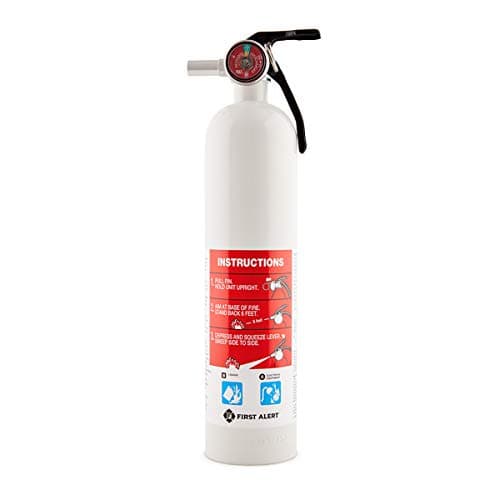 First Alert AUTOMAR10 Auto/Marine Fire Extinguisher Rechargeable, metal-headed, bracketed and sold for marine duty. The right default for a recreational boat. | A boat under 26 feet — the whole requirement in one unit | 8.1/ 10 | |
| 2 | 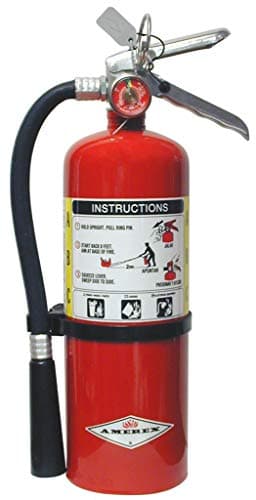 Amerex B500 5 lb ABC Dry Chemical Extinguisher 2-A:10-B:C in an all-metal rechargeable body. The unit that covers the cushions a marine B:C unit cannot. | The accommodation, or a boat big enough to carry two | 8.0/ 10 | $75.01 · View on Amazon #ad how we are funded · price as of October 19, 2026 |
| 3 | 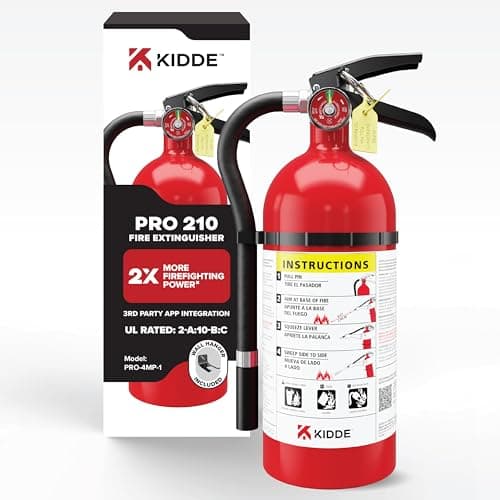 Kidde Pro 210 4 lb Multi-Purpose Extinguisher 4 lb and 2-A:10-B:C. The compromise when you want A-class coverage you can hold out at arm's length on a rolling deck. | The lightest unit that still carries a 2-A rating | 7.6/ 10 | $54.97 · View on Amazon #ad how we are funded · price as of October 19, 2026 |
| 4 | 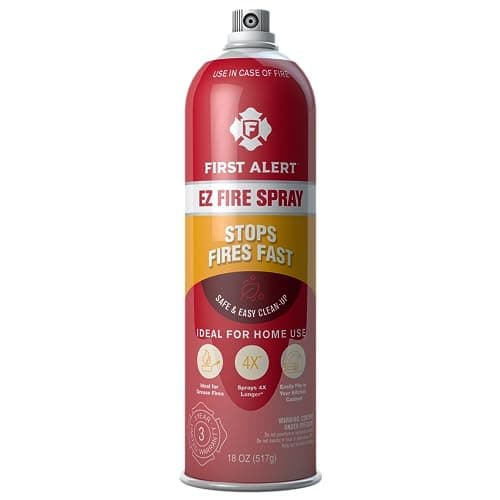 First Alert EZ Fire Spray AF400 Aim and spray, wipes up with a cloth. Genuinely useful in a galley, and legally worth nothing. | A galley flare-up, as a supplement and never a substitute | 6.2/ 10 | $11.98 · View on Amazon #ad how we are funded · price as of October 19, 2026 |
The picks
1. A boat under 26 feet — the whole requirement in one unit
First Alert AUTOMAR10 Auto/Marine Fire Extinguisher
Rechargeable, metal-headed, bracketed and sold for marine duty. The right default for a recreational boat.
- Listed to
- UL rated 10-B:C
- Sensing / agent
- Sodium bicarbonate dry chemical
- Power / service life
- Rechargeable by a certified professional; mounting bracket included
Why a B:C unit rather than an ABC. On a boat the realistic ignition sources are fuel, oil, a battery bank and an electrical fault — Class B and Class C fires. Sodium bicarbonate is formulated for exactly those, and it is markedly less corrosive than the monoammonium phosphate in a household ABC unit. Where the thing you are protecting is largely metal and wire, that difference is worth having.
What it will not do. There is no Class A rating on this unit, and that is not a technicality. A mattress, a cushion, a bag of towels or a coil of rope is a Class A fire, and a 10-B:C extinguisher is the wrong tool for it. If your boat has a cabin you sleep in, carry a second A-rated unit for the accommodation and keep this one near the engine and the fuel.
Mount it, do not stow it. The bracket is the most underrated part of this purchase. An extinguisher buried in a locker under three fenders is an extinguisher nobody reaches in the forty seconds that matter. Mount it where a person standing in the cockpit can take it off the bulkhead one-handed, and put a second one on the far side of the fire you are worried about so you are never reaching through flames to get it. Where to mount a fire extinguisher covers that geometry.
What it does well
- UL rated 10-B:C — flammable liquids and energized electrical gear, which is the fire a boat actually has
- Sodium bicarbonate rather than monoammonium phosphate: the less corrosive of the two dry chemicals, which matters around aluminum and wiring
- Rechargeable, with a metal head and a metal pull pin rather than the plastic valve of the throwaway tier
- Corrosion-resistant pressure gauge, so one glance tells you whether it survived a winter in a damp locker
- Vehicle bracket in the box — an extinguisher rolling loose in a bilge is not an extinguisher you will find
- First Alert publishes 5.3 lb total weight and a 14.1 in body, which fits the lockers boats actually have
The downside
- **No Class A rating at all** — it will not reliably put out a berth mattress, a cushion or a locker full of line
- Roughly ten seconds of agent. A marine fire that is not out in one approach is a fire you leave
- Dry chemical fouls an engine bay: anything you discharge it into needs cleaning before it runs again
- Rechargeable means a service relationship, and nobody recharges a small unit cheaply
- Check the label yourself for the Coast Guard approval marking — a B rating alone does not satisfy the carriage requirement
Do not buy this if: your boat has a cabin with soft furnishings and you want one extinguisher to cover everything. A 10-B:C unit has no Class A rating, so the accommodation needs an A-rated unit as well — the Amerex B500 or the Kidde Pro 210 below.
- 10-B:C — flammable liquids and energized electrical equipment, with no A rating at all
- Sodium bicarbonate rather than monoammonium phosphate, which is the less corrosive of the two dry chemicals
- Metal head and metal pull pin with a safety seal, plus a corrosion-resistant gauge
- First Alert publishes 5.3 lb total weight and a 14.1 in body, with a vehicle bracket in the box
- No Class A rating means it is the wrong unit for a sofa, a mattress or a wastebasket fire
First Alert product documentation
2. The accommodation, or a boat big enough to carry two
Amerex B500 5 lb ABC Dry Chemical Extinguisher
2-A:10-B:C in an all-metal rechargeable body. The unit that covers the cushions a marine B:C unit cannot.
- Listed to
- UL rated 2-A:10-B:C
- Sensing / agent
- Monoammonium phosphate dry chemical
- Power / service life
- Rechargeable; all-metal valve and body
This is the extinguisher for the half of a boat fire the marine unit is not rated for. Anything soft — a berth, a cushion, a sail bag, a locker of line — is a Class A fire, and the 2-A rating here is what addresses it.
It is also the sensible answer to the 12-year expiration rule, because that rule applies to disposable extinguishers. A rechargeable unit with an all-metal valve is maintained rather than discarded: inspected, recharged after use, hydrostatically tested on a schedule. It does not quietly become unlawful on an anniversary you forgot.
What it does well
- 2-A:10-B:C, so it covers bedding, upholstery and stowed gear as well as fuel and electrics
- All-metal valve and body — this is the commercial tier, not the hardware-store tier
- Rechargeable rather than disposable, which sidesteps the 12-year disposable expiration clock entirely
- 5 lb of agent is real run time compared with the compact units
- Amerex is a fire-industry manufacturer, and service companies stock parts for its units
The downside
- 5 lb plus the cylinder is a lot to aim accurately from a moving deck
- Monoammonium phosphate is the more corrosive dry chemical — fine for a cabin, less ideal beside an engine
- Bulky for a small boat. On anything under about 20 feet it is more extinguisher than there is space for
- **Confirm the Coast Guard approval marking on the unit you receive** before you count it toward a carriage requirement
Do not buy this if: a small open boat. On a 17-foot center console there is nowhere sensible to put a 5 lb cylinder, and the compact marine unit is the better buy.
- All-metal valve rather than plastic, which is the difference between a serviceable unit and a disposable one
- Rechargeable, so a partial discharge during a small fire does not write off the extinguisher
- 2-A:10-B:C covers ordinary combustibles, flammable liquids and energized electrical equipment
- 5 lb is heavier than the supermarket unit and needs a proper bracket
#ad how we are funded · price as of October 19, 2026
3. The lightest unit that still carries a 2-A rating
Kidde Pro 210 4 lb Multi-Purpose Extinguisher
4 lb and 2-A:10-B:C. The compromise when you want A-class coverage you can hold out at arm's length on a rolling deck.
- Listed to
- UL rated 2-A:10-B:C
- Sensing / agent
- Monoammonium phosphate dry chemical
- Power / service life
- Rechargeable; mounting bracket included
The honest case for this unit on a boat is ergonomic rather than technical. Extinguisher ratings are measured by a trained operator against a standard test fire; the figure that decides a real outcome is whether the person holding it can keep the nozzle on the base of the flames while the deck moves. Four pounds is a great deal easier to do that with than five.
Everything in what size fire extinguisher do I need applies afloat, with the weight penalty roughly doubled.
What it does well
- 2-A:10-B:C from a 4 lb unit — the same class coverage as the 5 lb, a pound lighter in the hand
- Rechargeable, with the bracket in the box
- Easier to aim one-handed than a 5 lb cylinder, which afloat is most of the game
- Fits lockers and bulkhead runs that will not take a full 5 lb body
The downside
- Less agent means less margin: if the first approach misses, there is not much left
- Monoammonium phosphate residue, the same clean-up problem as any ABC unit
- No marine-specific corrosion packaging — it is a land unit used afloat
Do not buy this if: an engine bay you expect to have to fight. Less agent is less time, and an engine fire is the one that most rewards a longer discharge.
- 4 lb — the lightest unit that still reaches a 2-A rating, which matters for one-handed use
- Rechargeable, with the bracket in the box
- Same 2-A:10-B:C class coverage as heavier units, with less run time
- Less agent means less margin for error if the first attempt misses
#ad how we are funded · price as of October 19, 2026
4. A galley flare-up, as a supplement and never a substitute
First Alert EZ Fire Spray AF400
Aim and spray, wipes up with a cloth. Genuinely useful in a galley, and legally worth nothing.
- Listed to
- Aerosol extinguishing spray — not a UL-rated A:B:C portable extinguisher
- Sensing / agent
- Sodium-bicarbonate-based extinguishing aerosol
- Power / service life
- Single use; check the stamped expiry
This is on the page because the commonest boat fire is a galley fire, and the commonest reason an extinguisher fails is that the person holding it did not know how to use it. An aerosol removes the technique problem completely.
What it does not remove is the legal requirement, and we are not going to pretend otherwise: it is not a rated extinguisher, it does not count toward the carriage table, and a boarding officer will not accept it. A fire blanket has the same honest status and the same genuine usefulness in a galley — see fire blanket vs fire extinguisher.
What it does well
- No pin, no gauge, no technique — the format somebody who has never practiced can actually use
- Wipes up with a cloth instead of coating a galley in corrosive powder
- Small enough to live in the galley locker rather than on a bulkhead
- Sodium-bicarbonate-based, so chemically on the right side for a cooking-oil flare
The downside
- **Not a UL-rated A:B:C extinguisher**, so it satisfies no Coast Guard carriage requirement and no other code requirement
- Single use, with a stamped expiry to check
- Nothing like the reach or the knock-down of a dry chemical cylinder
- No bracket, so it lives in a locker — and a locker is where things get buried
Do not buy this if: any part of the legal requirement. Buy it as the thing you grab for a pan, after the rated extinguisher is already mounted on the bulkhead.
- Aerosol can format — no pin, no pressure gauge, aim and spray
- Wipes up with a cloth instead of the corrosive mess dry chemical leaves
- Genuinely easier for someone who will never practice with a real extinguisher
- It is not a rated extinguisher and does not satisfy a code requirement for one
#ad how we are funded · price as of October 19, 2026
The marine fire nobody plans for
Two situations are worth naming because they change what you buy. The first is a lithium-ion battery — a trolling motor pack, an e-foil, a power bank, a lithium house bank. Dry chemical does essentially nothing to a cell in thermal runaway, and no extinguisher sold to consumers will stop a large pack once it has started. The marine answer is the same as the household one: charge packs where a fire can only burn the thing it is standing on, and get people off the boat. Best fire extinguishers for lithium batteries covers what little can be done.
The second is the engine compartment. Opening an engine hatch onto a fire feeds it a lungful of air at the exact moment you least want to — which is the whole argument for a fixed system, and the reason the carriage table rewards having one. If your boat has a fixed system, know where its discharge port and its manual pull are, and do not open the hatch to check whether it worked.
And afloat, more than anywhere, the honest advice is that the extinguisher is the second-best option. You are on the water, the fuel is aboard, and the exit is over the side. Lifejackets on, a radio call made and people clear of the fire all come before any attempt to fight it.
Questions people actually ask
How many fire extinguishers does a boat need?
Do boat fire extinguishers expire?
What is the difference between B-I, B-II and 5-B, 10-B, 20-B?
Can I use a household ABC extinguisher on a boat?
What kind of fire extinguisher is best for a boat engine fire?
How these picks were chosen. On published specifications, safety listings and manufacturer documentation — plus the findings of organizations that do run tests. We have no laboratory and we do not burn anything. Read the full methodology.
Sources
- US Code of Federal Regulations — 46 CFR 25.30-20 — hand portable fire extinguishers for motorboats
- National Safe Boating Council — New USCG fire extinguisher regulations
- UL Solutions — Fire extinguisher testing and certification (UL 711)
- UL Solutions — UL 711 — rating and fire testing of fire extinguishers
- NFPA — NFPA 10, Standard for Portable Fire Extinguishers
- NFPA — Lithium-ion battery safety
Read next
Fire Extinguishers
The Best Fire Extinguishers for a Car
Size, rating and the mount — plus why you should not open a smoking hood.
Fire Extinguishers
Three positions, three ratings. Why the canister the RV shipped with is not enough.
Fire Extinguishers
Fire Extinguisher Expiration and Service
Where the date is, what the gauge means, and the service intervals that apply.
Fire Extinguishers
The A rating is the decision. What each letter is tested on, and the three places a BC unit beats an ABC one.
Fire Extinguishers
Where to Mount a Fire Extinguisher
Beside the exit, under 5 ft, visible from the middle of the room. Never above the hazard.