Fire Extinguishers
ABC vs BC Fire Extinguishers
Two letters versus three, and the missing one is the whole argument. A is ordinary combustibles — wood, paper, fabric, trash — which is most of what burns in a house.
By Ryder M.Last reviewed
Buy ABC for a house. The A rating covers ordinary combustibles — furniture, bedding, paper, trash, framing — and a BC extinguisher has no A rating at all, which means it is not tested on and not intended for the fires most likely to start in a home. BC units earn their place in three narrow situations: a vehicle or boat, where the fuel and electrical hazards dominate and weight matters; a bench or server position where carbon dioxide's zero residue is worth paying for; and alongside an ABC unit, never instead of one. Everything below is about recognizing which of those you are actually in.
Siren & Safe is reader-funded. We earn a commission on some links on this page, at no cost to you. It does not change what we recommend or the order we rank it in. Full disclosure.
What the letters are actually tested on
The letters on an extinguisher are not a marketing grade. They are the classes of fire that a testing laboratory has put the unit against under UL 711, and the numbers in front of A and B are relative measures of how much fire it extinguished in that test. Everything in this comparison follows from what each letter means.
A — ordinary combustibles. Wood, paper, cloth, rubber, many plastics, trash. Tested against a wood crib and panel fire. This is most of the contents of a house.
B — flammable liquids and gases. Gasoline, oil, solvents, grease that is not in a cooking vessel, paint. The number is roughly the square footage of burning liquid surface the unit handled.
C — energized electrical equipment. Not a size, a property: the agent has been tested as electrically non-conductive, so using it will not conduct current back up the stream to the operator. Once the power is off, a C fire is whatever is actually burning — usually A.
So ABC means all three. BC means two, and the one it drops is the one a home is full of. That is the entire decision, and no amount of specification detail changes it.
Classes are one half of the question and the extinguishing agent is the other. CO2 vs dry chemical extinguishers compares the agents themselves — residue against coverage, and the oxygen-displacement limit a CO2 unit brings with it.
ABC vs BC, side by side
Ratings and agents as the manufacturers publish them. The last column is the question that decides a purchase.
| Rating | Agent | Residue | Right for a house? | |
|---|---|---|---|---|
| Amerex B500 (5 lb ABC) | 2-A:10-B:C | Monoammonium phosphate | Fine yellow powder, mildly corrosive | Yes — this is the baseline |
| First Alert HOME1 (2.5 lb ABC) | 1-A:10-B:C | Monoammonium phosphate | Same powder, less of it | Yes, as a second position |
| First Alert AUTOMAR10 (auto/marine BC) | 10-B:C | Sodium bicarbonate | Powder, less corrosive than ABC agent | No — vehicle and boat only |
| Amerex 322 (5 lb CO2 BC) | 5-B:C | Carbon dioxide | None at all | No — a specialist addition |
A B rating without an A rating is the signature of a unit built for a vehicle, a fuel store or an electrical room. It is not a smaller version of an ABC extinguisher.
Quick picks
Scored against class coverage, residue and cleanup, weight and handling, cost per rating point and serviceability. Tap a row for the full write-up. The price in each buy button is the live Amazon price at the last check, stamped with the date it was taken.
| # | Product | Best for | Score | Price |
|---|---|---|---|---|
| 1 | 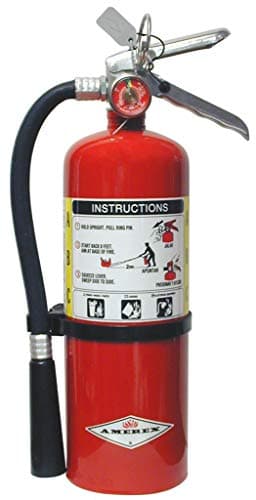 Amerex B500 5 lb ABC Dry Chemical Extinguisher 2-A:10-B:C in an all-metal rechargeable body. Covers all three fire classes, which is what a home needs. | The house — the ABC default | 8.6/ 10 | $75.01 · View on Amazon #ad how we are funded · price as of October 20, 2026 |
| 2 | 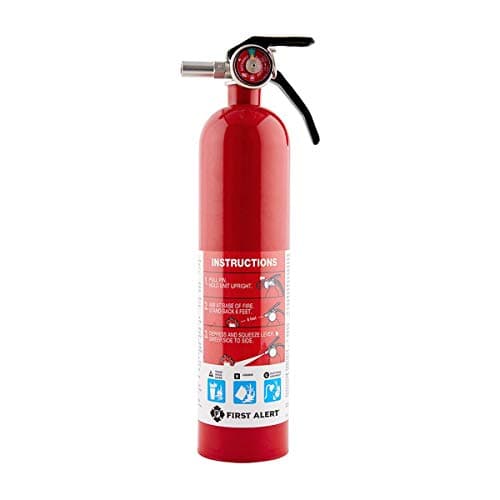 First Alert HOME1 Rechargeable Home Extinguisher (2.5 lb) 1-A:10-B:C at 2.5 lb. Half the A rating of a 5 lb unit, and the one most people can actually aim. | A second ABC unit where weight matters | 8.0/ 10 | $19.98 · View on Amazon #ad how we are funded · price as of October 20, 2026 |
| 3 | 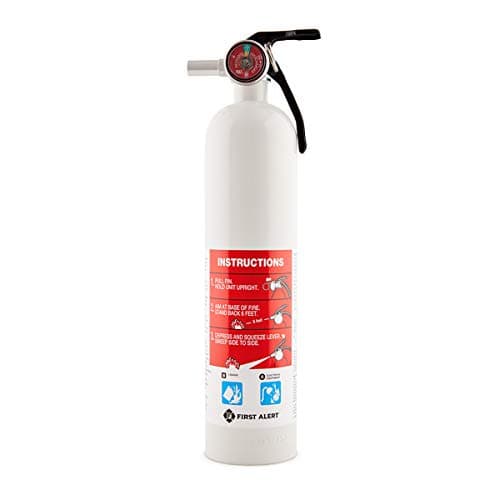 First Alert AUTOMAR10 Auto/Marine Fire Extinguisher 10-B:C in sodium bicarbonate, with a bracket. The one place a BC unit is the better choice on the merits. | A car, a truck or a boat | 7.4/ 10 | |
| 4 | 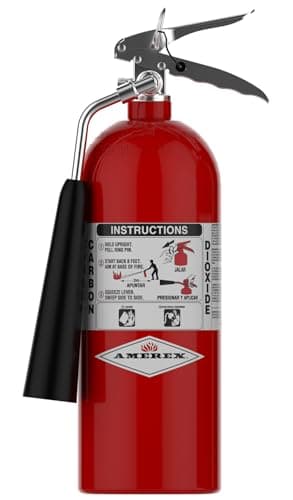 Amerex 322 5 lb Carbon Dioxide Extinguisher 5-B:C in carbon dioxide. Leaves nothing behind, costs a great deal, and still has no A rating. | Electronics, a lab bench or a server position — no residue at any price | 6.4/ 10 | $298.00 · View on Amazon #ad how we are funded · price as of October 20, 2026 |
The four units, compared
1. The house — the ABC default
Amerex B500 5 lb ABC Dry Chemical Extinguisher
2-A:10-B:C in an all-metal rechargeable body. Covers all three fire classes, which is what a home needs.
- Listed to
- UL rated 2-A:10-B:C
- Sensing / agent
- Monoammonium phosphate dry chemical
- Power / service life
- Rechargeable; all-metal valve and body
This is the comparison's baseline because the A rating is the comparison. In US home fires the leading items first ignited are cooking materials, upholstered furniture, mattresses and bedding, electrical wiring and trash — and apart from cooking oil, which is its own class, all of those are Class A. An extinguisher without an A rating is not tested against any of them.
What the 2-A means. UL tests Class A ratings against a stacked wood crib and panel fire of a defined size, and the number is a relative measure of how much fire the unit can put out. A 2-A unit is tested on roughly twice the Class A fire a 1-A unit is. The 10-B is the flammable-liquid figure, in approximate square feet of burning liquid surface. The C is not a size at all: it means the agent has been tested as non-conductive and is therefore safe to use on energized electrical equipment. Fire extinguisher classes sets out all five letters.
The honest downside is the mess. Dry chemical discharged indoors coats everything in the room with a fine, mildly corrosive powder that gets into electronics, HVAC returns and the gaps between floorboards. It is a nuisance, not a reason to buy less extinguisher — a house fire costs more than a cleanup — but it is the reason CO2 exists further down this page. Fire extinguisher powder cleanup covers putting a room back together afterwards.
If you are buying one extinguisher for a home, buy this class of unit, mount it where you can reach it on the way out rather than at the back of the garage, and read where to mount a fire extinguisher before you pick the spot.
What it does well
- 2-A:10-B:C — the A rating is the one a house actually needs, and this unit has it
- All-metal valve rather than plastic, which is what separates a serviceable extinguisher from a disposable one
- Rechargeable, so a partial discharge on a small fire does not write the unit off
- 5 lb of monoammonium phosphate is enough agent to make a second attempt
The downside
- Monoammonium phosphate is mildly corrosive and leaves a stubborn yellow residue — the real cost of a dry-chemical discharge indoors
- 5 lb is heavy enough that it needs a proper bracket and a two-hand stance
- Dry chemical is the wrong agent over an open bench of electronics you hope to keep
- Not a kitchen-grease answer — that is Class K territory
Do not buy this if: a boat locker or a car footwell, where a 5 lb steel cylinder is both overweight and awkward to deploy from a seat. Buy the auto/marine unit for the vehicle and keep this one in the house.
- All-metal valve rather than plastic, which is the difference between a serviceable unit and a disposable one
- Rechargeable, so a partial discharge during a small fire does not write off the extinguisher
- 2-A:10-B:C covers ordinary combustibles, flammable liquids and energized electrical equipment
- 5 lb is heavier than the supermarket unit and needs a proper bracket
#ad how we are funded · price as of October 20, 2026
2. A second ABC unit where weight matters
First Alert HOME1 Rechargeable Home Extinguisher (2.5 lb)
1-A:10-B:C at 2.5 lb. Half the A rating of a 5 lb unit, and the one most people can actually aim.
- Listed to
- UL rated 1-A:10-B:C
- Sensing / agent
- Monoammonium phosphate dry chemical
- Power / service life
- Rechargeable by a certified professional; metal head and pull pin
The reason this is on an ABC-versus-BC page is that it is the honest alternative to a BC unit at the same size and price. If what attracted you to a compact BC extinguisher was the weight and the cost, a 2.5 lb ABC unit gives you the same handling with a Class A rating added — and in a home that is a straight upgrade.
Aim is a specification. An extinguisher you cannot hold steady is an extinguisher that empties into a wall. NFPA's guidance is only to fight a fire that is small, contained and between you and nothing — and that means sweeping a nozzle accurately at the base of the flames for the handful of seconds the unit lasts. For a smaller adult, a 2.5 lb unit genuinely does this better than a 5 lb one. What size fire extinguisher do I need weighs that up properly.
The usual sensible arrangement in a house is one 5 lb ABC unit mounted on the main escape route, plus a compact ABC unit near the kitchen exit and another in a vehicle. Not one of each letter combination.
What it does well
- Still has an A rating, which is the thing a BC unit of the same size does not
- 2.5 lb is light enough for one-handed aiming by most adults, including from a seated or awkward position
- Metal head and metal pull pin with a safety seal, not the plastic-valve disposable tier
- Cheap enough that a second and third position in the house is a realistic purchase
The downside
- 1-A is half the ordinary-combustible rating of a 5 lb unit — less fire, less margin
- Short discharge time, so a missed first attempt may be the only attempt
- Same corrosive dry-chemical residue as any ABC unit
- Rechargeable only through a certified professional, which for a unit at this price often means replacing it instead
Do not buy this if: the one extinguisher in a house with a garage, a workshop or a wood stove. For a single whole-home unit the extra agent in a 5 lb body is worth the weight.
- 2.5 lb — the lightest unit most people can aim accurately with one hand
- Metal head and a metal pull pin with a safety seal, not the plastic valve of the disposable tier
- Color-coded corrosion-resistant gauge and a mounting bracket in the box
- 1-A is half the ordinary-combustible rating of a 2-A unit, which is the trade for the size
First Alert product documentation
#ad how we are funded · price as of October 20, 2026
3. A car, a truck or a boat
First Alert AUTOMAR10 Auto/Marine Fire Extinguisher
10-B:C in sodium bicarbonate, with a bracket. The one place a BC unit is the better choice on the merits.
- Listed to
- UL rated 10-B:C
- Sensing / agent
- Sodium bicarbonate dry chemical
- Power / service life
- Rechargeable by a certified professional; mounting bracket included
This is the case for BC that actually holds up. In a vehicle, the fires that start are fuel, oil, hydraulic fluid and electrical — and the electrical system stays energized until somebody pulls a battery terminal, which nobody is doing in the first thirty seconds. A 10-B:C unit is tested on exactly that.
Sodium bicarbonate versus monoammonium phosphate is the other half of the argument. Both are dry chemicals. Monoammonium phosphate, the ABC agent, is mildly acidic and corrosive to metals over time, which is one reason the marine and automotive units are usually bicarbonate. On a wiring harness or an outboard you hope to keep running, that distinction is worth something.
The limit is honest and it is big: no Class A rating. A car interior is full of Class A material — seats, carpet, headliner, luggage. A bicarbonate BC unit is not tested on any of it. That is a reason to carry this unit in the car and still have an ABC extinguisher in the building, not a reason to skip it. Best car fire extinguishers covers vehicle choice in full, and the standing advice there has not changed: a vehicle fire with flames reaching the hood line is an evacuation, not a fight.
What it does well
- 10-B:C matches the real hazard in a vehicle: fuel, oil, and an electrical system that is live until the battery is disconnected
- Sodium bicarbonate is the less corrosive of the two common dry chemicals, which matters around a motor and a wiring harness
- Mounting bracket in the box — in a vehicle an unsecured cylinder is a projectile, not a safety device
- First Alert publishes 5.3 lb total weight and a 14.1 in body, so it stows in a locker or behind a seat
- Metal head, metal pull pin with a safety seal, corrosion-resistant gauge
The downside
- **No A rating at all** — upholstery, carpet, a seat or a load of cardboard in the trunk are outside what it is tested on
- Dry chemical still leaves residue; sodium bicarbonate is gentler than monoammonium phosphate, not clean
- A vehicle fire escalates faster than most people expect, and this unit buys seconds rather than minutes
- Being a BC unit, it is the wrong extinguisher to be the only one in a house
Do not buy this if: your house. It is a vehicle extinguisher and the missing A rating is the reason. If the garage holds a car and a workbench, the car gets this and the garage wall gets an ABC unit.
- 10-B:C — flammable liquids and energized electrical equipment, with no A rating at all
- Sodium bicarbonate rather than monoammonium phosphate, which is the less corrosive of the two dry chemicals
- Metal head and metal pull pin with a safety seal, plus a corrosion-resistant gauge
- First Alert publishes 5.3 lb total weight and a 14.1 in body, with a vehicle bracket in the box
- No Class A rating means it is the wrong unit for a sofa, a mattress or a wastebasket fire
First Alert product documentation
4. Electronics, a lab bench or a server position — no residue at any price
Amerex 322 5 lb Carbon Dioxide Extinguisher
5-B:C in carbon dioxide. Leaves nothing behind, costs a great deal, and still has no A rating.
- Listed to
- UL and ULC rated 5-B:C; UL listed and FM approved
- Sensing / agent
- Stored-pressure carbon dioxide, discharged through a horn
- Power / service life
- Rechargeable aluminum cylinder; professional hydrostatic testing applies
Carbon dioxide is the reason the BC class exists outside vehicles. It smothers a flammable-liquid or electrical fire and then evaporates, leaving no powder in the keyboard, the switchgear or the open equipment rack. For a home lab, a radio shack, a machine bench or a home server cabinet, that is a real and specific value — and it is the only case where paying several times the cost of an ABC unit is a rational decision.
Why it is still not your only extinguisher. CO2 has very little cooling effect. Dry chemical and water both leave something behind that keeps working on the fuel; CO2 removes the oxygen for a few seconds and then disperses. On a Class A material with a glowing, deep-seated core — a charred armchair, a smoldering stack of paper — the fire can reignite the moment the gas clears. That is why the unit carries no A rating, and why it sits beside an ABC extinguisher rather than replacing it.
The oxygen-displacement warning is not boilerplate. Discharging 5 lb of CO2 inside a small, closed room genuinely lowers the oxygen fraction in that space. Use it with a door open, do not use it inside a closet or a crawl space you are standing in, and do not hold the horn, which chills hard enough to injure skin.
If what you actually want is a residue-free answer for a specific hazard rather than a general upgrade, non-toxic fire extinguishers and best fire extinguishers for electrical fires both cover the alternatives.
What it does well
- Carbon dioxide leaves no residue whatsoever — nothing to clean off a board, a motor, a lathe or a bench
- Rated 5-B:C and both UL listed and FM approved, so the paperwork is unambiguous
- Published discharge of roughly 10 seconds at a 3 to 8 ft range, and an operating range of -22 to 120 degrees F
- Rechargeable aluminum cylinder built for professional service rather than disposal
The downside
- **Many times the price of an ABC unit** — this is a specialist purchase, not a home-safety baseline
- No A rating, and CO2 has no cooling persistence, so a deep-seated Class A fire can simply reignite behind it
- The horn gets extremely cold in use and can cause a contact injury
- CO2 displaces oxygen: in a small closed room, discharging a cylinder creates a second hazard
- Heavy and awkward compared with a 2.5 lb dry-chemical unit
Do not buy this if: a house, a kitchen or a car, and it is not a general-purpose extinguisher at all. Buy it when the thing you are protecting would be destroyed by dry chemical and you understand the oxygen-displacement risk.
- Carbon dioxide leaves no residue at all — nothing to clean off a board, a motor or a bench
- 5 lb of agent, published as roughly a 10-second discharge at a 3 to 8 ft range
- Rated 5-B:C, so flammable liquids and live electrical only — no Class A rating
- Published operating range of -22 to 120 degrees F
- A CO2 horn gets extremely cold in use and displaces oxygen in a small closed space
#ad how we are funded · price as of October 20, 2026
When BC is genuinely the right answer
Three situations, and they are narrower than the shelf at a hardware store suggests.
- A car, truck, RV or boat. The hazard is fuel and live electrics, the space is small, weight and corrosion both matter, and a bicarbonate BC unit with a bracket is purpose-built for it.
- Equipment you cannot replace or clean. A home lab, a server cabinet, a workshop full of bare machine surfaces, a radio bench. CO2 leaves nothing behind, and dry chemical in a running motor or an open board is its own kind of loss.
- A fuel store or generator position, where what is present is almost entirely Class B and the A rating buys you nothing. Even here, the building it is attached to still needs an ABC unit — see generator CO safety for the other hazard that position creates.
- Never as the only extinguisher in a dwelling. This is the one rule on the page with no exception. If there is one unit in the building, it has an A rating.
The mistakes this question usually hides
Buying BC because it was cheaper or lighter. A 2.5 lb ABC unit is both cheap and light and has the A rating as well. If weight was the concern, size down within ABC rather than dropping a class.
Assuming the C covers your electronics. It covers using the extinguisher on live equipment without electrocuting yourself. It says nothing about what the agent does to the equipment — which, for dry chemical, is considerable. That is a CO2 question, not a C question.
Treating a kitchen as a B problem. Cooking oil in a pan is Class K, a separate class with its own agent, and a B-rated dry chemical blast across a hot pan can spread burning oil. Kitchen: Class K vs ABC explains why, and how to put out a grease fire covers what to do with the pan you already have alight.
Forgetting that rating is not the same as reach. A 10-B:C rating on a small cylinder still only discharges for a few seconds. Agent quantity, not just the letters, decides whether a missed first pass leaves you a second one. What size fire extinguisher do I need has the arithmetic.
Questions people actually ask
What is the difference between ABC and BC fire extinguishers?
Can I use a BC fire extinguisher in my house?
Is a BC extinguisher better for electronics?
Why do car and marine fire extinguishers say 10-B:C?
What does the number before the B mean?
How these picks were chosen. On published specifications, safety listings and manufacturer documentation — plus the findings of organizations that do run tests. We have no laboratory and we do not burn anything. Read the full methodology.
Sources
- UL Solutions — Fire extinguisher testing and certification (UL 711)
- UL Solutions — UL 711 — rating and fire testing of fire extinguishers
- NFPA — NFPA 10, Standard for Portable Fire Extinguishers
- NFPA — Cooking equipment fires in US homes
- Amerex — Fire extinguisher types and extinguishing agents
- US Fire Administration — Home fire prevention
Read next
Fire Extinguishers
The full class chart, what the numbers measure, and which agent suits which fire.
Fire Extinguishers
What Size Fire Extinguisher Do I Need?
Weight against rating and run time, and why the likely operator decides it.
Fire Extinguishers
The Best Fire Extinguishers for a Home
Four rated units, what the numbers mean, and why the valve material matters.
Fire Extinguishers
The Best Fire Extinguishers for a Car
Size, rating and the mount — plus why you should not open a smoking hood.
Fire Extinguishers
Why Class K exists, what saponification does, and what a home kitchen should keep instead.
Fire Extinguishers
What Class B covers, what the number measures, and the rating a garage actually needs.