Fire Extinguishers
CO2 vs Dry Chemical Fire Extinguishers
Not a comparison of classes — a comparison of agents. One of these cleans up with a dustpan you will never need; the other covers the fire your house is most likely to have.
By Ryder M.Last reviewed
For a home, buy dry chemical: a monoammonium phosphate ABC unit covers ordinary combustibles, flammable liquids and live electrical equipment, which is every fire a house realistically produces. Carbon dioxide is the better agent in exactly one situation — electronics, a bench, a server rack or a lab where the clean-up from dry chemical would cost more than the fire — and it comes with two hard limits: no Class A rating at all, and it displaces oxygen, which makes a small closed room the wrong place to use it. Most households should own the dry chemical unit and know why they do not own the CO2 one.
Siren & Safe is reader-funded. We earn a commission on some links on this page, at no cost to you. It does not change what we recommend or the order we rank it in. Full disclosure.
The difference in one paragraph
Dry chemical interrupts the chemical chain reaction of the fire and leaves a crust on the fuel; carbon dioxide smothers the fire by displacing oxygen and then disperses completely. That is the entire difference, and every practical consequence follows from it.
Because dry chemical leaves a crust, it holds a Class A fire down and stops it re-igniting — so an ABC unit carries an A rating. Because CO2 disperses, it does not, which is why a CO2 extinguisher is rated B:C and never A. Because dry chemical leaves a crust, it also leaves it on your laptop. Because CO2 disperses, it leaves nothing at all.
So the question is not which agent is better. It is which failure you would rather have: a fire that re-ignites in a sofa, or a workshop you have to decontaminate.
CO2 vs dry chemical, by property
Figures are from the manufacturers' published listings for the units on this page. Everything else is a property of the agent, not of a brand.
| Carbon dioxide | Dry chemical (monoammonium phosphate) | |
|---|---|---|
| Typical rating | 5-B:C (Amerex 322) | 2-A:10-B:C to 4-A:60-B:C |
| Class A (solids) | No rating — will re-ignite | Yes |
| Class B (liquids) | Yes | Yes |
| Class C (energized electrical) | Yes | Yes |
| Residue | None | Corrosive, clingy powder everywhere |
| Safe to use in a small closed room | No — displaces oxygen | Yes, though visibility drops hard |
| Works outdoors or in a draft | Poorly — blows away | Yes |
| Discharge hazard | Horn becomes extremely cold | Visibility loss and respiratory irritation |
| Published temperature range | -22 to 120°F (Amerex 322) | Narrower; check the unit |
| Servicing | Rechargeable; hydrostatic testing | Rechargeable or disposable |
Quick picks
Scored against class coverage, clean-up, reach and knock-down, safe in a small room and electronics-friendly. Tap a row for the full write-up. The price in each buy button is the live Amazon price at the last check, stamped with the date it was taken.
| # | Product | Best for | Score | Price |
|---|---|---|---|---|
| 1 | 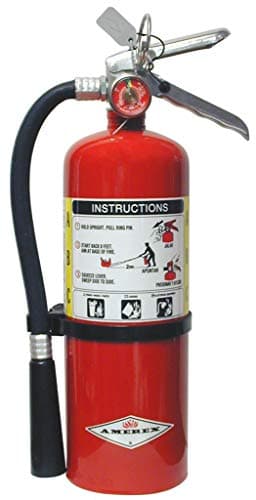 Amerex B500 5 lb ABC Dry Chemical Extinguisher The agent that covers the fire you will actually have. Buy this, and accept the mess if you ever use it. | The house — dry chemical, 2-A:10-B:C | 8.2/ 10 | $75.01 · View on Amazon #ad how we are funded · price as of October 19, 2026 |
| 2 | 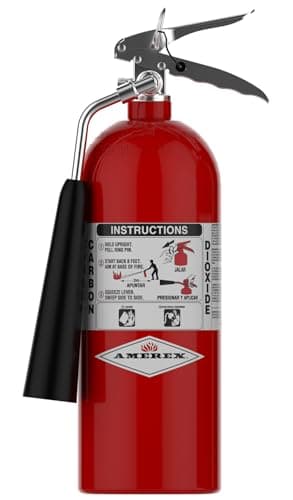 Amerex 322 5 lb Carbon Dioxide Extinguisher No residue at all, no Class A rating at all. A specialist tool bought for one specific room. | A bench, a rack or a lab — CO2, 5-B:C | 7.0/ 10 | $298.00 · View on Amazon #ad how we are funded · price as of October 19, 2026 |
| 3 | 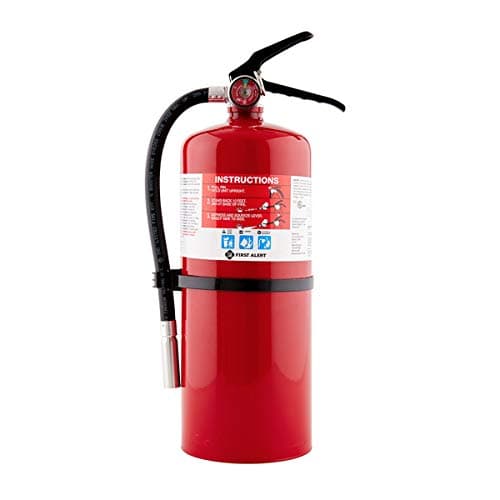 First Alert PRO10 Rechargeable Heavy Duty Extinguisher 4-A:60-B:C. If the worry is solvents and fuel rather than circuit boards, buy rating rather than cleanliness. | A workshop that wants dry chemical with a bigger rating | 8.1/ 10 | $72.98 · View on Amazon #ad how we are funded · price as of October 19, 2026 |
| 4 | 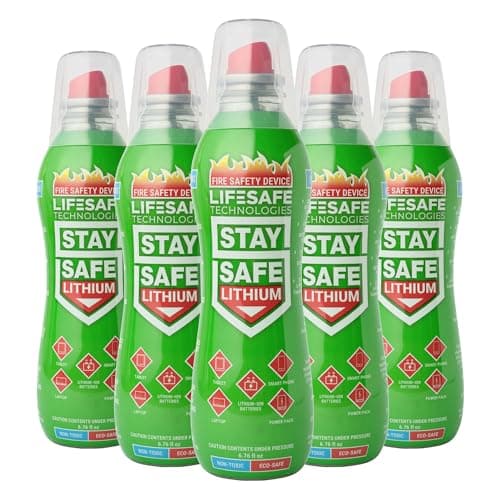 StaySafe Lithium Fire Extinguishing Spray Neither CO2 nor dry chemical does much to a cell in thermal runaway. This is the honest third option, with honest limits. | The fire neither agent handles — lithium-ion | 6.6/ 10 | $99.95 · View on Amazon #ad how we are funded · price as of October 19, 2026 |
What to buy, by room
1. The house — dry chemical, 2-A:10-B:C
Amerex B500 5 lb ABC Dry Chemical Extinguisher
The agent that covers the fire you will actually have. Buy this, and accept the mess if you ever use it.
- Listed to
- UL rated 2-A:10-B:C
- Sensing / agent
- Monoammonium phosphate dry chemical
- Power / service life
- Rechargeable; all-metal valve and body
Why this is the default. The three fire classes a home actually produces are A (furniture, bedding, paper, trash), B (cooking oil, solvents, fuel) and C (a live appliance or circuit). A monoammonium phosphate ABC unit is rated for all three. No other agent sold to households covers that spread, which is why every general-purpose recommendation on this site lands on dry chemical.
The honest cost. The residue is genuinely unpleasant. It is a fine powder, it carries a static charge so it sticks to surfaces, and it is mildly corrosive to metals over time. After a real discharge you are vacuuming, wiping with a damp cloth and writing off anything porous. Fire extinguisher powder cleanup is the step-by-step, and it is worth reading before you need it.
And it is not toxic in the way people fear. Monoammonium phosphate is a fertilizer salt; the hazard from a discharge indoors is irritation and reduced visibility, not poisoning. Is fire extinguisher powder toxic goes through what the safety data actually says, including for pets.
What it does well
- 2-A:10-B:C: ordinary combustibles, flammable liquids and energized electrical gear from one cylinder
- Monoammonium phosphate is the broadest household agent there is — nothing else covers all three classes this cheaply
- All-metal valve and body, rechargeable, and supported by every extinguisher service company
- 5 lb gives real run time, and the discharge reaches across a room
- Works outdoors and in a draft, where CO2 is blown away
The downside
- **The residue is the problem.** Mildly corrosive, electrostatically clingy, and it goes everywhere
- Anything with a circuit board that takes a dose of it should be treated as contaminated
- 5 lb is heavy for one-handed use, especially overhead
- Needs annual inspection and a shake to stop the powder caking at the bottom of the cylinder
Do not buy this if: a room full of electronics you cannot afford to replace. That is the one case where CO2 earns its place, and it is the whole reason this comparison exists.
- All-metal valve rather than plastic, which is the difference between a serviceable unit and a disposable one
- Rechargeable, so a partial discharge during a small fire does not write off the extinguisher
- 2-A:10-B:C covers ordinary combustibles, flammable liquids and energized electrical equipment
- 5 lb is heavier than the supermarket unit and needs a proper bracket
#ad how we are funded · price as of October 19, 2026
2. A bench, a rack or a lab — CO2, 5-B:C
Amerex 322 5 lb Carbon Dioxide Extinguisher
No residue at all, no Class A rating at all. A specialist tool bought for one specific room.
- Listed to
- UL and ULC rated 5-B:C; UL listed and FM approved
- Sensing / agent
- Stored-pressure carbon dioxide, discharged through a horn
- Power / service life
- Rechargeable aluminum cylinder; professional hydrostatic testing applies
What CO2 actually does. It smothers: it displaces the oxygen immediately around the fire and chills the surface slightly as it expands. That is perfect for a liquid or an energized component, and insufficient for a deep-seated fire in a solid fuel, because the moment the gas disperses the hot material has oxygen again. That single mechanism explains both of its properties — the clean finish and the missing A rating.
The oxygen point deserves its own sentence. The same displacement that puts the fire out works on the person standing over it. In an open garage or a workshop it is a non-issue. In a small windowless server cupboard it is a real one, and the right technique is to discharge from the doorway and back out rather than walk in.
Who should own one. Somebody with a specific, high-value, electrically dense room: a workshop bench, a studio, a home lab, a rack of equipment. Buy it as the second extinguisher for that room, not the first extinguisher for the house. Best fire extinguishers for electrical fires sets out the whole electrical case.
What it does well
- Carbon dioxide leaves nothing behind — no powder on a board, a motor, a lens or a bench
- Rated 5-B:C, so flammable liquids and energized electrical equipment are both covered
- Published as roughly a ten-second discharge at a 3 to 8 ft range from 5 lb of agent
- Published operating range of -22 to 120°F, far wider than a dry chemical unit's comfort zone
- UL and ULC rated and FM approved, in a rechargeable aluminum cylinder
The downside
- **No Class A rating.** It will not reliably put out paper, cloth, furniture or trash, because it does not cool the fuel enough to stop re-ignition
- **It displaces oxygen.** In a small closed space that is a hazard to the person holding it, and the reason CO2 is a bad choice for a cupboard-sized room
- The discharge horn gets extremely cold in use — bare skin on it is a cold burn
- A draft or an open door blows the agent away before it does anything
- Rechargeable cylinders need professional hydrostatic testing, which is a cost dry chemical mostly avoids
Do not buy this if: general household fire protection. A CO2 unit with no A rating hanging in a hallway is a false sense of security — the commonest home fire is Class A, and this cannot put it out.
- Carbon dioxide leaves no residue at all — nothing to clean off a board, a motor or a bench
- 5 lb of agent, published as roughly a 10-second discharge at a 3 to 8 ft range
- Rated 5-B:C, so flammable liquids and live electrical only — no Class A rating
- Published operating range of -22 to 120 degrees F
- A CO2 horn gets extremely cold in use and displaces oxygen in a small closed space
#ad how we are funded · price as of October 19, 2026
3. A workshop that wants dry chemical with a bigger rating
First Alert PRO10 Rechargeable Heavy Duty Extinguisher
4-A:60-B:C. If the worry is solvents and fuel rather than circuit boards, buy rating rather than cleanliness.
- Listed to
- UL rated 4-A:60-B:C
- Sensing / agent
- Monoammonium phosphate dry chemical
- Power / service life
- Rechargeable by a certified professional; all-metal construction with a commercial-grade metal valve and head; 12-year limited warranty
When people reach for a CO2 extinguisher in a garage they are usually solving the wrong problem. If the hazard is a fuel can, a parts washer or a bench full of solvent, the thing you want is a bigger B rating — and 60-B is six times what a typical household unit carries.
Reserve CO2 for the one bench where the electronics matter. Best garage fire extinguishers works through the whole garage case.
What it does well
- 4-A:60-B:C is a far larger rating than most home units — six times the flammable-liquid rating of a 10-B:C supermarket unit
- All-metal construction with a commercial-grade valve and head, and a 12-year limited warranty
- Rechargeable, with a bracket and a corrosion-resistant gauge in the box
- The right unit for a garage or workshop where fuel, oil and solvent are the realistic risk
The downside
- Bigger and heavier — a genuine problem for anyone who cannot handle the weight one-handed
- Same corrosive residue as any dry chemical unit, in larger quantity
- Overkill in a kitchen or a hallway, where the handling penalty is not worth the rating
Do not buy this if: an apartment or a small kitchen. The rating is wasted and the weight is a liability.
- 4-A:60-B:C is a far larger rating than most home units — six times the flammable-liquid rating of the 10-B:C supermarket unit
- Rechargeable rather than disposable, with an all-metal valve and head
- Suits a garage, workshop or home office where liquids and equipment are the realistic risk
- Mounting bracket and a color-coded corrosion-resistant pressure gauge in the box
- Bigger and heavier, which is a real problem for anyone who cannot handle the weight one-handed
#ad how we are funded · price as of October 19, 2026
4. The fire neither agent handles — lithium-ion
StaySafe Lithium Fire Extinguishing Spray
Neither CO2 nor dry chemical does much to a cell in thermal runaway. This is the honest third option, with honest limits.
- Listed to
- Not a UL-rated A:B:C portable extinguisher. LifeSafe states the product is tested and approved with recognized standards bodies and third-party test facilities, without naming a rating
- Sensing / agent
- Patented non-toxic extinguishing fluid, sprayed from a hand-held canister
- Power / service life
- Single use — discharge the unit fully and replace it
This pick is here because the single most common question behind a CO2 search is about electronics, and a growing share of electronics fires are battery fires. Carbon dioxide does almost nothing to a cell in thermal runaway: the reaction supplies its own oxidizer, so smothering misses the point, and the gas carries away very little heat.
The realistic domestic answer is prevention and geography — charge packs on a hard surface away from exits, and never in a hallway you need to walk down. Best fire extinguishers for lithium batteries and best fire blankets for lithium batteries both state the limits plainly.
What it does well
- Formulated specifically for fires started by lithium-ion cells in phones, laptops and power banks
- LifeSafe states it is safe on electrical fires up to 1000V from a stated minimum distance
- Non-toxic with no residue to clean up, which indoors is the practical difference from dry chemical
- No pin and no gauge — remove the cap, point and spray until empty
The downside
- **Not a UL-rated A:B:C extinguisher.** LifeSafe names third-party test facilities without naming a rating
- Single use: discharge it fully and replace it
- **It will not stop a large pack already in full thermal runaway** — and nothing sold to consumers will
- A niche purchase that does not replace either of the units above
Do not buy this if: your general household extinguisher, and not for an e-bike battery pack fire. For a pack in runaway, the plan is distance and the fire service, not a canister.
- Formulated specifically for fires started by lithium-ion batteries in phones, laptops, power banks and other electronics
- LifeSafe states it is safe on electrical fires up to 1000V from a stated minimum distance
- No pin and no gauge: remove the cap, point and spray until the canister is empty
- Non-toxic with no residue to clean up, which is the practical difference from dry chemical indoors
- It will not stop a large pack already in full thermal runaway, and nothing sold to consumers will
#ad how we are funded · price as of October 19, 2026
Pick by room, not by agent
The practical version of this comparison. Three of these four rooms want dry chemical.
- Kitchen. Dry chemical, small, plus a fire blanket within reach of the hob. A CO2 unit on a pan fire blows burning oil around the room and has no A rating for the cabinets. Best kitchen fire extinguishers.
- Hallway or landing — the whole-house unit. Dry chemical ABC. This is the extinguisher that has to cover whatever happens, and only dry chemical covers all three classes.
- Garage or workshop with fuel and solvent. Dry chemical with a big B rating — the 4-A:60-B:C unit above. Best garage fire extinguishers.
- A bench, rack or studio full of electronics. This is the CO2 room, and the only one. Mount it at the door, discharge from the doorway, and back out rather than walk in.
Two things people get wrong
"CO2 is the electrical extinguisher." Both agents are rated for Class C. The letter C means the agent is non-conducting, so it is safe to use on energized equipment — and monoammonium phosphate is non-conducting too. What CO2 uniquely offers is that it does not destroy the equipment it saves. That is a property worth paying for in a rack room and worth nothing in a hallway.
"CO2 is the clean, safe, non-toxic option." It leaves no residue, which is not the same as being safe indoors. Carbon dioxide is an asphyxiant at concentration: NIOSH sets a recommended exposure limit of 5,000 ppm as an eight-hour average and 30,000 ppm as a short-term limit, with 40,000 ppm immediately dangerous to life or health. A 5 lb discharge in a walk-in cupboard gets into that territory. Discharge from a doorway, and ventilate afterwards.
If the thing you were really comparing was extinguisher classes rather than agents, fire extinguisher classes is the reference table, and ABC vs BC fire extinguishers is the class-level version of this page.
Questions people actually ask
Is CO2 or dry chemical better for a home?
Why does a CO2 extinguisher have no Class A rating?
Can you use a CO2 extinguisher in a small room?
Will a dry chemical extinguisher ruin electronics?
Do CO2 extinguishers expire?
How these picks were chosen. On published specifications, safety listings and manufacturer documentation — plus the findings of organizations that do run tests. We have no laboratory and we do not burn anything. Read the full methodology.
Sources
Read next
Fire Extinguishers
The A rating is the decision. What each letter is tested on, and the three places a BC unit beats an ABC one.
Fire Extinguishers
The full class chart, what the numbers measure, and which agent suits which fire.
Fire Extinguishers
The Best Fire Extinguishers for Electrical Fires
Every C-rated unit is safe on live equipment. The choice is agent quantity and aftermath.
Fire Extinguishers
Fire Extinguisher Powder: Safe Handling and Cleanup
Mildly acidic, hygroscopic and corrosive within hours. The sequence that limits the damage.
Fire Extinguishers
What each extinguishing agent leaves behind, and the least harmful option that still works.