Fire Extinguishers
Non-Toxic Fire Extinguishers
Every agent sold for a house is an irritant of some kind. The useful question is not which one is harmless, it is which one you can be in a room with afterwards.
By Ryder M.Last reviewed

There is no non-toxic fire extinguisher, and any listing that uses the phrase is marketing. What exists is a spread of aftermaths. The lowest-harm device that actually puts out a household fire is a fire blanket, because it deploys no agent at all. If you want something you spray, the First Alert EZ Fire Spray leaves a sodium-bicarbonate residue you wipe up with a damp cloth instead of the corrosive monoammonium phosphate powder a standard ABC unit coats a room in. Neither replaces a rated ABC extinguisher where one is required.
Siren & Safe is reader-funded. We earn a commission on some links on this page, at no cost to you. It does not change what we recommend or the order we rank it in. Full disclosure.
Why no extinguisher is non-toxic
An extinguisher works by interrupting a fire chemically, by smothering it, or by taking heat out of it. Every agent that does one of those things at useful speed is something you would not want a lungful of, and every discharge happens in a room you are standing in.
That is why the phrase is marketing. A listing that says "non-toxic" is almost always describing an agent that is not acutely poisonous — which is true of ordinary ABC powder as well. Monoammonium phosphate is a fertilizer salt. It is not poison. It is also a fine acidic dust that irritates the airway, corrodes aluminum and electronics, and gets into every surface in the room.
So the question worth asking is not "is this non-toxic". It is "what is in the air while I am using it, and what is on my surfaces afterwards" — and those two answers separate the options on this page cleanly.
What is on your surfaces afterwards is a job with a correct order to it, and getting it wrong is what causes most of the damage — the powder cleanup guide has the sequence.
One more framing that matters for this buyer. The most consequential safety purchase in a house is not an extinguisher at all, it is a working smoke alarm, and it releases nothing into anything. If the alarms are old or missing, start at the smoke detector roundup and come back to agent chemistry afterwards.
What each agent leaves behind
Built from the listings and manufacturer documentation for the products above. Nothing here is a laboratory measurement of ours — we do not run tests.
| Device | Agent | Airborne during use | Aftermath |
|---|---|---|---|
| Fire blanket | None — smothers | Nothing released; loose glass fiber possible from woven fiberglass on handling | Throw the blanket away. No surface contamination. |
| EZ Fire Spray | Sodium-bicarbonate-based aerosol | Aerosol mist; ventilate the room | Wipes up with a damp cloth |
| StaySafe Lithium | Encapsulator agent, misted | Water mist carrying a chemical concentrate | Damp surfaces; follow the safety data sheet |
| ABC dry chemical | Monoammonium phosphate | Dense powder cloud filling the room | Fine acidic dust everywhere; corrosive to metal and electronics over time |
Agent identities are as published by each manufacturer. Class ratings for the ABC units are the UL ratings printed on the label. What the ratings mean.
Quick picks
Scored against aftermath, ease of use, rated capability, cleanup effort and kitchen suitability. Tap a row for the full write-up. The price in each buy button is the live Amazon price at the last check, stamped with the date it was taken.
| # | Product | Best for | Score | Price |
|---|---|---|---|---|
| 1 | 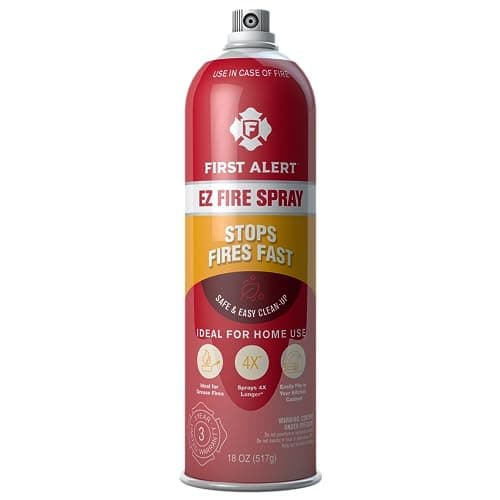 First Alert EZ Fire Spray AF400 Sodium bicarbonate, not monoammonium phosphate — the aftermath is the whole point. | A spray you can clean up with a cloth | 7.7/ 10 | $11.98 · View on Amazon #ad how we are funded · price as of October 20, 2026 |
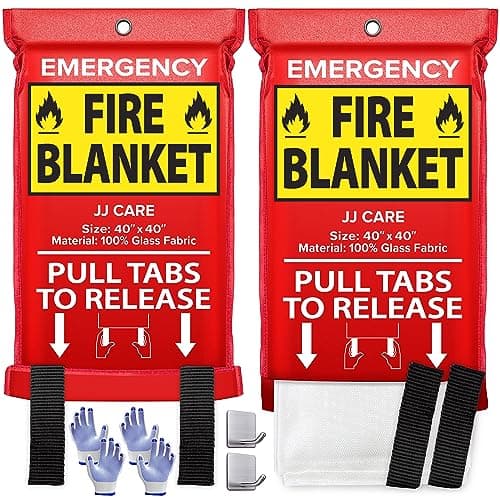
| 2 | 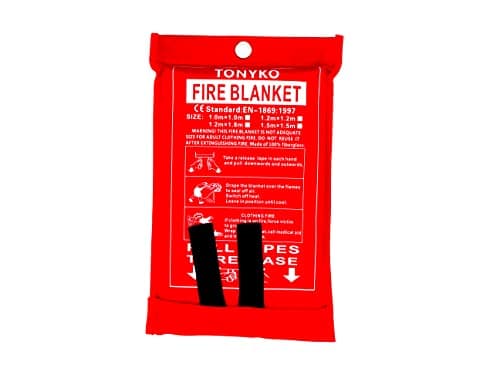 Tonyko Fiberglass Fire Blanket Nothing is released, so there is nothing to breathe, wipe or dispose of as a chemical. | Putting a fire out with no agent at all | 8.6/ 10 | $21.99 · View on Amazon #ad how we are funded · price as of October 20, 2026 |
| 3 | 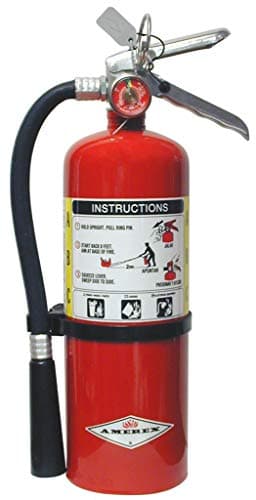 Amerex B500 5 lb ABC Dry Chemical Extinguisher The worst aftermath here, and still the extinguisher a house should own. | When you need a rated unit regardless | 7.3/ 10 | $75.01 · View on Amazon #ad how we are funded · price as of October 20, 2026 |
| 4 | 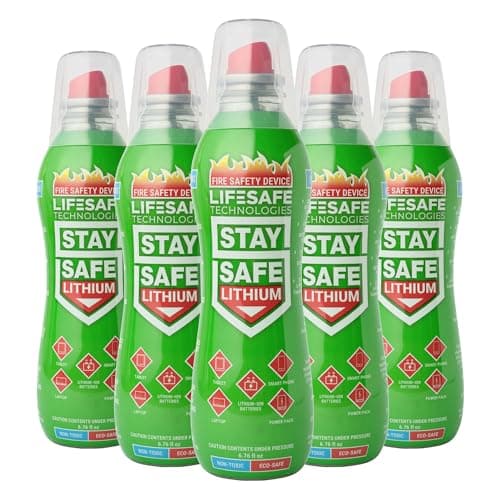 StaySafe Lithium Fire Extinguishing Spray Different chemistry, different aftermath. A fluid rather than a powder, and single use. | The lithium-specific agent, and a different aftermath | 6.1/ 10 | $99.95 · View on Amazon #ad how we are funded · price as of October 20, 2026 |
1. A spray you can clean up with a cloth
First Alert EZ Fire Spray AF400
Sodium bicarbonate, not monoammonium phosphate — the aftermath is the whole point.
- Listed to
- Aerosol extinguishing spray — not a UL-rated A:B:C portable extinguisher
- Sensing / agent
- Sodium-bicarbonate-based extinguishing aerosol
- Power / service life
- Single use; check the stamped expiry
The reason this sits at the top of a page about toxicity is narrow and specific: the agent is sodium-bicarbonate-based, and the cleanup is a cloth.
That matters more than it sounds. What ruins a kitchen after a small fire is usually not the fire. A 2.5 lb ABC extinguisher discharged indoors puts a fine, slightly acidic phosphate powder into every surface, every cupboard, the extractor, the toaster and the air — and dry chemical is corrosive to aluminum and to electronics given time and humidity. People who have done it describe the cleanup, not the fire.
What you give up is capability and a rating. This is not an extinguisher in the UL sense and we will not call it one. It is a hedge for the fire you catch in the first few seconds, which is also the only fire a household member should be fighting at all.
Keep it alongside a rated unit, not instead of one. Aerosol spray vs traditional extinguishers works through that trade properly.
What it does well
- Sodium-bicarbonate-based agent — chemically the same family as baking soda, rather than the ammonium phosphate salt in an ABC unit
- Wipes up with a damp cloth instead of requiring the room to be stripped and the soft furnishings cleaned
- No pin, no gauge, no technique — point and spray, which is what somebody who has never practiced will actually manage
- Small enough to live in the cupboard beside the hob rather than out in the hall, so it is within reach of the fire that starts
The downside
- **Not a UL-rated A:B:C portable extinguisher**, so it does not satisfy a code requirement, a landlord requirement or an insurer
- Single use with a stamped expiry — there is no recharge path
- Much less agent than even a 2.5 lb extinguisher
- Still an inhalation irritant in a confined space; ventilate afterward like any discharge
Do not buy this if: a garage, a workshop or any space where the realistic fire is a flammable-liquid fire with some size to it. This is a small-fire, first-thirty-seconds device, and treating it as a house's only extinguisher is a mistake the packaging does not discourage.
- Aerosol can format — no pin, no pressure gauge, aim and spray
- Wipes up with a cloth instead of the corrosive mess dry chemical leaves
- Genuinely easier for someone who will never practice with a real extinguisher
- It is not a rated extinguisher and does not satisfy a code requirement for one
#ad how we are funded · price as of October 20, 2026
2. Putting a fire out with no agent at all
Tonyko Fiberglass Fire Blanket
Nothing is released, so there is nothing to breathe, wipe or dispose of as a chemical.
- Listed to
- Tonyko states the blanket meets EN 1869:1997 for cooking-fire suppression
- Sensing / agent
- Woven fiberglass
- Power / service life
- Single use on a real fire
If the question is strictly "what puts out a fire without releasing a chemical into my home", the answer is a blanket, and it is not close. A blanket works by cutting off oxygen. There is no agent, which means no residue, no inhalation exposure and no disposal question beyond throwing the blanket away.
The honest caveat is the material. Woven fiberglass can shed fine glass fibers when it is handled, folded or dragged, and those fibers irritate skin and eyes. That is a real concern for anyone buying on a non-toxic basis, which is why are fire blankets toxic and fiberglass-free fire blankets exist as separate pages rather than a footnote.
The practical reading: fiber exposure is a handling risk measured in minutes, and a dry-chemical discharge is a whole-room exposure plus weeks of cleanup. If toxicity is your filter, the blanket wins on every axis except the one about glass fiber.
Mount it within one step of the hob and on the side you would approach from, never behind the pan. Where to mount a fire blanket has the positions.
What it does well
- Smothers by excluding oxygen — no powder, no aerosol, no propellant, nothing airborne
- The manufacturer names a specific standard edition, EN 1869:2019, which is more than most sellers in this category manage
- The right tool for a pan fire, which is the fire households actually get
- Cheap enough in multi-packs to put one by the hob and one by the grill
The downside
- **Woven fiberglass**, which can shed glass fiber and irritate skin on handling — the one toxicity question a blanket does have
- Single use, and you have to get close enough to lay it over the fire
- Useless on anything you cannot cover: a wall, a ceiling, a spreading liquid fire
- No UL rating and no A:B:C classification, so it satisfies no code requirement
Do not buy this if: someone who wants a single device for the whole house. A blanket covers the hob and very little else, and a house still needs a rated extinguisher on the escape route.
- Tonyko names a specific EN 1869 edition, which is more than most sellers in this category do
- 47.2 x 47.2 in (1.2 x 1.2 m) in the size linked here — large enough to wrap around a body as a heat shield, which the smaller hob blankets are not
- Also sold in a 47.2 x 70.9 in and a 78.7 x 78.7 in, so check which size you are adding to the basket
- Plain blanket — no pouch or hooks in the pack, so plan the fixing yourself
- Tonyko names the kitchen, fireplace, grill, car and camping as the intended uses
#ad how we are funded · price as of October 20, 2026
3. When you need a rated unit regardless
Amerex B500 5 lb ABC Dry Chemical Extinguisher
The worst aftermath here, and still the extinguisher a house should own.
- Listed to
- UL rated 2-A:10-B:C
- Sensing / agent
- Monoammonium phosphate dry chemical
- Power / service life
- Rechargeable; all-metal valve and body
We are not going to park this at the bottom of a toxicity page for the sake of a tidy narrative. It is the most capable device here and the one we would keep in a house, and the aftermath is genuinely unpleasant. Both things are true.
Monoammonium phosphate is the standard ABC dry chemical. It is not acutely poisonous — it is a fertilizer salt — but "not poisonous" and "harmless" are different claims. It irritates the airway, it turns mildly acidic as it takes up moisture, and that is what corrodes aluminum and circuit boards in the weeks after a discharge.
So the sensible arrangement in a house that cares about this is layered rather than binary: a blanket at the hob, a low-residue spray in the kitchen cupboard, and a rated ABC unit on the escape route for the fire the other two cannot handle. Is fire extinguisher powder toxic covers the exposure question in detail, including the question about dogs.
If the rating is what you need and the weight is the problem, a 4 lb unit keeps the same 2-A:10-B:C.
What it does well
- 2-A:10-B:C — real, tested, rated capability across ordinary combustibles, flammable liquids and energized electrical equipment
- All-metal valve and body, rechargeable, serviceable for decades
- Meets the minimum rating that code requirements, landlords and insurers commonly specify
- 5 lb of agent gives enough run time to correct a first attempt, which the low-residue options do not
The downside
- **Monoammonium phosphate dry chemical** — a fine, slightly acidic powder, corrosive to metals and electronics and an inhalation irritant in a confined space
- The discharge contaminates an entire room, not just the fire
- Heavy enough that some household members will not be able to aim it well
- Cleanup is a professional job in some rooms and a weekend in the rest
Do not buy this if: a kitchen as the first thing you reach for. A blanket is faster, cleaner and better suited to a pan. Keep this on the escape route for the fire a blanket cannot cover.
- All-metal valve rather than plastic, which is the difference between a serviceable unit and a disposable one
- Rechargeable, so a partial discharge during a small fire does not write off the extinguisher
- 2-A:10-B:C covers ordinary combustibles, flammable liquids and energized electrical equipment
- 5 lb is heavier than the supermarket unit and needs a proper bracket
#ad how we are funded · price as of October 20, 2026
4. The lithium-specific agent, and a different aftermath
StaySafe Lithium Fire Extinguishing Spray
Different chemistry, different aftermath. A fluid rather than a powder, and single use.
- Listed to
- Not a UL-rated A:B:C portable extinguisher. LifeSafe states the product is tested and approved with recognized standards bodies and third-party test facilities, without naming a rating
- Sensing / agent
- Patented non-toxic extinguishing fluid, sprayed from a hand-held canister
- Power / service life
- Single use — discharge the unit fully and replace it
This is here for completeness rather than as a recommendation. StaySafe Lithium appears on a toxicity page because LifeSafe states the fluid is non-toxic and leaves no residue — the aftermath is a damp surface rather than a phosphate dust layer through a whole room.
The delivery does as much work as the chemistry. A fluid carries heat away from a cell in a way a dry powder cannot, which is why the agents built for lithium-ion fires are wet rather than dry.
It is also single use and unrated, and LifeSafe names no test protocol. If lithium batteries are the reason you are reading this, the realistic household answer is prevention and containment rather than a better extinguisher — the lithium battery extinguisher page is blunt about why.
What it does well
- A sprayed fluid rather than a dry powder, so there is no phosphate dust layer afterward
- Formulated specifically for lithium-ion battery fires in phones, laptops and power banks, which almost nothing else at retail is
- LifeSafe states the fluid is non-toxic, eco-friendly and leaves no toxic residue
- A liquid, which is a materially different cleanup from dry chemical
The downside
- **Single use** — once the canister is discharged it is spent, where a rechargeable unit is not
- Low residue is not the same as inert — it is a chemical formulation and its safety data sheet still applies
- A fluid on an electrical fire only within the voltage and distance LifeSafe publishes, which is a limit to read before you need it
- **No UL rating and no named test protocol** — LifeSafe cites recognized standards bodies without naming one, and it will not stop a large pack already in full thermal runaway
Do not buy this if: a general-purpose extinguisher. It is a one-hazard, one-use tool, and it does not satisfy a code requirement for a rated extinguisher.
- Formulated specifically for fires started by lithium-ion batteries in phones, laptops, power banks and other electronics
- LifeSafe states it is safe on electrical fires up to 1000V from a stated minimum distance
- No pin and no gauge: remove the cap, point and spray until the canister is empty
- Non-toxic with no residue to clean up, which is the practical difference from dry chemical indoors
- It will not stop a large pack already in full thermal runaway, and nothing sold to consumers will
#ad how we are funded · price as of October 20, 2026
The arrangement we would actually fit
Reading this page as a ranked list and buying the winner is the wrong use of it. These devices cover different fires, and a household that cares about what it is breathing is better served by layering them than by picking one.
At the hob: a blanket. Within one step, on the approach side, in a pull-tab pouch. Pan fires are the household fire, and a blanket beats everything else here on speed and on aftermath.
In the kitchen cupboard: the low-residue spray. For the toaster, the extractor filter, the small fire that is not a pan. It is the device an untrained person will actually operate correctly.
On the escape route: a rated ABC unit. Not in the kitchen, where the fire is. Near the door you would leave by. This is the one that handles a fire with some size to it, and the aftermath is the price of that capability.
In the garage: a bigger B rating. Fuel, solvent, oil and paint are a different hazard, and that is a flammable-liquid question rather than a toxicity one. Class B fire extinguishers covers the sizing.
What to do after any discharge
This is the part that determines your actual exposure, and the part nobody reads until they need it.
- Ventilate before you clean. Open windows and doors, leave the room, give it time. Cleaning in a powder-filled room is the highest-exposure thing you can do
- Wear a dust mask and gloves for dry chemical. It is an airway and skin irritant, and sweeping it dry puts it straight back into the air
- Vacuum first with a filtered vacuum, then wipe. Dry chemical plus water makes a paste that is harder to remove and more corrosive than the dry powder
- Get electronics and aluminum cleaned quickly, or write them off. The corrosion is slow and it does not stop on its own
- Throw away exposed food and wash anything the powder touched. It is not poison and it is not food
- Recharge or replace the extinguisher the same week. A partially-discharged unit loses pressure over days — expiration and service
What about halon, CO2 and clean-agent extinguishers?
These come up constantly in this search and they deserve a straight answer rather than being quietly left out.
Halon is not sold as new production for household use. Halon 1211 was phased out under the Montreal Protocol for its ozone impact, and the units still circulating are recycled stock sold mostly into aviation and specialist applications. It is not an option we would point a household at.
Carbon dioxide extinguishers leave no residue at all, which is exactly why they are used around electronics and in laboratories. They are also an asphyxiation hazard in a small enclosed room, heavy for their capability, essentially without a Class A rating, and the discharge horn gets cold enough to cause a freeze burn. For a house, the aftermath advantage does not survive the trade-offs.
Clean agent (halocarbon) units behave much like CO2 on residue and are expensive, low-rated for their size and aimed at server rooms and boats. If you have one room full of irreplaceable electronics, they make sense. For a kitchen, a blanket is cheaper, faster and leaves even less behind.
None of this changes the conclusion. For a household, the low-residue answer is a blanket plus a bicarbonate spray, with a rated dry chemical unit kept for the fire those cannot handle.
Questions people actually ask
Is there such a thing as a non-toxic fire extinguisher?
Is fire extinguisher powder toxic?
What is the least toxic fire extinguisher for a kitchen?
Are CO2 fire extinguishers safe for home use?
Can I still buy a halon fire extinguisher?
Is fire extinguisher powder dangerous to pets?
Does a non-toxic extinguisher satisfy a code or landlord requirement?
How these picks were chosen. On published specifications, safety listings and manufacturer documentation — plus the findings of organizations that do run tests. We have no laboratory and we do not burn anything. Read the full methodology.
Sources
- UL Solutions — Fire extinguisher testing and certification (UL 711)
- NFPA — NFPA 10, Standard for Portable Fire Extinguishers
- Hazard Control Technologies — F-500 EA encapsulator agent fire extinguishers
- CPSC — Recalls and product safety news
- US Fire Administration — Home fire prevention
Read next
Fire Extinguishers
Is Fire Extinguisher Powder Toxic?
What ABC powder actually is, and what it does to lungs, electronics and pets.
Fire Blankets
Not poisonous, not inert. The fiber-handling question answered without the hand-waving.
Fire Blankets
The alternative materials, and a straight answer about what you can actually buy today.
Fire Extinguishers
Aerosol Spray vs Traditional Extinguishers
Rated capability against something an untrained person will actually use.
Fire Extinguishers
The Best Fire Extinguishers for a Home
Four rated units, what the numbers mean, and why the valve material matters.
Fire Extinguishers
The full class chart, what the numbers measure, and which agent suits which fire.