Fire Extinguishers
The Best Fire Extinguishers for a Garage
Every other room in a house is an A-class risk. A garage is the one room where flammable liquids, battery chargers and stored cardboard share a floor, and the rating you need reflects that.
By Ryder M.Last reviewed

The First Alert PRO10 is the pick for a garage: 4-A:60-B:C, which is six times the flammable-liquid rating of a standard home extinguisher. A garage is the one room in a house where gasoline, solvent, paint, oil and lithium chargers coexist with stored combustibles, and a 1-A:10-B:C unit bought for a kitchen is undersized for it. Buy on the B number, mount it beside the door you would leave through rather than beside the workbench, and keep the 2-A units for the house.
Siren & Safe is reader-funded. We earn a commission on some links on this page, at no cost to you. It does not change what we recommend or the order we rank it in. Full disclosure.
Buy the B number, not the brand
The single most common mistake in a garage is fitting the extinguisher that was bought for the kitchen. A 1-A:10-B:C home unit is a sensible thing to own and the wrong thing to rely on in a room with fuel in it.
B is the flammable-liquid rating, and it relates to the square footage of liquid fire the unit extinguished under UL 711 test conditions. 10-B and 40-B are not two shades of the same thing.
Gasoline does not stay where you put it. A spilled quart under a bench spreads, finds a drain or a gap in the slab, and the fire travels with it — which is why run time and rating both matter more here than anywhere else in a house.
There is one more reason to go up a rating in a garage: you are often fighting across a larger room than you would indoors, from further back, with a vehicle in the way. Reach is a function of pressure and agent quantity, and the larger unit has more of both.
Two things belong on the garage wall beside the extinguisher. Heat alarms for garages is the detection layer, because a smoke alarm in this room gets disconnected within a month, and automatic fire extinguishers is the honest assessment of the self-activating devices sold for charging benches.
Quick picks
Scored against flammable-liquid rating, ordinary-combustible rating, run time, one-handed control and fits a crowded wall. Tap a row for the full write-up. The price in each buy button is the live Amazon price at the last check, stamped with the date it was taken.
| # | Product | Best for | Score | Price |
|---|---|---|---|---|
| 1 | 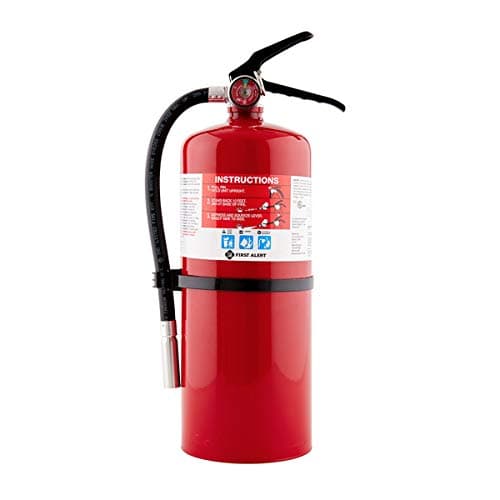 First Alert PRO10 Rechargeable Heavy Duty Extinguisher 4-A:60-B:C. The only rating on this page that matches what a garage holds. | A garage, properly | 8.2/ 10 | $72.98 · View on Amazon #ad how we are funded · price as of October 20, 2026 |
| 2 | 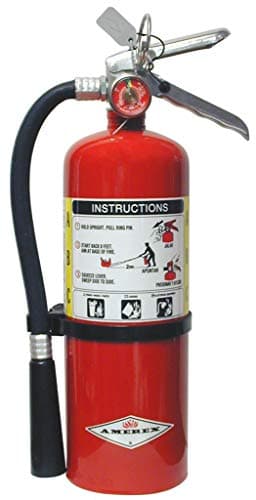 Amerex B500 5 lb ABC Dry Chemical Extinguisher 2-A:10-B:C, all-metal, serviceable for decades. The sensible middle. | A tidy garage, or a second unit | 7.4/ 10 | $75.01 · View on Amazon #ad how we are funded · price as of October 20, 2026 |
| 3 | 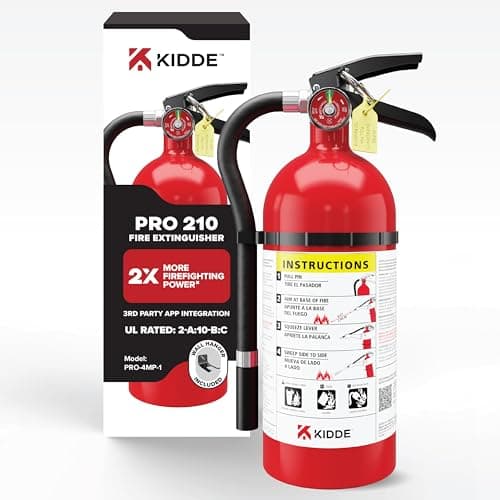 Kidde Pro 210 4 lb Multi-Purpose Extinguisher 4 lb, 2-A:10-B:C, bracket included. The one that actually gets mounted. | A small garage with no wall to spare | 7.2/ 10 | $54.97 · View on Amazon #ad how we are funded · price as of October 20, 2026 |
The units in full
1. A garage, properly
First Alert PRO10 Rechargeable Heavy Duty Extinguisher
4-A:60-B:C. The only rating on this page that matches what a garage holds.
- Listed to
- UL rated 4-A:60-B:C
- Sensing / agent
- Monoammonium phosphate dry chemical
- Power / service life
- Rechargeable by a certified professional; all-metal construction with a commercial-grade metal valve and head; 12-year limited warranty
A garage is not a bigger kitchen. The fire load is different in kind: gasoline in a mower or a can, two-stroke mix, brake cleaner, thinners, half-used paint, chain oil, aerosols, and a propane cylinder somebody brought in for the winter. Those are Class B fuels, and the B rating is the number that describes how much of that fire the unit extinguished in test.
40-B against 10-B is not a marginal upgrade. It is the difference between a unit rated for a tray of liquid and a unit rated for a spill that has run under a shelf.
The 3-A is the second half. Garages store the most ordinary combustible material of any room in a house — boxes, timber offcuts, tires, garden furniture cushions, insulation in an unfinished ceiling — and that is what carries the fire from the liquid to the structure.
Where this unit needs thought is position. It wants to be on the wall beside the door into the house or the door to the driveway, not at the back of the bench. A garage fire fought from the back of the garage is a fire fought with no exit behind you.
What it does well
- **60-B** — six times the flammable-liquid capability of the 10-B units sold for homes, which is the number that matters in a garage
- 3-A for the stored cardboard, timber, tires and insulation that make up most of a garage fire load
- Rechargeable with a metal valve rather than a disposable plastic-valve unit
- Enough agent for a second attempt, which a spreading liquid fire will demand
The downside
- Heavy — this is a two-hand lift for many people and a real control problem at arm's length
- Takes significant wall space, which a crowded garage does not always have
- Dry-chemical residue over the whole room and everything stored in it
Do not buy this if: the garage is a single-car space used only for parking, or the likely user cannot control the weight. In those cases a 4 lb 2-A:10-B:C unit mounted by the door beats a 4-A:60-B:C unit mounted where nobody can lift it.
- 4-A:60-B:C is a far larger rating than most home units — six times the flammable-liquid rating of the 10-B:C supermarket unit
- Rechargeable rather than disposable, with an all-metal valve and head
- Suits a garage, workshop or home office where liquids and equipment are the realistic risk
- Mounting bracket and a color-coded corrosion-resistant pressure gauge in the box
- Bigger and heavier, which is a real problem for anyone who cannot handle the weight one-handed
#ad how we are funded · price as of October 20, 2026
2. A tidy garage, or a second unit
Amerex B500 5 lb ABC Dry Chemical Extinguisher
2-A:10-B:C, all-metal, serviceable for decades. The sensible middle.
- Listed to
- UL rated 2-A:10-B:C
- Sensing / agent
- Monoammonium phosphate dry chemical
- Power / service life
- Rechargeable; all-metal valve and body
This is the right answer for the garage that is really a store room: bikes, boxes, a chest freezer, a tool chest, nothing liquid beyond a can of chain oil. 2-A:10-B:C covers it, and the build quality is the best on this page.
It is also the right second unit for a larger garage that already has a 40-B extinguisher at the far end — one by the house door, one by the vehicle door, so neither position leaves you crossing the fire to reach equipment.
The reason it keeps appearing on this site is serviceability. An all-metal valve means a technician will recharge it after a partial discharge rather than shrugging at a plastic body, and that is what makes it a twenty-year purchase. The home roundup makes the same case for the main level.
What it does well
- All-metal valve and body — the unit professional suppliers stock and recharge
- 2-A:10-B:C satisfies the minimum ratings most code requirements and inspections specify
- 5 lb is controllable for more people than the larger unit
- Rechargeable, so a partial discharge on a small fire does not write the extinguisher off
The downside
- 10-B is a sixth of the flammable-liquid rating of the PRO10 — undersized if the garage genuinely stores fuel
- Still 5 lb, which is not nothing to hold out and sweep
- Same corrosive dry-chemical aftermath
Do not buy this if: the garage holds a mower, a can of gas and a shelf of solvents. That is a 40-B room, and buying 10-B for it is buying the wrong number to save a few pounds of weight.
- All-metal valve rather than plastic, which is the difference between a serviceable unit and a disposable one
- Rechargeable, so a partial discharge during a small fire does not write off the extinguisher
- 2-A:10-B:C covers ordinary combustibles, flammable liquids and energized electrical equipment
- 5 lb is heavier than the supermarket unit and needs a proper bracket
#ad how we are funded · price as of October 20, 2026
3. A small garage with no wall to spare
Kidde Pro 210 4 lb Multi-Purpose Extinguisher
4 lb, 2-A:10-B:C, bracket included. The one that actually gets mounted.
- Listed to
- UL rated 2-A:10-B:C
- Sensing / agent
- Monoammonium phosphate dry chemical
- Power / service life
- Rechargeable; mounting bracket included
The case for this one is entirely about getting it on the wall in the right place. Garages are crowded, and the position an extinguisher needs — beside the exit, at a height you can lift it from, not behind the car — is often a narrow strip of wall next to a door frame.
A 4 lb unit fits there. A larger one ends up on the floor behind a shelf, which is where extinguishers go to be useless.
You keep the 2-A, which matters for any requirement that specifies a minimum rating, and you keep the full 10-B:C class coverage. What you give up is seconds. For a garage used as a garage rather than a workshop, that is a defensible trade. What size do I need works through the thresholds in detail.
What it does well
- 4 lb — the lightest unit that still reaches a 2-A rating
- Mounting bracket in the box, which is the difference between mounted and leaning in a corner
- Same 10-B:C class coverage as the 5 lb unit
- Fits beside a door frame in a single-car garage where a larger body will not
The downside
- Least agent on this page — little margin for a missed first attempt
- 10-B is undersized for a garage that stores real quantities of fuel
- Dry-chemical residue, as with every unit here
Do not buy this if: the garage is a workshop. Less agent in the room with the most fuel is the wrong direction, and the weight saving is not worth the run time.
- 4 lb — the lightest unit that still reaches a 2-A rating, which matters for one-handed use
- Rechargeable, with the bracket in the box
- Same 2-A:10-B:C class coverage as heavier units, with less run time
- Less agent means less margin for error if the first attempt misses
#ad how we are funded · price as of October 20, 2026
Ratings side by side
Ratings exactly as each manufacturer publishes them, produced under UL 711 testing. Prices are shown live inside each buy button, dated.
| First Alert PRO10 | Amerex B500 | Kidde Pro 210 | |
|---|---|---|---|
| UL rating | 4-A:60-B:C | 2-A:10-B:C | 2-A:10-B:C |
| Flammable-liquid capability | Highest here | Standard | Standard |
| Agent weight | Largest | 5 lb | 4 lb |
| Agent | Monoammonium phosphate | Monoammonium phosphate | Monoammonium phosphate |
| Rechargeable | Yes | Yes | Yes |
| Valve and body | Metal valve | All-metal valve and body | Metal valve |
| Bracket included | Check the listing | Check the listing | Yes |
| One-handed control | Hardest | Moderate | Easiest |
| Right for a workshop | Yes | Marginal | No |
| Right for a parking-only garage | Oversized | Yes | Yes |
What makes a garage the highest-risk room in a house
Not one hazard, but five overlapping ones in a space that usually has no smoke alarm in it.
- Flammable liquids in open or part-used containers — gasoline, two-stroke mix, solvent, thinners, brake cleaner, aerosols. Vapor is the hazard, not the liquid, and vapor pools low.
- Lithium-ion charging — e-bikes, scooters, mower packs and power-tool batteries left on a charger overnight. Blankets rated for that and the extinguisher question are separate problems.
- Stored ordinary combustibles — cardboard, timber, tires, cushions, paper. The highest fire load per square foot in most homes.
- Heat and ignition sources — a water heater, a furnace, a freezer compressor, grinders and extension leads with no thermal cut-out.
- No detection, usually. Garages are exempt from the smoke alarm requirement in most residential code because vehicle exhaust and dust cause nuisance alarms, so the fire runs unobserved. A heat alarm is the device designed for this room.
Where to mount it in a garage
Beside a door you would leave through, at a height between roughly 3 and 5 ft, and visible from the middle of the room. Those three rules settle almost every garage.
The common error is mounting it over the bench, next to the hazard. An extinguisher beside the grinder is an extinguisher inside the fire. The correct logic is that you approach a fire from the exit and retreat the way you came, so the equipment lives at the exit.
The second error is the floor. An extinguisher standing on the slab gets moved to sweep, gets knocked by a bumper, and ends up behind a bag of compost. Bracket it. NFPA 10 sets mounting height limits for portable extinguishers for exactly this reason, and the full mounting guide covers the dimensions.
If the garage is attached to the house, the door between them matters as much as the extinguisher — a closed, solid door buys a remarkable amount of time, and a garage fire that reaches the house usually did so through an open one.
The lithium exception, stated clearly
If the garage charges an e-bike, a scooter or a bank of tool batteries, an ABC extinguisher is not the answer to that specific hazard, and no amount of rating changes it.
A lithium cell in thermal runaway generates its own oxidizer internally. Dry chemical interrupts the chemical chain reaction of a conventional fire; it does not cool a cell that is producing heat from within, and the cell can re-ignite after the flame is out.
What an ABC unit does do is control the surrounding fire — the shelf, the cardboard, the bench — which is frequently the thing that would have taken the garage. That is worth having.
The honest position on consumer equipment for the cell itself is set out in the lithium extinguisher page, and the NFPA guidance on charging practice is better value than any purchase: charge on a hard non-combustible surface, never overnight, never on an exit route.
What else belongs on the garage wall
A heat alarm rather than a smoke alarm. Garages are the standard application for a fixed-temperature heat alarm, because dust and exhaust make a smoke alarm nuisance-prone, and a heat alarm that interconnects with the house alarms gives you warning in the bedroom. The comparison explains what you give up — a heat alarm is deaf to smoke, and that is not a small limitation.
A carbon monoxide alarm if there is a fuel-burning appliance or a vehicle. Running an engine in an attached garage, even with the door up, is one of the recognized residential CO exposure routes. Where to install CO alarms covers the position.
A fire blanket near the charging bench, which is cheap, needs no technique and smothers a small fire without putting powder over every tool in the room.
Taken together that is the garage set: detection that reaches the bedrooms, a blanket for the small event, and an extinguisher with the right B number mounted beside the door.
Questions people actually ask
What size fire extinguisher do I need for a garage?
What type of fire extinguisher is best for a garage?
Where should a fire extinguisher be mounted in a garage?
Will an ABC extinguisher put out a lithium battery fire?
Do I need a smoke alarm in my garage?
How many fire extinguishers should a garage have?
How these picks were chosen. On published specifications, safety listings and manufacturer documentation — plus the findings of organizations that do run tests. We have no laboratory and we do not burn anything. Read the full methodology.
Sources
- NFPA — NFPA 10, Standard for Portable Fire Extinguishers
- UL Solutions — Fire extinguisher testing and certification (UL 711)
- NFPA — Lithium-ion battery safety
- US Fire Administration — Home fire prevention
Read next
Fire Extinguishers
The Best Fire Extinguishers for a Home
Four rated units, what the numbers mean, and why the valve material matters.
Fire Extinguishers
What Size Fire Extinguisher Do I Need?
Weight against rating and run time, and why the likely operator decides it.
Fire Extinguishers
Where to Mount a Fire Extinguisher
Beside the exit, under 5 ft, visible from the middle of the room. Never above the hazard.
Fire Extinguishers
The Best Fire Extinguishers for Lithium Battery Fires
Why no consumer unit stops a pack in runaway, and what genuinely helps instead.
Smoke Detectors
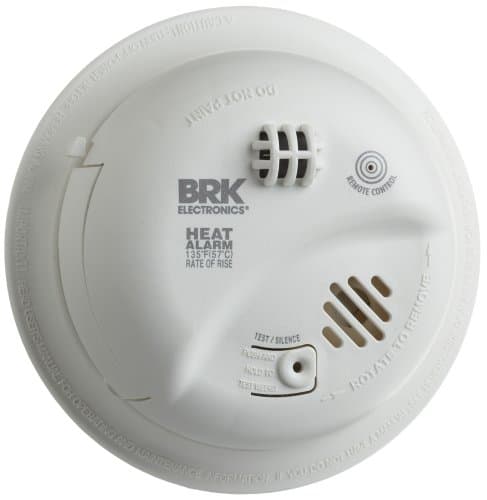
Smoke Detectors vs Heat Detectors
Why a heat alarm is always slower, and the four rooms where that is the right trade.