Fire Extinguishers
The Best Fire Extinguishers for Electrical Fires
The C in an A:B:C rating is the only thing that matters here, and it is a yes-or-no property rather than a quantity. That changes what you should actually be shopping for.
By Ryder M.Last reviewed
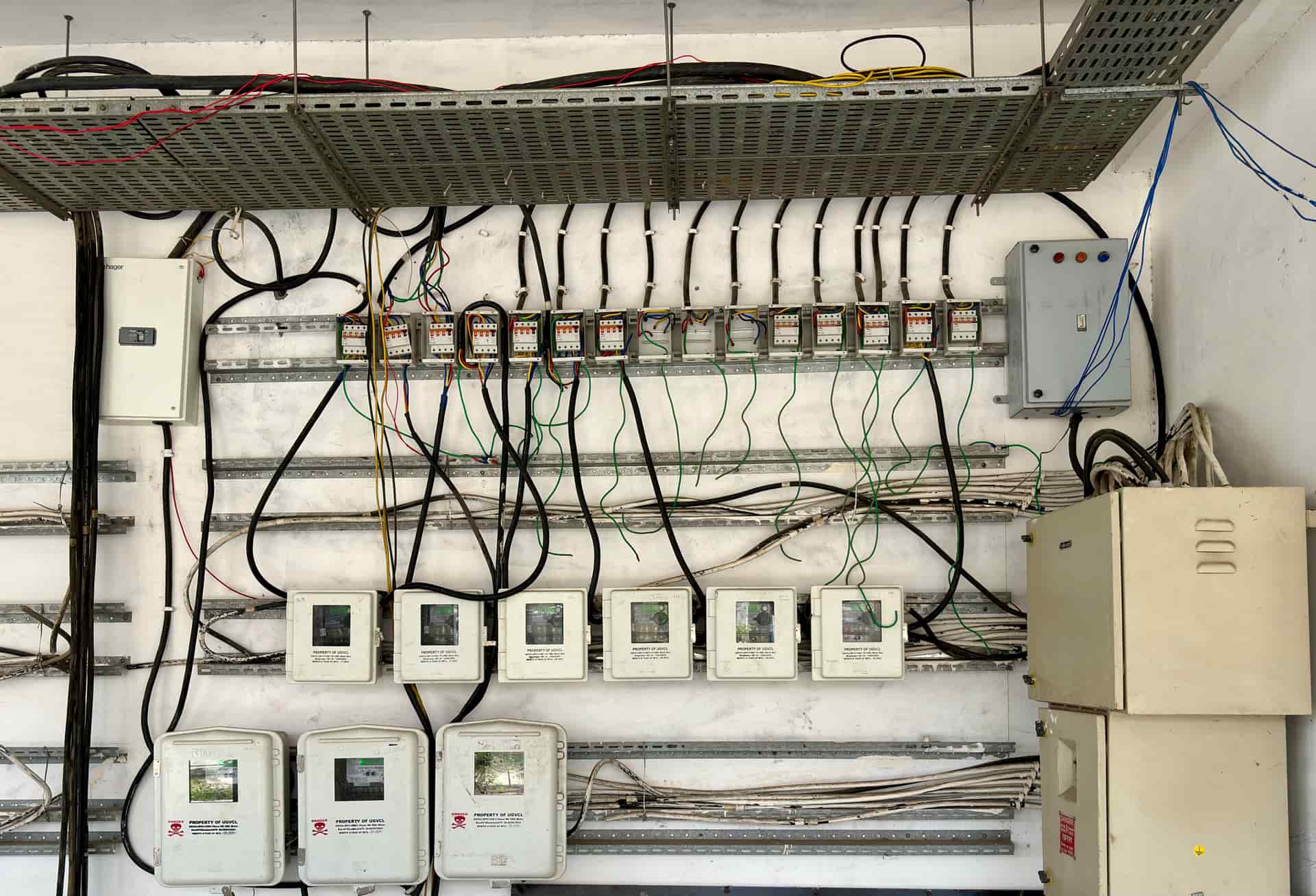
The Amerex B500 is the pick for most homes: rated 2-A:10-B:C, all-metal, rechargeable, and large enough that a fire in an appliance or a wall cavity does not outrun it. Every rated unit on this page carries a C rating, which certifies the agent is non-conductive and therefore safe to discharge at energized equipment — so the choice is not about which one handles electricity. It is about how much agent sits behind the C, and how much clean-up you are willing to accept around electronics.
Siren & Safe is reader-funded. We earn a commission on some links on this page, at no cost to you. It does not change what we recommend or the order we rank it in. Full disclosure.
Kill the power first, if you can do it without reaching into the fire
An electrical fire with the circuit still live is a fire that keeps being re-ignited by its own cause. If the breaker panel is somewhere you can reach safely — not past the fire, not in the same cupboard — switch the circuit off, or pull the plug if the plug is not the thing burning.
That single action converts the problem. With the power off, what remains is an ordinary Class A or Class B fire, and your extinguisher choice stops being constrained by conductivity.
Do not go looking for the panel. If it is not on your way, or the fire is between you and it, skip this step entirely and use a C-rated unit from a distance. A C rating exists precisely so that the power question is not a prerequisite.
And if the fire is inside a wall, a ceiling void or a sealed appliance housing, the honest answer is that you cannot reach the seat of it. Get out, close the door, and let the fire service open the structure.
Both dry chemical and carbon dioxide are rated for Class C, so the real question is what each leaves behind on the equipment it saves. CO2 vs dry chemical extinguishers is that comparison in full.
Quick picks
Scored against c rating, agent quantity, reach from a safe distance, build and serviceability and aftermath around electronics. Tap a row for the full write-up. The price in each buy button is the live Amazon price at the last check, stamped with the date it was taken.
| # | Product | Best for | Score | Price |
|---|---|---|---|---|
| 1 | 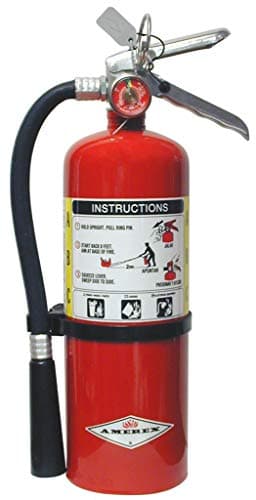 Amerex B500 5 lb ABC Dry Chemical Extinguisher 2-A:10-B:C, 5 lb, all-metal. Enough agent for a fire inside something. | A house, and the panel | 7.7/ 10 | $75.01 · View on Amazon #ad how we are funded · price as of October 20, 2026 |
| 2 | 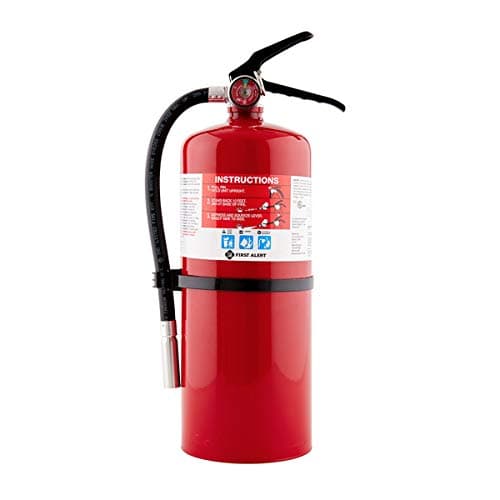 First Alert PRO10 Rechargeable Heavy Duty Extinguisher 4-A:60-B:C. The largest rating here, for the room with the most to burn. | A workshop, a home office or a garage panel | 7.8/ 10 | $72.98 · View on Amazon #ad how we are funded · price as of October 20, 2026 |
| 3 | 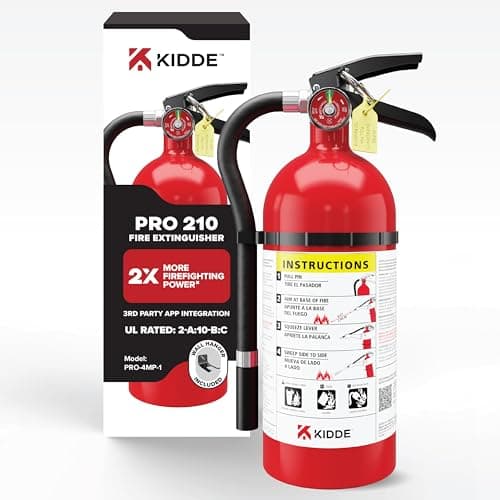 Kidde Pro 210 4 lb Multi-Purpose Extinguisher 4 lb at 2-A:10-B:C, bracket in the box. The compromise that works. | The lightest unit that still reaches 2-A:10-B:C | 7.1/ 10 | $54.97 · View on Amazon #ad how we are funded · price as of October 20, 2026 |
| 4 | 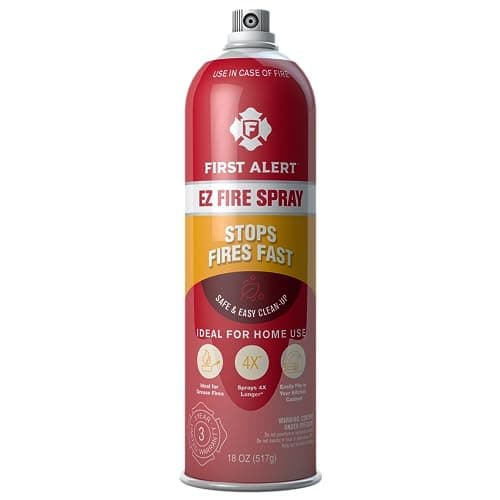 First Alert EZ Fire Spray AF400 No rating, no pin, no technique. Wipes off electronics. Keep one and know its limits. | The appliance fire somebody untrained meets first | 5.3/ 10 | $11.98 · View on Amazon #ad how we are funded · price as of October 20, 2026 |
The units in full
1. A house, and the panel
Amerex B500 5 lb ABC Dry Chemical Extinguisher
2-A:10-B:C, 5 lb, all-metal. Enough agent for a fire inside something.
- Listed to
- UL rated 2-A:10-B:C
- Sensing / agent
- Monoammonium phosphate dry chemical
- Power / service life
- Rechargeable; all-metal valve and body
The C rating is the whole qualification, and it is worth being precise about what it means: UL certifies that the agent will not conduct electricity back up the discharge stream to the operator. It is not a measure of capability against electrical fires — there is no such measure — it is a safety property of the agent.
What you choose on, then, is agent quantity. Electrical fires almost never present as an open flame you can see all of. They are inside a wall, behind a panel cover, in the back of a dishwasher, under a dash. You get at them through a gap, which means several short bursts rather than one sweep, which means you want more than a 2.5 lb can holds.
The 2-A matters more than people expect here too. By the time you see flame from an outlet or a light fitting, the fault has usually set something ordinary alight — insulation, a stud, carpet, a cardboard box. The fire you end up fighting is a Class A fire with an electrical cause, and the A rating is what covers it.
And the all-metal construction is why this unit appears on nearly every list on this site. It is built to be serviced for decades rather than replaced after one gauge drift, which makes it the only honest long-term buy in the category.
What it does well
- Rated C — non-conductive monoammonium phosphate, safe to discharge at energized equipment
- 5 lb of agent, which matters because an electrical fire is usually inside a housing or a cavity and takes more than one pass
- All-metal valve and body: a unit a professional supplier will recharge rather than a disposable
- 2-A:10-B as well, so it still covers the ordinary combustibles the fault has set alight
The downside
- Dry chemical is brutal on electronics — the residue is mildly corrosive and conductive once it absorbs moisture
- 5 lb takes real grip to hold out and steer accurately
- Nothing about a C rating makes a fire inside a sealed wall safe to approach
Do not buy this if: the thing on fire is a computer, a server rack or an instrument you are hoping to recover. Dry chemical will put the fire out and write off the equipment. If the hardware matters more than the room, that is a clean-agent job and no household extinguisher does it.
- All-metal valve rather than plastic, which is the difference between a serviceable unit and a disposable one
- Rechargeable, so a partial discharge during a small fire does not write off the extinguisher
- 2-A:10-B:C covers ordinary combustibles, flammable liquids and energized electrical equipment
- 5 lb is heavier than the supermarket unit and needs a proper bracket
#ad how we are funded · price as of October 20, 2026
2. A workshop, a home office or a garage panel
First Alert PRO10 Rechargeable Heavy Duty Extinguisher
4-A:60-B:C. The largest rating here, for the room with the most to burn.
- Listed to
- UL rated 4-A:60-B:C
- Sensing / agent
- Monoammonium phosphate dry chemical
- Power / service life
- Rechargeable by a certified professional; all-metal construction with a commercial-grade metal valve and head; 12-year limited warranty
This is the unit for the room where an electrical fault has the most to feed on. A workshop has a sub-panel, extension leads, battery chargers, a compressor, solvents and sawdust in the same twenty square feet, and the 40-B rating is there because a fire that starts electrically very often finds a liquid.
The 3-A is the other half of the argument. A garage fire that starts in a charger and reaches stored cardboard, timber or tires is an ordinary-combustible fire by the time you arrive, and 3-A is meaningfully more capability than the 1-A units sold as home extinguishers.
Where it is wrong is anywhere small. Rating is not free: this is a unit you lift with intent, and the whole technique — aim at the base, squeeze, sweep while advancing — gets harder with every pound.
If the garage also charges e-bikes or power-tool packs, read the lithium page before assuming an ABC unit covers it. A cell in thermal runaway is a different problem and the C rating does not help with it.
What it does well
- 4-A:60-B:C — six times the flammable-liquid rating of a standard home unit and double the A rating
- The right size where electrical risk sits next to flammable liquids: a garage, a workshop, a shed with a sub-panel
- Rechargeable with a metal valve
- More run time than any other unit here, which is what a fire inside a machine housing demands
The downside
- Heavy and bulky — a genuine problem for anyone who cannot steer it one-handed
- Same dry-chemical aftermath, over a larger area
- Oversized for a hallway or an apartment kitchen
Do not buy this if: it is the only extinguisher in a small apartment, or the likely user will struggle with the weight. A big unit that gets dropped is worse than a small one that gets aimed.
- 4-A:60-B:C is a far larger rating than most home units — six times the flammable-liquid rating of the 10-B:C supermarket unit
- Rechargeable rather than disposable, with an all-metal valve and head
- Suits a garage, workshop or home office where liquids and equipment are the realistic risk
- Mounting bracket and a color-coded corrosion-resistant pressure gauge in the box
- Bigger and heavier, which is a real problem for anyone who cannot handle the weight one-handed
#ad how we are funded · price as of October 20, 2026
3. The lightest unit that still reaches 2-A:10-B:C
Kidde Pro 210 4 lb Multi-Purpose Extinguisher
4 lb at 2-A:10-B:C, bracket in the box. The compromise that works.
- Listed to
- UL rated 2-A:10-B:C
- Sensing / agent
- Monoammonium phosphate dry chemical
- Power / service life
- Rechargeable; mounting bracket included
The practical argument for this one is mounting. An extinguisher for electrical fires wants to live near the panel and near the room's exit, and those are often cramped positions — the back of a utility cupboard, a stair cupboard, a hallway wall beside a breaker box. A 4 lb body fits where a 5 lb one does not.
You keep the class coverage. 2-A:10-B:C is the same label as the 5 lb unit; what you lose is seconds of discharge, not capability. For a fire caught early at an outlet or a light fitting, that is an acceptable trade.
The bracket being in the box matters more than it sounds. An extinguisher standing on a shelf falls over, gets moved, and ends up behind something. Where to mount it is a shorter conversation when the fixing came with the unit.
What it does well
- 4 lb is the lightest weight that still carries a 2-A rating, the threshold many code requirements start at
- Rechargeable, with the mounting bracket included rather than sold separately
- Identical 10-B:C class coverage to the 5 lb units
- Easier to mount inside a utility cupboard or beside a panel than a 5 lb body
The downside
- Less agent means less margin if the first burst misses the seat of the fire
- Same dry-chemical residue
- Short enough on run time that a fire inside a cavity may outlast it
Do not buy this if: the room is a workshop or a garage with stored liquids. There, the extra B rating of a larger unit is the point of the purchase.
- 4 lb — the lightest unit that still reaches a 2-A rating, which matters for one-handed use
- Rechargeable, with the bracket in the box
- Same 2-A:10-B:C class coverage as heavier units, with less run time
- Less agent means less margin for error if the first attempt misses
#ad how we are funded · price as of October 20, 2026
4. The appliance fire somebody untrained meets first
First Alert EZ Fire Spray AF400
No rating, no pin, no technique. Wipes off electronics. Keep one and know its limits.
- Listed to
- Aerosol extinguishing spray — not a UL-rated A:B:C portable extinguisher
- Sensing / agent
- Sodium-bicarbonate-based extinguishing aerosol
- Power / service life
- Single use; check the stamped expiry
This is included with a caveat stated plainly: it has no C rating. First Alert sells it as an extinguishing aerosol, not as a rated portable extinguisher, and it carries no published A:B:C capability of any kind.
What it does cover is the overwhelmingly common version of a household electrical fire: a toaster, a charger, a lamp, a power strip — small, visible, and smoking rather than burning. For that, the honest sequence is to kill the power at the breaker or the plug first, and then deal with what is left. Once the circuit is dead, the C rating stops being the deciding factor and the aftermath starts mattering.
That is the case for keeping one in a drawer. Dry chemical over a kitchen worktop and a row of appliances is frequently a worse outcome than the fire was, and bicarbonate aerosol wipes off.
It is not the case for buying one instead of a rated extinguisher. The full comparison sets out both sides.
What it does well
- Point and press — nothing to remember, which is the real failure mode in domestic fires
- Bicarbonate-based agent wipes up with a cloth instead of coating a room in corrosive powder
- Small enough to keep in a drawer beside the appliances most likely to fail
- Far gentler on surrounding electronics than dry chemical
The downside
- **Not a UL-rated A:B:C extinguisher and carries no C rating at all**
- Will not satisfy a code requirement, a landlord obligation or an inspection
- Single use, with a stamped expiry nobody checks
Do not buy this if: it is your only fire tool, or you need a rated unit for any requirement. It is a companion to a rated extinguisher, and buying it instead of one is the single way to get this page wrong.
- Aerosol can format — no pin, no pressure gauge, aim and spray
- Wipes up with a cloth instead of the corrosive mess dry chemical leaves
- Genuinely easier for someone who will never practice with a real extinguisher
- It is not a rated extinguisher and does not satisfy a code requirement for one
#ad how we are funded · price as of October 20, 2026
Side by side on what matters for an electrical fire
Ratings as published by each manufacturer and produced under UL 711 testing. Prices are shown live inside each buy button, dated.
| Amerex B500 | First Alert PRO10 | Kidde Pro 210 | EZ Fire Spray | |
|---|---|---|---|---|
| C rating | Yes | Yes | Yes | No — not a rated extinguisher |
| Full UL rating | 2-A:10-B:C | 4-A:60-B:C | 2-A:10-B:C | None published |
| Agent weight | 5 lb | Larger | 4 lb | Aerosol can |
| Agent | Monoammonium phosphate | Monoammonium phosphate | Monoammonium phosphate | Sodium bicarbonate aerosol |
| Rechargeable | Yes | Yes | Yes | No — single use |
| Bracket included | Check the listing | Check the listing | Yes | n/a |
| Meets a 2-A minimum | Yes | Yes | Yes | No |
| Aftermath on electronics | Severe | Severe | Severe | Wipes off |
| Best position | Main level, by the panel | Garage, workshop, office | Utility cupboard, hallway | Kitchen or desk drawer |
What the C rating actually certifies
The A and B numbers on an extinguisher label are quantities. A relates to the size of ordinary-combustible fire the unit extinguished in test, and B to the square footage of flammable-liquid fire. More is more.
The C has no number, and it never will. It is a certification that the extinguishing agent is non-conductive — that discharging it at equipment which is still energized will not give the operator a path to earth through the stream. It says nothing about how well the unit fights an electrical fire, because the fire itself is always burning some ordinary material. Electricity is the ignition source, not the fuel.
Class C fire extinguishers is the reference page for that certification, with the agent-by-agent table of what carries a C and what must never touch energized equipment.
This is why a page about the best extinguisher for electrical fires is really a page about everything else. Every ABC dry-chemical unit sold in the US consumer channel carries the C. Once you have filtered for it, the filter has done nothing, and you are back to choosing on agent quantity, weight, build and whether you can mount it where it needs to be.
The classes reference sets out every letter and what each one covers, including Class K, which is what most kitchens actually need alongside an ABC unit.
The dry chemical problem nobody mentions
Monoammonium phosphate puts electrical fires out reliably. It also destroys the equipment it lands on, and a good deal of the equipment it does not land on directly.
The residue is mildly acidic. It is hygroscopic, meaning it pulls moisture out of the air, and damp monoammonium phosphate on a circuit board is both corrosive and conductive. Boards that survived the fire fail weeks later from the extinguishing agent instead.
For a house, that is the right trade every time — the structure matters more than the appliance. For a home office full of hardware, a studio, or a rack, it is worth knowing that clean-agent extinguishers exist for exactly this reason and that nothing in the consumer channel is one.
The practical hedge is a drawer-level aerosol for the small, visible, already-de-energized fire, and a rated ABC unit by the door for everything bigger. Clean-up, when it happens, needs care rather than a vacuum cleaner — the powder clean-up guide covers what the residue is and how to handle it without making the exposure worse.
Where to put them in a house with an electrical risk
Position beats rating. An extinguisher two rooms away from the fire is a decoration.
- One rated ABC unit on the main level, near the route past the breaker panel — approached with the exit behind you, never with the panel between you and the door.
- One in the garage or workshop, larger and with a higher B rating, because that is where chargers, extension leads and flammable liquids share a bench.
- One aerosol in a kitchen drawer, for the appliance fire caught in its first ten seconds once the plug is out.
- Nothing above an appliance, and nothing inside the cupboard that holds the hazard. The fixing point has to be reachable when the hazard is already on fire.
- Tell every adult in the house where each one is, out loud. An extinguisher nobody knows about does not exist.
The detection question this page does not solve
Electrical fires have a long, quiet, smoldering phase. That is their defining characteristic and the reason they so often start overnight inside a wall or a loft: a loose connection warms, insulation degrades, and the fire produces smoke for a long time before it produces flame.
Photoelectric smoke sensing is the technology that responds fastest to exactly that profile, which is why every current alarm recommendation on this site is photoelectric. Why that is is worth five minutes.
An extinguisher is the last line. The alarm that wakes you at the smoldering stage is worth more than any upgrade in rating, and the placement guide is where that starts.
Questions people actually ask
What type of fire extinguisher is best for an electrical fire?
Can you use an ABC extinguisher on an electrical fire?
Should I turn the power off before using an extinguisher?
Why does the C rating have no number?
Will a fire extinguisher ruin my electronics?
What size extinguisher do I need for a home electrical fire?
How these picks were chosen. On published specifications, safety listings and manufacturer documentation — plus the findings of organizations that do run tests. We have no laboratory and we do not burn anything. Read the full methodology.
Sources
- UL Solutions — Fire extinguisher testing and certification (UL 711)
- NFPA — NFPA 10, Standard for Portable Fire Extinguishers
- US Fire Administration — Home fire prevention
- CPSC — Recalls and product safety news
Read next
Fire Extinguishers
The full class chart, what the numbers measure, and which agent suits which fire.
Fire Extinguishers
The Best Fire Extinguishers for a Home
Four rated units, what the numbers mean, and why the valve material matters.
Fire Extinguishers
The Best Fire Extinguishers for a Garage
A garage is a B-class room. Buy the flammable-liquid rating, not the home-kitchen unit.
Fire Extinguishers
Where to Mount a Fire Extinguisher
Beside the exit, under 5 ft, visible from the middle of the room. Never above the hazard.
Fire Extinguishers
Aerosol Spray vs Traditional Extinguishers
Rated capability against something an untrained person will actually use.