Fire Extinguishers
Best RV Fire Extinguishers
A motorhome is a kitchen, a bedroom, a propane system and a fuel tank in a vibrating metal box. One 2 lb canister by the door is not a fire plan.
By Ryder M.Last reviewed

The Kidde Pro 210 is the right primary extinguisher for an RV: a UL-rated 2-A:10-B:C unit at 4 lb, light enough to aim one-handed in a narrow aisle, rechargeable rather than disposable, and supplied with the bracket that keeps it on the wall over rough road. Add a First Alert HOME1 at 2.5 lb inside the galley within reach of the cooktop, and an Amerex B500 at 5 lb in an exterior storage bay for the engine, generator or propane compartment. The one your RV came with is almost certainly a small disposable unit, and it belongs in the bin rather than on the wall.
Siren & Safe is reader-funded. We earn a commission on some links on this page, at no cost to you. It does not change what we recommend or the order we rank it in. Full disclosure.
Why the unit your RV came with is not enough
Almost every recreational vehicle is delivered with one small extinguisher clipped near the entry door. It is usually a disposable unit with a plastic valve, a low rating, and no realistic path to being recharged or serviced.
The problem is not that it is bad. It is that an RV has three separate fire problems in three separate places, and one canister by the door addresses roughly one of them.
There is a kitchen, with the cooking-oil and cooktop risk that dominates residential fire statistics, in the smallest galley you have ever cooked in. There is a 12V and 120V electrical system running behind every panel, plus a converter, an inverter and increasingly a lithium battery bank. And there is a fuel system, a propane system and often a generator, any of which can produce a fire you have to fight from outside the vehicle.
Three positions, three ratings, three different handling situations. That is the whole structure of this page.
If the vehicle in question floats rather than drives, the requirement is federal and specific. Best fire extinguishers for boats covers the Coast Guard carriage table, the 5-B/10-B/20-B labeling and the 12-year expiration on disposable units.
The three positions
Ratings below are the UL ratings printed on each unit's label. The classes are the NFPA 10 classes those ratings map to.
| Position | Realistic fire | Rating to look for | Unit here |
|---|---|---|---|
| By the entry door, inside | Anything in the living space — upholstery, electrical, a spreading galley fire | 2-A:10-B:C minimum | Kidde Pro 210, 4 lb |
| Galley, within one step of the cooktop | Cooking oil, a pan, a tea towel, a scorching cable | 1-A:10-B:C or better, light enough to aim one-handed | First Alert HOME1, 2.5 lb |
| Exterior bay | Engine, generator, propane compartment, wheel-well brake fire | 2-A:10-B:C with real capacity | Amerex B500, 5 lb |
| Galley drawer (optional supplement) | A small contained fire where powder clean-up would be worse than the fire | Not rated — supplement only | First Alert EZ Fire Spray |
Check your own RV's documentation and your state's requirements before relying on this table for an inspection or an insurance condition. Vehicle rules are not household rules.
Quick picks
Scored against rating for the space, weight and handling, mounting security, rechargeable and class coverage. Tap a row for the full write-up. The price in each buy button is the live Amazon price at the last check, stamped with the date it was taken.
| # | Product | Best for | Score | Price |
|---|---|---|---|---|
| 1 | 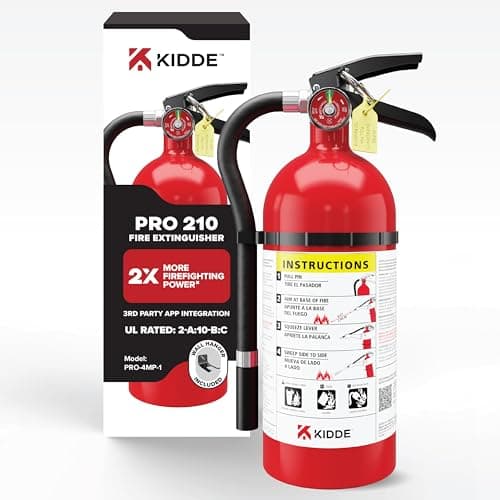 Kidde Pro 210 4 lb Multi-Purpose Extinguisher UL rated 2-A:10-B:C at 4 lb with the bracket in the box — the best balance of capability and one-handed control in a narrow aisle. | The primary unit, by the door | 9.2/ 10 | $54.97 · View on Amazon #ad how we are funded · price as of October 20, 2026 |
| 2 | 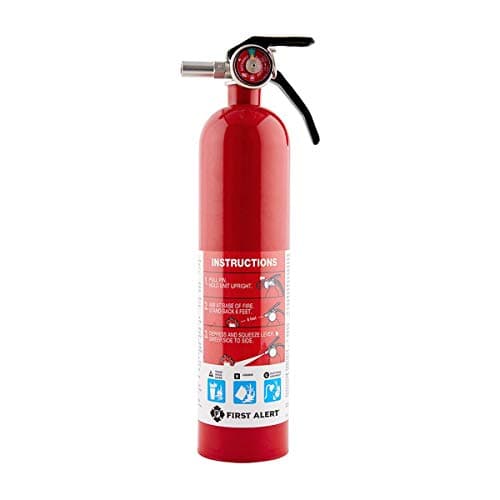 First Alert HOME1 Rechargeable Home Extinguisher (2.5 lb) 2.5 lb, UL rated 1-A:10-B:C, with a metal head and pull pin. The lightest unit most people can aim accurately. | Inside the galley, within one step of the cooktop | 8.4/ 10 | $19.98 · View on Amazon #ad how we are funded · price as of October 20, 2026 |
| 3 | 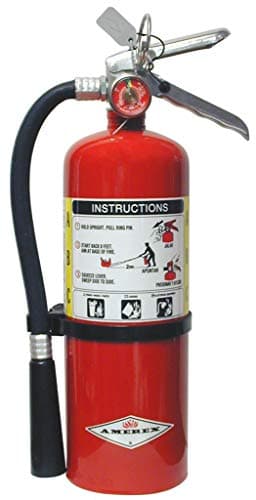 Amerex B500 5 lb ABC Dry Chemical Extinguisher 5 lb, UL rated 2-A:10-B:C, all-metal valve and body. The unit for a fire you are fighting from outside the vehicle. | The exterior bay — engine, generator, propane | 8.8/ 10 | $75.01 · View on Amazon #ad how we are funded · price as of October 20, 2026 |
| 4 | 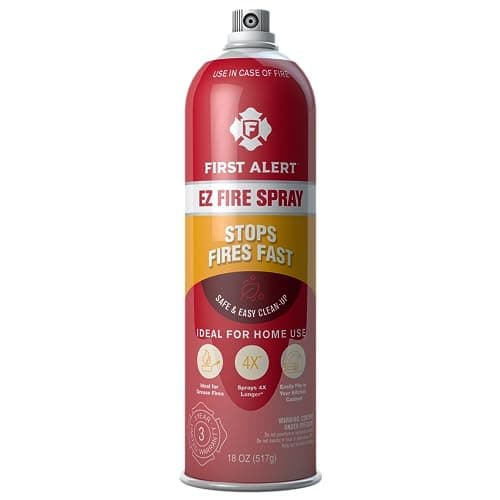 First Alert EZ Fire Spray AF400 An aerosol can that wipes up with a cloth. Not a UL-rated extinguisher and it satisfies no requirement for one. | A supplement for a tiny galley, not a replacement | 5.4/ 10 | $11.98 · View on Amazon #ad how we are funded · price as of October 20, 2026 |
The four units, by position
1. The primary unit, by the door
Kidde Pro 210 4 lb Multi-Purpose Extinguisher
UL rated 2-A:10-B:C at 4 lb with the bracket in the box — the best balance of capability and one-handed control in a narrow aisle.
- Listed to
- UL rated 2-A:10-B:C
- Sensing / agent
- Monoammonium phosphate dry chemical
- Power / service life
- Rechargeable; mounting bracket included
The reason this is the primary rather than the 5 lb is reach and control. An RV interior is a corridor. You are standing in a doorway or a passage, aiming at something a few feet away, often with one hand on something to steady yourself. A 4 lb cylinder is manageable in that position; a 5 lb with a full hose is not, for a lot of people.
The bracket matters more in a vehicle than anywhere else in this hub. A loose extinguisher in a moving motorhome is a projectile, and worse, it is an extinguisher that is not where you left it when you need it. Fit the bracket into a structural member or a cabinet frame, not into the thin decorative paneling that RV interiors are mostly made of.
Mount it where you walk past it, not where it is tidy. The right position is between you and the exit, which means near the door rather than deep in the galley: where to mount a fire extinguisher covers the principle, and it is the same one in a vehicle.
On rating: 2-A:10-B:C is the practical minimum for a living space with a fuel system attached. The B rating is what deals with gasoline, diesel, propane-fed fires and cooking oil; the C rating means the agent is non-conductive, which matters in a vehicle where the 12V system runs through every wall.
What it does well
- 4 lb is the lightest unit that still reaches a 2-A rating, which matters when you are aiming down a 30-inch aisle
- Rechargeable, so a partial discharge on a small fire does not write off the extinguisher
- Mounting bracket included — the part an RV absolutely cannot do without
- 2-A:10-B:C covers ordinary combustibles, flammable liquids and energized electrical equipment
The downside
- Less agent than a 5 lb unit, so there is less margin if the first attempt misses
- Dry chemical in a confined cabin is a severe visibility and clean-up problem
- Needs its bracket fitted into something solid, not a thin trim panel
Do not buy this if: a large Class A coach with a long interior. In that case the 5 lb unit is your primary and this is the secondary by the door.
- 4 lb — the lightest unit that still reaches a 2-A rating, which matters for one-handed use
- Rechargeable, with the bracket in the box
- Same 2-A:10-B:C class coverage as heavier units, with less run time
- Less agent means less margin for error if the first attempt misses
#ad how we are funded · price as of October 20, 2026
2. Inside the galley, within one step of the cooktop
First Alert HOME1 Rechargeable Home Extinguisher (2.5 lb)
2.5 lb, UL rated 1-A:10-B:C, with a metal head and pull pin. The lightest unit most people can aim accurately.
- Listed to
- UL rated 1-A:10-B:C
- Sensing / agent
- Monoammonium phosphate dry chemical
- Power / service life
- Rechargeable by a certified professional; metal head and pull pin
The galley is where RV fires start, for the same reason kitchen fires dominate house fire statistics: that is where the heat and the oil are, in the smallest space in the vehicle.
What a galley unit has to be is reachable without crossing the fire. An extinguisher on the far side of the cooktop is an extinguisher you cannot get to. One step away, on the aisle side, at a height you can grab without opening a cabinet.
The corrosion-resistant gauge is a genuine RV feature rather than a marketing one. An RV lives through condensation cycles, road salt and temperature swings that a hallway cupboard never sees, and a gauge you cannot read is an extinguisher you cannot check.
A fire blanket beside it is the better first move on a pan of oil, and it does not fill a 200 square foot living space with corrosive powder. How to put out a grease fire explains the order of operations, and in a galley that order matters more than in a house kitchen.
What it does well
- 2.5 lb — light enough for almost anyone to lift and aim with one hand from a standing start
- Metal head and metal pull pin with a safety seal, not the plastic valve of the disposable tier
- Color-coded corrosion-resistant gauge, which is the one you can actually read in a dim galley
- Mounting bracket in the box
The downside
- 1-A is half the ordinary-combustible rating of a 2-A unit — this is a first-response size, not a primary
- Short discharge time, which punishes a missed first attempt
- Dry chemical, so the galley will need a full clean-up afterwards
Do not buy this if: this is your only extinguisher. A 1-A unit in a vehicle with a fuel tank, a propane system and a generator is thin cover on its own.
- 2.5 lb — the lightest unit most people can aim accurately with one hand
- Metal head and a metal pull pin with a safety seal, not the plastic valve of the disposable tier
- Color-coded corrosion-resistant gauge and a mounting bracket in the box
- 1-A is half the ordinary-combustible rating of a 2-A unit, which is the trade for the size
First Alert product documentation
#ad how we are funded · price as of October 20, 2026
3. The exterior bay — engine, generator, propane
Amerex B500 5 lb ABC Dry Chemical Extinguisher
5 lb, UL rated 2-A:10-B:C, all-metal valve and body. The unit for a fire you are fighting from outside the vehicle.
- Listed to
- UL rated 2-A:10-B:C
- Sensing / agent
- Monoammonium phosphate dry chemical
- Power / service life
- Rechargeable; all-metal valve and body
Engine fires, generator fires and propane-compartment fires are fought from outside the vehicle, standing on the ground, with time to aim properly. Every constraint that made the 4 lb unit the right primary inside disappears out here, and capacity becomes the thing that matters.
Five pounds of monoammonium phosphate gives you somewhere between two and three times the useful discharge of a 2.5 lb canister. On a fuel fire under a hot engine, that difference is whether you knock it down or empty the bottle into it and watch it come back.
One hard rule on engine and generator fires: do not open the hood or the bay door wide. Cracking it and discharging through the gap keeps the oxygen supply down. Opening it fully gives the fire exactly what it was short of. If you cannot reach the fire through a gap, the answer is distance, not a bigger extinguisher.
Store it in a bay you can open from outside without walking past the fire, and check the gauge every time you dump the tanks. Fire extinguisher expiration and service covers what checking actually involves — and an RV extinguisher lives a harder life than a household one, so the interval is shorter.
What it does well
- All-metal valve rather than plastic, which is the difference between a serviceable unit and a disposable one
- 5 lb of agent gives real run time, which is what an engine-bay or generator fire needs
- Rechargeable, and because the valve is metal it is worth recharging
- 2-A:10-B:C class coverage for fuel, oil, electrical and ordinary combustibles
The downside
- Heavy enough that aiming it one-handed in a narrow aisle is unrealistic for many people
- Needs a proper bracket into structure — this is not a unit to leave loose in a bay
- Takes real storage space in a bay that is already full
Do not buy this if: a small camper van or a travel trailer with no exterior storage. Carry the 4 lb unit and skip this one rather than block the only locker you have.
- All-metal valve rather than plastic, which is the difference between a serviceable unit and a disposable one
- Rechargeable, so a partial discharge during a small fire does not write off the extinguisher
- 2-A:10-B:C covers ordinary combustibles, flammable liquids and energized electrical equipment
- 5 lb is heavier than the supermarket unit and needs a proper bracket
#ad how we are funded · price as of October 20, 2026
4. A supplement for a tiny galley, not a replacement
First Alert EZ Fire Spray AF400
An aerosol can that wipes up with a cloth. Not a UL-rated extinguisher and it satisfies no requirement for one.
- Listed to
- Aerosol extinguishing spray — not a UL-rated A:B:C portable extinguisher
- Sensing / agent
- Sodium-bicarbonate-based extinguishing aerosol
- Power / service life
- Single use; check the stamped expiry
The honest case for this product in an RV is the clean-up, and in a vehicle that case is stronger than it is in a house.
Discharging dry chemical inside a 200 square foot cabin coats every surface, every soft furnishing and every vent in corrosive powder, in a space you cannot simply walk out of and close the door on. On a small contained fire — a pan, a bin, a scorching cable — an aerosol that wipes off is a materially better outcome.
That is a clean-up argument, not a capability argument, and it has to be read alongside the listing. This is not a rated extinguisher. Aerosol spray vs traditional extinguishers sets out the trade in full, and is fire extinguisher powder toxic covers what the powder alternative actually leaves behind.
Carry it as a third item if the galley has room. Never as the only one.
What it does well
- No pin and no gauge — aim and spray, which genuinely suits someone who will never practice with a real extinguisher
- Wipes up with a cloth instead of the corrosive mess dry chemical leaves in a confined cabin
- Small enough to live in a galley drawer where a cylinder will not fit
- Light, so it is realistic for anyone to use from any position
The downside
- It is not a UL-rated A:B:C portable extinguisher and does not satisfy a code or insurance requirement for one
- Single use with a stamped expiry — there is no recharging and no second attempt
- No bracket, so in a moving vehicle it needs a drawer or a strap
Do not buy this if: you are trying to save space by carrying this instead of a rated extinguisher. That is the one use this product must not be put to.
- Aerosol can format — no pin, no pressure gauge, aim and spray
- Wipes up with a cloth instead of the corrosive mess dry chemical leaves
- Genuinely easier for someone who will never practice with a real extinguisher
- It is not a rated extinguisher and does not satisfy a code requirement for one
#ad how we are funded · price as of October 20, 2026
What makes a vehicle different from a house
Five things that change the answer, none of which apply to a kitchen cupboard at home.
- Vibration. Thousands of miles of road input loosens brackets, settles dry chemical into a cake at the bottom of the cylinder, and walks fittings out of thin paneling. Invert and shake a dry chemical unit a couple of times a season, and check the bracket screws are still in something solid.
- Temperature range. An RV sitting in summer sun or stored through a hard winter sees temperatures a hallway never does. Check the temperature range on the label, and read the gauge when the vehicle is at a normal temperature rather than straight out of the sun.
- Confined volume. Discharging a 5 lb dry chemical unit inside a small cabin means near-zero visibility within seconds, in a space with one or two exits. That is the single strongest argument for a smaller interior unit and an exterior unit for the big jobs.
- Propane. If a fire involves the propane system, the first move is the gas shut-off, not the extinguisher. An extinguisher that knocks down a propane-fed flame without stopping the gas leaves you with unburned propane filling a confined space, which is worse.
- Exit distance. In a motorhome every position is within a few steps of a door, which is genuinely good news. Use it. How to use a fire extinguisher assumes you are between the fire and the exit, and in an RV that is easy to arrange and very easy to get wrong.
Lithium batteries change the calculation
An increasing number of RVs now carry a lithium-iron-phosphate house bank, plus e-bikes, scooters, power tools and portable power stations charging on board.
No dry chemical extinguisher stops lithium-ion thermal runaway. ABC powder interrupts the chemistry of a conventional fire; a cell in runaway is generating its own oxygen and its own heat internally, and powder on the outside of the pack does not reach that. NFPA's own guidance on lithium-ion batteries is about prevention, separation and evacuation rather than extinguishment, and that is not an oversight.
What that means in practice for an RV: charge batteries where a failure does not block your exit, never overnight in the aisle, and treat a hissing, swelling or venting pack as an evacuation rather than a firefighting problem. Best lithium battery fire extinguishers and automatic fire extinguishers both deal with what is and is not available, and both are blunter than the marketing.
A fire blanket rated for a battery pack is the one consumer product with a realistic role here, and best fire blankets for lithium batteries covers the limits of that too.
Questions people actually ask
What size fire extinguisher do I need for an RV?
Is the extinguisher my RV came with good enough?
Can I use an ABC extinguisher inside an RV?
Do I need a different extinguisher for a lithium battery bank?
How these picks were chosen. On published specifications, safety listings and manufacturer documentation — plus the findings of organizations that do run tests. We have no laboratory and we do not burn anything. Read the full methodology.
Sources
- NFPA — NFPA 10, Standard for Portable Fire Extinguishers
- UL Solutions — Fire extinguisher testing and certification (UL 711)
- NFPA — Lithium-ion battery safety
- US Fire Administration — Home fire prevention
- NFPA — Cooking equipment fires in US homes
Read next
Fire Extinguishers
The Best Fire Extinguishers for a Car
Size, rating and the mount — plus why you should not open a smoking hood.
Fire Extinguishers
What Size Fire Extinguisher Do I Need?
Weight against rating and run time, and why the likely operator decides it.
Fire Extinguishers
The full class chart, what the numbers measure, and which agent suits which fire.
Fire Blankets
The Best Fire Blankets for RVs
Galley pan fires, mounting in a moving vehicle, and the line between fighting and leaving.
Carbon Monoxide Detectors
The Best CO Detectors for RVs and Travel
A battery unit for the bag, and why an RV needs an RV-listed alarm instead.