Placement & Code
Smoke Detector Placement With Ceiling Fans
A paddle fan and a smoke alarm want the same piece of ceiling. The code already has an answer, and it is a number most people have never seen.
By Ryder M.Last reviewed
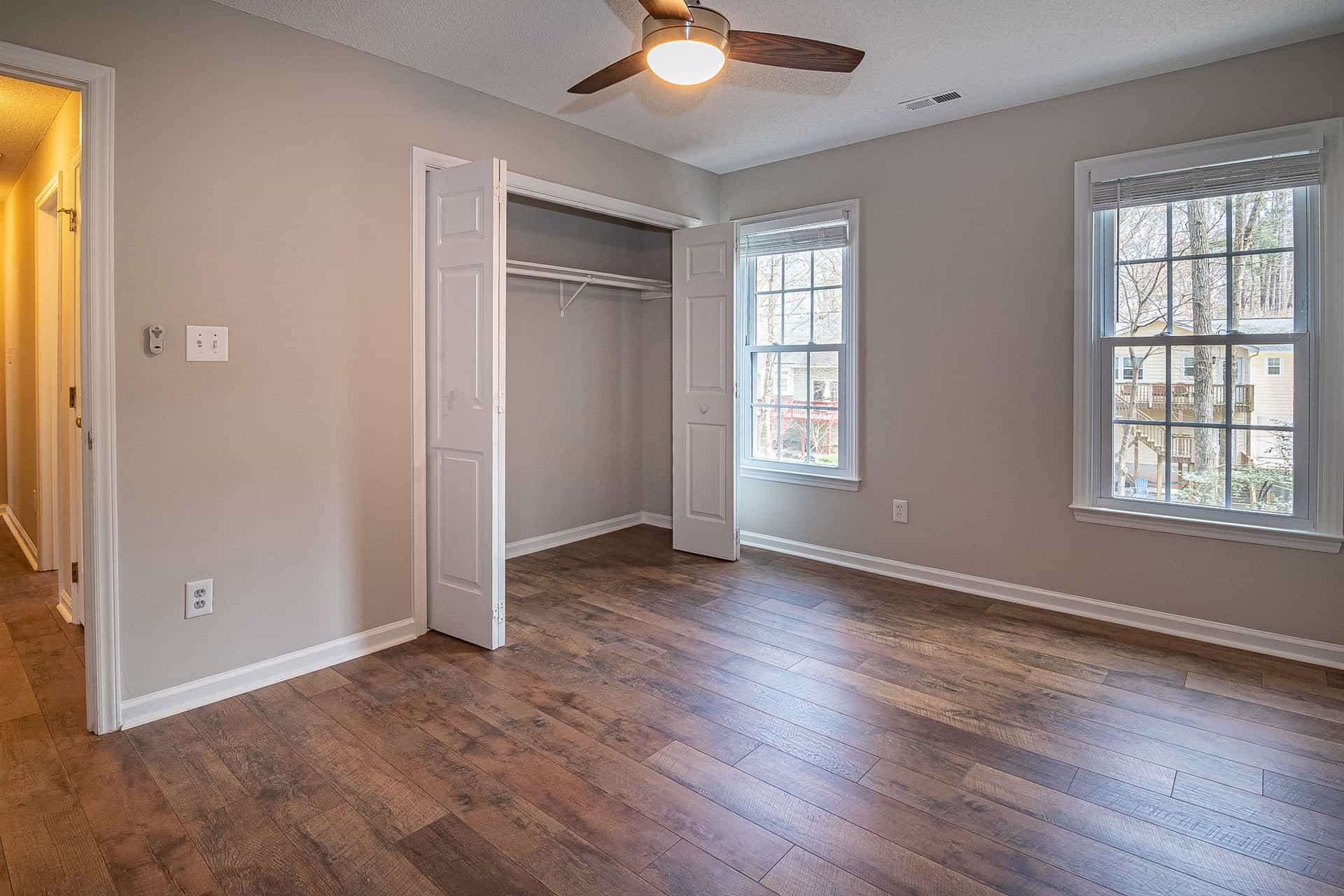
Install the smoke alarm at least 36 in (910 mm) measured horizontally from the tip of the ceiling fan blade — the same 36 in clearance the code requires from a forced-air supply register, and for the same reason. Moving air sweeps smoke away from the sensing chamber and delays the alarm. In a bedroom where the geometry genuinely will not allow that clearance, the code permits an exception, and the practical answer is a wall position 4 to 12 in down from the ceiling on the wall furthest from the fan.
Siren & Safe is reader-funded. We earn a commission on some links on this page, at no cost to you. It does not change what we recommend or the order we rank it in. Full disclosure.
Why moving air delays an alarm
A smoke alarm works by getting smoke into a small sensing chamber. Everything about where an alarm goes is really about whether smoke arriving at the ceiling will reach that chamber promptly.
Smoke rises in a plume, hits the ceiling, and spreads outward along it in a thin layer. That layer is what an alarm samples, and it is fragile. A ceiling fan running underneath it does two things: it dilutes the smoke layer with clean air from the room, and it pushes the layer outward and away from the center of the ceiling.
A supply register does the same damage by a different mechanism, and NFPA 72 sets the same 36 in distance for it — smoke detector distance from vents covers registers, returns and extract fans.
The result is not that the alarm never sounds. It is that it sounds later, and in a bedroom at night, later is the only variable that matters.
The 36 in figure is the clearance the standard settled on as the distance at which blade-tip turbulence stops meaningfully disturbing the smoke layer. It is measured as a horizontal path from the tip of the blade, not from the fan's motor housing — which is the detail almost everybody gets wrong, because the tip can be 2 ft or more from the center.
Measuring it properly
Two minutes with a tape measure. Do this before you drill anything, and do it again if a fan is ever added to a room that already has an alarm.
Find the blade tip, not the fan body
Measure from the center of the fan out to the end of one blade. On a typical 52 in fan that is about 26 in. This is the point every other measurement is taken from.
Add 36 in to that radius
A 52 in fan needs the alarm at least 26 + 36 = 62 in from the fan's center — a little over 5 ft. A 44 in fan needs about 58 in. The bigger the fan, the further out the alarm goes.
Measure as a horizontal path, not a diagonal
The requirement is a horizontal distance across the ceiling plane. Do not measure a sloping line from the blade tip up to the alarm and call it compliant.
Check the other clearances at the same time
36 in horizontally from any forced-air supply register, out of the direct airflow from it, 36 in from a bathroom door where there is a shower or tub, and at least 10 ft from a cooking appliance.
Stay out of the ceiling-wall corner
Air barely moves in the few inches where a ceiling meets a wall. Keep a ceiling-mounted alarm at least 4 in out from the wall, and a wall-mounted one between 4 and 12 in down from the ceiling.
If nothing works, use the exception deliberately
The code allows for a room whose configuration restricts meeting the clearance. Take the best available position, document why, and read the next section before you settle.
Quick picks
Scored against placement freedom, nuisance resistance, listing clarity and install effort. Tap a row for the full write-up. The price in each buy button is the live Amazon price at the last check, stamped with the date it was taken.
| # | Product | Best for | Score | Price |
|---|---|---|---|---|
| 1 | 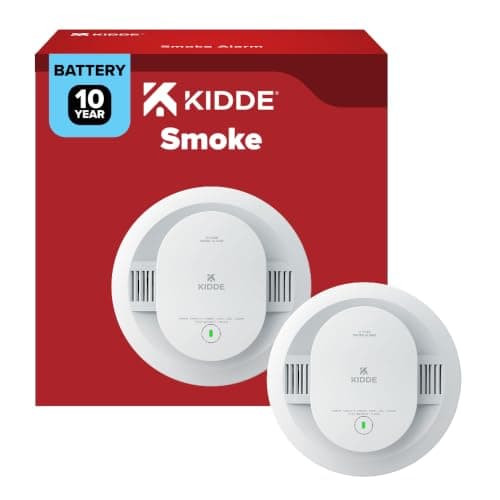 Kidde 20SD10 10-Year Battery Smoke Alarm Battery and sealed, so you can put it where the clearance works rather than where a wire runs. | A bedroom where the alarm has to move | 9.3/ 10 | $32.47 · View on Amazon #ad how we are funded · price as of October 19, 2026 |
| 2 | 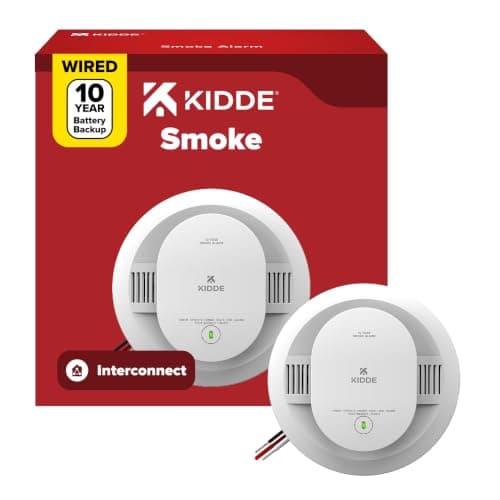 Kidde 20SA10 Hardwired Smoke Alarm with 10-Year Backup Battery Same listing, mains powered, interconnects over the wire you already have. | Keeping the interconnect when you move the alarm | 7.4/ 10 | $39.97 · View on Amazon #ad how we are funded · price as of October 19, 2026 |
Alarms that make the move easy
1. A bedroom where the alarm has to move
Kidde 20SD10 10-Year Battery Smoke Alarm
Battery and sealed, so you can put it where the clearance works rather than where a wire runs.
- Listed to
- UL 217, 10th edition (UL 217-2024 Ed.10)
- Sensing / agent
- Photoelectric smoke sensing only — no CO cell
- Power / service life
- Sealed 10-year lithium battery; 10-year limited warranty
The reason a battery alarm is the useful answer to a ceiling fan problem is that the problem is geometric. You need a specific piece of ceiling, and the existing alarm box is almost always in the wrong one — frequently right next to the fan, because both were centered in the room.
A sealed battery unit can go on the far side of the room, or on a wall, without an electrician. If the room has no alarm wiring at all, this is simply the right alarm for it.
If the room does have a wired alarm, the better fix is to move it rather than to abandon the circuit — see the wiring note further down this page.
What it does well
- No wiring, so the position is decided by the ceiling geometry rather than by an existing box
- Sealed ten-year lithium cell — no annual battery change above a bed
- Listed to UL 217 10th edition, which carries the cooking-nuisance test the 8th edition introduced
- Self-testing, which matters for a unit in a room people sleep in rather than walk through
The downside
- **No CO cell**, so a gas house needs CO coverage in the same bedroom separately
- No interconnect — a bedroom alarm sounding does not wake the rest of the house
- Photoelectric only
- Replacing it in ten years means a ladder in a bedroom again
Do not buy this if: a bedroom on an existing interconnected circuit. Do not swap a wired alarm for a battery one to solve a clearance problem — move the wired alarm, or add a wire-free interconnect model.
- Listed to the 10th edition of UL 217, which carries the cooking-nuisance test the 8th edition introduced
- Kidde's own wording: enhanced sensing technology reduces false alarms often caused by cooking
- No low-battery chirps for ten years — the first end-of-life beep is the replacement signal
- Three long beeps and a red flash on smoke, so the pattern tells you which hazard it is
- Twist-and-click bracket, and it self-tests rather than waiting for you to press the button
#ad how we are funded · price as of October 19, 2026
2. Keeping the interconnect when you move the alarm
Kidde 20SA10 Hardwired Smoke Alarm with 10-Year Backup Battery
Same listing, mains powered, interconnects over the wire you already have.
- Listed to
- UL 217, 10th edition (UL 217-2024 Ed.10)
- Sensing / agent
- Photoelectric smoke sensing only — no CO cell
- Power / service life
- 120V AC with a sealed 10-year backup battery; 10-year limited warranty
If the bedroom is on an interconnected circuit, keeping that interconnect is worth more than the convenience of a battery unit, and it is the reason this is on the page.
Interconnection is what wakes somebody on the far side of the house when a fire starts in a bedroom they are not in. Replacing a wired alarm with a battery one to dodge a fan is a downgrade that looks like a fix — the position still has an alarm, so nothing appears wrong, and the house has quietly lost whole-house alerting.
Moving a ceiling box 3 ft is a modest job for an electrician and the right one. Interconnected smoke alarms covers the wire-free option for a house where that is not practical.
What it does well
- Interconnects over an existing 120V alarm circuit — one sounds, they all sound
- UL 217 10th edition, same as the battery unit in the series
- Sealed ten-year backup battery, so a tripped breaker does not leave a bedroom unprotected
- The direct successor to the discontinued P4010ACS that occupies a lot of existing ceiling boxes
The downside
- **Moving it means moving the box**, which is electrical work in a finished ceiling
- Smoke only, no CO cell
- Mixing brands on one interconnected circuit can silently break the interconnect
- Overkill if the room has no alarm wiring to begin with
Do not buy this if: a room with no existing alarm circuit. Running a new one to solve a 36 in clearance problem is a disproportionate answer to a geometry question.
- Drops onto an existing 120V alarm circuit and interconnects over the wire — one sounds, they all sound
- Sealed 10-year backup battery, so a tripped breaker does not leave the house unprotected
- Same reduced-nuisance sensing as the battery model in this series
- No low-battery chirps across the ten years
- The direct successor to the P4010ACS line, which Kidde has discontinued
#ad how we are funded · price as of October 19, 2026
Fan size against the clearance you need
Measured from the center of the fan, which is the easier thing to find on a ceiling. Blade span is the figure printed on the fan's box.
| Fan blade span | Blade tip from center | Minimum alarm distance from fan center |
|---|---|---|
| 36 in | About 18 in | About 54 in (4 ft 6 in) |
| 44 in | About 22 in | About 58 in (4 ft 10 in) |
| 52 in | About 26 in | About 62 in (5 ft 2 in) |
| 60 in | About 30 in | About 66 in (5 ft 6 in) |
| 72 in | About 36 in | About 72 in (6 ft) |
Approximate working figures derived from the 36 in blade-tip clearance. Measure your own fan rather than assuming its span, and confirm the adopted code edition locally.
When the room will not allow 36 in
This is the common case and the reason the code carries an exception. A 10 by 10 ft bedroom with a 52 in fan centered in it has no ceiling position more than about 5 ft from the fan center in any direction, and the clearance cannot be met.
The exception exists for exactly that. The alarm still has to be in the room — the requirement that bedrooms have alarms does not bend — and the goal becomes the best available position rather than a compliant one.
Take the ceiling position furthest from the fan, typically a corner area of the ceiling at least 4 in clear of both walls. Distance is doing real work even when it falls short of 36 in.
Or use a wall position. Mount the alarm on the wall furthest from the fan, with the top of the unit 4 to 12 in below the ceiling. A wall at the edge of the room is a long way from blade-tip turbulence, and the smoke layer still reaches it.
Do not put it directly above the bed to get the distance. An alarm there is in the one part of the room where you need the most warning, and it is also the position you are most likely to disable when it chirps at 3am.
The broader room-by-room logic is on smoke detector placement, and the sloped-ceiling version of the same problem is on sloped and vaulted ceilings.
Mistakes that show up in this exact room
Every one of these is common, and every one of them is found in a bedroom with a fan.
- Measuring from the fan body instead of the blade tip. On a 52 in fan that is a 26 in error, which is most of the clearance
- Mounting the alarm on the fan's own electrical box. It is the one position guaranteed to be wrong, and the box being there makes it the tempting one
- Adding a fan to a room that already has an alarm and not re-checking. The alarm was compliant when it was fitted and is not now
- Swapping a hardwired alarm for a battery one to dodge the problem. The position keeps an alarm and the house loses interconnection
- Taking the alarm out of the bedroom entirely. The hallway alarm does not cover a bedroom with the door closed, and a closed bedroom door is exactly what you want at night
- Running the fan on high all night and assuming it makes no difference. It makes the most difference at the moment you are least able to notice
- Forgetting the supply register. The same 36 in applies, and a bedroom frequently has both a fan and a vent competing for the same ceiling
Should you turn the fan off at night?
Asked constantly and worth answering plainly: no, not for this reason.
If the alarm has its 36 in clearance, the fan running is not a meaningful problem — the clearance is exactly what buys that. If the alarm does not have the clearance, a fan running all night does measurably degrade response, and the fix is to move the alarm rather than to change how your household sleeps.
Advice that depends on somebody remembering to do something every single night is advice that will fail. The whole point of getting placement right once is that it then works without anybody thinking about it.
The same logic applies to the smart-fan and HVAC-integration question. Some whole-house systems can shut down air handling when an alarm sounds, which is genuinely useful in a large house — and it is a refinement on top of correct placement, never a substitute for it.
Questions people actually ask
How far should a smoke detector be from a ceiling fan?
Can a ceiling fan stop a smoke detector working?
What if my bedroom is too small to keep 36 inches from the fan?
Can I mount a smoke detector on the ceiling fan's electrical box?
Does the same rule apply to air vents?
Should I turn my ceiling fan off at night for fire safety?
I added a ceiling fan to a room that already had a smoke alarm. Do I need to move it?
How these picks were chosen. On published specifications, safety listings and manufacturer documentation — plus the findings of organizations that do run tests. We have no laboratory and we do not burn anything. Read the full methodology.
Sources
Read next
Placement & Code
Smoke Detector Placement, Room by Room
The three requirements, the four exclusions, and an original placement diagram.
Placement & Code
Why the apex is the wrong spot, and how peaked, vaulted, tray and joisted ceilings differ.
Placement & Code
NFPA 72 Residential Requirements
The residential sections, quoted with their numbers, and what each one means in practice.
Placement & Code
How Many Smoke Detectors Do I Need?
Worked counts for real house shapes, including split levels and open plans.
Smoke Detectors
Why Your Smoke Alarm Goes Off for No Reason
Position first, contamination second, faulty alarm a distant third.
Placement & Code
Kitchen and Bathroom Placement
The cooking and bathroom exclusion distances, and how to satisfy them in an open plan.