Smoke Detectors
The Best Air Quality Monitors for Smoke
These are instruments, not alarms. They answer a question a certified smoke alarm is specifically designed not to answer.
By Ryder M.Last reviewed

Buy the Qingping Air Quality Monitor Gen 2 if you want a real instrument: PM2.5 and PM10 on a color touchscreen with a published accuracy figure, plus a logging app and an open API, which is what turns a reading into a record. The budget pick is the Amazon Smart Air Quality Monitor - the cheapest way to put a particulate reading in a room, with Alexa notifications and routines, though it has no display and tells you least about why a number moved. For a landlord policing smoking or vaping in a rental, the Forensics Detectors FD-VAPE-WALL is purpose-built for aerosol rather than general air quality and pushes a phone alert in five seconds or less. One rule governs all three: none of them is a smoke alarm, none is certified to UL 217, and none replaces one.
Siren & Safe is reader-funded. We earn a commission on some links on this page, at no cost to you. It does not change what we recommend or the order we rank it in. Full disclosure.
What a monitor measures that an alarm deliberately ignores
A certified smoke alarm is engineered to be insensitive to most of the smoke in your life. It has to be: an alarm that sounded at the particulate level produced by searing a steak, lighting a candle or opening a window on a hazy day would be unplugged within a week. UL 217 defines the sensitivity window and the cooking-nuisance tests precisely so that normal smoke does not trigger it.
That design choice leaves a real gap, and it is the gap these instruments fill. Wildfire smoke infiltrating a house can hold PM2.5 at levels that matter for health for days without ever approaching an alarm threshold. Cigarette and vape aerosol in a rental is a tenancy issue, not a fire, and no alarm will ever report it. A smoldering appliance or a badly drawing wood stove can put particulate into a room for weeks before anything reaches an alarm point. In all three cases the useful device is a monitor with a number and a history.
The practical split is therefore simple. The alarm is the safety device: certified, tested, loud, and the thing that wakes you. The monitor is the instrument: it quantifies, logs and explains. Buying the second instead of the first is a mistake with a serious consequence, and some marketing in this category blurs that line - which is why the warning above is the first thing on this page.
If what you actually want is earlier warning of a fire rather than measurement of smoke, the answer is not a monitor. It is more certified alarms in more positions, interconnected so they all sound together. How many smoke detectors do I need counts it out, and best smoke detectors is where to buy them.
Quick picks
Scored against measurement quality, readable without a phone, record keeping, smoke specificity and install simplicity. Tap a row for the full write-up. The price in each buy button is the live Amazon price at the last check, stamped with the date it was taken.
| # | Product | Best for | Score | Price |
|---|---|---|---|---|
| 1 | 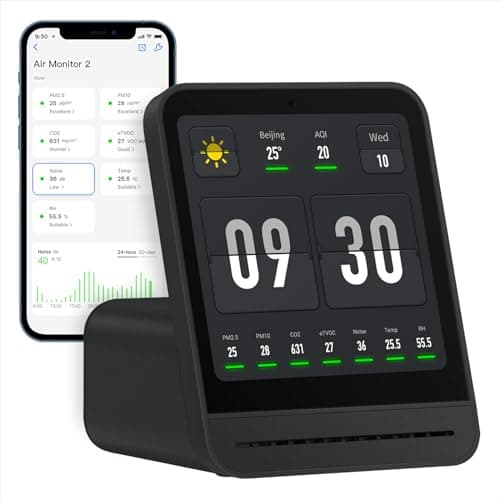 Qingping Air Quality Monitor Gen 2 Seven readings on a color touchscreen with a published PM2.5 accuracy figure, a logging app and an open API. The only instrument here that produces a record rather than a snapshot. | Anyone who wants a number they can defend - and a history | 9.1/ 10 | $149.99 · View on Amazon #ad how we are funded · price as of November 11, 2026 |
| 2 | 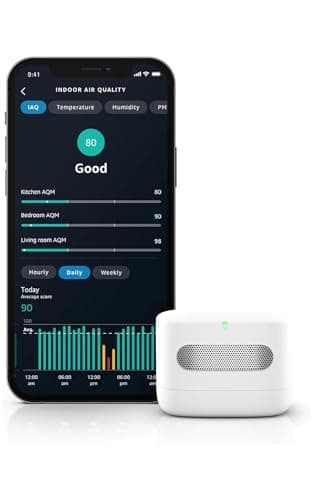 Amazon Smart Air Quality Monitor The cheapest way to get PM2.5 in a room, with Alexa notifications and routines. No display, and the least specific about why a reading moved. | The budget pick - a particulate reading in a room, with phone alerts | 7.6/ 10 | |
| 3 | 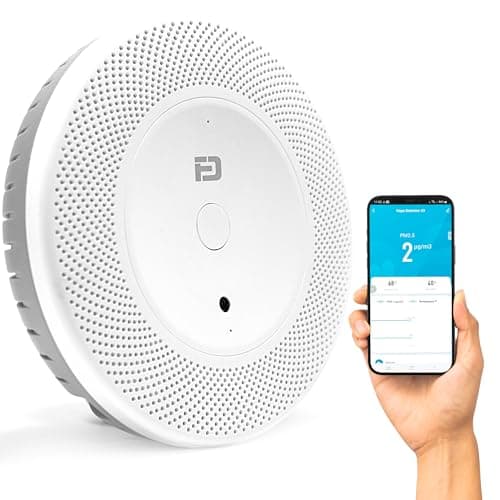 Forensics Detectors FD-VAPE-WALL Vape Detector Purpose-built for smoking and vaping aerosol rather than general air quality, with a published five-second response and a phone push alert. | A landlord or property manager policing smoking and vaping | 8.2/ 10 | $475.00 · View on Amazon #ad how we are funded · price as of November 11, 2026 |
The picks
1. Anyone who wants a number they can defend - and a history
Qingping Air Quality Monitor Gen 2
Seven readings on a color touchscreen with a published PM2.5 accuracy figure, a logging app and an open API. The only instrument here that produces a record rather than a snapshot.
- Listed to
- Not a listed smoke or CO alarm — a monitoring instrument with a screen
- Sensing / agent
- Laser particulate sensor for PM2.5 and PM10 plus a Sensirion SCD40 NDIR sensor for carbon dioxide
- Power / service life
- USB powered with a small internal battery for short periods off the cable
Why a logged history is the feature to pay for. A single PM2.5 reading tells you almost nothing - the number moves when you fry an egg. What tells you something is a week of readings with the spikes lined up against events: the afternoon the wildfire smoke arrived, the evening the wood stove was lit badly, the three nights the upstairs neighbor smoked. An open API and an app with history are what let you build that.
PM2.5 is the smoke-relevant number. Combustion smoke is dominated by fine particulate in the 2.5 micron range and below, which is also the fraction that reaches deep into the lungs. A monitor reporting PM2.5 and PM10 separately lets you distinguish a smoke event from a dusty one.
It is still an instrument, not a safety device. Put it beside the certified alarms rather than instead of them. The alarm is the thing that wakes you; this is the thing that explains the week.
What it does well
- **PM2.5 and PM10 both reported**, which is the pair that distinguishes combustion smoke from coarse dust
- **Published PM2.5 range of 0 to 999 micrograms per cubic meter at plus or minus 10 micrograms or 10 percent** - an accuracy figure, which almost nothing in this category publishes
- **Color touchscreen** showing all seven values, so you are not reaching for a phone to read your own air
- **Qingping+ app with history, plus an open API**, which is what makes a logged record possible - the difference between "it smells smoky" and a chart
- **CO2 from 400 to 9,999 ppm** as well, useful for ventilation decisions in a closed room
- Ambient noise, temperature and humidity on the same screen
The downside
- **Not a smoke alarm and not certified as one.** Qingping describes it as a monitoring instrument, and it must not be treated as a substitute for a UL 217 alarm
- **The internal battery runs only a few hours**, so in practice it is a plugged-in device rather than a portable one
- **Most expensive instrument here**, and the extra money buys measurement rather than alerting
- **CO2 is not carbon monoxide**, and the screen's CO2 reading tells you nothing about the CO hazard - that needs a UL 2034 alarm
- General air quality rather than smoke-specific: it will read a cooking plume and a wildfire the same way
Do not buy this if: anyone who wants an alerting device rather than a measuring one, or a landlord who needs a vaping-specific trigger - the FD-VAPE-WALL is built for that. It is also not a CO detector; see [CO2 versus carbon monoxide detectors](/carbon-monoxide-detectors/co2-vs-carbon-monoxide-detectors).
- Seven readings on a color touchscreen: PM2.5, PM10, CO2, TVOC, temperature, humidity and ambient noise
- Published PM2.5 range of 0 to 999 micrograms per cubic meter at plus or minus 10 micrograms or 10 percent
- Published CO2 range of 400 to 9,999 ppm — useful for ventilation, and not a substitute for a CO alarm
- Qingping+ app with history, plus an open API, which is what makes a record rather than a snapshot
- Internal battery runs only a few hours, so it is a plugged-in device in practice
#ad how we are funded · price as of November 11, 2026
2. The budget pick - a particulate reading in a room, with phone alerts
Amazon Smart Air Quality Monitor
The cheapest way to get PM2.5 in a room, with Alexa notifications and routines. No display, and the least specific about why a reading moved.
- Listed to
- Not a listed smoke or CO alarm — a monitoring device that reports to an app
- Sensing / agent
- Fan-assisted particulate sensor plus VOC, CO, temperature and humidity sensing
- Power / service life
- Mains powered over micro USB; no battery
Where the budget pick is genuinely the right pick. If the question is "is the wildfire smoke getting inside", a PM2.5 trend from a $70 device answers it, and so does a routine that turns the purifier on when the number climbs. That is a real use, and paying four times more for a touchscreen does not improve it.
The CO reading needs stating carefully. The device reports a carbon monoxide value, and that is informative. It is not certified to UL 2034, its thresholds are not the tested ones, and it cannot be relied on to wake a household. Put a certified CO alarm in the house regardless - best battery CO detectors covers that purchase.
One per room, not one per house. Particulate is local. A monitor in the hallway tells you about the hallway.
What it does well
- **Cheapest route to a particulate reading** by a wide margin, which is what makes covering more than one room realistic
- **Five values reported** - PM2.5, VOCs, carbon monoxide, temperature and humidity
- **Push notifications through the Alexa app, plus routines and spoken announcements** on an Echo device, so it can switch on a purifier or tell a room
- **Reports a CO value**, which is informative - though it is explicitly not a certified CO alarm
- **Plugs in and pairs in minutes**, with no screws and no account beyond the one you have
- Small enough to sit on a shelf without comment
The downside
- **No display at all.** A single LED indicates current air quality and the numbers live in the app, so you cannot glance at it
- **Not a listed smoke or CO alarm**, and Amazon says so - it is a monitoring device reporting to an app
- **Permanently tied to a 5 V adapter**, so it cannot be moved around a property casually
- **Least specific instrument here about why a number moved** - one particulate reading and a VOC index, with no PM10 to compare against
- Requires an Alexa account and cloud connectivity to do anything useful
Do not buy this if: anyone who wants to read their air without a phone, or who needs a defensible measurement with a published accuracy figure. The Qingping covers both. It is also not a CO alarm, whatever its CO reading says.
- Reports five values — PM2.5, VOCs, carbon monoxide, temperature and humidity
- Push notifications through the Alexa app, plus Alexa routines and spoken announcements on an Echo device
- No display: a single LED indicates current air quality, and the numbers live in the app
- Permanently powered by a 5V adapter, so it cannot be moved around a property casually
- The cheapest way to put a particulate reading in a room — and the least specific about why the reading moved
3. A landlord or property manager policing smoking and vaping
Forensics Detectors FD-VAPE-WALL Vape Detector
Purpose-built for smoking and vaping aerosol rather than general air quality, with a published five-second response and a phone push alert.
- Listed to
- Not a fire or smoke alarm and not a listed alarm of any kind — an air-quality instrument
- Sensing / agent
- Laser-scattering particulate sensor, reading PM2.5 from 0 to 999 micrograms per cubic meter
- Power / service life
- Mains powered over USB; 1-year limited warranty
Response time is the whole specification. A general air quality monitor averages its readings over minutes, which is correct for air quality and useless for catching a single vape exhale in a bathroom. A device that responds in five seconds is measuring the event rather than the day, and that is the difference between a dashboard and evidence.
Count the units before you cost the project. At one unit per 200 to 300 square feet, a two-bedroom apartment is two or three detectors and a small block is dozens. The per-unit price is only the start of the number.
It does not replace the legally required alarms. A rental needs certified smoke alarms, and in most jurisdictions CO alarms too. This sits alongside them - rental and landlord requirements covers the obligations.
What it does well
- **Purpose-built for vaping and smoking aerosol**, with a manufacturer-published response time of five seconds or less - general monitors average over minutes and miss a single exhale entirely
- **Laser-scattering particulate sensor reading PM2.5 from 0 to 999 micrograms per cubic meter**
- **Phone push alerts through the Tuya Smart app** over 2.4 GHz Wi-Fi, with SMS and email available through Tuya at extra cost
- **Wall-mounted with the screw kit in the box** and powered continuously from USB, so it is a fixture rather than a gadget
- **One detector pairs to one phone at a time**, though a phone can hold several detectors - workable for a manager with a portfolio
- The only instrument here designed for an enforcement use rather than a curiosity one
The downside
- **By far the most expensive device on this page**, and a whole-property install multiplies that
- **Manufacturer recommends one unit per 200 to 300 square feet**, so a house is several units, not one
- **Not a smoke alarm**, not certified to UL 217, and not a substitute for the alarms a rental is legally required to have
- **Mains powered over USB with no battery**, so a tenant who unplugs it has defeated it
- **Tuya ecosystem dependency** for alerts, and the useful notification channels are a paid add-on
Do not buy this if: a homeowner wanting to understand their own air - both cheaper instruments here do that better per dollar. For the wider rental-monitoring case see [cigarette and vape detectors for rentals](/smoke-detectors/cigarette-and-vape-detectors-for-rentals).
- Purpose-built for vaping and smoking aerosol rather than general air quality, with a response time the manufacturer publishes as 5 seconds or less
- Phone push alerts through the Tuya Smart app over 2.4 GHz Wi-Fi, with SMS and email available through Tuya at extra cost
- Manufacturer recommends one unit per 200 to 300 sq ft, so a whole house is several units
- Wall-mounted with the screw kit in the box, and powered continuously from USB
- One detector pairs to one phone at a time, though a phone can hold several detectors
Forensics Detectors product documentation
#ad how we are funded · price as of November 11, 2026
The three instruments side by side
Specifications as published by the manufacturers, checked on 2026-11-10. The live price and the date it was taken sit in each buy button.
| Instrument | Smoke-relevant readings | Display | Alerting | Certified alarm? |
|---|---|---|---|---|
| Qingping Gen 2 | PM2.5 and PM10, published accuracy | Color touchscreen | App, history and open API | No |
| Amazon Smart Air Quality Monitor | PM2.5 and a VOC index | Single status LED | Alexa app, routines, announcements | No |
| Forensics Detectors FD-VAPE-WALL | PM2.5, response under 5 seconds | None | Tuya app push; SMS and email extra | No |
The "certified alarm" column is the one that matters. A monitor can be excellent and still be the wrong device to rely on in a fire - the certified alarms on the rest of this site are what that job needs.
Questions people actually ask
What is the best air quality monitor for smoke?
Can an air quality monitor replace a smoke detector?
Will an air quality monitor detect wildfire smoke indoors?
Do air quality monitors detect cigarette smoke?
Is PM2.5 the right number to watch for smoke?
How these picks were chosen. On published specifications, safety listings and manufacturer documentation — plus the findings of organizations that do run tests. We have no laboratory and we do not burn anything. Read the full methodology.
Sources
- UL Solutions — UL 217 — smoke alarms
- UL Solutions — UL 217, Standard for Smoke Alarms, published with new technical requirements
- NFPA — Cooking equipment fires in US homes
- US Fire Administration — Home fire prevention
Read next
Smoke Detectors
Best Cigarette and Vape Detectors for Rentals
Particulate monitors that notice smoking and vaping, what each one can actually prove, and why your smoke alarm is not one of them.
Smoke Detectors
The Best Smoke Detectors for a Home
Four alarms, what UL 217 tests, and why interconnection beats every other feature.
Carbon Monoxide Detectors
CO2 vs Carbon Monoxide Detectors
CO kills; CO2 makes a room stuffy. Which alarm a home is required to have, what a CO2 monitor is genuinely for, and why a smoke alarm detects neither.
Smoke Detectors
UL 217 against UL 268, self-contained against panel-connected. What a house actually needs.
Placement & Code
Rental and Landlord Requirements
Where rental alarm duties actually come from, and what tenants and landlords should check.
Smoke Detectors
What the standard tests, what the recent editions changed, and how to verify a mark is real.