Smoke Detectors
X-Sense SC07-W Review
A sealed ten-year smoke and CO alarm with a radio link to 23 others. The specification that matters here is the one you cannot see on the box: range through your walls.
By Ryder M.Last reviewed

The X-Sense SC07-W is the alarm this site recommends more often than any other, and the reason is narrow and specific: it is the cheapest certified way to make every alarm in a house sound at once when any one of them detects, in a building that has no alarm wiring. It is certified to UL 217 and UL 2034, sealed for ten years, shows the measured CO concentration on an LCD, and interconnects by radio with up to 24 units with no hub, router or account involved. Buy it if you have bedrooms on a different floor from the living space. Do not buy a single one - on its own it is just a more expensive SC07 - and do not drill until you have tested the link in the real positions.
Siren & Safe is reader-funded. We earn a commission on some links on this page, at no cost to you. It does not change what we recommend or the order we rank it in. Full disclosure.
Who this alarm is for
The SC07-W answers one question: how do you get every alarm in a house to sound at once when the ceilings have no alarm wiring? If that is not your question, there is a cheaper or better answer. A single-floor flat does not need interconnection. A house with alarm cable in the ceilings already has a better version of it. A household that wants phone alerts needs a smart alarm instead.
If it is your question - and in US housing stock it very often is, because interconnection requirements apply to new construction while most existing homes were built before them - then this is the cheapest certified way to solve it. Each unit is a complete alarm: UL 217 for smoke, UL 2034 for carbon monoxide, photoelectric smoke sensing and an electrochemical CO cell, a sealed ten-year cell, and a display showing the measured CO concentration. The radio link is additive rather than load-bearing: if it fails, you still have four certified alarms rather than none.
The cost structure is worth being explicit about. One SC07-W is a worse buy than one SC07, because you are paying for a radio with nothing to talk to. Two is the minimum sensible purchase, and the honest comparison is a set of these against a set of plain alarms: the interconnect premium per unit is small, and in a multi-floor house it buys the most valuable feature available.
Where it does not fit the household, the alternatives are straightforward. A wired house should use the wiring - see interconnected smoke alarms for both routes. A household needing notification away from home needs a smart alarm, and best smart smoke detectors covers that field. A deaf or hard-of-hearing household needs a strobe or a bed shaker, which no interconnect replaces.
Quick picks
Scored against interconnect value, detection and certification, readability, ten-year upkeep and commissioning effort. Tap a row for the full write-up. The price in each buy button is the live Amazon price at the last check, stamped with the date it was taken.
| # | Product | Best for | Score | Price |
|---|---|---|---|---|
| 1 | 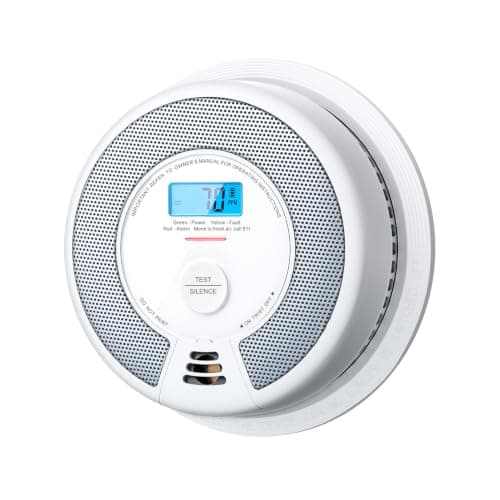 X-Sense SC07-W Wireless Interconnected Smoke & CO Alarm Certified for both hazards, sealed for ten years, and interconnected by radio with no hub. The cheapest honest route to alarms that sound together. | A multi-floor house with no alarm wiring | 9.0/ 10 |
The verdict
1. A multi-floor house with no alarm wiring
X-Sense SC07-W Wireless Interconnected Smoke & CO Alarm
Certified for both hazards, sealed for ten years, and interconnected by radio with no hub. The cheapest honest route to alarms that sound together.
- Listed to
- UL 217 and UL 2034
- Sensing / agent
- Photoelectric smoke sensing plus an electrochemical CO cell
- Power / service life
- 10-year sealed lithium battery, not hardwired
What the interconnect is actually for. The scenario behind most home fire deaths is not a missing alarm in the room where the fire starts. It is a sleeping person two floors away, behind a closed door, with a fan running, who never hears the alarm that did detect. An interconnected set puts an 85 dB horn in that person's own room the moment anything in the house detects. No display, app or voice feature competes with that.
Why radio instead of wire, honestly. Pulling alarm cable through finished ceilings is an electrician's invoice that often exceeds the cost of the alarms several times over. Radio achieves the same functional outcome for the price of the hardware, which is the entire reason this product class exists. The trade is that the link is invisible and needs commissioning rather than just wiring.
The two things to test before you drill. First, pair the whole set on a table and confirm every unit sounds when you test one. Second - the step everyone skips - carry the paired units to their real positions, prop them up, and test again from the furthest one. Masonry, foil-backed insulation and a long run through a basement are where links fail, and finding that out after the holes are drilled is the one avoidable mistake with these alarms.
Label them before they go up. Write the room on the back of each unit in permanent marker along with the install month. In two years, when one chirps, you will want to know which is which without a ladder tour.
What it does well
- **Wireless interconnect for up to 24 units** - one alarm triggers the whole set, which is the feature with the strongest safety evidence behind anything in this category
- **Certified to UL 217 and UL 2034**, so each unit is a real smoke alarm and a real CO alarm in its own right
- **Photoelectric smoke sensing plus an electrochemical CO cell**, both named on the listing - better disclosure than either US major's current ranges offer
- **Radio between the alarms, not Wi-Fi.** No router, no account, no cloud, no subscription: the link survives an internet outage, a router replacement and a vendor losing interest
- **Sealed 10-year lithium cell** in every unit - no battery ritual, no low-battery chirp until end of life
- **LCD CO reading on each unit**, and X-Sense recommends the model specifically for large or multi-story homes
The downside
- **A single unit is pointless.** The feature needs at least two alarms, so the real entry price is double and a house-wide set is a real outlay
- **Range is decided by your building, not the spec sheet.** Masonry, foil-backed insulation, steel studs and a detached garage all cut into the link, and no published figure accounts for your walls
- **ETL certified to UL 217 rather than UL-listed.** Same standard, recognized laboratory, different mark - and some inspectors and insurers have written "UL listed" into their requirements
- **It will not join a hardwired loop.** A wireless set is its own network alongside anything already fitted, never an extension of it
- **No app and no phone alerts**, so an empty house tells you nothing
- **Sealed and disposable at ten years**, and you will be replacing a matched set rather than one unit
Do not buy this if: a studio, a single-floor one-bedroom or any home where there is nothing to interconnect - the plain SC07 is the same alarm for less. It is also the wrong buy for a wired house, where the wiring already in the ceiling does this job better; see [best hardwired smoke detectors](/smoke-detectors/best-hardwired-smoke-detectors).
- Wireless interconnect for up to 24 units — one alarm triggers the whole set
- No wiring, which is the point: it retrofits interconnection into a house that never had it
- LCD CO reading on each unit
- X-Sense recommends it for large or multi-story homes
Specification
As published by X-Sense and its retail listing, checked on 2026-11-10. The live price and the date it was taken sit in the buy button rather than in this table.
| Specification | What X-Sense publishes |
|---|---|
| Hazards detected | Smoke and carbon monoxide |
| Certification | ETL certified to UL 217; UL 2034 for the CO function |
| Sensors | Photoelectric smoke sensing plus an electrochemical CO cell |
| Power | Sealed 10-year lithium battery, not hardwired |
| Interconnect | Wireless, up to 24 units, no hub or Wi-Fi required |
| Display | LCD showing the measured CO concentration on each unit |
| Mounting | Wall or ceiling; bracket, screws and anchors supplied |
| Recommended use | X-Sense names large or multi-story homes |
The specification that decides whether this alarm works in your house - radio range through your particular walls - is not on any manufacturer's list and cannot be. Commission the set in its real positions before drilling.
Commissioning a set properly
Three groups, in order. The second group is the one people skip.
On the table
- Unbox every unit and pair the whole set at once, following the sequence in the manual rather than adding units later.
- Press test on one and confirm every other unit sounds. If one does not, repair it before going any further.
- Write the room name and the install month on the back of each unit in permanent marker.
- Note the manufacture date stamped on each unit - the ten-year clock starts there, not at purchase.
In the real positions
- Carry the paired set to the positions you intend to use and prop each unit up there - on a stepladder, a shelf, a box.
- Test from the furthest unit, not the nearest. A link that works across a room may not work from a basement to a loft.
- Pay attention to masonry walls, foil-backed insulation, steel studwork and any detached structure. These are where links fail.
- If a position will not hold the link, move the alarm rather than accepting a half-connected set - a silent unit in a set is worse than a standalone alarm, because you will assume it is connected.
After mounting
- Press test monthly on one unit and confirm the whole set responds.
- Do the real test once: bedroom door shut, fan on, lights off, someone presses an alarm on another floor.
- Vacuum the vents every six months, more often near a kitchen or in a utility space.
- Replace the whole set together at ten years. A matched set bought on one day expires on one day.
Questions people actually ask
Is the X-Sense SC07-W worth buying?
How many SC07-W alarms do I need?
Does the SC07-W need Wi-Fi or a hub?
Is the SC07-W UL listed?
Can the SC07-W connect to my existing hardwired alarms?
What is the difference between the SC07 and the SC07-W?
How these picks were chosen. On published specifications, safety listings and manufacturer documentation — plus the findings of organizations that do run tests. We have no laboratory and we do not burn anything. Read the full methodology.
Sources
- UL Solutions — UL 217 — smoke alarms
- UL Solutions — UL 217, Standard for Smoke Alarms, published with new technical requirements
- UL Solutions — UL 2034 — single and multiple station carbon monoxide alarms
- X-Sense — SC07 10-year battery combination smoke and carbon monoxide alarm with LCD
- NFPA — Smoke Alarms in US Home Fires
- NFPA — Smoke alarms — installation and placement guidance
- NFPA — NFPA 72, National Fire Alarm and Signaling Code (2025 edition)
- International Code Council — IRC Chapter 3 — building planning (R310, R314, R315)
Read next
Smoke Detectors
Both listings, a display and a ten-year battery — and no interconnect.
Smoke Detectors
The Best Smoke and Carbon Monoxide Alarms Under $50
Four certified combination smoke and CO alarms under $50, including one with a wireless interconnect. What the price cap does and does not cost you.
Smoke Detectors
Why interconnection matters most, and the wired, wireless and hybrid routes.
Smoke Detectors
The Best Interconnected Smoke Detectors
One sounds, they all sound. Wireless retrofit and hardwired picks, and the mixing mistake to avoid.
Smoke Detectors
Three alternatives to X-Sense for buyers who need a UL mark, a wired interconnect or phone alerts - with an honest account of what X-Sense does well.
Smoke Detectors
Best Smoke Detectors for a Two-Story Home
Why the staircase makes interconnection non-optional in a two-story house, and the hardwired and battery routes to getting it.