Carbon Monoxide Detectors
Plug-In vs Battery CO Detectors
One is tied to an outlet and survives a power cut. The other goes exactly where the standard says it should. The right answer depends on which constraint your house actually has.
By Ryder M.Last reviewed

Buy a **plug-in unit with battery backup** where there is an outlet in the position the alarm needs, because the one night you most need a CO alarm — a power cut with a generator running — is also the night a mains-only unit is dead. Buy a **sealed-battery unit** wherever there is no outlet in the right place, which in most houses is the bedroom wall or hallway outside the sleeping areas. A plug-in unit without battery backup is the one option to avoid outright: it fails at precisely the moment the risk peaks.
Siren & Safe is reader-funded. We earn a commission on some links on this page, at no cost to you. It does not change what we recommend or the order we rank it in. Full disclosure.
The comparison in one table
Specifications as published by each manufacturer. Prices are shown live inside each buy button, dated.
| Plug-in with battery backup | Sealed 10-year battery | Replaceable battery | Plug-in, mains only | |
|---|---|---|---|---|
| Survives a power cut | Yes, on backup | Yes | Yes | No |
| Goes where the room needs it | Only at an outlet | Anywhere | Anywhere | Only at an outlet |
| Annual battery task | Yes — the backup cell | None | Yes | None |
| Can be disabled by removing a battery | Partly | No | Yes | n/a |
| Easy to read and test | Yes, at outlet height | Depends on position | Depends on position | Yes |
| Occupies a socket | Yes | No | No | Yes |
| Easy to relocate | Yes | No | Yes | Yes |
| Right for a bedroom wall | Rarely | Yes | Yes | No |
| Right for a hallway with a socket | Yes | Yes | Yes | No |
| Recommended | Yes | Yes | Situationally | No |
Why mains-only is the one wrong answer
A carbon monoxide alarm with no battery at all is dead the moment the power is, and the power being out is one of the most dangerous CO scenarios a house ever experiences.
The chain is well documented and entirely predictable. A storm takes the grid down. Somebody starts a portable generator. It ends up too close to the house, or in a garage with the door partly open, or in a basement doorway out of the rain. Exhaust accumulates while every mains-powered alarm in the building is off.
The same applies to a furnace that misbehaves on restart after an outage, and to a fuel-burning space heater or camping stove brought indoors for warmth.
So the rule is simple: if the unit plugs in, it must have battery backup, and the backup cell must be part of the annual check. Generator safety is the companion page, and it is the one worth reading before the next storm rather than during it.
Quick picks
Scored against survives a power cut, placement freedom, annual effort, readability and testing and fit and forget. Tap a row for the full write-up. The price in each buy button is the live Amazon price at the last check, stamped with the date it was taken.
| # | Product | Best for | Score | Price |
|---|---|---|---|---|
| 1 | 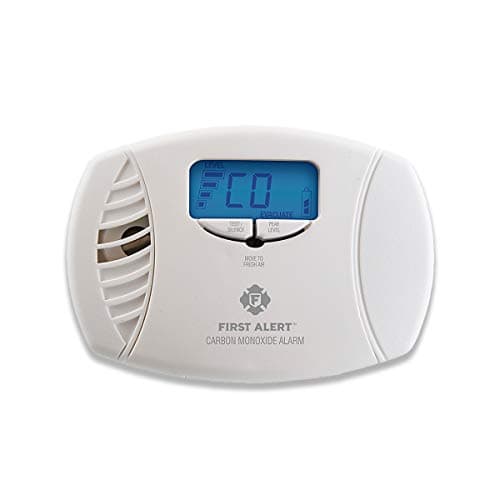 First Alert CO615 Plug-In CO Alarm with Battery Backup Plug-in with battery backup and a display. The resilient option. | A hallway with an outlet in the right place | 7.4/ 10 | $44.95 · View on Amazon #ad how we are funded · price as of October 19, 2026 |
| 2 | 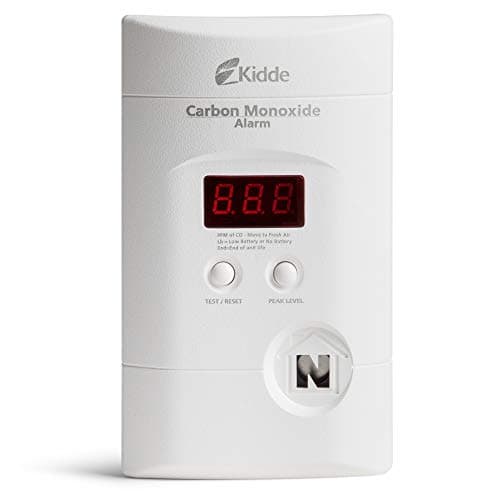 Kidde Nighthawk KN-COPP-3 Plug-In CO Alarm Plug-in with 9V backup, a display and peak memory down to 11 ppm. | Plug-in, cord or tabletop — one unit, three positions | 7.6/ 10 | $44.50 · View on Amazon #ad how we are funded · price as of October 19, 2026 |
| 3 | 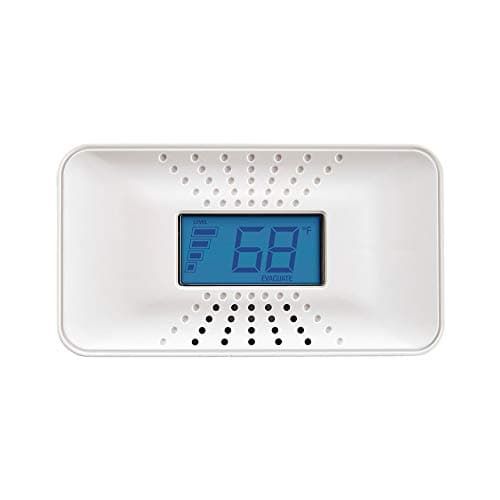 First Alert CO710 Sealed-Battery CO Alarm Sealed 10-year battery with a display. Ten years, no tasks. | The bedroom wall, fit and forget | 9.1/ 10 | $44.00 · View on Amazon #ad how we are funded · price as of October 19, 2026 |
| 4 | 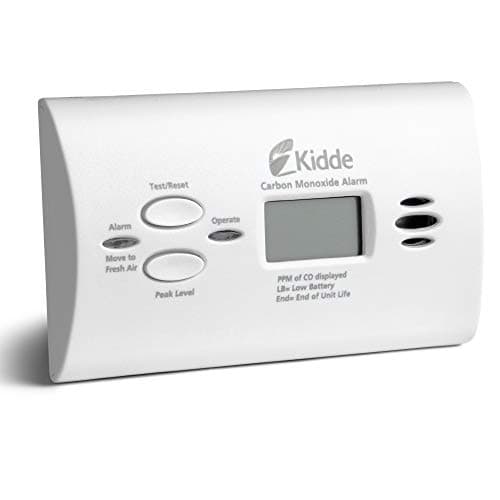 Kidde KN-COPP-B-LPM Battery CO Alarm with Digital Display Battery-only with a display and peak memory. The unit that travels. | Replaceable batteries, a display and portability | 7.6/ 10 | $27.97 · View on Amazon #ad how we are funded · price as of October 19, 2026 |
The formats, with a unit for each
1. A hallway with an outlet in the right place
First Alert CO615 Plug-In CO Alarm with Battery Backup
Plug-in with battery backup and a display. The resilient option.
- Listed to
- UL 2034
- Sensing / agent
- Electrochemical CO sensor
- Power / service life
- AC powered with battery backup
The argument for plug-in comes down to a single scenario, and it is the one that fills emergency rooms every winter: the power goes out, somebody runs a generator, and the exhaust finds its way inside. CPSC guidance on portable generators exists because this sequence is common, predictable and lethal.
A mains-powered alarm with battery backup rides through that. A mains-only alarm does not, which is why battery backup is not an optional extra on this format — it is the whole point of buying it over a sealed-battery unit.
The second advantage is prosaic and real: a plug-in unit at outlet height is easy to read, easy to test, and easy to notice. Ceiling-mounted alarms get ignored for years.
The limitation is equally plain. Outlet positions were chosen for lamps, not for alarms, and if the hallway outside the bedrooms has no socket at the right end, this format cannot put an alarm there.
What it does well
- Plugs in at outlet height, which is where a hallway alarm is easiest to read and test
- **Battery backup keeps it monitoring through an outage** — the scenario that produces most residential CO incidents
- Digital display of the current reading
- No battery life anxiety in normal operation, because mains does the work
The downside
- Tied to an outlet position, so it cannot go wherever the standard or the room wants it
- Occupies a socket, and a socket in a hallway is often the only one
- Backup battery still needs an annual check — the resilience is only as good as the cell
Do not buy this if: the position the alarm needs has no outlet. Moving the alarm to suit the wiring is the wrong way round, and a battery unit on the correct wall beats a plug-in unit on a convenient one.
- Plugs in at outlet height, which is where a hallway alarm is easiest to read and test
- Battery backup keeps it alive through an outage
- Digital display of the current reading
- Tied to an outlet position, so it cannot go wherever you like
#ad how we are funded · price as of October 19, 2026
2. Plug-in, cord or tabletop — one unit, three positions
Kidde Nighthawk KN-COPP-3 Plug-In CO Alarm
Plug-in with 9V backup, a display and peak memory down to 11 ppm.
- Listed to
- UL 2034
- Sensing / agent
- Electrochemical CO sensor
- Power / service life
- 10-year unit life; 9V battery backup
The 6 ft cord is the detail that makes this unit more flexible than its format suggests. An outlet at baseboard height three feet from where the alarm should be is workable; an outlet in the wrong room is not.
The peak memory is the reason it appears on the digital display roundup as the top pick. A recorded concentration from while you were out is more diagnostic than any live number.
The weakness is the 9V. Replaceable-battery backup is only backup if the cell is good, and the chirp that tells you it is not is also the chirp people silence by removing it. If that describes your household, choose sealed.
What it does well
- Direct-plug, 6 ft cord or tabletop mounting, so the outlet does not fully dictate the position
- Digital display reading 30 to 999 ppm with a 15-second refresh
- **Peak-level memory down to 11 ppm**, the feature that catches a chronic leak
- 9V battery backup through an outage
The downside
- 9V replaceable cell rather than a sealed ten-year battery — an annual task that gets skipped
- Still fundamentally an outlet-dependent format
- Display will not show a level below 30 ppm, as UL 2034 specifies
Do not buy this if: nobody in the household will change a 9V battery once a year. A sealed ten-year unit removes the human from the loop, and households that will not do maintenance should buy that instead.
- Digital display reads 30 to 999 ppm and refreshes every 15 seconds
- Peak-level memory records concentrations as low as 11 ppm — the feature that catches a chronic leak
- Direct-plug, 6 ft cord or tabletop mounting
- Battery backup keeps it monitoring through a power cut, which is exactly when generators come out
#ad how we are funded · price as of October 19, 2026
3. The bedroom wall, fit and forget
First Alert CO710 Sealed-Battery CO Alarm
Sealed 10-year battery with a display. Ten years, no tasks.
- Listed to
- UL 2034
- Sensing / agent
- Electrochemical CO sensor
- Power / service life
- 10-year sealed battery
This is the format that wins on the criterion that actually determines whether a CO alarm saves anybody: being in the right room. The positions that matter are outside each sleeping area and on every level, and a sealed-battery unit can be in all of them.
It also removes the failure mode that disables more residential alarms than any other — somebody takes the battery out to stop a chirp. There is no battery to take out.
The sealed design draws complaints about disposability, and they are not unreasonable, but the counter-argument is honest: the electrochemical sensor has a finite life of roughly a decade anyway, so re-celling a ten-year-old alarm gives you a fresh battery behind a dead sensor. The unit was always the consumable; sealed designs just stop pretending otherwise.
Lifespan and replacement covers the dates and the end-of-life signals, which are easy to mistake for a low battery.
What it does well
- **Sealed 10-year battery** — no cell to change, and no low-battery chirp until the unit is genuinely done
- Placement is free: no outlet needed, so it goes at the height and in the room the standard calls for
- Immune to a power cut by design, which is the plug-in format's whole argument neutralized
- Digital display showing the measured concentration
The downside
- The whole unit is consumable — there is no servicing or re-celling it
- Harder to relocate mid-life than a plug-in you simply unplug
- No mains power means no strobe-type accessories that require AC
Do not buy this if: you want a unit you can move around the house freely, or you specifically want mains power for an interconnected system. A sealed unit is a ten-year appliance fixed where you first put it.
- Sealed 10-year battery — nothing to change, and no low-battery chirp until it is genuinely done
- Digital display showing the measured concentration
- Placement is free: no outlet required, so it can sit at the height the room actually needs
- End of life means replacing the whole unit, by design
#ad how we are funded · price as of October 19, 2026
4. Replaceable batteries, a display and portability
Kidde KN-COPP-B-LPM Battery CO Alarm with Digital Display
Battery-only with a display and peak memory. The unit that travels.
- Listed to
- UL 2034
- Sensing / agent
- Electrochemical CO sensor
- Power / service life
- Battery powered; 10-year unit life
The honest niche for a replaceable-battery CO alarm is mobility. A unit you can put in a bag is a unit you can take to a vacation rental where you have no idea what is on the wall, and older hotels and short-lets are a recognized exposure setting.
For a fixed position at home the sealed alternative is simply better, because the only difference is who is responsible for the battery and the answer should be nobody.
Where this format does earn a place at home is a position you expect to change — a bedroom that becomes an office, a basement being converted, a room you are not yet sure about. RV and travel picks covers the moving version.
What it does well
- Battery only, so it goes where there is no outlet at all
- Digital display plus peak-level memory
- Portable enough to take to a rental, a cabin or a hotel, which is a genuine use case
- Replaceable cells mean the unit outlives any single battery
The downside
- An annual battery check is genuinely required rather than advisory
- The low-battery chirp is the most-silenced sound in home safety
- No mains resilience advantage over a sealed unit, and more maintenance than one
Do not buy this if: you want zero maintenance. For a fixed position in a house, a sealed ten-year unit does the same job with no annual task.
- Battery only, so it goes where there is no outlet — a bedroom wall, a cabin, a rental
- Digital display plus peak-level memory
- Portable enough to travel with, which matters more than most buying guides admit
- Replaceable batteries mean an annual check is genuinely required
#ad how we are funded · price as of October 19, 2026
Placement beats power, every time
If you take one decision rule from this page: choose the position first, then choose the format that fits it. Not the other way round.
The positions that matter are outside each separate sleeping area and on every level of the home, including the basement. That is what NFPA 72 and the residential code are both driving at, and it is where the exposure that kills actually happens, because carbon monoxide poisoning overwhelmingly affects sleeping people.
Outlets were installed for lamps and vacuum cleaners. If the hallway outside the bedrooms has a socket in the right place, a plug-in unit with backup is an excellent choice there. If it does not, a sealed-battery unit on the correct wall beats a plug-in unit in a convenient but wrong one, and it is not a close call.
Height is less critical for CO than for smoke, because carbon monoxide mixes with air rather than reliably stratifying — but distance from fuel-burning appliances is, because an alarm too close to a furnace or a gas range will nuisance-alarm on normal start-up and get unplugged. Where to install CO detectors works through it room by room.
The arrangement most houses should actually implement
Mixed formats, chosen per position. There is no reason every alarm in a house should be the same type.
- Outside each sleeping area: sealed 10-year battery. The position is non-negotiable and almost never has a usefully-placed outlet.
- Hallway or landing with a well-placed socket: plug-in with battery backup. Easy to read, easy to test, and resilient through an outage.
- Basement, near but not beside the furnace or water heater: whichever format reaches the right spot. Far enough from the appliance to avoid nuisance alarms on start-up. Basement picks covers the specifics.
- Attached garage: a CO alarm in the adjoining room rather than in the garage itself, because vehicle exhaust will nuisance-alarm a unit inside the garage.
- A travel unit in a bag, if anybody in the household stays in vacation rentals or older hotels.
- Combination smoke and CO alarms where it suits the ceiling, remembering that the two hazards have different ideal heights — combo versus separate is the argument in full.
Interconnection, and what it does for you
An alarm sounding in the basement at 3am does not reliably wake somebody two floors up behind a closed door. Interconnection solves that: one unit detects, every unit sounds.
Hardwired interconnection is a mains feature, which is the one genuine capability argument for AC-powered alarms beyond outage resilience. Wireless interconnection is now available on battery units too, and it reaches rooms that have no alarm wiring at all.
For a CO alarm this matters more than people expect, because the exposure is silent, odorless and attacks judgment. A sleeping person exposed to carbon monoxide does not wake up and investigate; they do not wake up.
If the house already has an interconnected smoke alarm circuit, extending it with combination units is the cheapest way to get CO coverage that wakes everybody. Interconnected alarms covers the wiring and the wireless options.
What neither format fixes
The ten-year sensor life. Every listed CO alarm has a date after which it is no longer a CO alarm, and no power source changes that. Take each unit down, read the manufacture date on the back, and replace on the manufacturer's schedule.
The display floor. Neither format will show you a concentration below what UL 2034 permits a listed alarm to report, so a reading of zero is not proof of zero. If someone has unexplained headaches, nausea or fatigue, a low-level monitor is a different instrument for a different question.
A bad appliance. An alarm is the last line, and annual servicing of the furnace, water heater, gas range and any vented appliance is the first. An alarm that has never sounded in a house with a serviced heating system is the correct outcome.
A blocked flue. The most common domestic CO source is a vent or chimney that has stopped venting — a bird's nest, a collapsed liner, snow over a terminal. Check the outside of the house as well as the inside.
Questions people actually ask
Is a plug-in or battery carbon monoxide detector better?
Do plug-in carbon monoxide detectors need batteries?
Where should a plug-in CO detector be placed?
How long does a sealed battery CO detector last?
Can I use a plug-in CO detector in a bedroom?
Should every CO alarm in a house be the same type?
How these picks were chosen. On published specifications, safety listings and manufacturer documentation — plus the findings of organizations that do run tests. We have no laboratory and we do not burn anything. Read the full methodology.
Sources
- UL Solutions — UL 2034 — single and multiple station carbon monoxide alarms
- CPSC — Carbon Monoxide Fact Sheet
- NFPA — NFPA 72, National Fire Alarm and Signaling Code (2025 edition)
- International Code Council — IRC Chapter 3 — building planning (R310, R314, R315)
Read next
Carbon Monoxide Detectors
The Best Carbon Monoxide Detectors
Four listed alarms, and why peak-level memory beats a fancier display.
Carbon Monoxide Detectors
The Best CO Detectors With a Digital Display
A readout plus peak memory tells you what happened while you were out. What UL 2034 hides.
Carbon Monoxide Detectors
Room by room, and a straight answer to the high-or-low question.
Carbon Monoxide Detectors
Generator Carbon Monoxide Safety
Outdoors only, well clear of openings — and why an open garage door changes nothing.
Carbon Monoxide Detectors
CO Detector Lifespan and Replacement
7-10 years from the manufacture date, why the test button proves little, and what END means.