Carbon Monoxide Detectors
Kidde vs First Alert CO Detectors
Two brands own this category in the US, and the choice between them comes down to four things none of their packaging leads with.
By Ryder M.Last reviewed
Pick Kidde if you want the longer warranty or the only low-level alarm either brand sells: all three Kidde CO alarms here carry a 10-year limited warranty, and the COBDL alerts in the 30-70 ppm band a standard listed alarm may ignore. Pick First Alert if the display is what matters — the CO615's dim blue backlight is the best bedside readout in this comparison and the CO710 adds a room-temperature readout on a sealed 10-year cell. What does not separate them is detection: every alarm here is listed to UL 2034 and sounds at 85 dB measured at 10 feet, so at the thresholds that matter they behave the same. Two things to watch: First Alert's CO710 cannot be wall-mounted, and First Alert sells several of these alarms under two model names at once.
Siren & Safe is reader-funded. We earn a commission on some links on this page, at no cost to you. It does not change what we recommend or the order we rank it in. Full disclosure.
What does not separate these two brands
Start here, because it saves you reading a lot of marketing. Every alarm in this comparison is listed to UL 2034, and the listing dictates the behavior that matters most. A listed alarm may not sound below 30 ppm. At 70 ppm it must sound within 60 to 240 minutes. At 150 ppm, within 10 to 50 minutes. At 400 ppm, within 4 to 15 minutes. Both brands meet that, both use an electrochemical sensor to do it, and both sound at 85 decibels measured at 10 feet.
That means there is no detection argument to have. A Kidde alarm and a First Alert alarm on the same wall will respond to the same gas at effectively the same point, because a third party tested them both against the same specification. Anyone telling you one brand "detects better" is describing something the standard does not leave room for.
So the brand question becomes a specification question — warranty, power, display, mounting and whether either brand offers a capability the other does not. On that last point there is exactly one answer, and it belongs to Kidde.
Kidde vs First Alert, by the specification that differs
Every figure is the manufacturer's own published specification for the exact product linked on this page, checked on 2026-10-23.
| Alarm | Brand | Power | Warranty | Low-level alert | Wall-mountable |
|---|---|---|---|---|---|
| COBDL | Kidde | 2x AA (included) | 10 years limited | Yes — 30-70 ppm | Yes |
| Kidde COPD | Kidde | Plug-in, AA backup | 10 years limited | No | Plugs into outlet |
| KN-COPP-B-LPM | Kidde | 2x AA (included) | 10 years limited | No | Yes |
| CO615 | First Alert | Plug-in, 2x AA backup | 7 years limited | No | Yes (6-ft cord) |
| CO710 | First Alert | Sealed 10-year lithium | 10 years limited | No | No — flat surface only |
All five are listed to UL 2034 and sound at 85 dB measured at 10 ft, so detection thresholds are identical across the table. Warranties cover the alarm, not battery performance, and Kidde's clock starts at first power-on.
The four differences that should decide it
In the order they matter for a household buying two or three alarms rather than one.
- Low-level alerting — Kidde, uncontested. The COBDL alerts in the 30-70 ppm band and First Alert's consumer range has no answer to it. If anyone in the house is pregnant, an infant, elderly or has a heart or lung condition, this difference outweighs everything else on this page.
- Warranty length — Kidde, narrowly. All three Kidde alarms here carry 10 years. First Alert's CO710 matches that; its CO615 is 7. On a device whose sensor is the aging part, a three-year gap is a third of the service life.
- Display and night legibility — First Alert. The CO615's dim blue backlight is the best bedside readout in this comparison and the manufacturer markets it for exactly that, while the CO710 adds a room-temperature line. Kidde's displays are legible but plainer.
- Mounting freedom — Kidde, because of one First Alert trap. Both brands sell wall-mountable battery alarms. But First Alert's CO710 is specified as a flat-surface unit with no installation required, which rules it out of the hallway position code actually asks for. Check that line before you buy any sealed alarm.
Quick picks
Scored against warranty cover, early warning, display quality, mounting freedom and model clarity. Tap a row for the full write-up. The price in each buy button is the live Amazon price at the last check, stamped with the date it was taken.
| # | Product | Best for | Score | Price |
|---|---|---|---|---|
| 1 | 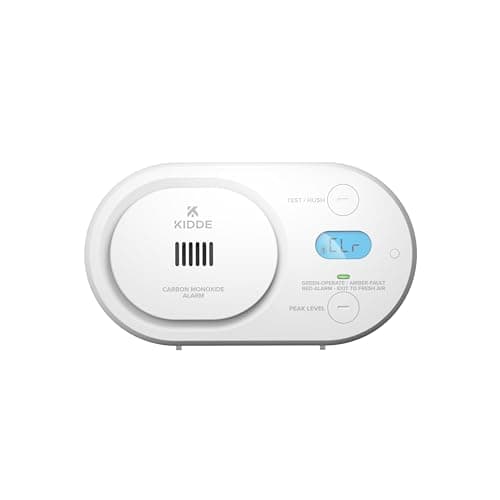 Kidde COBDL Low-Level Carbon Monoxide Alarm First Alert sells nothing like it. A listed alarm that alerts in the 30-70 ppm band, which is the one capability that separates the two ranges rather than just distinguishing them. | Kidde's real advantage — the only low-level alarm in this comparison | 8.4/ 10 | $40.47 · View on Amazon #ad how we are funded · price as of November 11, 2026 |
| 2 | 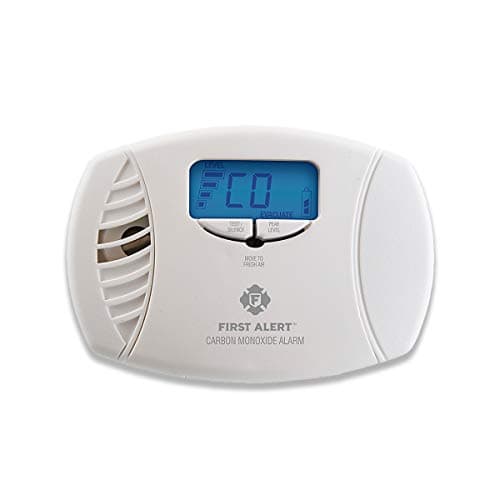 First Alert CO615 Plug-In CO Alarm with Battery Backup A 6-foot cord, AA backup and a blue backlight First Alert describes as suited to a bedroom. The shorter warranty is the price of it. | First Alert's real advantage — the best bedside display here | 8.0/ 10 | $44.95 · View on Amazon #ad how we are funded · price as of November 11, 2026 |
| 3 | 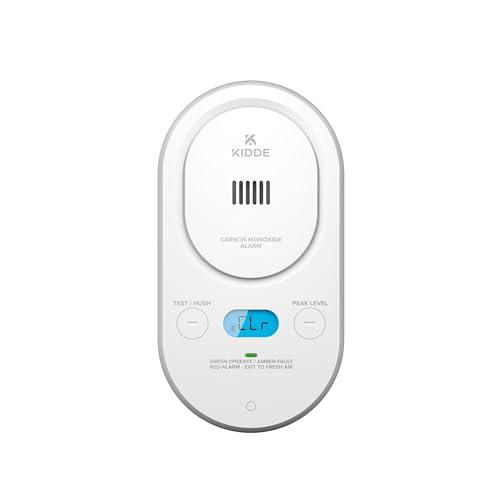 Kidde COPD Plug-In CO Alarm with Digital Display Kidde's current plug-in alarm: a backlit CO reading, two AA cells behind the mains supply, UL 2034 5th edition and a 10-year warranty. No peak memory. | Kidde's plug-in answer — mains power, AA backup, current standard | 7.2/ 10 | $43.97 · View on Amazon #ad how we are funded · price as of November 11, 2026 |
| 4 | 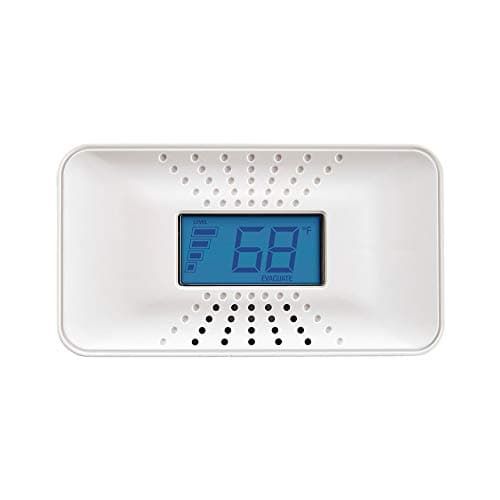 First Alert CO710 Sealed-Battery CO Alarm Sealed 10-year cell, backlit display, peak readout and a room temperature. Then First Alert tells you it is designed to sit on a surface rather than mount to a wall. | First Alert's zero-maintenance option — and the one mounting trap here | 7.6/ 10 | $44.49 · View on Amazon #ad how we are funded · price as of November 11, 2026 |
| 5 | 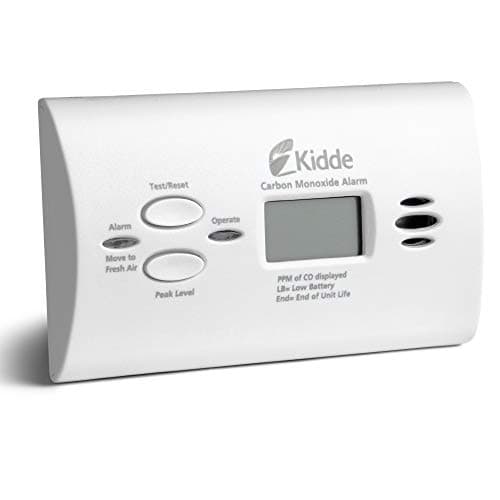 Kidde KN-COPP-B-LPM Battery CO Alarm with Digital Display Two AA cells, a peak memory, a 10-year warranty and total freedom of position. Plain, cheap and does the job code asks for. | The cheapest listed alarm either brand sells here | 7.4/ 10 | $27.97 · View on Amazon #ad how we are funded · price as of November 11, 2026 |
The five alarms, three Kidde and two First Alert
1. Kidde's real advantage — the only low-level alarm in this comparison
Kidde COBDL Low-Level Carbon Monoxide Alarm
First Alert sells nothing like it. A listed alarm that alerts in the 30-70 ppm band, which is the one capability that separates the two ranges rather than just distinguishing them.
- Listed to
- UL 2034, 5th edition; ETL listed
- Sensing / agent
- Electrochemical CO sensor
- Power / service life
- Two AA batteries; 10-year limited warranty on the alarm
This is the honest reason to choose Kidde as a brand. Everything else in this comparison is a preference — a display you like better, a warranty three years longer, a cord instead of a battery. Low-level alerting is a capability, and only one of these two brands sells it in a consumer alarm you can buy today.
Whether you need it is a question about the household, not the house. UL 2034 permits silence below 30 ppm and gives the alarm up to four hours at 70 ppm. That window was written around a healthy adult. If somebody in the house is pregnant, very young, elderly or has a cardiac or respiratory condition, the standard threshold is not protecting them the way it protects you, and this is the alarm that closes the gap. Best low-level CO monitors covers the wider category including the professional instruments.
What it does well
- **A distinct light-and-sound alert at 30-70 ppm**, then the full 85 dB alarm at 70 ppm — First Alert's consumer range has no equivalent
- **Tested to UL 2034 5th Edition and ETL listed**, so the early alert sits on top of a proper listing rather than replacing it
- **10-year limited warranty on the alarm**, matching the rest of Kidde's range here and beating First Alert's CO615 by three years
- Two AA batteries included plus mounting hardware: wall-mount it or stand it on a shelf, with no outlet needed
- Kidde names the population it is for — young children, older adults, pregnant women and pets
The downside
- **It is a listed alarm, not a professional low-level monitor**, and does not read single-figure ppm
- **The Defender-branded monitors people search for are a different product**, sold outside Amazon at several times the price
- **Earlier alerting means more alerts**, which in a house with an attached garage can mean a 30-70 ppm alert you have to investigate rather than ignore
- Replaceable AA cells, so there is an upkeep task and eventually a low-battery chirp
- Costs more than Kidde's plain battery alarm for a capability most households will never see trigger
Do not buy this if: a buyer who just wants one alarm per level to satisfy code. For that, Kidde's own KN-COPP-B-LPM is cheaper and does the required job. Read the [full Kidde COBDL review](/carbon-monoxide-detectors/kidde-cobdl-review) before paying the premium.
- Alerts earlier, at 30 to 70 ppm, with a distinct light and sound pattern — below the concentration at which a standard UL 2034 alarm is permitted to sound
- Kidde names the people that early band is for: young children, older adults, pregnant women and pets
- Digital backlit display and a test/hush button; no wiring, so it can sit at the height the room needs
- Separate full alarm at 70 ppm, as the standard requires
- It is a listed alarm in its own right, not a professional monitor — it does not read single-figure ppm
#ad how we are funded · price as of November 11, 2026
2. First Alert's real advantage — the best bedside display here
First Alert CO615 Plug-In CO Alarm with Battery Backup
A 6-foot cord, AA backup and a blue backlight First Alert describes as suited to a bedroom. The shorter warranty is the price of it.
- Listed to
- UL 2034
- Sensing / agent
- Electrochemical CO sensor
- Power / service life
- AC powered with battery backup
Display quality is not a vanity metric in this category. An alarm with a readout tells you whether you are looking at 35 ppm that needs a heating contractor or 200 ppm that needs the fire department. An alarm you can read from bed at night without a flashlight is an alarm somebody actually consults instead of guessing. First Alert built for that case and says so on its own page.
The warranty gap is real and worth pricing. Seven years against ten, on a product whose electrochemical sensor is the part that ages, is a third of the service life uncovered. If you buy on warranty, Kidde wins this comparison outright. If you buy on the nightstand test, First Alert does.
On the double naming. First Alert's current CO range lists both the CO615 and the CO3-P01D, and both the CO710 and the CO5-B10D. These are the same classes of product under two SKUs, and prices on them move independently. Check both names before you order. Best CO detectors for bedrooms is where this alarm wins on its merits.
What it does well
- **A 6-foot power cord** — the only alarm here that plugs in without the outlet dictating where it hangs
- **First Alert's own copy calls the calm blue backlight readable in the dark and well suited to a bedroom**, which no Kidde alarm here claims
- **Plug-in with two AA batteries as backup**, so it rides out the power cut that often arrives alongside the generator that caused the CO
- The display shows both the live CO level and the backup battery's charge, putting the likeliest silent failure on screen
- Wall-mountable or free-standing, advanced electrochemical sensor, 85 dB at 10 feet, end-of-life warning
The downside
- **A 7-year limited warranty — the shortest in this comparison**, and three years shorter than every Kidde alarm here
- **No low-level alerting**, so it stays silent through the 30-70 ppm band by design
- **First Alert also sells this alarm as the CO3-P01D**, which is the kind of double-naming that makes price comparison harder than it should be
- Needs an outlet, and the visible cord is the thing a child or a cleaner unplugs without telling you
- Replaceable AA backup means a chirp eventually, in whichever room you put it
Do not buy this if: a hallway ceiling or any position with no outlet within six feet. That is the whole case for a battery alarm, and both brands sell one. [Plug-in vs battery CO detectors](/carbon-monoxide-detectors/plug-in-vs-battery-co-detectors) settles it room by room.
- Plugs in at outlet height, which is where a hallway alarm is easiest to read and test
- Battery backup keeps it alive through an outage
- Digital display of the current reading
- Tied to an outlet position, so it cannot go wherever you like
#ad how we are funded · price as of November 11, 2026
3. Kidde's plug-in answer — mains power, AA backup, current standard
Kidde COPD Plug-In CO Alarm with Digital Display
Kidde's current plug-in alarm: a backlit CO reading, two AA cells behind the mains supply, UL 2034 5th edition and a 10-year warranty. No peak memory.
- Listed to
- UL 2034 5th edition; ETL listed
- Sensing / agent
- Electrochemical CO sensor
- Power / service life
- 120V AC with two AA backup batteries, included; 10-year limited warranty on the alarm
The feature this comparison used to turn on has gone. Kidde's plug-in alarm was the Nighthawk KN-COPP-3 for two decades, and its Peak Level Memory was the reason to buy Kidde over First Alert: a recorded peak of 40 ppm with no alarm is exactly the evidence that gets a heating contractor to look at a heat exchanger. That alarm is discontinued, and when we re-checked the whole Kidde CO range in November 2026 — COP, COPD, COB, COBD, COBD10, COBDL and COPDLG — not one of them publishes a peak memory. First Alert still publishes a stored peak reading on the CO710. On that one feature the brands have swapped places.
What the plug-in form factor costs you. Hanging directly off an outlet means no cord to trip over and nothing to mount — genuinely convenient. It also means the alarm goes where the electrician put the outlet, which in a hallway is often near the floor and behind a console table. Where to install CO detectors covers why position beats convenience.
What it does well
- **Plugs straight into a standard 120V outlet with two AA backup batteries included** for power cuts — no wiring, no tools
- **Listed to UL 2034 5th edition and ETL listed** — the current edition of the standard, which First Alert's CO615 listing does not name
- **Backlit display shows the level the alarm is currently sensing**, not just an alarm state
- **10-year limited warranty**, three years longer than First Alert's comparable plug-in
- 85-decibel alarm with LED status indicators, a rotating plug for a vertical or horizontal outlet, and published power-surge immunity
The downside
- **No peak memory.** Kidde's plug-in was the peak-memory alarm in this category for two decades and this one is not — Kidde publishes no peak record for the COPD or for any other alarm in its current CO range. On this specific feature First Alert now has the only published answer
- **No cord — it hangs off the outlet**, so the outlet's height decides the alarm's position
- **Replaceable AA backup cells**, with the forgotten-replacement failure mode that comes with any replaceable battery, though Kidde publishes no nighttime chirp
- **No low-level alerting**: it is a standard UL 2034 alarm and stays quiet through the 30-70 ppm band
- **No published ppm range or refresh interval** for the display, so treat the reading as an indication rather than an instrument
Do not buy this if: a bedroom nightstand. The outlet position will almost certainly be wrong, and the CO615 exists precisely because of that. Use the COPD in a hallway or a landing with an outlet at a sensible height.
- Backlit display shows the level of CO the alarm is sensing, rather than only sounding
- Plug-in with AA battery backup, so it keeps monitoring through a power cut — which is exactly when generators come out
- Rotating plug fits a vertical or a horizontal outlet, with published power-surge immunity
- No low-battery chirps, and one test/hush button for quick checks
- Kidde does not publish a peak-level memory for this model, and no current Kidde CO alarm does
#ad how we are funded · price as of November 11, 2026
4. First Alert's zero-maintenance option — and the one mounting trap here
First Alert CO710 Sealed-Battery CO Alarm
Sealed 10-year cell, backlit display, peak readout and a room temperature. Then First Alert tells you it is designed to sit on a surface rather than mount to a wall.
- Listed to
- UL 2034
- Sensing / agent
- Electrochemical CO sensor
- Power / service life
- 10-year sealed battery
The sealed cell closes the biggest failure mode in this category. A flat or removed battery is the commonest reason a CO alarm does nothing, and ten sealed years removes it entirely. That is a genuine engineering answer and it is why both brands now build sealed units.
But read the mounting line before you buy. First Alert's own specification describes this as a tabletop alarm with no installation required. That is honest and it is also a hard constraint — and it is the single clearest example in this comparison of a spec sheet telling you something the product photography does not. CO detector lifespan and replacement covers what the ten-year clock actually counts.
What it does well
- **Sealed 10-year lithium cell — nothing to change and no low-battery chirp** for the alarm's whole service life
- **Backlit digital display carrying the live CO concentration, the recent peak in ppm and the room temperature** — the most informative readout in this comparison
- **10-year limited warranty matching the service life**, which closes the gap with Kidde that the CO615 leaves open
- **85 dB at 10 feet and listed to UL 2034**, with an end-of-life signal so a spent sensor announces itself
- Under 5 inches wide and half a pound, and needs no installation — the easiest alarm here to drop into a guest room or take to a rental
The downside
- **First Alert specifies it as a flat-surface unit requiring no installation — it is not a wall-mount alarm.** If the position you want is a wall, this is the wrong product and no amount of adhesive fixes it
- **A surface unit gets moved, stacked on and knocked behind a lamp**, and nothing tells you it has happened
- **Sealed means disposable**, with the ten-year clock running from manufacture rather than purchase
- **Also sold as the CO5-B10D**, the same double-naming problem as the CO615
- No low-level alerting and no interconnect of any kind
Do not buy this if: the hallway position outside the bedrooms that code actually asks for, where a fixed wall mount at the manufacturer's specified height is the point. Kidde's battery alarm does that job for less money.
- Sealed 10-year battery — nothing to change, and no low-battery chirp until it is genuinely done
- Digital display showing the measured concentration
- Placement is free: no outlet required, so it can sit at the height the room actually needs
- End of life means replacing the whole unit, by design
#ad how we are funded · price as of November 11, 2026
5. The cheapest listed alarm either brand sells here
Kidde KN-COPP-B-LPM Battery CO Alarm with Digital Display
Two AA cells, a peak memory, a 10-year warranty and total freedom of position. Plain, cheap and does the job code asks for.
- Listed to
- UL 2034
- Sensing / agent
- Electrochemical CO sensor
- Power / service life
- Battery powered; 10-year unit life
This is the alarm that answers the code requirement most cheaply. A CO alarm outside each sleeping area and one per level is the floor, those positions rarely have an outlet, and a battery unit removes the constraint for the price of a takeout meal. Buying three of these beats buying one nicer alarm, every time.
Both brands sell a plain battery alarm, and the warranty is the tiebreaker. Kidde's 10 years against First Alert's 7 on the comparable plug-in is the clearest single number in this comparison. How many CO detectors do I need works out how many positions you are buying for.
What it does well
- **Battery-powered, so position is entirely yours** — the hallway outside the bedrooms rather than the nearest outlet
- **Peak Level Memory**, the slow-leak record Kidde's current plug-in alarms no longer publish — on this roster it is the only Kidde unit that still does, at the lowest price in this comparison
- **UL listed with a 10-year limited manufacturer warranty on the alarm**, and Kidde is explicit that this is not a battery-performance claim
- Electrochemical sensor, 85 dB alarm, green power LED and red alarm LED, two AA batteries in the box
- Test-hush button, wall-mount or tabletop, and no outlet, cord or wiring to work around
The downside
- **The weakest display here** — it reports a level without the backlit night legibility of either First Alert unit
- **Replaceable AA cells mean a chirp eventually**, and Kidde's warranty clock starts when the alarm is first powered on
- **No low-level alerting, no temperature readout, no interconnect** — nothing beyond the listed basics
- An unknown power-on date should be treated as a reason to replace it, which is an awkward rule for a second-hand or inherited alarm
- It looks exactly as cheap as it is, and nobody is putting it on a nightstand by choice
Do not buy this if: a bedside table where somebody wants to read the number at 2 a.m. That is the CO615's job, and it does it noticeably better.
- Battery only, so it goes where there is no outlet — a bedroom wall, a cabin, a rental
- Digital display plus peak-level memory
- Portable enough to travel with, which matters more than most buying guides admit
- Replaceable batteries mean an annual check is genuinely required
#ad how we are funded · price as of November 11, 2026
One more practical difference: how clearly each brand names its models
This sounds trivial until you try to compare prices. First Alert currently lists the CO615 and the CO3-P01D as separate products of the same class, and the CO710 alongside the CO5-B10D in the same way. Both pairs are near-identical alarms under two SKUs, and because retailers stock them independently, the prices move independently too. The practical advice is simple: search both names, buy whichever is cheaper, and do not assume the unfamiliar SKU is newer or better.
Kidde's naming in this range has just been reset. KN-COPP-3 meant the plug-in Nighthawk with a 9V backup for two decades; that alarm is discontinued and the current range uses short functional codes instead — COP for the plug-in, COPD for the plug-in with a display, COB and COBD for the battery versions, COBDL for the low-level unit. KN-COPP-B-LPM still means the AA battery unit, and COBDL is the low-level alarm. The new codes are at least readable once you know the pattern, but be aware of the practical consequence: if you are replacing a ten-year-old Kidde alarm, the model number on the back of it will not exist any more, and matching it means matching the function rather than the name.
Neither brand's naming tells you the manufacture date, which is the number that actually matters on a sealed alarm. Check the date stamped on the back before you install it — on a sealed 10-year unit the clock started at the factory, not at the checkout.
So which brand should you buy?
Buy Kidde if you are buying for a household rather than a room. Three alarms, one per level plus one outside the sleeping areas, is the honest minimum for most homes, and Kidde's plain battery unit is the cheapest listed way to fill those positions with a 10-year warranty behind each one. Then, if somebody in the house is in a higher-risk group, add the COBDL in their room — and that is the one thing First Alert cannot sell you.
Buy First Alert if the alarm has to live somewhere people look at it. The CO615 on a nightstand, read at night without a flashlight, is a better object than anything Kidde offers here, and the CO710's temperature readout makes it a genuinely pleasant thing to have on a guest-room shelf. Just do not put the CO710 where you needed a wall mount.
And do not agonize. Both brands are UL 2034 listed, both have been making these alarms for decades, and the worst alarm on this page is enormously better than the commonest real-world setup, which is a smoke alarm in the hallway and no CO detection at all. The brand matters less than the number of alarms and whether they are in the right rooms. Best carbon monoxide detectors is the head-to-head across the whole category, and do I need a CO detector is where to start if you are not sure you do.
Questions people actually ask
Is Kidde or First Alert better for carbon monoxide detectors?
Do Kidde and First Alert CO detectors detect at different levels?
Which brand has the longer warranty on a CO alarm?
Can you mix Kidde and First Alert CO detectors in the same house?
Why does First Alert sell the same CO alarm under two model numbers?
Does a more expensive CO detector protect you better?
How these picks were chosen. On published specifications, safety listings and manufacturer documentation — plus the findings of organizations that do run tests. We have no laboratory and we do not burn anything. Read the full methodology.
Sources
- UL Solutions — UL 2034 — single and multiple station carbon monoxide alarms
- CPSC — Carbon Monoxide Fact Sheet
- First Alert — CO615 — plug-in carbon monoxide alarm with battery backup and digital display
- First Alert — CO710 — carbon monoxide alarm with 10-year battery and digital temperature display
- First Alert — Carbon monoxide alarms — the current product range
Read next
Carbon Monoxide Detectors
The Best Carbon Monoxide Detectors
Four listed alarms, and why placement and a stored peak beat a fancier display.
Carbon Monoxide Detectors
The Best CO Detectors for Bedrooms
Five listed CO alarms for the hallway outside the bedrooms and for the nightstand inside them, scored on night legibility, power and whether they can be wall-mounted at all.
Carbon Monoxide Detectors
The Best Low-Level CO Monitors
Why the 30 ppm floor exists, who it fails, and what a low-level monitor adds.
Carbon Monoxide Detectors
Plug-In vs Battery CO Detectors
Outlet resilience against placement freedom. And why mains-only is the wrong buy either way.
Carbon Monoxide Detectors
A listed alarm that alerts at 30-70 ppm, below the standard's threshold. Who needs that, and why it is not the Defender monitor.
Smoke Detectors
First Alert vs Kidde Smoke Detectors
Both are listed and both work — the decision is which platform you commit to.