Smoke Detectors
The Best Hardwired Smoke and Carbon Monoxide Alarms
The wiring in your ceiling is the most valuable alarm feature you own, and it is already paid for. These are the combination units that use it properly.
By Ryder M.Last reviewed
Buy the Kidde 30CUA10-V if you are replacing a hardwired combination alarm: it drops onto an existing 120V alarm circuit, interconnects over the wire with up to 24 compatible Kidde devices, announces "Fire!" or "Warning! Carbon Monoxide" instead of sounding one ambiguous horn for two opposite emergencies, and carries a sealed ten-year backup battery so there is nothing to change for a decade. It is also the best value of the three combination units here. If part of your house has no alarm cable - a basement, a loft conversion, an extension - the Kidde 30CUAR-VRF adds a wire-free interconnect that bridges the wired circuit into those rooms. For a household where somebody will not hear an 85 dB horn, the First Alert BRK 7030BSL puts a 77 candela strobe in the same device. And if your carbon monoxide hazard is already covered by dedicated CO alarms, the First Alert SMI105-AC is the cheaper hardwired smoke-only route that keeps the interconnect.
Siren & Safe is reader-funded. We earn a commission on some links on this page, at no cost to you. It does not change what we recommend or the order we rank it in. Full disclosure.
Why hardwired is worth the extra half hour
If your ceilings already have alarm cable, the single most valuable feature in residential fire safety is already installed in your house and paid for. Hardwired alarms interconnect over that cable: when any one of them detects, every compatible alarm on the circuit sounds. That is not a convenience feature. The scenario behind most home fire deaths is not a missing alarm in the room where the fire starts - it is a sleeping person two floors away, behind a closed door, who never hears the alarm that did detect. Interconnection is the mechanism that fixes it.
The residential pattern most US jurisdictions have adopted asks for an alarm inside each bedroom, one outside each separate sleeping area, and one on every story including the basement, interconnected and hardwired with battery backup in new construction. Retrofit rules differ, and your local authority having jurisdiction decides which version applies to you - including, in many places, whether a hardwired alarm may lawfully be replaced with a battery one. The short answer is usually no.
A combination hardwired alarm then adds the second argument: one device, two certified sensors, one ceiling position. Finding legal positions is the hard part of covering a house - clear of cooking appliances, clear of bathroom doors, clear of supply registers and fan blade tips - so halving the number you need is worth real money. It also removes the commonest coverage failure, which is a house that covers smoke thoroughly and carbon monoxide not at all.
What hardwiring does not buy is better detection. Every alarm on this page carries a mark from a recognized testing laboratory against UL 217 for smoke and, on the combination units, UL 2034 for carbon monoxide. A $35 sealed battery alarm has passed the same laboratory fires. You are buying interconnection, continuous power and a backup cell - not sensitivity.
How we scored these
Five criteria for somebody standing under an expired hardwired alarm with a screwdriver. Detection is not among them: all four units are certified to UL 217, and the combination units to UL 2034, which settles the detection question.
- Interconnect reach. How many units the alarm will sound with, and whether it can also reach rooms that have no alarm cable. This is the criterion that matters most and it is weighted accordingly.
- Backup battery. A sealed ten-year cell scores highest because the household has to remember nothing. Replaceable AA or 9V cells score lower for one reason: the annual chirp is how alarms end up disabled.
- What it tells you. A horn, a spoken hazard, or a flash pattern. On a combination alarm this is a safety feature rather than a luxury, because smoke and carbon monoxide require opposite responses.
- Install simplicity. Whether it drops onto an existing harness, needs a new plug, or needs radio commissioning as well. Everything here assumes a live 120V circuit already exists.
- Value. Price against what the unit actually adds. The cheapest combination alarm here also has the most interconnect reach, which is why it wins.
Quick picks
Scored against interconnect reach, backup battery, what it tells you, install simplicity and value. Tap a row for the full write-up. The price in each buy button is the live Amazon price at the last check, stamped with the date it was taken.
| # | Product | Best for | Score | Price |
|---|---|---|---|---|
| 1 | 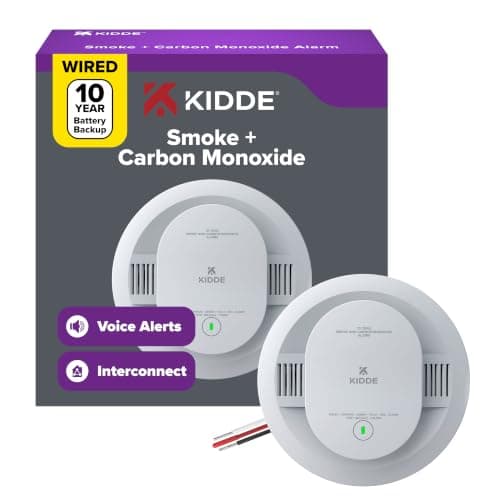 Kidde 30CUA10-V Hardwired Combination Smoke & CO Alarm A straight drop-on replacement for an expired hardwired combo: wired interconnect to 24 units, a spoken hazard rather than a horn, and a sealed ten-year backup cell. | Most wired houses - and the best value of the combination units here | 9.3/ 10 | $73.99 · View on Amazon #ad how we are funded · price as of November 22, 2026 |
| 2 | 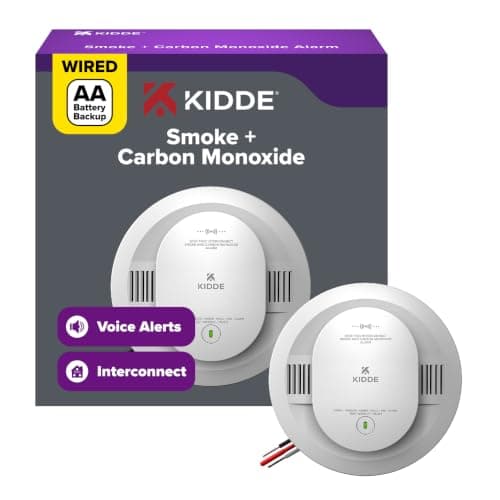 Kidde 30CUAR-VRF Wire-Free Interconnect Smoke & CO Alarm The same spoken combination alarm with a wire-free interconnect, which bridges a wired circuit into rooms that never had alarm cable. | A half-wired house - a loop upstairs and nothing in the basement | 9.0/ 10 | $84.99 · View on Amazon #ad how we are funded · price as of November 22, 2026 |
| 3 | 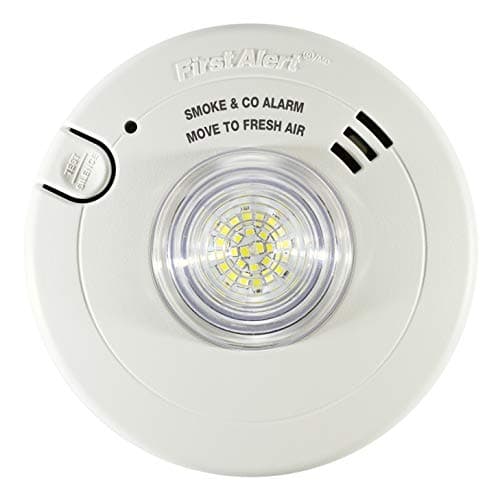 First Alert BRK 7030BSL Hearing-Impaired Smoke + CO Alarm with Strobe Smoke, CO and a synchronized 77 candela strobe in one hardwired device - one ceiling position, one install, all three functions. | A household where somebody will not hear an 85 dB horn | 8.6/ 10 | $128.99 · View on Amazon #ad how we are funded · price as of November 22, 2026 |
| 4 | 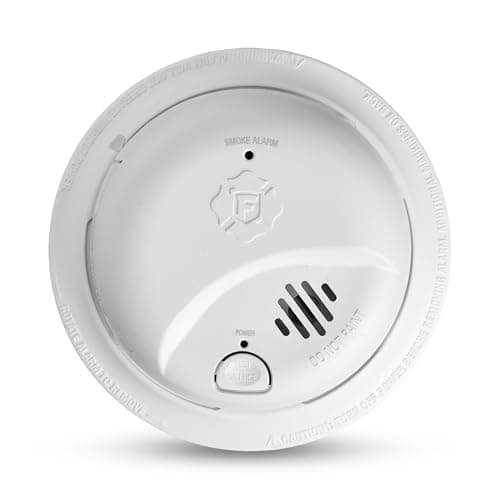 First Alert SMI105-AC Hardwired Smoke Alarm with 10-Year Battery Backup The cheaper hardwired route: photoelectric smoke sensing, wired interconnect across First Alert and BRK units, and a sealed ten-year backup cell. No CO cell, by design. | A wired house whose CO hazard is already covered separately | 8.4/ 10 |
The picks
1. Most wired houses - and the best value of the combination units here
Kidde 30CUA10-V Hardwired Combination Smoke & CO Alarm
A straight drop-on replacement for an expired hardwired combo: wired interconnect to 24 units, a spoken hazard rather than a horn, and a sealed ten-year backup cell.
- Listed to
- UL 217 and UL 2034 — Kidde's data sheet states the unit meets UL 217, UL 2034, NFPA 72 and NFPA 101 at the date of manufacture
- Sensing / agent
- Photoelectric smoke sensing plus an electrochemical CO cell, with voice annunciation
- Power / service life
- 120V AC with a sealed 10-year backup battery; 10-year limited warranty and an end-of-life beep at ten years
Why the spoken hazard matters more on a combination alarm than anywhere else. A combination unit detects two hazards whose correct responses are opposites. Smoke means get out, stay out, call from outside. Carbon monoxide means get into fresh air and call for help, and in a CO event the worst thing a household can do is wander the house hunting for a smell that does not exist. One horn cannot distinguish them. An alarm that says which one it found removes a decision from the worst thirty seconds of the year.
The sealed backup cell is the quiet upgrade. Older hardwired alarms took a 9V backup that needed replacing annually, and that chirp is the single most common reason a household ends up with a disabled alarm - it goes off at an awkward hour, somebody pulls the cell, and the cell does not go back. A sealed ten-year backup removes the option. Over a decade it also costs less than the batteries it replaces.
Replace the whole loop, not one alarm. Alarms on a shared circuit were installed on the same day and they age together, so a single new unit on a nine-year-old loop is a loop you will be back up a ladder for next year. Do them all, write the install month on the back of each in permanent marker, and keep the model number somewhere other than the ceiling. When to replace smoke detectors explains why the stamped date is not the date that matters.
What it does well
- **Drops straight onto an existing hardwired circuit** and interconnects over the wire with up to 24 compatible Kidde devices - one sounds, they all sound, which is the feature with the strongest safety evidence behind anything in this category
- **Voice alerts announce "Fire!" or "Warning! Carbon Monoxide"** rather than sounding an ambiguous horn. The two hazards demand opposite responses, and a household that guesses wrong on a CO alarm goes outside when it should be calling for help, or stays inside when it should leave
- **Sealed ten-year backup battery** rather than the 2 AA cells its 30CUAR sibling uses - nothing to change for a decade, and no low-battery chirp at 3 a.m. that ends with a cell being pulled out
- **85 dB at 10 ft with Kidde's enhanced sensing technology** for the cooking-nuisance resistance the latest residential standard tests
- **Both hazards from one ceiling position**, which halves the number of legal positions you have to find - the genuinely hard part of covering a house
- The cheapest of the three combination units on this page, which is unusual for the one that also has the most interconnect reach
The downside
- **Needs an existing 120V alarm circuit.** It is not a battery-only retrofit, and if there is no cable in the ceiling this is the wrong product entirely
- **Kidde does not name the sensor type** in its published material for this model - the wording is "enhanced sensing technology"
- **Interconnect compatibility is per-brand and per-family**, not universal. A Kidde alarm on a circuit with First Alert alarms will detect and sound alone, which defeats the point of a loop
- **No display**, so there is no CO concentration to read - it alarms rather than reporting a number
- A nuisance alarm now speaks in every room at once, which is the point and is still unpleasant at 2 a.m.
Do not buy this if: a rental or any home with no alarm wiring - a sealed battery combination alarm is the answer there, and [best smoke and carbon monoxide alarms under $50](/smoke-detectors/best-combination-alarms-under-50) covers that tier. Before you mix brands on an existing loop, read [are smoke alarms interchangeable](/smoke-detectors/are-smoke-alarms-interchangeable).
- Drops straight onto an existing hardwired circuit and interconnects over the wire, with up to 24 compatible Kidde devices on one set
- Voice alerts announce "Fire!" or "Warning! Carbon Monoxide" rather than sounding an ambiguous horn
- Sealed ten-year backup battery rather than the 2 AA cells its 30CUAR sibling uses — nothing to change for a decade
- 85 dB at 10 ft, with Kidde's enhanced sensing technology for the cooking-nuisance resistance the latest residential standard tests
- Needs an existing 120V alarm circuit — it is not a battery-only retrofit
#ad how we are funded · price as of November 22, 2026
2. A half-wired house - a loop upstairs and nothing in the basement
Kidde 30CUAR-VRF Wire-Free Interconnect Smoke & CO Alarm
The same spoken combination alarm with a wire-free interconnect, which bridges a wired circuit into rooms that never had alarm cable.
- Listed to
- UL 217 10th edition and UL 2034 5th edition; ETL listed
- Sensing / agent
- Photoelectric smoke sensing plus an electrochemical CO cell, with voice annunciation
- Power / service life
- 120V AC with two AA backup batteries
The half-wired house is extremely common in US stock. Alarm cable on the bedroom floor because that is what the code required when the house was built, and nothing in the basement, the loft conversion or the extension added later. That building is exactly what this product class exists for, and the voice makes it better again: a basement alarm announcing a basement hazard, upstairs, while everyone is asleep two floors up.
Commission it before you drill. Pair the whole set on a table, confirm every unit responds when you test one, then carry them to their real positions and test again from the furthest one. Every wireless interconnect problem is a range problem, and every range problem is cheaper to find before the holes exist.
Put the AA cells on a calendar. The backup is what keeps this alarm alive through a tripped breaker, and it is the one component on this page that will not look after itself for ten years.
What it does well
- **Wire-free interconnect bridges hardwired alarms to rooms with no alarm wiring** - Kidde names renovations, basements and lofts as the case for it, which is the commonest real building rather than a hypothetical one
- **Listed to UL 217 10th edition and UL 2034 5th edition, and ETL listed** - the most specifically documented listing of any alarm on this page
- **Voice announcement of "Fire" or "Warning, Carbon Monoxide"** on every unit in the set
- **Both hazards from one position**, same as its wired-only sibling
- **Solves the retrofit problem without pulling cable** through finished ceilings, which is an electrician's invoice that dwarfs the alarms
- Pairs with Kidde's battery wire-free units for rooms that have no AC supply at all
The downside
- **Still needs AC power at each hardwired position.** This unit is not the answer for a room with no electricity - it bridges to Kidde's battery wire-free alarms for those
- **Two AA backup batteries rather than a sealed cell**, so this is the one alarm here that keeps the annual visit and the eventual low-battery chirp
- **Radio range is decided by your house.** Masonry, foil-backed insulation and steel studwork all cut into the link, so pair the set and test it in the real positions before drilling
- **It will not join a landlord's existing hardwired loop** from another manufacturer - a wireless set is its own network alongside whatever is fitted
- More expensive than the plain wired version, for a feature you only need if the wiring is incomplete
Do not buy this if: a fully wired house, where the 30CUA10-V above does the same job for less and keeps the sealed backup cell. In a house with no wiring at all, a battery wireless-interconnect set is simpler - see [interconnected smoke alarms](/smoke-detectors/interconnected-smoke-alarms).
- Wire-free interconnect bridges hardwired alarms to rooms with no alarm wiring
- Voice alerts announce "Fire" or "Warning, Carbon Monoxide" rather than an ambiguous horn
- Kidde names renovations, basements and lofts as the case for it — the half-wired house, original circuit upstairs and nothing below
- Still needs AC power at each hardwired position; pair it with Kidde's battery wire-free units for the rooms that have none
- AA backup batteries rather than a sealed cell, so this one still needs an annual visit
#ad how we are funded · price as of November 22, 2026
3. A household where somebody will not hear an 85 dB horn
First Alert BRK 7030BSL Hearing-Impaired Smoke + CO Alarm with Strobe
Smoke, CO and a synchronized 77 candela strobe in one hardwired device - one ceiling position, one install, all three functions.
- Listed to
- Hardwired combination smoke and carbon monoxide alarm with an integrated LED strobe
- Sensing / agent
- Smoke sensing through First Alert's Optipath 360 chamber plus a carbon monoxide cell, with an LED strobe
- Power / service life
- 120V AC hardwired; 10-year limited warranty
Where a strobe is the right purchase. For someone with partial hearing loss, or anyone awake in a room when the alarm sounds, a synchronized strobe at a published candela rating is a genuine second channel - and getting it in the same housing as the detection means one position, one circuit and one replacement date instead of three.
Where it is not enough. Research into waking sleeping adults with hearing loss has repeatedly favored tactile and low-frequency signals over visual ones, so for a profoundly deaf sleeper this alarm belongs alongside a bed shaker rather than instead of one. That is not a criticism of the product; it is the honest boundary of what a ceiling strobe does.
One accessibility feature is worth more than every other upgrade on this page. If somebody in the house cannot hear the horn, no amount of interconnect reach, voice or sealed-cell convenience substitutes for an alert they can actually perceive. Spend here first and buy plainer alarms everywhere else.
What it does well
- **Smoke alarm, CO alarm and strobe in one device**, so one ceiling position and one install covers all three rather than needing a separate notification appliance
- **First Alert publishes the synchronized LED strobe at 77 candela**, intended to wake hearing-impaired residents - a published figure rather than a brightness adjective
- **Smart strobe: separate flash patterns distinguish a smoke event from a carbon monoxide event**, which is the visual equivalent of the spoken hazard on the Kidde units
- **Interconnected units flash in unison as well as sounding together**, so the visual alert is not confined to one room
- **Optipath 360 gives the sensing chamber 360 degrees of direct access** to the air it is sampling
- Hardwired, so the strobe has the continuous power a strobe actually needs
The downside
- **The strobe needs live AC power.** This is a hardwired appliance, not a battery alarm, and in a power cut the strobe is the function you lose first
- **The most expensive unit on this page** by a clear margin, which is the cost of the accessibility hardware rather than of better detection
- **A ceiling strobe is not a bed shaker.** For a profoundly deaf sleeper, the evidence favors a tactile alert, and this is a strobe - see the note below
- **No voice annunciation**, so the hazard is distinguished visually by flash pattern rather than announced
- First Alert's published material for this model describes it as a hardwired combination alarm with an integrated strobe rather than naming a sensor type
Do not buy this if: a household that needs a tactile alert while asleep - a bed shaker reads the alarm you already own and is the stronger answer there. [Best smoke detectors for the hard of hearing](/smoke-detectors/best-smoke-detectors-for-hard-of-hearing) covers the whole accessibility field, including the bedside kits.
- Smoke alarm, CO alarm and strobe in one device, so one ceiling position and one install covers all three
- First Alert publishes the synchronized LED strobe at 77 candela, intended to wake hearing-impaired residents
- Smart strobe: separate flash patterns distinguish a smoke event from a carbon monoxide event
- Interconnected units flash in unison as well as sounding together
- Optipath 360 gives the sensing chamber 360 degrees of direct access
- **The strobe needs live AC power** — it is a hardwired appliance, not a battery alarm
#ad how we are funded · price as of November 22, 2026
4. A wired house whose CO hazard is already covered separately
First Alert SMI105-AC Hardwired Smoke Alarm with 10-Year Battery Backup
The cheaper hardwired route: photoelectric smoke sensing, wired interconnect across First Alert and BRK units, and a sealed ten-year backup cell. No CO cell, by design.
- Listed to
- UL 217 — First Alert states compliance with the latest edition
- Sensing / agent
- Photoelectric smoke sensing only — no CO cell
- Power / service life
- 120V AC with a sealed 10-year lithium backup battery
Why a smoke-only hardwired alarm still belongs on this page. Plenty of houses already have dedicated CO alarms at sensible heights - a plug-in unit in the hallway, a low-level alarm in a nursery, a sealed battery alarm on each landing. Fitting combination alarms on top of that means paying twice for a CO cell and then replacing it on the smoke alarm's schedule rather than its own. For that house this is the correct buy and it costs less than half as much.
It is also the cheapest way to keep an interconnect. Interconnection is normally the feature that pushes an alarm's price up, and here the expensive part is already in your ceiling. Dropping a wired house down to standalone battery alarms to save an hour of work is the worst trade available in this whole category, because every alarm sounding at once is the mechanism that gets a sleeping person out of a back bedroom with the door shut.
Check the family before you order a set. Interconnect compatibility is per-manufacturer and often per-series. Mixing families on one loop produces alarms that detect correctly and never sound together, which is the failure mode nobody notices until it matters.
What it does well
- **Wired interconnect across compatible First Alert and BRK units** - the largest interconnect family in US residential alarms, which matters if your existing loop is already First Alert
- **Sealed ten-year lithium backup battery**, so a tripped breaker does not leave the house unprotected and there is no annual 9V change
- **Photoelectric smoke sensing on a hardwired circuit**, which is the configuration most US houses should be replacing into - photoelectric responds sooner to the smoldering fires that kill people in their sleep
- **Alarm-origin indicator** identifies which unit started it, which ends the hunt around the house an interconnected system otherwise creates
- **Test and silence button that holds the hush for up to eight hours**, plus an end-of-life warning rather than silent expiry
- **Less than half the price of the combination units here**, which is the whole argument when CO is covered elsewhere
The downside
- **No CO cell at all.** In a house with gas, oil, a fireplace, an attached garage or a generator, this alarm covers one of two hazards and you must have certified CO alarms as well
- **First Alert does not name the sensor type** on this listing - "Precision Detection" is the published wording, and the photoelectric attribution here is this site's own determination from the product family
- **Will not interconnect with a Kidde loop**, so it is the right pick only if your existing family is First Alert or BRK, or you are replacing the whole set
- **No voice, no display, no strobe** - it is a horn, an LED and an interconnect
- Needs a wired base and 120V, like everything else on this page
Do not buy this if: a house with no CO coverage, where one of the combination units above does both jobs from one position and is the safer purchase. [Combination or separate alarms](/carbon-monoxide-detectors/combo-vs-separate-alarms) weighs that honestly, and [do I need a CO detector](/carbon-monoxide-detectors/do-i-need-a-co-detector) settles whether your house needs CO cover at all.
- Photoelectric sensing on a hardwired circuit, which is the combination most houses should be replacing into
- Precision Detection sensing, which First Alert states meets the new industry standards on cooking nuisance alarms
- Non-replaceable 10-year backup cell rather than an annual 9V change
- Test/silence button that holds the hush for up to eight hours
- Interconnects over the existing alarm circuit with compatible First Alert and BRK units
First Alert product documentation
If your ceilings have no alarm cable
Everything on this page assumes a live 120V alarm circuit. If your ceilings do not have one, the hardwired route is not worth retrofitting cable for - radio achieves the same functional outcome for the price of the alarms. Best wireless interconnected smoke alarms covers the sets that do it, including the two Kidde units that bridge a part-wired house. For a price-led comparison across both routes, best smoke and carbon monoxide alarms under $100 puts the battery, smart and hardwired tiers in one table.
The four alarms side by side
Specifications as published by the manufacturers, checked on 2026-11-14. No prices appear in this table on purpose - the live price sits in each buy button with the date it was taken.
| Alarm | Hazards | Backup power | Interconnect | Alert type |
|---|---|---|---|---|
| Kidde 30CUA10-V | Smoke and CO | Sealed 10-year cell | Wired, up to 24 compatible units | Spoken hazard plus 85 dB |
| Kidde 30CUAR-VRF | Smoke and CO | Two AA cells | Wired plus wire-free bridge | Spoken hazard plus 85 dB |
| First Alert BRK 7030BSL | Smoke and CO | Hardwired, 10-year warranty | Interconnected, flashes in unison | 85 dB plus 77 candela strobe |
| First Alert SMI105-AC | Smoke only | Sealed 10-year cell | Wired, First Alert and BRK family | 85 dB with origin indicator |
Interconnect compatibility is the column to read twice. No alarm here joins another manufacturer's loop - a Kidde unit on a First Alert circuit will power up, detect smoke and sound entirely alone. If you are switching family, budget for the whole set.
The three mistakes people make replacing a hardwired alarm
Replacing one alarm instead of the loop. Alarms on a shared circuit were fitted on the same day and expire within months of each other. One new unit on a nine-year-old loop buys you one working alarm and a repeat trip up the ladder, and mixed-age loops are where the mystery chirping comes from. Do all of them, and write the same install month on the back of every unit.
Mixing manufacturers on one circuit. Interconnect signaling runs over the third conductor and it is manufacturer-specific, usually series-specific. A mixed loop detects perfectly and never sounds together - the one failure mode that looks fine from the ground. Are smoke alarms interchangeable is the page that saves the most money in this hub.
Dropping to battery alarms because the swap looked awkward. This is the trade to avoid. A wired, interconnected house downgraded to standalone sealed battery alarms has given up the most valuable feature it had, usually to save an hour. If the wiring exists, use it; if the harness plug does not match, a replacement harness is a few dollars, not a reason to abandon the circuit. And check the local requirement first - in many jurisdictions the downgrade is not permitted at all.
One more, slightly softer: do not skip the CO side to save money if the house burns anything. Gas, oil, wood, an attached garage or a generator all put carbon monoxide in play, and a smoke alarm cannot detect it. The combination units here cost more than the smoke-only one for exactly that reason, and in a fuel-burning house it is the right spend.
Doing the swap properly
Three groups: before you go up, at the ceiling, and once the loop is back on.
Before you go up
- Find and label the breaker for the alarm circuit, switch it off, and confirm the alarm is dead at the ceiling rather than trusting a light switch.
- Count the alarms on the loop and buy that many. Replacing the whole set at once is the only version of this job you do once.
- Check the family: if the existing alarms are First Alert or BRK, stay in that family or replace everything. The same applies to Kidde.
- Decide the CO question now. If the house burns any fuel, buy combination units rather than planning to add CO alarms later.
At the ceiling
- Compare the harness plug on the old alarm with the new one before you cut anything. A mismatched keyed plug means a new harness, not a different alarm.
- Keep the mounting plate orientation in mind - most alarms twist onto the plate, and a plate fitted at the wrong angle makes the alarm sit crooked.
- Write the install month on the back of each unit in permanent marker. The stamped date is the manufacture date and the ten-year clock starts there.
- If a wire-free interconnect model is in the set, pair the whole set and test the link from the furthest position before the final fixing.
Once the loop is back on
- Press test on one alarm and confirm every other alarm on the loop responds. If one stays quiet, the loop is not a loop.
- Do the real test once: bedroom door shut, fan on, lights off, somebody presses an alarm on another floor.
- Note the model and the install month somewhere other than the ceiling - it is the evidence a buyer's surveyor or an insurer asks for.
- Vacuum the vents every six months, more often near a kitchen, and never silence a repeat nuisance alarm by pulling the backup cell.
Questions people actually ask
What is the best hardwired smoke and carbon monoxide alarm?
Do hardwired smoke alarms need batteries?
Can I replace a hardwired smoke alarm with a battery one?
Will a Kidde hardwired alarm work with my First Alert alarms?
How many hardwired combination alarms does a house need?
Are hardwired alarms better at detecting fire?
How these picks were chosen. On published specifications, safety listings and manufacturer documentation — plus the findings of organizations that do run tests. We have no laboratory and we do not burn anything. Read the full methodology.
Sources
- UL Solutions — UL 217 — smoke alarms
- UL Solutions — UL 217, Standard for Smoke Alarms, published with new technical requirements
- UL Solutions — UL 2034 — single and multiple station carbon monoxide alarms
- NFPA — NFPA 72, National Fire Alarm and Signaling Code (2025 edition)
- NFPA — Smoke alarms — installation and placement guidance
- NFPA — Smoke Alarms in US Home Fires
- NFPA — Cooking equipment fires in US homes
- International Code Council — IRC Chapter 3 — building planning (R310, R314, R315)
- UpCodes — Specific location requirements for smoke alarms (NFPA 72 §29.11.3.4)
- US Fire Administration — Home fire prevention
- CPSC — Carbon Monoxide Fact Sheet
Read next
Smoke Detectors
The Best Hardwired Smoke Detectors
Four current hardwired alarms, the backup-battery decision, and the compatibility rule that breaks interconnects.
Smoke Detectors
The Best Combination Smoke and CO Alarms
Two listings, one position — and the one room where separate units win.
Smoke Detectors
First Alert 9120B Alternatives
Four certified replacements for an expired First Alert 9120B, with the harness and interconnect checks to do before you buy and the case for moving to a combination alarm.
Smoke Detectors
Why interconnection matters most, and the wired, wireless and hybrid routes.
Smoke Detectors
Hardwired vs Battery Smoke Detectors
Interconnection is the real difference, not detection. What the code requires, what you can legally swap, and five alarms across both sides.
Smoke Detectors
Are Smoke Alarms Interchangeable?
The connector fits across brands; the interconnect signal does not. Why a mixed circuit fails silently.