Smoke Detectors
First Alert vs Kidde vs X-Sense
Two American incumbents and the brand that undercut them. The honest split is sensor coverage, how specific each is about its UL edition, and whether a CO cell is included.
By Ryder M.Last reviewed
For a sealed ten-year battery alarm, buy Kidde if you want the clearest listing evidence — the 20SD10 names UL 217 10th edition, the current edition of the standard. Buy First Alert if you want dual-sensor coverage, because the SM310 is the only unit of the three with both a photoelectric and an ionization chamber. Buy X-Sense if you want smoke and carbon monoxide in one device for less money, which the SC07 does with an LCD showing the measured CO level. All three are listed, all three detect smoke, and none of them is a mistake.
Siren & Safe is reader-funded. We earn a commission on some links on this page, at no cost to you. It does not change what we recommend or the order we rank it in. Full disclosure.
What this comparison is and is not
All three brands make listed alarms that detect smoke. We have not burned anything, we do not have a laboratory, and anyone telling you that one of these brands detects smoke and another does not is making it up.
What genuinely separates them, once you are comparing like for like in the sealed ten-year battery class, is three things: which sensors are in the housing, how specific the manufacturer is about the UL edition it is listed to, and whether a carbon monoxide cell is included. Those are checkable, they are published, and they change what you should buy.
This page compares the battery-powered sealed alarms because that is the class most people are actually choosing between. If your house has alarm wiring, the choice is different and more constrained — see first alert vs Kidde for the platform argument and interconnected smoke alarms for why you should not drop to battery units.
The three, side by side
Specifications as published by each manufacturer. Prices are shown live inside each buy button, dated.
| Kidde 20SD10 | First Alert SM310 | X-Sense SC07 | |
|---|---|---|---|
| Smoke sensor | Photoelectric | Photoelectric + ionization | Photoelectric |
| CO cell | No | No | Yes — UL 2034 |
| Stated UL edition | UL 217 10th edition, named | UL 217, latest edition, not named | UL 217 and UL 2034, edition not named |
| Power | Sealed 10-year lithium | Sealed 10-year lithium | Sealed 10-year lithium |
| Display | None | None | LCD showing CO concentration |
| Tamper resistance | Standard twist bracket | Optional locking feature | Standard bracket |
| Interconnect | No | No | No — the SC07-W is the wireless version |
| Self-test | Yes | Manual test button | Manual test button |
| Best single reason to buy it | Named listing edition | Both sensor types | Two hazards, one device |
Listings as published by each manufacturer. What UL 217 actually tests.
Quick picks
Scored against listing clarity, sensor coverage, nuisance resistance, what you get for the money and fit and finish. Tap a row for the full write-up. The price in each buy button is the live Amazon price at the last check, stamped with the date it was taken.
| # | Product | Best for | Score | Price |
|---|---|---|---|---|
| 1 | 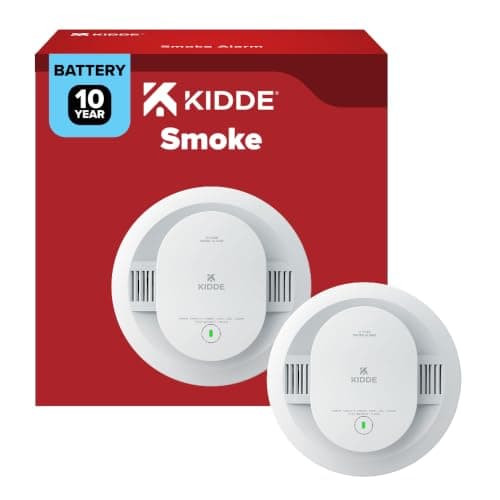 Kidde 20SD10 10-Year Battery Smoke Alarm Names UL 217 10th edition explicitly, which almost nothing else in this price band does. | The clearest listing evidence | 8.7/ 10 | $32.47 · View on Amazon #ad how we are funded · price as of October 19, 2026 |
| 2 | 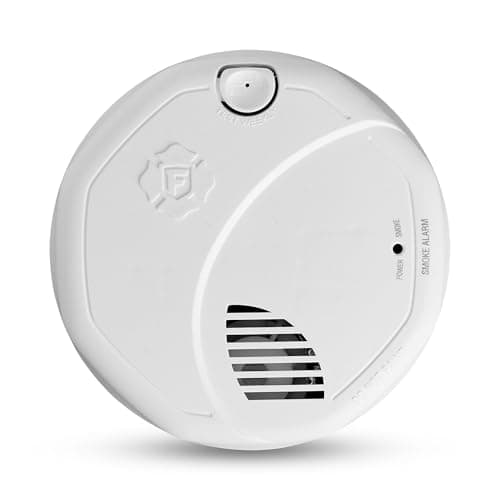 First Alert SM310 10-Year Sealed Battery Dual Sensor Smoke Alarm The only dual-sensor alarm here — photoelectric and ionization in one housing. | Covering both fire profiles in one unit | 8.4/ 10 | |
| 3 | 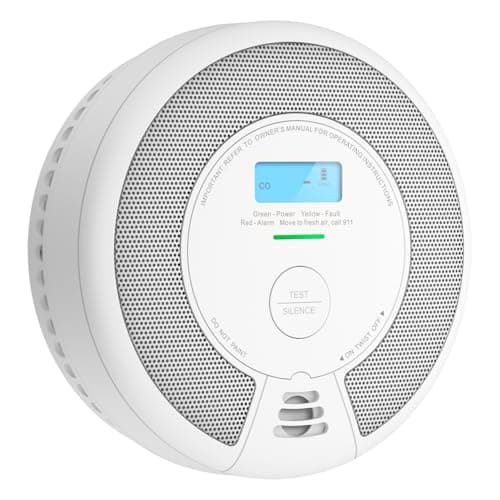 X-Sense SC07 Smoke & Carbon Monoxide Alarm Two hazards, one unit, an LCD reading the CO level — and the lowest cost per covered hazard. | Smoke and CO in one device for less | 8.5/ 10 |
The three in full
1. The clearest listing evidence
Kidde 20SD10 10-Year Battery Smoke Alarm
Names UL 217 10th edition explicitly, which almost nothing else in this price band does.
- Listed to
- UL 217, 10th edition (UL 217-2024 Ed.10)
- Sensing / agent
- Photoelectric smoke sensing only — no CO cell
- Power / service life
- Sealed 10-year lithium battery; 10-year limited warranty
The reason this takes the top slot in a three-way is narrow and it is about evidence rather than performance.
Everybody in this category says their alarm resists cooking nuisance alarms. Only some of them tell you which edition of UL 217 they are listed to. A 10th-edition listing carries the cooking-nuisance test the 8th edition introduced and the go/no-go flaming-foam test the 9th added, so naming it is a checkable claim rather than a marketing sentence — and for the buyer who filters on what a product is certified to, that distinction is the entire point.
The trade is sensor coverage. A photoelectric chamber responds well to smoldering fires, which are the ones that kill people overnight, and it responds more slowly than an ionization chamber to a fast flaming fire. Ionization vs photoelectric covers why that trade exists and why most guidance still lands on photoelectric for the positions near kitchens.
If your house has alarm wiring, the same series has a hardwired version. Best hardwired smoke detectors.
What it does well
- Listed to UL 217, 10th edition — the current edition, stated as a specific edition number rather than as a vague claim
- Photoelectric sensing, which is the right single sensor for a hallway near a kitchen
- Sealed ten-year lithium cell with no low-battery chirps across its life
- Self-testing, so it is not relying on somebody pressing a button monthly
- Distinct alarm pattern — three long beeps and a red flash for smoke
The downside
- **Photoelectric only.** No ionization chamber, so fast flaming fires are detected later than a dual-sensor unit would
- **No CO cell**, so any house with gas, a fireplace or an attached garage needs separate CO alarms
- No interconnect of any kind in this model
- No display, no voice, no app — it is an alarm and nothing else
Do not buy this if: a house that needs CO coverage in the same positions. Buying smoke-only and then discovering you need a CO alarm in every one of those rooms doubles the device count.
- Listed to the 10th edition of UL 217, which carries the cooking-nuisance test the 8th edition introduced
- Kidde's own wording: enhanced sensing technology reduces false alarms often caused by cooking
- No low-battery chirps for ten years — the first end-of-life beep is the replacement signal
- Three long beeps and a red flash on smoke, so the pattern tells you which hazard it is
- Twist-and-click bracket, and it self-tests rather than waiting for you to press the button
#ad how we are funded · price as of October 19, 2026
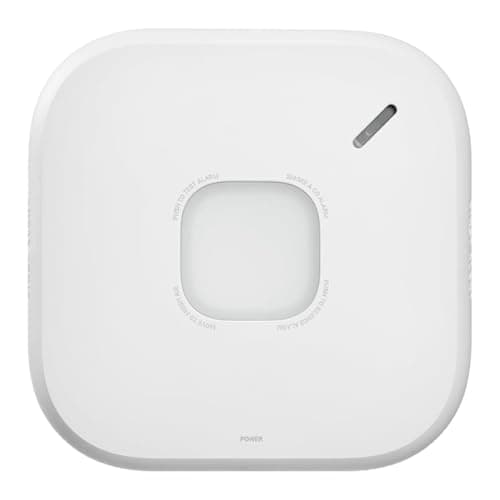
2. Covering both fire profiles in one unit
First Alert SM310 10-Year Sealed Battery Dual Sensor Smoke Alarm
The only dual-sensor alarm here — photoelectric and ionization in one housing.
- Listed to
- UL 217 — First Alert states compliance with the latest edition
- Sensing / agent
- Dual sensor: a photoelectric chamber and an ionization chamber in one housing
- Power / service life
- Sealed 10-year lithium battery; 10-year limited warranty
Dual sensor is the strongest technical argument any of these three brands makes, and it is worth taking seriously.
The two sensing technologies are good at different fires. Photoelectric responds earlier to a smoldering fire — a cigarette in a sofa, an overheating cable in a wall. Ionization responds earlier to a fast flaming fire — a pan flaring, a Christmas tree. A dual-sensor unit removes the need to guess which one your house will produce.
The cost is nuisance behavior. Ionization chambers are the ones that respond to cooking aerosol, which is why putting a dual-sensor alarm within range of a kitchen needs more care than putting a photoelectric one there. Kitchen and bathroom placement has the distances that make this a non-problem.
The locking bracket is an underrated feature for anyone letting a property. Smoke detectors for rental property explains why that is the feature landlords should be buying for.
What it does well
- Genuinely dual sensor — a photoelectric chamber and an ionization chamber, so no fire profile is left uncovered
- Optional locking feature that stops the alarm being lifted off its bracket, which matters in rentals and shared houses
- First Alert's Precision Detection sensing, which the manufacturer states reduces cooking nuisance alarms
- Sealed ten-year lithium cell and a ten-year limited warranty
- 85 dB at 10 ft, the standard residential sounder output
The downside
- **First Alert states compliance with the latest edition of UL 217 without naming it**, which is a weaker claim than a stated edition number
- The ionization chamber is the half historically associated with cooking nuisance alarms — position matters more with this unit, not less
- No CO cell
- Costs more per position than a single-sensor alarm, which adds up across a whole house
Do not buy this if: a small apartment where the only legal alarm position is close to the kitchen. There, a photoelectric-only unit is the better choice, because an alarm that nuisance-trips is an alarm that comes off the ceiling.
- The only dual-sensor unit here — photoelectric and ionization, so it is not trading one fire type for the other
- First Alert calls the sensing Precision Detection, and states it reduces cooking nuisance alarms
- 85 dB at 10 ft
- Optional locking feature that stops the alarm being lifted off its bracket
- 5 x 5 x 2 in, 0.54 lb
First Alert product documentation
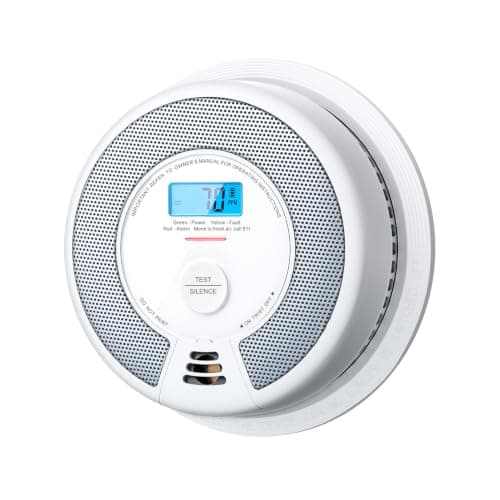
3. Smoke and CO in one device for less
X-Sense SC07 Smoke & Carbon Monoxide Alarm
Two hazards, one unit, an LCD reading the CO level — and the lowest cost per covered hazard.
- Listed to
- UL 217 and UL 2034
- Sensing / agent
- Photoelectric smoke sensing plus an electrochemical CO cell
- Power / service life
- 10-year sealed lithium battery, not hardwired
The value argument here is not that X-Sense undercuts the incumbents on a smoke alarm. It is that it covers two hazards for roughly what a single-hazard alarm from the other two costs, and for most houses that is the decision that actually saves money.
Work it through for a three-bedroom house. Code-level coverage is an alarm inside each bedroom, one outside each sleeping area and one per level — call it six positions. Smoke-only alarms in those six positions plus CO alarms wherever they are needed is nine or ten devices. Combination units in the same six positions is six.
Fewer devices is not only cheaper. It is fewer manufacture dates to track, fewer units quietly past their life, and fewer chances for one position to get skipped.
The LCD is the second reason to look at this one. A CO alarm that displays a reading lets you distinguish "nothing" from "a low level that never reaches the alarm threshold", which is the signature of a failing appliance. Best combination smoke and CO alarms has the full field.
What it does well
- UL 217 and UL 2034 together — smoke and carbon monoxide covered by one device in one position
- LCD reads the measured CO concentration rather than only alarming, which turns the unit into a diagnostic as well as an alarm
- Sealed ten-year lithium battery, so no annual battery ritual
- Halves the number of devices, dates and ceiling positions compared with buying smoke and CO separately
- Test and silence on a single control
The downside
- **Photoelectric only on the smoke side**, like the Kidde — no ionization chamber
- Standalone: no interconnect, no app, no base station in this model
- A combination unit replaces as a whole when either sensor reaches end of life
- The brand has less service history in the US market than the two incumbents, which is a real consideration on a ten-year device
Do not buy this if: a basement where the best smoke position and the best CO position genuinely differ. There, two separate units in two places beats one compromise — see [combination vs separate alarms](/carbon-monoxide-detectors/combo-vs-separate-alarms).
- LCD reads the measured CO concentration rather than only alarming
- Standalone unit — no wireless interconnect, no Wi-Fi, no base station
- Sealed battery, so there is no annual battery ritual and no low-battery chirp until end of life
- Test and silence on one control
The UL edition question, which nobody else covers
This is the one place where the three brands genuinely differ in a way you can verify, and it is worth understanding before you read another spec sheet.
UL 217 is the standard for smoke alarms, and it has moved quickly in the last few editions. The 8th edition introduced a cooking nuisance alarm test and smoldering and flaming polyurethane foam tests. The 9th added a go/no-go flaming-foam test immediately after the cooking test, so an alarm has to prove it can still tell a hostile fire from a nuisance one. The 10th harmonized US and Canadian requirements and added low-frequency audibility requirements. Each edition carries the previous ones forward, so a 10th-edition listing is the most tested product in the category.
Kidde names the edition in its documentation for this series. First Alert states compliance with the latest edition without naming it, which is a weaker claim not because the product is worse but because it is not checkable. X-Sense names the standards but not the edition.
None of that makes an unnamed-edition alarm a bad alarm. It makes the named-edition alarm the one you can verify, which for a buyer who filters on certification is the whole basis of the decision. UL 217 certification explained goes through what the standard actually tests.
Which one to buy, by situation
Shortcut the rest of the page. Find your house below.
- Gas appliances, a fireplace or an attached garage — the X-Sense SC07, because you need CO coverage anyway and buying it separately in every position costs more and adds devices
- All-electric house, no attached garage, no fuel appliances — the Kidde 20SD10. You do not need a CO cell, and the named listing edition is the best evidence available in the category
- You want the widest sensor coverage and the kitchen is far enough away — the First Alert SM310, for the second sensing chamber
- A rental or a shared house — the First Alert SM310, for the locking feature. Rental property picks
- A small apartment where the kitchen is close to everything — the Kidde, photoelectric only, with the 10th edition nuisance listing behind it
- Existing hardwired alarms on a circuit — none of these. Replace like for like and keep the interconnect: best hardwired smoke detectors
Can you mix the three brands in one house?
Battery alarms: yes, freely. A standalone battery alarm is not talking to anything. Different brands on different ceilings is completely fine, and buying the right unit for each position is better practice than brand loyalty.
Interconnected alarms: no. Whether the interconnect is over a wire or wireless, it is a manufacturer-specific protocol. Mixing brands on one circuit can leave you with alarms that each pass their own test button and do not trigger each other — a failure that is invisible unless you test the interconnect rather than the alarms.
The way to test an interconnected set is to hold the test button on the unit furthest from the others and confirm every other alarm in the house sounds. Testing them one at a time will pass a set that does not interconnect at all.
This is the single most common way a house ends up with alarms that look correct and are not. Interconnected smoke alarms has the detail.
What matters more than any of this
Having read fifteen hundred words about three brands, the honest closing note is that the brand is a long way down the list of things that decide whether an alarm protects you.
Coverage first. One inside every bedroom, one outside each separate sleeping area, one on every level including the basement. A house with five cheap listed alarms in the right positions is better protected than a house with two excellent ones in the wrong ones. How many smoke detectors do I need.
Age second. An alarm past ten years from its manufacture date is not protecting anyone regardless of brand, and the test button confirms the horn and the battery rather than the sensing chamber. When to replace smoke detectors.
Position third. At least 10 ft from the cooking appliance, 36 in clear of a paddle fan blade tip and of a supply register, out of the dead air at a ceiling-wall corner. Smoke detector placement.
Then the brand. By which point the decision is the three-line one at the top of this page.
Questions people actually ask
Is First Alert, Kidde or X-Sense better?
Are X-Sense smoke detectors any good?
Can I mix First Alert, Kidde and X-Sense alarms in the same house?
Which brand has the best false alarm resistance?
Do I need a dual sensor smoke alarm?
Which of these includes a carbon monoxide detector?
How these picks were chosen. On published specifications, safety listings and manufacturer documentation — plus the findings of organizations that do run tests. We have no laboratory and we do not burn anything. Read the full methodology.
Sources
- UL Solutions — UL 217 — smoke alarms
- UL Solutions — UL 217, Standard for Smoke Alarms, published with new technical requirements
- UL Solutions — UL 2034 — single and multiple station carbon monoxide alarms
- NFPA — NFPA 72, National Fire Alarm and Signaling Code (2025 edition)
- NFPA — Smoke alarms — installation and placement guidance
- CPSC — Recalls and product safety news
Read next
Smoke Detectors
First Alert vs Kidde Smoke Detectors
Both are listed and both work — the decision is which platform you commit to.
Smoke Detectors
What the standard tests, what the recent editions changed, and how to verify a mark is real.
Smoke Detectors
Both listings, a display and a ten-year battery — and no interconnect.
Smoke Detectors
The Best Smoke Detectors for a Home
Four alarms, what UL 217 tests, and why interconnection beats every other feature.
Smoke Detectors
The Best Combination Smoke and CO Alarms
Two listings, one position — and the one room where separate units win.
Smoke Detectors
The two mechanisms, the fires each sees first, and why photoelectric wins at home.