Fire Extinguishers
How Many Fire Extinguishers Does a House Need?
No residential code in the US requires you to own one at all, which means the number is a judgment call. Here is the judgment, and the reasoning you can argue with.
By Ryder M.Last reviewed
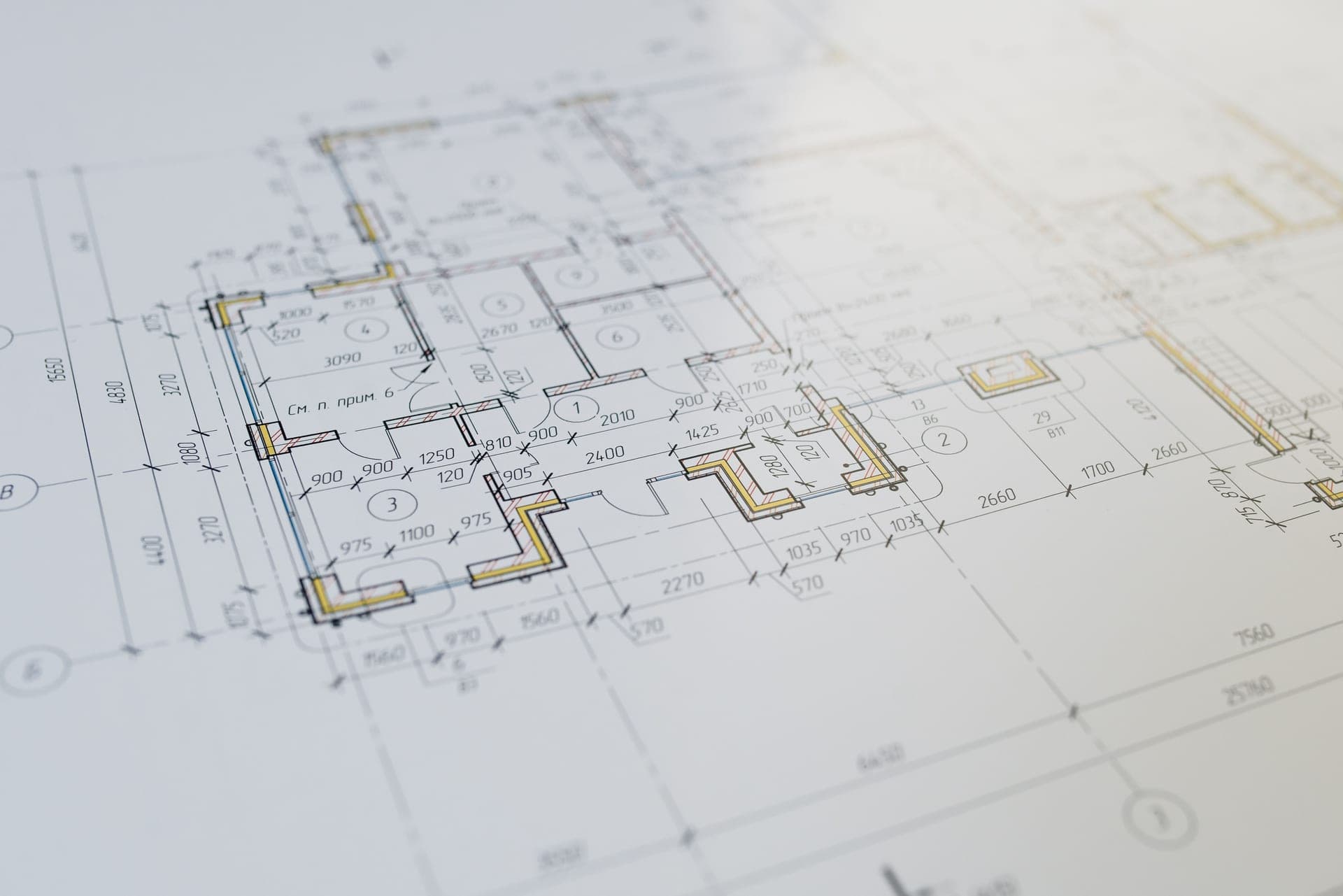
For the commonest US house — two stories, a basement and an attached garage — the honest answer is four: one rated extinguisher on each floor including the basement, positioned on the way out rather than in the room a fire is likeliest to start, plus a larger unit for the garage or workshop where the flammable liquids live. A one-floor apartment needs one. The kitchen, counter-intuitively, is not usually one of the four: a pan fire is a Class K hazard and a lid or a fire blanket beats a dry-chemical blast that can splash burning oil. Nothing below is a legal requirement — no US residential code obliges a homeowner to own an extinguisher, so the count is a decision about risk, not compliance.
Siren & Safe is reader-funded. We earn a commission on some links on this page, at no cost to you. It does not change what we recommend or the order we rank it in. Full disclosure.
The short answer, and the reason it is a judgment rather than a rule
One rated extinguisher on every floor, including the basement, positioned on the way out — plus a larger one for the garage or workshop. For the commonest US house that comes to four. For a single-story house with no garage it is one. For an apartment it is one, near the exit. Those numbers are this site's recommendation, and the reasoning is below so you can disagree with it where your house is different.
It has to be a recommendation rather than a requirement because no US residential code obliges a homeowner to own a fire extinguisher at all. Smoke alarms are mandated, in specific positions, by the residential code. Extinguishers are not. The standard people cite — NFPA 10, Standard for Portable Fire Extinguishers — is written for occupancies: offices, shops, workplaces. It governs selection, placement, inspection and maintenance in buildings that have to comply, and your house almost certainly is not one of them.
That matters because a lot of the advice circulating about household extinguisher counts is NFPA 10's occupancy logic applied to a home where it was never meant to run. The most quoted example is the maximum travel distance to a Class A extinguisher in the occupancies that standard covers — 75 ft. As an idea it is useful: nobody should have to walk far to reach one. As a rule for a house it is close to meaningless, because almost any point in an average home is within 75 ft of almost any other point, and it would license a single extinguisher in the hallway for a whole two-story house. The floor you are standing on matters far more than the distance.
So the count below is built from a different question: on which floor, and on which route, would somebody actually reach for one? The answer is the floor they are on and the route they are leaving by, which is why the recommendation is per-floor rather than per-square-foot.
The four rules the count is built on
Each one is a decision about human behavior under stress rather than about fire chemistry, which is why they produce a different answer from a code table.
- One per floor, because nobody carries an extinguisher up stairs. A unit in the basement does nothing for a fire on the second-floor landing, and a fire between you and the extinguisher means there is no extinguisher. Floors are the unit of coverage in a house.
- On the escape route, not in the hazard. An extinguisher belongs between the likely fire and the way out, with your back to the exit when you use it. Mounting one in the corner of the room most likely to catch fire is the commonest placement error in a house. Where to mount a fire extinguisher covers the geometry.
- Sized to the person, not the room. A 5 lb unit nobody can aim is worse than a 2.5 lb unit used well, and the person who reaches for it may not be the person who bought it. Pick up a loaded extinguisher in the shop before you buy four of them.
- One oversized unit where the liquids are. Garages, workshops and utility rooms hold fuel, solvents and charging batteries, and that is a Class B hazard that a household 10-B rating handles only at the small end. This is the one position where capacity beats handling.
Quick picks
Scored against one-handed use, rating per pound, fits a hallway, serviceability and value per position. Tap a row for the full write-up. The price in each buy button is the live Amazon price at the last check, stamped with the date it was taken.
| # | Product | Best for | Score | Price |
|---|---|---|---|---|
| 1 | 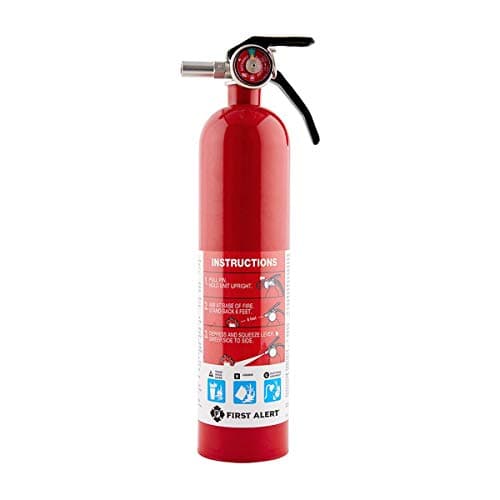 First Alert HOME1 Rechargeable Home Extinguisher (2.5 lb) At 2.5 lb this is the lightest rechargeable unit most people can still aim accurately with one hand, which is the specification that decides whether a per-floor extinguisher gets used at all. | The per-floor unit — hallway, landing, near the exit | 8.6/ 10 | $26.98 · View on Amazon #ad how we are funded · price as of November 11, 2026 |
| 2 | 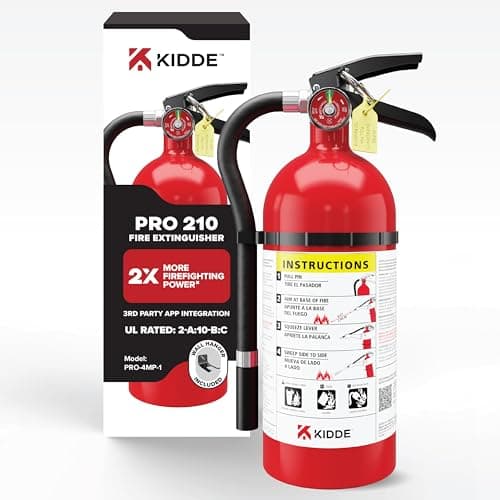 Kidde Pro 210 4 lb Multi-Purpose Extinguisher The lightest unit here that reaches a full 2-A:10-B:C. If you want the doubled Class A rating without the 5 lb of a trade extinguisher, this is the middle ground. | A full 2-A rating at a weight most people can still handle | 8.3/ 10 | $54.97 · View on Amazon #ad how we are funded · price as of November 11, 2026 |
| 3 | 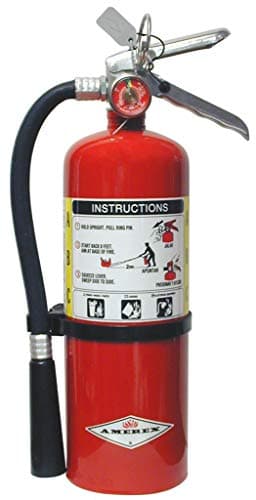 Amerex B500 5 lb ABC Dry Chemical Extinguisher The serviceable 5 lb unit for the one room in the house that genuinely needs more extinguisher. An all-metal valve is what separates a unit you recharge from one you replace. | The garage, workshop or utility room — the fourth unit | 8.7/ 10 | $75.00 · View on Amazon #ad how we are funded · price as of November 11, 2026 |
| 4 | 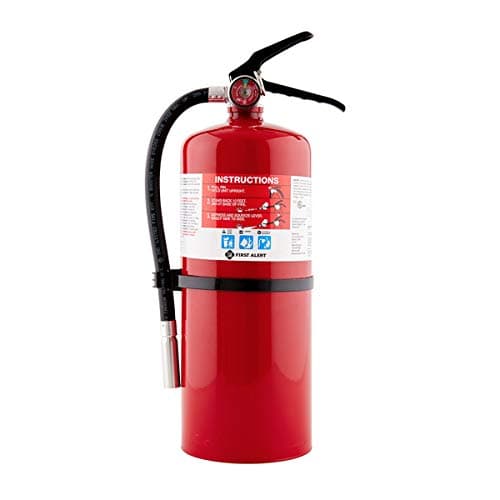 First Alert PRO10 Rechargeable Heavy Duty Extinguisher 4-A:60-B:C — six times the flammable-liquid rating of a household unit. The right answer when the garage has graduated into a workspace, and overkill everywhere else. | A workshop with solvents, or a garage that is really a shop | 8.2/ 10 | $72.98 · View on Amazon #ad how we are funded · price as of November 11, 2026 |
What to buy for each position
1. The per-floor unit — hallway, landing, near the exit
First Alert HOME1 Rechargeable Home Extinguisher (2.5 lb)
At 2.5 lb this is the lightest rechargeable unit most people can still aim accurately with one hand, which is the specification that decides whether a per-floor extinguisher gets used at all.
- Listed to
- UL rated 1-A:10-B:C
- Sensing / agent
- Monoammonium phosphate dry chemical
- Power / service life
- Rechargeable by a certified professional; metal head and pull pin
Why the lightest unit wins the per-floor position. A hallway extinguisher exists for a small, early fire — a wastebasket, a power strip, a curtain catching from a candle. The thing that decides the outcome is whether somebody can get it off the wall and aim it in the first thirty seconds, not whether it holds five pounds. Weight is the variable that fails, and 2.5 lb is the weight almost nobody fails at.
Buy one per floor, not one per house. Carrying an extinguisher up or down a staircase in a fire is not a plan. The whole point of the per-floor count is that the unit is on the level the fire is on, within a few steps of the route out.
It is rechargeable, which matters more than it sounds. Discharge a plastic-valve disposable for a second and you buy a new extinguisher; discharge this one and you take it to a shop. Fire extinguisher expiration and service covers what the dates actually mean.
What it does well
- **UL rated 1-A:10-B:C** — ordinary combustibles, flammable liquids and energized electrical equipment, which covers what a hallway or a landing actually faces
- **2.5 lb of agent**, light enough that almost any adult can lift it off a bracket and sweep it accurately under stress — and accuracy is worth more than capacity on a small fire
- **Rechargeable with a metal head and a metal pull pin**, so a two-second burst does not write the extinguisher off
- **Mounting bracket in the box**, which matters because an extinguisher on the floor of a cupboard is not in a position
- Cheap enough that buying three for three floors is a real decision rather than a project
The downside
- **1-A is half the Class A rating of a 2-A unit.** On a cardboard-and-timber fire it runs out of agent sooner, which is the trade you accept for the lower weight
- **Short discharge.** Less agent means less time to re-aim after a miss, and people under stress do miss
- **ABC dry chemical is corrosive and goes everywhere.** It is unpleasant to clean up and hard on electronics
- **Not a kitchen answer.** A 10-B rating is a flammable-liquid rating, and a dry-chemical blast can splash a pan of burning oil
- Needs the gauge checked and an annual look-over like any stored-pressure unit
Do not buy this if: a garage with fuel cans, a workshop with solvents or any space where the hazard is liquids rather than clutter — size up to the B500 or the PRO10 below. It is also not the kitchen's first answer: read [best kitchen fire extinguishers](/fire-extinguishers/best-kitchen-fire-extinguishers) for that room.
- 2.5 lb — the lightest unit most people can aim accurately with one hand
- Metal head and a metal pull pin with a safety seal, not the plastic valve of the disposable tier
- Color-coded corrosion-resistant gauge and a mounting bracket in the box
- 1-A is half the ordinary-combustible rating of a 2-A unit, which is the trade for the size
First Alert product documentation
#ad how we are funded · price as of November 11, 2026
2. A full 2-A rating at a weight most people can still handle
Kidde Pro 210 4 lb Multi-Purpose Extinguisher
The lightest unit here that reaches a full 2-A:10-B:C. If you want the doubled Class A rating without the 5 lb of a trade extinguisher, this is the middle ground.
- Listed to
- UL rated 2-A:10-B:C
- Sensing / agent
- Monoammonium phosphate dry chemical
- Power / service life
- Rechargeable; mounting bracket included
The case for standardizing on one unit. There is a real argument for buying the same extinguisher for every position in the house: one set of instructions, one gauge to recognize, one service date to remember, and no chance of grabbing the wrong one. If you want to do that, 2-A:10-B:C at 4 lb is the specification to standardize on, because it is the lightest unit that still carries the doubled Class A rating.
Where the extra Class A rating pays. A 1-A unit is sized for a small fire in a small volume. A fire in a basement full of stored cardboard, or a hallway with a laundry pile, is an ordinary-combustibles fire with more fuel than that, and the 2-A rating is the difference between knocking it down and running dry. Fire extinguisher classes sets out what the numbers are measuring.
Mount it, do not store it. The bracket is in the box for a reason. An extinguisher behind a vacuum cleaner is an extinguisher you will not find in the dark.
What it does well
- **UL rated 2-A:10-B:C at 4 lb** — twice the Class A rating of a typical household 1-A unit, which is the part buyers underrate on an ordinary-combustibles fire
- **Rechargeable and serviceable**, built on the commercial Pro line rather than a disposable household chassis
- **Bracket included**, so it mounts where you decided rather than where there is floor space
- More agent than a 2.5 lb unit means more margin to re-aim after a first attempt that misses
- A sensible single answer for a household that wants one specification for every position in the house
The downside
- **4 lb loaded is noticeably heavier than 2.5 lb** in the hands of somebody who has never lifted it, and the person most likely to reach for it may not be the person who bought it
- **Dry chemical, so the same corrosive cleanup** as any ABC unit and the same argument against it near computers
- **Still not the kitchen answer** — the 10-B rating is a flammable-liquid rating, not a cooking-oil one
- Dearer per unit than the 2.5 lb household extinguisher, which matters when you are buying three or four
- Needs the same monthly gauge check and annual inspection as everything else here
Do not buy this if: a household where the likeliest user cannot comfortably handle 4 lb at arm's length — in that case the lighter First Alert HOME1 used well beats a heavier unit that gets dropped. [What size fire extinguisher do I need](/fire-extinguishers/what-size-fire-extinguisher-do-i-need) works through the weight question properly.
- 4 lb — the lightest unit that still reaches a 2-A rating, which matters for one-handed use
- Rechargeable, with the bracket in the box
- Same 2-A:10-B:C class coverage as heavier units, with less run time
- Less agent means less margin for error if the first attempt misses
#ad how we are funded · price as of November 11, 2026
3. The garage, workshop or utility room — the fourth unit
Amerex B500 5 lb ABC Dry Chemical Extinguisher
The serviceable 5 lb unit for the one room in the house that genuinely needs more extinguisher. An all-metal valve is what separates a unit you recharge from one you replace.
- Listed to
- UL rated 2-A:10-B:C
- Sensing / agent
- Monoammonium phosphate dry chemical
- Power / service life
- Rechargeable; all-metal valve and body
Why the garage gets a different extinguisher. Every other position in a house is a clutter-and-electrical hazard. The garage is a liquids hazard: petrol in a mower, a can of thinner, a charging battery, an oily rag. That is a Class B problem with a Class A pile of stored cardboard sitting next to it, and it is the one position where capacity genuinely beats handling.
It is also the position where the extinguisher gets neglected. Mount it by the door you walk through, not at the back of the garage behind the workbench — because the fire is likeliest to be at the workbench, and an extinguisher you have to walk toward the fire to collect is not in a position.
If the hazard is liquids rather than clutter, size up again. Best garage fire extinguishers compares the heavier tier, and the PRO10 below is the unit for a workshop with real solvent volumes.
What it does well
- **UL and ULC rated 2-A:10-B:C** with 5 lb of monoammonium phosphate dry chemical — the rating and capacity a garage with fuel, solvents and a workbench actually calls for
- **All-metal valve with an anodized aluminum body**, the clearest single marker of a serviceable extinguisher rather than a disposable one
- **14 seconds of discharge with a 12 to 18 ft reach**, which is the margin to stand back, sweep, see what is happening and sweep again
- **Wall bracket in the box**, and a drawn steel cylinder that survives a garage wall
- Specified for a -65 to 120°F operating range, so an unheated garage is inside the envelope
The downside
- **Five pounds loaded is heavy.** Not everybody can lift it off a bracket, pull the pin and sweep accurately one-handed, and there is no second attempt
- **Recharging costs money and a trip** — the feature that makes it serviceable only pays off if you actually use it
- **Corrosive dry chemical** that goes everywhere, which is the argument against it near electronics
- **Wrong tool for the kitchen.** A 10-B rating is not a cooking-oil answer
- No hose on this model, so the discharge is from the nozzle at the valve
Do not buy this if: a hallway position in a house where the person most likely to use it cannot handle 5 lb, and not the kitchen under any circumstances. [Amerex B500 review](/fire-extinguishers/amerex-b500-review) is the full single-product write-up.
- All-metal valve rather than plastic, which is the difference between a serviceable unit and a disposable one
- Rechargeable, so a partial discharge during a small fire does not write off the extinguisher
- 2-A:10-B:C covers ordinary combustibles, flammable liquids and energized electrical equipment
- 5 lb is heavier than the supermarket unit and needs a proper bracket
#ad how we are funded · price as of November 11, 2026
4. A workshop with solvents, or a garage that is really a shop
First Alert PRO10 Rechargeable Heavy Duty Extinguisher
4-A:60-B:C — six times the flammable-liquid rating of a household unit. The right answer when the garage has graduated into a workspace, and overkill everywhere else.
- Listed to
- UL rated 4-A:60-B:C
- Sensing / agent
- Monoammonium phosphate dry chemical
- Power / service life
- Rechargeable by a certified professional; all-metal construction with a commercial-grade metal valve and head; 12-year limited warranty
When the fourth unit is not enough. A garage with a car and a lawnmower is a B500 position. A garage with a bench, a parts washer, a gallon of thinner and a welder is a different hazard, and the Class B rating is the number that has to grow. 60-B against 10-B is not a marginal upgrade; it is a different category of fire.
It does not change the count, it changes one of them. This is still the garage extinguisher. The per-floor units stay small and light, because their job is still a wastebasket at the top of a staircase.
Size does not substitute for the plan. A bigger extinguisher does not extend the window in which fighting a fire is sensible. It extends what you can do inside that window, and the window is short.
What it does well
- **UL rated 4-A:60-B:C** — double the Class A and six times the Class B rating of a 2-A:10-B:C unit, which is the specification a solvent bench or a fuel store calls for
- **Rechargeable commercial-duty build** with a metal valve, meant to be serviced rather than replaced
- Enough agent and reach to work a fire from a safe standing distance rather than close in
- Bracket included, and the unit is built to live on a wall in an unfinished space
- The one extinguisher on this page that is genuinely oversized for its position, which in a workshop is the correct error to make
The downside
- **Heavy.** This is a two-handed object for many people, and it is the wrong unit for anyone who cannot control it
- **Far too much extinguisher for a hallway**, where the weight will cost you more than the rating gains
- **Dry chemical in large volume** — the cleanup after a discharge in a finished space is genuinely bad
- Costs more than two household units, so it only makes sense where the hazard justifies it
- Recharge cost scales with size, so a partial discharge is a bigger bill
Do not buy this if: a per-floor hallway position, an apartment, or any household choosing a single standard unit for the whole house. Buy it as a fifth extinguisher for a specific hazard, not as a replacement for the four.
- 4-A:60-B:C is a far larger rating than most home units — six times the flammable-liquid rating of the 10-B:C supermarket unit
- Rechargeable rather than disposable, with an all-metal valve and head
- Suits a garage, workshop or home office where liquids and equipment are the realistic risk
- Mounting bracket and a color-coded corrosion-resistant pressure gauge in the box
- Bigger and heavier, which is a real problem for anyone who cannot handle the weight one-handed
#ad how we are funded · price as of November 11, 2026
How many, by home type
This site's recommendation, not a code requirement. Where a row says "blanket" that is deliberate — see the kitchen section below for why a blanket rather than a fifth extinguisher.
| Home | Rated extinguishers | Where they go | Plus |
|---|---|---|---|
| Studio or one-bedroom apartment | 1 | Near the exit, not in the kitchen | Fire blanket by the hob |
| Single-story house, no garage | 1 - 2 | Hallway near the exit; second one near the utility room or furnace if there is one | Fire blanket by the hob |
| Two-story house, no basement, attached garage | 3 | One per floor on the landing or hallway, plus a larger unit in the garage | Fire blanket by the hob |
| Two-story house with a basement and attached garage | 4 | Ground floor, upstairs landing, basement stairs, garage (larger unit) | Fire blanket by the hob |
| House with a workshop, solvent store or EV charging | 4 - 5 | As above, with the garage unit upsized and a dedicated unit at the bench or charger | Fire blanket; see the lithium guidance |
| RV, boat or vehicle | Set by regulation, not by preference | Per the carriage requirements for the vessel or vehicle | See the RV and marine pages |
An RV or a boat is the one case where a legal minimum does exist — federal carriage requirements set the number and the rating. Best RV fire extinguishers and best fire extinguishers for boats cover those rules.
Why the kitchen is not one of the four
This is the part of the answer that surprises people, because cooking equipment is the leading cause of reported home structure fires and the kitchen is therefore where you would expect to put the first extinguisher. The reason it does not get one is that the fire the kitchen actually produces is the wrong kind for the extinguisher you would buy.
A pan of overheated cooking oil is a Class K hazard. An ABC dry-chemical unit rated 10-B is rated for flammable liquids in a pool, not for a deep vessel of hot oil, and the discharge can splash burning fuel out of the pan and across a kitchen. The correct first move at a hob fire is to turn off the heat and cover the pan — a lid, a baking sheet, or a fire blanket, which is the purpose-built version of covering it.
So the kitchen gets a fire blanket within one step of the cooker and never above it, and the nearest rated extinguisher is the one on that floor, in the hallway, for the fire that has left the pan. If you want an extinguisher in the kitchen as well, buy the right one: kitchen Class K vs ABC explains the distinction and best kitchen fire extinguishers covers what is available for a domestic kitchen.
The same logic applies to the other two hazards people try to solve with a bigger extinguisher. A lithium-ion battery fire is not reliably put out by any household portable — best lithium battery fire extinguishers is honest about how limited the options are. And an aerosol spray can like the First Alert EZ Fire Spray is not a UL-rated A:B:C portable extinguisher at all; it is a useful thing in a kitchen drawer and it does not count toward the four. Aerosol spray vs traditional extinguishers is the honest comparison.
What rating to buy for each position
The US Fire Administration's household guidance is straightforward on type: a multipurpose extinguisher labeled A-B-C or B-C handles most home fires, and that is what the shops stock. The letters are hazard classes — A for ordinary combustibles, B for flammable liquids, C meaning the agent is safe on energized electrical equipment — and the numbers in front of A and B are tested performance from the UL 711 fire tests, not marketing.
For a per-floor hallway unit, 1-A:10-B:C at 2.5 lb or 2-A:10-B:C at 4 lb are both defensible. Choose by who will lift it. The lighter unit aimed well beats the heavier unit fumbled, and the heavier one gives you more agent to re-aim with. There is no wrong answer between those two; there is a wrong answer in buying a 5 lb unit for a hallway in a house where nobody can hold it steady.
For the garage or workshop, go to 2-A:10-B:C at 5 lb as a floor, and up to 4-A:60-B:C if there are real solvent or fuel volumes. The Class B number is the one that should grow in that room, because liquids are the hazard that distinguishes it from the rest of the house.
Everything on this page should carry a UL rating on the label. An unrated canister is not an extinguisher for the purposes of this count, however it is marketed. What size fire extinguisher do I need is the longer version of this section.
Putting the four in place
Three groups: deciding the positions, mounting them, and the ten minutes of upkeep per year that stops them becoming ornaments.
Deciding the positions
- Walk each floor to its exit and pick the point you would pass on the way out. That is the position, not the corner of the room you think is riskiest.
- Put the basement unit at the bottom or the top of the basement stairs, whichever is on the route out, not at the far end of the basement.
- Put the garage unit by the door into the house or the door to the drive — never behind the bench or the car.
- Check the mounting height is one everybody in the household can reach with one hand, including the shortest adult.
Mounting them
- Use the bracket that came in the box. An extinguisher standing on the floor falls over, gets moved and ends up behind something.
- Mount into a stud or use proper anchors. A loaded 5 lb unit on a plasterboard screw is a matter of time.
- Keep the label and the gauge facing out so a monthly check takes a glance rather than a lift.
- Do not hide it in a cupboard to keep it tidy. Visible is the point.
The annual ten minutes
- Check every gauge monthly — the needle belongs in the green band, and a stored-pressure unit can lose pressure slowly with no obvious cause.
- Once a year: nozzle clear, pull pin and tamper seal intact, no dents or corrosion, label legible, bracket tight.
- Once a year, invert and shake each dry-chemical unit so the agent does not cake at the bottom of a cylinder that has stood untouched.
- Read the service and expiry guidance on the label — fire extinguisher expiration and service explains what the dates mean and what a rechargeable unit needs after any discharge.
- Show everybody in the household where all four are and how PASS works. An extinguisher nobody can find is not in the count.
Three ways people get the count wrong
Buying one and calling it done. A single extinguisher in a two-story house is a single extinguisher on one floor, and fires do not consult you about which floor. The marginal value of the second and third unit is higher than the marginal value of upgrading the first one from 1-A to 2-A.
Buying for the hazard instead of the route. The instinct is to put the extinguisher where the fire will start — the kitchen, the garage bench, next to the furnace. That puts you reaching toward a fire with your back to the room. The US Fire Administration's own guidance is built around a set of conditions that all have to be true before you use one at all: the fire is small and contained, everybody else is out, somebody has called the fire department, and you have a clear way out behind you. Positioning on the route is what makes that last condition possible.
Counting things that are not extinguishers. An aerosol can, a fire blanket and a stovetop automatic unit are all useful and none of them is a rated portable extinguisher. Buy them because they do a job the extinguisher cannot — a blanket at the hob is better than an extinguisher there — but do not let them reduce the number of rated units in the house.
The one thing worth more than any of this: the extinguishers are the third priority. Working smoke alarms come first, a practiced escape plan second, and the extinguisher is what you use in the narrow case where a fire is small, contained and between you and nothing. Home fire safety checklist puts the whole list in order, and the best fire extinguishers for home is the roundup if you want the field rather than the count.
Questions people actually ask
How many fire extinguishers does a house need?
Is one fire extinguisher enough for a house?
Does NFPA 10 require fire extinguishers in homes?
Should I keep a fire extinguisher in the kitchen?
What size fire extinguisher should each one be?
Do fire blankets and aerosol sprays count toward the number?
How these picks were chosen. On published specifications, safety listings and manufacturer documentation — plus the findings of organizations that do run tests. We have no laboratory and we do not burn anything. Read the full methodology.
Sources
- NFPA — NFPA 10, Standard for Portable Fire Extinguishers
- US Fire Administration — Fire extinguishers — when and how to use one at home
- UL Solutions — UL 711 — rating and fire testing of fire extinguishers
- NFPA — Cooking equipment fires in US homes
- US Fire Administration — Home fire prevention
Read next
Fire Extinguishers
The Best Fire Extinguishers for a Home
Four rated units, what the numbers mean, and why the valve material matters.
Fire Extinguishers
What Size Fire Extinguisher Do I Need?
Weight against rating and run time, and why the likely operator decides it.
Fire Extinguishers
Where to Mount a Fire Extinguisher
Beside the exit, under 5 ft, visible from the middle of the room. Never above the hazard.
Fire Extinguishers
The full class chart, what the numbers measure, and which agent suits which fire.
Fire Extinguishers
The Best Fire Extinguishers for a Garage
A garage is a B-class room. Buy the flammable-liquid rating, not the home-kitchen unit.
Placement & Code
A printable room-by-room audit of alarms, CO detection, exits and suppression.